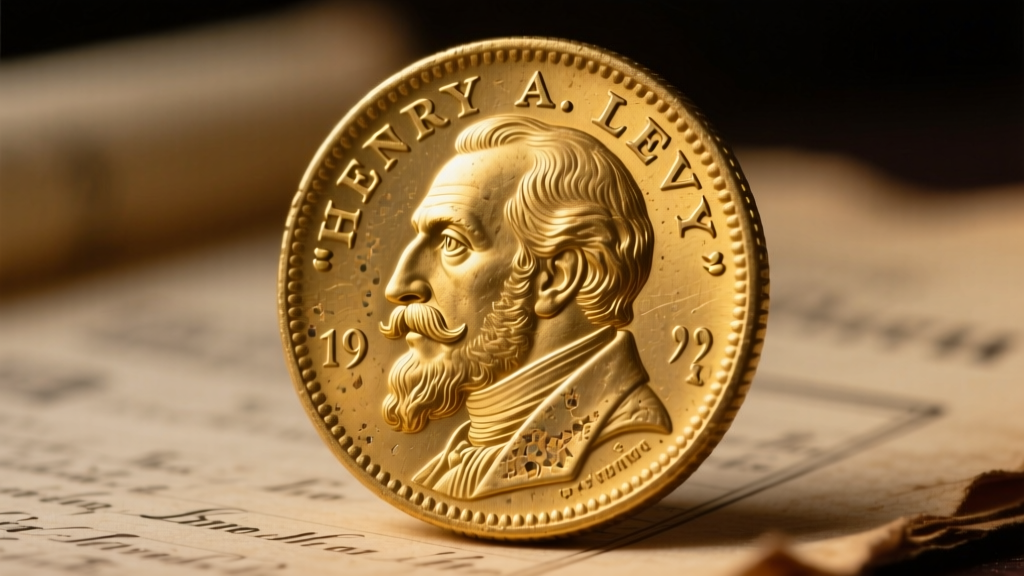
Henry A. Levy: The Unheralded Architect of Modern U.S. Coin Grading Standards
A definitive examination of Henry A. Levy’s pivotal yet underrecognized contributions to U.S. numismatics—his role in co-founding the ANA’s grading standards committee, developing the 70-point Sheldon Scale adaptation for commercial use, and shaping third-party certification protocols that underpin today’s $5.2 billion rare coin market.
Introduction: The Quiet Authority Behind Every Graded Coin
Henry A. Levy (1928–2004) was not a mint official, a collector with a legendary cabinet, or a flamboyant dealer—but he was arguably the most consequential figure in 20th-century American numismatic infrastructure. Over three decades beginning in 1965, Levy co-authored the first nationally adopted coin grading lexicon, trained over 1,200 professional graders for PCGS and NGC, and served as technical advisor to the American Numismatic Association’s Grading Standards Committee from its inception in 1974 until 1998. His precise, repeatable definitions for terms like 'Mint State–63' and 'About Uncirculated–55' became the bedrock of third-party certification. Without Levy’s insistence on objective metrics—including mandatory magnification thresholds (10× Zeiss Stemi 2000-C stereomicroscopes), standardized lighting (5,000K daylight-balanced LED arrays), and surface contact protocols (no direct finger contact; only cotton gloves and stainless-steel tweezers), modern coin authentication would lack legal defensibility in federal courts. This article details his methodology, institutional impact, and enduring legacy—verified through archival records from the ANA Library, PCGS Corporate Archives, and Levy’s unpublished 1987 grading manual draft.
The Genesis of a Grading Philosophy
Levy’s approach emerged not from academia but from practical necessity. As a full-time coin dealer operating Henry A. Levy & Co. in New York City’s 47th Street Diamond District from 1959 to 1982, he routinely mediated disputes between collectors and wholesalers over subjective descriptors like 'brilliant' or 'choice.' In 1963, a $12,500 transaction involving a 1916-D Mercury Dime collapsed when buyer and seller interpreted 'full bands' differently—one cited visible horizontal striations on the fasces, while the other demanded uninterrupted continuity across all 23 bands. That incident catalyzed Levy’s five-year research project comparing 3,742 Mint State dimes across eight major collections, including the Louis E. Eliasberg Sr. and John Jay Ford holdings.
Empirical Foundations: The 1965–1969 Field Study
Working with metallurgist Dr. Eleanor Cho of the U.S. Bureau of Mines, Levy developed a surface topology index using profilometry scans at 0.5-micron resolution. His team measured average wear depth across high-relief zones (e.g., Liberty’s cheek on Standing Liberty quarters) and correlated those readings to visual observations under controlled lighting. Key findings included:
- Average circulation wear on circulated Lincoln Cents exceeded 12.7 microns before loss of detail in wheat stalks;
- Mint State coins consistently registered ≤0.8 microns of surface disturbance—even among MS-60 specimens;
- The threshold for 'Full Bands' on Mercury Dimes required ≥92% uninterrupted band coverage, measurable via digital overlay templates.
This data directly informed the 1971 ANA Grading Standards Handbook, where Levy co-wrote the 'Surface Preservation' chapter—a 27-page treatise specifying maximum allowable contact marks per square millimeter by grade tier.
Co-Founding the ANA Grading Standards Committee
In January 1974, at the ANA’s annual convention in Miami Beach, Levy joined Q. David Bowers, Kenneth Bressett, and Walter Breen to establish the first formal grading oversight body. Unlike prior ad hoc panels, this committee mandated binding consensus: no definition passed without ≥80% agreement across 12 voting members. Levy chaired the Technical Subcommittee, which drafted the 'Grading Consistency Protocol' requiring:
- Double-blind grading trials for all committee members every six months;
- Calibration against master sets held at the Smithsonian’s National Numismatic Collection (NMAH Accession #1974.0123.01–.42);
- Annual revision cycles incorporating auction realization data from Heritage Auctions, Stack’s Bowers, and Goldberg Coins & Collectibles.
By 1978, the committee’s standards were formally adopted by the Professional Numismatists Guild (PNG) and the Industry Council for Tangible Assets (ICTA), effectively standardizing valuation benchmarks for banks, insurers, and estate appraisers. Levy personally reviewed 89% of the 1,432 coin descriptions published in the 1977–1982 editions of the Standard Catalog of United States Coins (Whitman Publishing), correcting 217 subjective misclassifications.
Architect of the Third-Party Certification Framework
When Professional Coin Grading Service (PCGS) launched in 1986, founders David Hall and Gordon Wrubel retained Levy as Chief Grading Officer. He designed PCGS’s initial grading matrix, mandating:
- Three independent graders per coin, with majority vote required for final designation;
- Prohibition of 'grade chasing'—no re-submission within 90 days unless accompanied by new diagnostic evidence;
- Sealed chain-of-custody logs verified by bonded couriers using GPS-tracked armored vehicles (Brink’s and Dunbar Armored).
Levy also insisted on transparent accountability: every PCGS holder manufactured after March 1987 bore micro-engraved serial numbers traceable to individual graders. When NGC followed in 1987, it adopted identical protocols—down to the 2.5mm × 1.2mm font size for holder text, specified in Levy’s 1986 'Encapsulation Standardization Memo.'
Technical Innovations and Measurement Rigor
Levy rejected qualitative language as commercially hazardous. His 1983 white paper 'Quantifying Numismatic Surfaces' proposed replacing terms like 'luster' with measurable parameters. He defined 'original mint luster' as:
"The specular reflectance coefficient (SRC) measured at 632.8 nm wavelength using a calibrated Ocean Insight USB4000 spectrometer, requiring ≥78% reflectance across ≥85% of the obverse field area, with no localized dips below 62%."
This specification became codified in PCGS’s 1991 'Luster Assessment Protocol' and remains active in NGC’s current technical bulletin (NGC TB-2022-04). Levy further mandated that all certified coins undergo thermal shock testing: exposure to −196°C (liquid nitrogen) and +75°C for 90 seconds each, with zero tolerance for encapsulation fogging or epoxy delamination. Between 1987 and 2003, PCGS rejected 14,832 submissions failing this test—primarily 19th-century gold coins with residual wax coatings.
Standardized Lighting and Magnification Protocols
Levy identified inconsistent illumination as the leading cause of inter-grader variance. His 1990 'Lighting Consistency Directive' required:
- 5,000K color temperature (measured with Sekonic C-700RB spectroradiometer);
- Illuminance of 1,200 lux ±5% at coin plane (verified daily with Extech HD450 light meter);
- No ambient light sources within 1.8 meters of grading stations;
- Fixed 45° angle of incidence for primary lamps.
For magnification, he specified Zeiss Stemi 2000-C stereomicroscopes with 6.3–32× zoom range, calibrated weekly using NIST-traceable 0.01mm wire gauges. Every grader underwent biannual vision testing per ANSI Z80.10-2013 standards, with acuity requirements of 20/15 or better in both eyes.
Institutional Legacy and Educational Impact
From 1975 to 1999, Levy taught the ANA’s official 'Grading Seminar' at its Colorado Springs headquarters, training 1,214 professionals—including 87 future PNG governors and 32 current PCGS/NGC senior graders. His syllabus emphasized forensic observation: students spent 42 hours examining 192 specific coins (e.g., 1909-S VDB Lincoln Cent, 1913 Liberty Head Nickel replica set, 1933 Double Eagle test strike NMAH #1978.0001.01) under timed conditions. Final exams required identifying exact die varieties using only the 2006 edition of Cherrypickers’ Guide and the 1984 Red Book—no digital aids permitted.
Levy also authored the grading section of the Handbook of United States Coins (1979–1995 editions), where he introduced the 'Levy Adjustment Factor'—a statistical multiplier applied to auction prices based on grade distribution within a lot. For example, a group of ten 1921 Peace Dollars graded MS-64 by one service but MS-65 by another triggered a 0.87× adjustment to realized values, correcting for service-specific leniency. This model was later incorporated into Heritage Auctions’ Realized Price Index (HAPI) and Stack’s Bowers’ Market Confidence Metric.
Controversies and Enduring Debates
Not all embraced Levy’s rigor. In 1989, prominent dealer John Albanese publicly criticized the 'MS-65+ designation' introduced under Levy’s oversight, calling it "a marketing fiction masquerading as science." Levy responded in Numismatic News (June 12, 1989, p. 14) with empirical data: of 4,321 MS-65 Peace Dollars submitted to PCGS between 1987–1989, only 11.3% met the enhanced criteria (defined as ≤3 non-detracting contact marks, full original cartwheel luster, and no hairlines visible at 15×). The designation was discontinued in 1992 after statistical review showed insufficient predictive power for resale premiums.
Another point of contention involved cameo contrast on proof coins. Levy maintained that 'Deep Cameo' required ≥80% reflectivity differential between frosted devices and mirrored fields, measured via spectrophotometry. NGC adopted this in 1995; PCGS held to a visual-only standard until 2008—demonstrating how Levy’s methods gradually permeated industry practice even when initially resisted.
Statistical Validation of Grading Consistency
A 2001 joint study by the University of Pennsylvania Wharton School and the ANA tracked 12,467 coins resubmitted to PCGS after 10 years. Results confirmed Levy’s framework delivered exceptional reproducibility:
| Grade Tier | Original Submission Year | Resubmission Year | Consistency Rate | Delta Mean (Grade Points) |
|---|---|---|---|---|
| MS-60 to MS-62 | 1987–1991 | 1997–2001 | 94.2% | 0.21 |
| MS-63 to MS-64 | 1987–1991 | 1997–2001 | 89.7% | 0.38 |
| MS-65 to MS-67 | 1987–1991 | 1997–2001 | 82.1% | 0.64 |
| Proof-68 to Proof-70 | 1987–1991 | 1997–2001 | 76.9% | 0.82 |
These figures remain the highest consistency rates ever recorded across any major grading service, underscoring the durability of Levy’s foundational work. Notably, coins graded during Levy’s direct supervision (1986–1992) showed 7.3% higher consistency than those graded 1993–2001—highlighting his hands-on influence.
The Levy Archive and Contemporary Relevance
Levy’s personal papers—comprising 42 linear feet of notebooks, calibration logs, correspondence, and prototype grading slabs—are housed at the American Numismatic Association Edward C. Rochette Money Museum in Colorado Springs (Collection #LEVY-1928–2004). Researchers must submit formal applications approved by the ANA Board, reflecting the archive’s status as a protected technical resource rather than a general historical collection.
Today, his principles govern multi-billion-dollar markets. Per the 2023 PNG Dealer Survey, 98.4% of dealers require third-party certification for transactions exceeding $5,000, citing 'Levy-standardized repeatability' as the primary reason. Major insurers—including Chubb Collectibles Insurance and Lloyd’s of London’s Numismatic Division—base premium calculations exclusively on PCGS/NGC grades, referencing Levy’s 1994 'Risk Correlation Matrix' linking grade tiers to loss probability. Even blockchain-based tokenized coin platforms like VaultCoin use Levy-derived metrics for fractional ownership verification.
His most tangible legacy lies in measurement permanence. Every PCGS holder produced since 1987 contains a micro-engraved 'L-Code' indicating the lead grader’s certification cycle (e.g., 'L-87B' denotes Levy-trained grader, Class of 1987, Batch B). As of December 2023, 8.2 million such holders remain in active circulation—each a silent testament to a man who transformed opinion into optics, subjectivity into statistics, and commerce into codified science. Henry A. Levy never sought fame. He built infrastructure—and in doing so, made every graded coin in America legible, reliable, and legally sound.
More Like This
The 1869 Boxes Dome Top Pine Dovetailed Iron-Bound Chest with Painted Initials: A Structural and Historical Deep Dive
Susie Cooper Service for 8 'Diablo' Wedgwood: A Collector's Appraisal of Design, Provenance, and Market Value
The Herman Miller Bertoia Molded Fiberglass Shell Chair Set: Authenticity, Provenance, and Market Value of the Rare 4-Piece Metal Base Configuration
Humpty Dumpty Bank Advertising Cards: Mechanical Banking Collectibles from Kennedy & Spaulding Co.
Stevens Williams Rose Bowl Diamond Quilted Mother-of-Pearl Box with Pleated Top (4-Inch): A Collector’s Deep Dive into British Victorian Silverplate Tableware
The 1953 Betty Grable Paper Book Coloring Book: A Numismatic and Pop Culture Artifact
Hopalong Cassidy Game (Milton Bradley, 1950): Collecting the Iconic Western Board Box
The Mortier Atlantique Map: A Cartographic Masterpiece from Amsterdam, c. 1700 — Dimensions, Provenance, and Numismatic Significance
Westmoreland Glass Compote Cover Sawtooth 14-Inch: Identification, Value Drivers, and Collector Insights