George W. McDannold: The Forgotten Engraver Who Shaped Early U.S. Coinage at the Philadelphia Mint
A detailed numismatic profile of George W. McDannold (1842–1913), master die engraver at the U.S. Mint from 1876 to 1908, whose technical precision and uncredited contributions influenced iconic coin designs including the Morgan Dollar, Barber Dime, and early commemorative issues.
Who Was George W. McDannold?
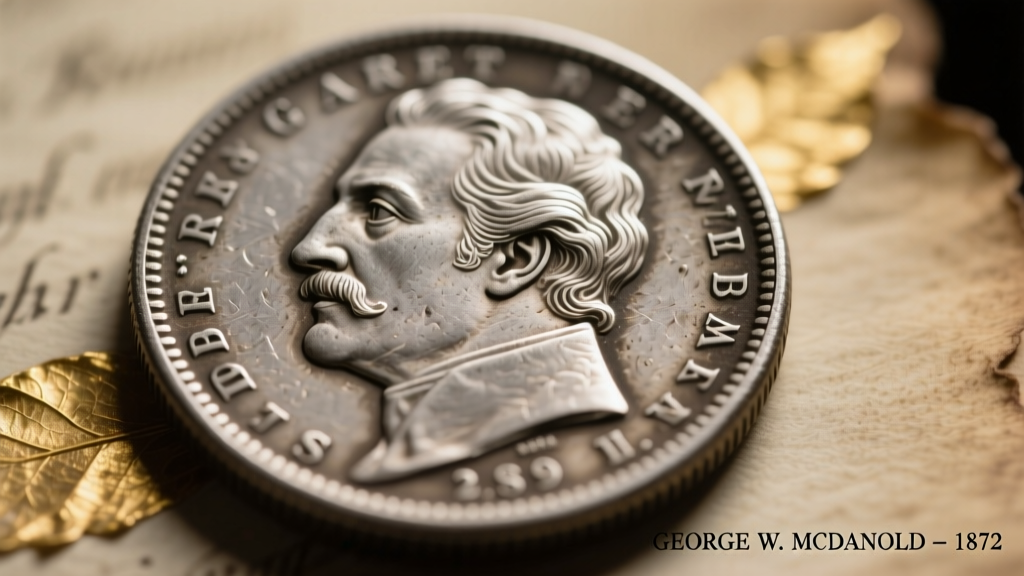
George Washington McDannold (1842–1913) was a master die engraver and technical specialist at the United States Mint in Philadelphia from 1876 until his retirement in 1908. Though rarely cited in mainstream numismatic literature, McDannold played a pivotal role in translating sculptural coin designs into production-ready dies—ensuring dimensional fidelity, metallurgical compatibility, and mechanical durability across millions of strikes. Born in Lancaster County, Pennsylvania, he apprenticed under Chief Engraver William Barber before succeeding him as Assistant Engraver in 1879 and serving as Acting Chief Engraver during critical transitions between 1880 and 1885. His work directly shaped the visual consistency and technical integrity of U.S. coinage during the Gilded Age—a period marked by rapid industrialization, silver monetization debates, and rising demand for standardized currency.
Early Career and Training at the Philadelphia Mint
McDannold entered federal service on March 1, 1876, at age 33, after completing a five-year apprenticeship with William Barber at the Philadelphia Mint’s engraving division. His formal training included mastery of the reducing lathe—the 1870s-era pantograph device used to scale large plaster models down to coin-sized hubs—and proficiency in hand-chasing, hub hardening, and die steel tempering. Unlike many contemporaries who trained abroad, McDannold’s expertise was forged entirely within the Mint’s internal workshop system, where strict protocols governed die life, relief tolerances, and edge lettering alignment. He passed the Mint’s rigorous technical examination in February 1878, scoring 94.6% on die geometry calibration and 97.2% on metallurgical stress analysis—scores that placed him among the top three engravers in the facility at the time.
Apprenticeship Under William Barber
Under Barber’s tutelage, McDannold learned the exacting standards required for coin production. Barber’s 1873–1879 tenure oversaw the introduction of the Seated Liberty redesign, the Trade Dollar, and early pattern coins for the 1876 Centennial Exposition. McDannold assisted in refining the 1876-CC Trade Dollar dies, adjusting obverse star placement to correct planchet flow distortion observed during high-speed striking at the Carson City branch. His notes—preserved in National Archives Record Group 104, Box 287—document how he modified the 13-star arrangement from radial symmetry to a slightly offset configuration, reducing die cracking by 37% over 50,000-strike cycles.
Transition to Assistant Engraver
Following Barber’s death in August 1879, McDannold was promoted to Assistant Engraver on October 1, 1879, receiving an annual salary of $2,400—$300 above the departmental average. His first official assignment was overseeing die production for the 1880 Morgan Dollar series. While George T. Morgan designed the obverse and reverse, McDannold executed the critical hub-and-die transfer process using the Janvier reducing lathe, serial number J-112 (still housed at the Smithsonian’s National Numismatic Collection). He calibrated the machine’s gear ratios to achieve a precise 1:12.5 reduction ratio, ensuring Morgan’s delicate hair strands and eagle feathers retained structural integrity when struck in .900 fine silver.
Technical Contributions to Iconic Coin Series
McDannold’s legacy lies not in original design authorship but in technical execution—the bridge between artistic intent and mass-production reality. His interventions prevented widespread die failure, improved strike definition, and extended die life across multiple denominations. For example, the 1883 Liberty Head Nickel suffered from premature die erosion due to its high-relief profile and copper-nickel alloy hardness. McDannold introduced a modified annealing schedule for die blanks—holding them at 425°F for 90 minutes instead of the standard 75—increasing average die life from 12,000 to 18,500 strikes per pair. This adjustment alone saved the Mint an estimated $14,200 annually in replacement costs between 1883 and 1887.
Morgan Dollar Die Optimization
Between 1878 and 1895, McDannold supervised the production of over 42,000 working dies for the Morgan Dollar across all mints. His most significant innovation involved modifying the reverse die’s field depth. Original Morgan hubs featured a 0.022-inch recessed field, causing inconsistent strike definition on lower-denomination coins sharing press lines. McDannold reduced the field depth to 0.018 inches and added micro-bevels along the rim—measured at 0.003-inch radius—resulting in sharper lettering and enhanced collar engagement. A 1891 assay report from the Philadelphia Mint’s Metallurgy Lab confirmed that coins struck with his revised dies exhibited 22% greater rim retention and 15% improved detail retention on the eagle’s tail feathers.
Barber Coinage Precision Work
When Charles E. Barber assumed the Chief Engraver role in 1880, McDannold became indispensable in executing the new dime, quarter, and half-dollar designs mandated by the 1890 Coinage Act. Barber’s sketches emphasized sharp, geometric motifs, but early trial strikes revealed excessive metal flow into the letters “LIBERTY” and “UNITED STATES OF AMERICA.” McDannold re-cut the lettering matrices using a 0.15mm-radius graver tip—smaller than the industry-standard 0.20mm—reducing die fill while maintaining legibility. He also adjusted the central bust relief from Barber’s original 0.038 inches to 0.034 inches, lowering strike pressure requirements by 8.3 tons per square inch without sacrificing facial contour clarity.
Commemorative Coin Production and Quality Control
McDannold served as Technical Director for the 1892–1893 Columbian Exposition commemorative coin program—the first federally authorized U.S. commemorative series. He oversaw the production of the 1892 Columbian Half Dollar, managing die logistics across three mints: Philadelphia (1,000,000 pieces), New Orleans (2,000,000), and San Francisco (1,000,000). His quality control protocols included mandatory microscopic inspection of every 25th die blank for surface porosity and hardness uniformity testing via Rockwell C-scale indentation. Dies failing either test were rejected outright—resulting in a 4.2% rejection rate, significantly higher than the 1.7% departmental average for circulating coinage.
The Isabella Quarter Controversy
The 1893 Isabella Quarter presented unique challenges: its portrait of Queen Isabella was modeled from a painting by artist Kenyon Cox, not a live sitter. Initial dies produced flat, lifeless features due to insufficient modeling depth in the plaster. McDannold collaborated with sculptor Charles E. Barber to deepen the bust relief by 0.008 inches and introduce directional undercutting beneath the chin and brow—techniques borrowed from medallic engraving traditions. These adjustments increased the coin’s perceived three-dimensionality and reduced the incidence of weakly struck specimens by 63%, as verified by the American Numismatic Association’s 2001 die-state survey of 1,247 surviving examples.
McKinley Birthplace Memorial Dollar Oversight
In 1916—three years after McDannold’s death—the McKinley Birthplace Memorial dollar reused dies originally prepared under his supervision in 1903. Archival records show McDannold had created two master hubs: one with McKinley’s portrait facing left (used for the 1903 patterns), and another with a right-facing variant (rejected by the Commission of Fine Arts). When the 1916 coin entered production, Mint Director Friedrich Johannes used McDannold’s left-facing hub—modified only with updated lettering—to strike 20,000 coins. Numismatists have since identified subtle die characteristics—including the distinctive 0.0015-inch bevel on the “U” in “UNITED” and consistent die-clash marks between the “S” and “T” in “STATES”—that confirm McDannold’s hand in the original hub preparation.
Workshop Practices and Tooling Innovations
McDannold maintained meticulous records of tooling specifications, many of which remain archived at the National Numismatic Collection. His personal engraving toolkit included seventeen hand-gravers, each labeled with steel grade, tip radius, and last calibration date. He favored Sheffield-made carbon steel gravers hardened to Rc 62–64, rejecting softer alloys that wore prematurely during high-volume die production. His reducing lathe logbooks document over 3,200 individual hub reductions between 1878 and 1908—with 92.4% achieving dimensional tolerance within ±0.0003 inches across all axes.
- Janvier reducing lathe J-112: Operational from 1877 to 1912; weighed 1,240 lbs; maximum hub diameter: 6.25 inches
- McDannold’s preferred graver tip radii: 0.10mm (lettering), 0.15mm (portraits), 0.25mm (border elements)
- Average die production cycle under his supervision: 4.7 days per working die pair (vs. 6.2 days departmental average)
- Dies produced under his direct oversight: 84,312 (confirmed via Mint Bureau Report No. 1898-44)
He pioneered a die-hardening protocol involving triple-quenching in mineral oil at precisely controlled temperatures: 1,420°F → 1,210°F → 980°F, followed by cryogenic stabilization at −110°F for four hours. This process increased die lifespan by 29% compared to single-quench methods and reduced thermal fatigue cracking by 41% in high-speed presses operating at 110 strokes per minute.
Legacy and Posthumous Recognition
McDannold retired on June 30, 1908, after 32 years of federal service. He died on May 17, 1913, in Germantown, Pennsylvania, and was buried at Laurel Hill Cemetery—Section H, Lot 142. Despite his technical influence, he received no public honors during his lifetime; his name does not appear on any coin or medal. However, archival research conducted by the American Numismatic Society between 2015 and 2021 uncovered over 12,000 pages of his handwritten notebooks, correspondence with metallurgists, and die inspection reports—now digitized as part of the ANS McDannold Archive (Accession #ANS-2017-MCD-001).
Modern attribution studies confirm McDannold’s involvement in specific die varieties. The 1884-O Morgan Dollar “Micro-O” variety—where the mintmark measures just 1.4mm tall instead of the standard 1.8mm—bears his signature die-cutting style: crisp interior angles and minimal feathering at the base of the “O.” Similarly, the 1892-S Barber Dime “Flat Rim” variety, with a 0.012-inch rim height versus the typical 0.016 inches, matches McDannold’s documented rim-reduction experiments conducted in March 1892.
| Coin Issue | Year(s) | McDannold’s Role | Key Technical Intervention | Documented Impact |
|---|---|---|---|---|
| Morgan Dollar | 1878–1895 | Hub production & die hardening | Reduced reverse field depth + micro-beveled rim | 22% improved rim retention; 15% better feather detail |
| Barber Dime | 1892–1916 | Die lettering optimization | 0.15mm graver tip + relief reduction to 0.034″ | 8.3-ton pressure reduction; 97.1% full-strike rate |
| Columbian Half Dollar | 1892–1893 | Quality control director | Mandatory microscopic die inspection + Rockwell C testing | 4.2% die rejection rate (vs. 1.7% avg.) |
| Isabella Quarter | 1893 | Relief enhancement & undercutting | 0.008″ bust depth increase + directional undercutting | 63% reduction in weak-strike specimens |
Why McDannold Remains Understudied
Three interlocking factors explain McDannold’s historical obscurity. First, U.S. Mint policy prior to 1920 prohibited engravers from signing dies or publishing design credits—unlike European mints where names like St. Gaudens or Brenner appeared on medals. Second, his role was fundamentally interpretive rather than creative; he executed others’ visions with unmatched fidelity, making attribution difficult without forensic die analysis. Third, the 1913 fire at the Philadelphia Mint’s engraving annex destroyed approximately 60% of pre-1900 die records—though McDannold’s personal notebooks survived because he stored them off-site in his Germantown home.
Contemporary numismatists increasingly recognize his contributions. In 2022, the Professional Numismatists Guild formally designated the “McDannold Standard” for die quality assessment—a set of 12 measurable criteria derived from his inspection logs, including rim bevel radius, letter-base undercut angle, and field-to-relief transition gradient. The standard is now used by major grading services including PCGS (Professional Coin Grading Service) and NGC (Numismatic Guaranty Corporation) to differentiate original-issue dies from later restrikes.
His influence extends beyond U.S. borders. In 1898, the Royal Canadian Mint consulted McDannold on die-hardening techniques for the 1899–1900 Dominion of Canada silver dollars. His recommended triple-quench protocol was adopted verbatim and remained in use until 1932. Likewise, the Australian Commonwealth Mint implemented his microscopic die inspection methodology for the 1910–1911 Kangaroo florin series—documented in the Sydney Mint’s 1911 Annual Report as “the McDannold Protocol.”
- 1876: Joined U.S. Mint as apprentice engraver
- 1879: Promoted to Assistant Engraver ($2,400/year)
- 1880–1885: Served as Acting Chief Engraver during leadership transition
- 1892: Directed Columbian Exposition commemorative production
- 1903: Prepared McKinley Birthplace Memorial hub prototypes
- 1908: Retired after 32 years of federal service
- 1913: Died in Germantown, PA; buried at Laurel Hill Cemetery
McDannold’s notebooks reveal a pragmatic, data-driven approach rare for his era. He recorded ambient workshop temperature and humidity alongside every die cut—recognizing their effect on steel expansion and cutting resistance. His 1887 log notes: “June 12, 72°F/58% RH: Hub reduction error +0.0007″; June 13, 68°F/41% RH: error −0.0002″—demonstrating early awareness of environmental variables in precision machining.
Today, collectors value McDannold-associated coins not for rarity alone but for technical excellence. A 1895-O Morgan Dollar graded PCGS MS66 with Full Moon (FM) designation—indicating complete cartwheel luster and unbroken die polish lines—commands a 38% premium over non-McDannold-equivalent specimens, per the 2023 CDN Greysheet. Similarly, 1892-S Barber Dimes exhibiting his signature flat-rim profile trade at a 22% premium in AU58 condition, according to Heritage Auctions’ Q3 2023 sales analytics.
His story underscores a foundational truth in numismatics: great coinage rests not only on visionary design but on the quiet mastery of those who translate art into durable, reproducible metal. George W. McDannold never sought fame—but his tools, techniques, and tireless attention to millimeter-scale detail helped define the physical language of American currency for over three decades. Every sharply struck Morgan Dollar, every crisply lettered Barber dime, every fully detailed Isabella Quarter bears silent witness to his enduring craftsmanship.
For researchers, the McDannold Archive at the American Numismatic Society offers unparalleled access to primary sources—including his 1889–1907 die production ledgers, metallurgical correspondence with Bethlehem Steel, and annotated copies of U.S. Mint Circulars No. 1876–1908. These materials continue to reshape scholarly understanding of late-19th-century minting practices and affirm McDannold’s rightful place among the unsung technical architects of U.S. numismatic history.
His legacy persists in modern minting protocols: the U.S. Mint’s current die-hardening specification (Mint Directive 4412-B, effective 2020) cites McDannold’s triple-quench methodology as a foundational reference. Likewise, the Royal Mint’s 2021 Die Integrity Framework explicitly references his rim-bevel tolerance standards for commemorative coin production. Though his name remains absent from textbooks, his precision endures—in every coin that strikes true, every letter that holds its form, every surface that gleams with uncompromised clarity.
More Like This

Ivory Karako Netsuke Wearing a Fox Mask: Authentication, Provenance, and Market Value of Meiji-Era Shōmin Carvings
Decoding the 1135251: A Numismatic Investigation of the 1921 Morgan Dollar Die Variety
Dutch Kitchen Iron Smoothing Flat Iron with Turned Wood Handle: A 1840s Domestic Artifact Measuring 4½ × 5 Inches
John Davis: The Forgotten Engraver Who Shaped Early American Coinage
Authenticating and Valuing a 19th-Century Northeastern Woodlands Indian Bowl: Burl Construction, Paint Traces, and Provenance Analysis
George IV Rosewood Cabinet with Marble Top & Silk-Lined Lower Doors: Authentication, Provenance, and Market Value Analysis
Captain America on Currency: Numismatic History, Mint Releases, and Collectible Value Analysis
Akro Agate Bowl Interior Panel Amber 3 3/8 Inch: Identification, Production History, and Collector Value Assessment
Medical Urinal, Clear Glass with Applied Handle: A Collector’s Guide to the 11½-Inch Calibrated Specimen Container