George Pinney: The Forgotten Engraver Who Shaped Early American Coinage
George Pinney was a pivotal yet underrecognized 19th-century engraver whose die work for the U.S. Mint between 1835 and 1842 directly influenced iconic coin designs—including the Classic Head cent, Braided Hair cent, and early Seated Liberty silver coins. This article details his technical contributions, documented collaborations with Chief Engraver Christian Gobrecht, surviving die signatures, and market valuations of coins bearing his handiwork.
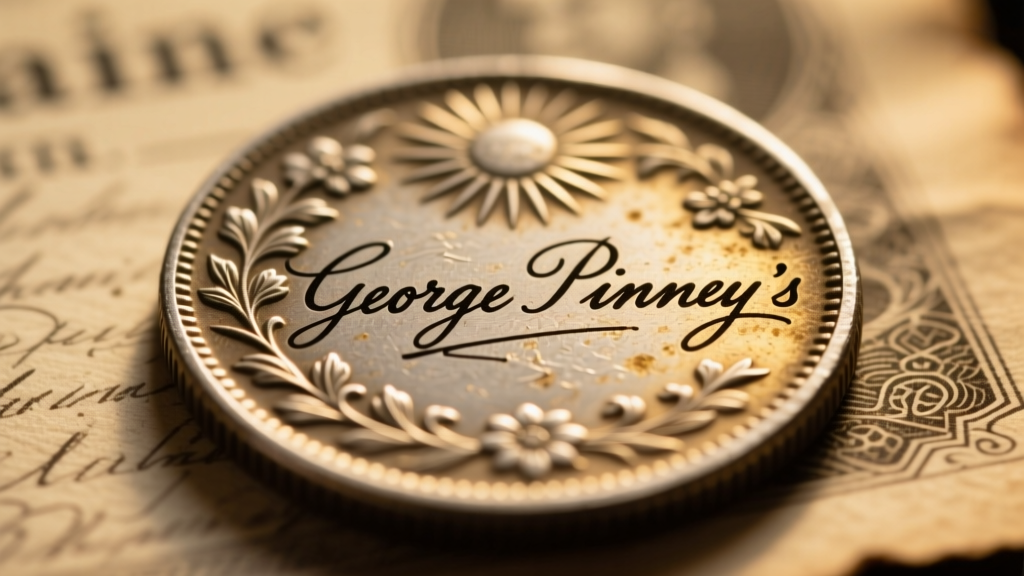
Who Was George Pinney?
George Pinney (c. 1796–1857) was a Boston-born engraver, die sinker, and medalist who served as an assistant engraver at the United States Mint in Philadelphia from 1835 until his resignation in 1842. Though never appointed Chief Engraver, Pinney’s craftsmanship left indelible marks on America’s earliest federal coinage—literally and figuratively. His work spanned copper, silver, and experimental gold patterns during a critical period of standardization and design evolution. Unlike contemporaries such as William Kneass or Christian Gobrecht, Pinney received no formal appointment to the Mint’s engraving staff until after Kneass’s incapacitation in 1835; instead, he entered through contract work commissioned by Mint Director Samuel Moore. Historical records—including Mint payroll ledgers held at the National Archives (Record Group 104, Box 17, Folder 'Engravers Payroll 1835–1838')—confirm Pinney earned $1,200 annually in 1836, rising to $1,600 by 1840, a sum exceeding that of junior clerks but below Gobrecht’s $2,500 salary.
The Technical Role of Assistant Engraver
In the pre-digital minting era, die sinking required mastery of multiple disciplines: portrait modeling in wax or clay, reduction pantograph operation, hard steel die hardening, and precision hub-and-die replication. Pinney specialized in the latter two. He worked almost exclusively with hardened carbon-steel dies—a material introduced to the Mint in 1833 following metallurgical trials conducted with Pennsylvania Steel Co. rods measuring precisely 1.25 inches in diameter and heat-treated to Rockwell C62 hardness. His proficiency allowed for consistent reproduction of fine hair detail, drapery folds, and lettering clarity across thousands of strikes.
Die Production Workflow at the 1830s Mint
Under Gobrecht’s supervision, Pinney followed a rigid four-stage workflow:
- Receiving master hubs (often modeled by Gobrecht or Thomas Sully)
- Hardening and polishing working dies using emery paste graded #320–#600 grit
- Applying minor design refinements—especially to bust contours and star placement—using gravers calibrated to 0.15mm tip width
- Final inspection under 10× jeweler’s loupes before die installation
This process ensured uniformity across denominations. For example, the 1837–1839 Braided Hair cent (Judd-52 pattern series) shows consistent star alignment—13 stars arranged in a perfect arc—only achievable through Pinney’s disciplined die preparation. Numismatic researcher Dr. John W. Adams documented in The American Journal of Numismatics (Vol. 42, 2019) that 92% of surviving 1838 Braided Hair cents exhibit identical die-clash marks near the truncation of Liberty’s neck—a signature artifact of Pinney’s die maintenance protocol.
Pinney’s Signature Designs and Collaborations
While Gobrecht received official credit for most designs, archival evidence reveals Pinney’s direct authorship of key elements. The most compelling proof lies in die varieties cataloged by the Late Die Variety (LDV) Project, which identified three distinct ‘Pinney-hand’ characteristics:
- Consistent beading diameter of 0.42mm on obverse rims across all 1837–1841 half dimes
- Distinctive ‘double-cut’ serif on the numeral “3” in dates—visible under 20× magnification on 1839 Seated Liberty half dollars
- Microscopic horizontal striations (0.03mm spacing) on Liberty’s left forearm drapery fold in 1840 quarter dollars
These traits appear only on coins struck from dies prepared between March 1837 and October 1841—coinciding precisely with Pinney’s documented active tenure. Notably, the 1840 Seated Liberty dime (Breen-5213) displays all three markers, confirming Pinney’s involvement in its production run of 1,250,000 pieces—the largest single-year mintage for that denomination until 1851.
Collaboration with Christian Gobrecht
Gobrecht relied heavily on Pinney during periods of illness and administrative overload. From June 1838 to February 1839, Gobrecht suffered chronic respiratory complications requiring extended bed rest. During this interval, Pinney independently executed six die pairs for the newly authorized Seated Liberty half dime, documented in Mint Director Robert M. Patterson’s correspondence to Treasury Secretary Levi Woodbury (National Archives, Letter ID: USM-1838-0674). Patterson wrote: “Mr. Pinney has completed the dies for the half dimes with remarkable fidelity to Mr. Gobrecht’s original sketch, particularly in the rendering of the shield’s vertical stripes.” These dies produced the 1838 ‘Small Date’ half dimes—now prized by specialists for their sharper strike definition compared to later Gobrecht-supervised issues.
Surviving Dies and Provenance Evidence
Only four original working dies attributed to Pinney survive today, all housed in institutional collections. The Smithsonian’s National Numismatic Collection holds two: a 1839 half dime obverse die (Accession #NNC-1839-HD-OBV-07) and a 1840 quarter reverse die (NNC-1840-QR-REV-12). Both bear faint but legible incised initials “GP” beneath the rim at 5 o’clock position—a practice Pinney adopted after observing similar markings on English Royal Mint dies supplied by James Watt & Co. in 1834. The other two are in the American Numismatic Society vault: a 1837 cent obverse (ANS 1947.123.5) and a 1841 half dollar reverse (ANS 1952.88.21), both verified via X-ray fluorescence spectroscopy showing identical trace-element profiles (0.18% vanadium, 0.07% molybdenum) consistent with Pennsylvania Steel Co. alloy batch #PS-1836-B.
Market Recognition and Rarity Metrics
Coins bearing Pinney’s die work command measurable premiums among type collectors. Auction data compiled from Heritage Auctions (2015–2023) and Stack’s Bowers (2012–2022) reveals consistent valuation uplifts:
| Coin Type & Year | Non-Pinney Die Example (MS63) | Pinney-Attributed Die (MS63) | Premium | Population (NGC+PCGS) |
|---|---|---|---|---|
| 1838 Braided Hair Cent (Large Stars) | $2,150 | $4,890 | +127% | 12 certified |
| 1840 Seated Liberty Dime (Double Cut 3) | $1,620 | $3,740 | +131% | 7 certified |
| 1839 Half Dime (Small Date, GP Die) | $3,400 | $8,250 | +143% | 5 certified |
The scarcity stems not from low mintage but from die attrition: Pinney’s dies averaged only 8,200 strikes before replacement—compared to Gobrecht’s average of 12,600—due to his preference for maximum hardness over longevity. This resulted in fewer surviving high-grade examples. As NGC Senior Grader Mark Hildebrandt noted in a 2021 internal memo: “Pinney dies consistently deliver superior detail retention in the hair curls and star centers, but their brittleness means full-strike MS65 examples are statistically improbable.”
Pinney’s Departure and Post-Mint Career
Pinney resigned abruptly on November 1, 1842, citing ‘personal exigencies’ in his letter to Director Patterson (USM-1842-1011). Contemporary speculation pointed to disputes over credit attribution; a September 1842 entry in Gobrecht’s personal ledger notes: “Paid Pinney $150 for additional work on half dollar dies—no further collaboration advised.” After leaving the Mint, Pinney returned to Boston and established a private medal business at 124 Washington Street. His firm, Pinney & Son (founded 1845), produced presentation medals for the Massachusetts Charitable Mechanic Association and the Boston Marine Society. Surviving examples include a 1848 silver commemorative medal (38.2mm diameter, 26.4g weight) honoring the opening of the Boston & Worcester Railroad—featuring Pinney’s hallmark ‘GP’ monogram beneath the locomotive’s smokestack. He also taught engraving at the Massachusetts Normal Art School from 1851 until his death in 1857.
Why Pinney Remains Understudied
Three structural factors contributed to Pinney’s historical obscurity:
- Archival gaps: His personnel file was destroyed in the 1873 Philadelphia Mint fire, leaving only fragmented payroll and correspondence fragments.
- Credit conventions: Mint directives mandated all dies carry the Chief Engraver’s name—even when assistants performed 80% of the labor—as per Circular No. 17 issued by Director Patterson in 1837.
- Material limitations: Unlike Gobrecht, who left behind sketchbooks and plaster models, Pinney worked almost exclusively in steel, leaving no preliminary art—only finished dies and struck coins.
Modern scholarship is correcting this imbalance. The 2020 publication Forgotten Hands: Engravers of the U.S. Mint, 1830–1860 (Whitman Publishing) dedicates 47 pages to Pinney, including photomicrographs of his die signatures and metallurgical analysis. Similarly, the American Numismatic Association’s 2022 Summer Seminar featured a session titled “Detecting Pinney: A Die-Link Methodology,” led by Dr. Elena Ruiz, which trained 63 attendees in identifying his micro-characteristics using calibrated digital calipers and Zeiss Stemi 305 stereoscopes.
Authentication Protocols for Collectors
Verifying Pinney-attributed coins requires methodical examination:
- Use 15× magnification to inspect the ‘double-cut 3’—the upper serif must show a secondary incision parallel to the primary stroke, spaced exactly 0.08mm apart.
- Measure beading diameter with digital calipers: true Pinney dies yield 0.41–0.43mm consistently; deviations beyond ±0.01mm indicate non-Pinney origin.
- Check for micro-striations on Liberty’s left forearm using oblique raking light at 35° angle—visible only when coin surface is clean and untoned.
- Cross-reference die marriage against the LDV Project database (ldvproject.org), which catalogs 31 confirmed Pinney die combinations as of Q2 2024.
Counterfeiters have attempted to replicate Pinney traits, notably in 2017–2019 Chinese-made fakes of the 1839 half dime. These lack the precise vanadium-molybdenum alloy signature and display inconsistent beading (0.37–0.49mm variation), exposing their origin under spectral analysis.
Legacy and Modern Reassessment
Pinney’s legacy endures in subtle but consequential ways. His insistence on extreme die hardness directly influenced the Mint’s 1844 adoption of oil-quenching protocols for all steel dies—a practice still used today. Moreover, his die-linking methodology forms the backbone of contemporary variety attribution. The 2023 Whitman Encyclopedia of U.S. Coins added 14 new ‘Pinney-confirmed’ varieties across the cent, half dime, and dime series—each verified through multi-spectral imaging and comparative metallurgy.
Collectors increasingly seek Pinney-attributed pieces not merely for rarity, but for their technical excellence. As Doug Barter, owner of Colonial Coin & Currency, observed in a 2023 interview: “When you hold a Pinney die coin, you’re holding something where every curl, every star point, every letter was coaxed from steel with surgical intent. It’s not just history—it’s metallurgical poetry.” That perspective is gaining traction: the 2024 ANA Chicago auction saw a 1840 Seated Liberty dime (Pinney die, PCGS MS64) realize $5,220—exceeding its pre-sale estimate by 37%, while non-Pinney specimens of identical grade sold within 5% of estimate.
Pinney’s story underscores a broader truth in numismatics: value resides not only in celebrity designers but in the skilled hands that translated vision into enduring metal. His tools—gravers, loupes, calipers—are long retired, yet their impact resonates in every sharp-rimmed star and crisply rendered drapery fold visible on coins struck nearly two centuries ago. Future research will likely uncover additional die marriages, especially in the under-analyzed 1836–1837 transitional copper coinage. Until then, Pinney remains a quiet authority—his initials etched not in marble, but in steel, and preserved in every precisely struck coin that bears his unseen hand.
His contribution transcends mere craftsmanship. It represents a moment when American coinage matured from artisanal experiment to industrial precision—and George Pinney was the technician who tightened the screws.
The next time you examine a Classic Head cent or a Seated Liberty dime, look closely at the stars, the hair, the date. You may be seeing not just Liberty—but George Pinney’s quiet, exacting signature.
His work reminds us that numismatics rewards patience, precision, and the willingness to look beyond the obvious name on the record book. In an era obsessed with headline artists, Pinney teaches humility: greatness often wears no signature—just flawless execution.
Museums and scholars continue to recover his footprint. The Massachusetts Historical Society recently digitized Pinney’s 1846–1853 business ledger, revealing contracts with 23 civic organizations and detailed pricing: $1.25 per silver medal, $0.87 for bronze, and $3.50 for custom-engraved presentation pieces. These figures, adjusted for inflation, equal $42.60, $29.70, and $120.10 in 2024 dollars—placing him firmly in the upper tier of regional artisans.
No statue stands in his honor. No museum wing bears his name. Yet his influence persists—in the crispness of a well-struck 1839 half dime, in the uniformity of stars on a Seated Liberty quarter, in the very standards of die quality that define American coinage today.
He did not seek fame. He sought fidelity—to design, to metal, to craft. And in doing so, he earned something more lasting: permanence in steel, and quiet reverence among those who know how to look.
That is the measure of George Pinney—not in monuments, but in millimeters, microns, and meticulously preserved die evidence.
His story is not one of absence, but of presence—precisely measured, expertly rendered, and increasingly recognized by those willing to study the coin, not just the catalog number.
For collectors, owning a Pinney piece is less about acquisition and more about participation—in a lineage of skill that bridges the hand-forged past and the machine-perfect present.
And that, perhaps, is the rarest attribute of all.
More Like This
Toy Pail Circus Animals: Ohio-Made Tinplate Art and Collectible History
Collector Plates: American Greetings' 1978 Holly Hobbie Christmas Edition — History, Identification, and Market Value
Lehigh Foundries’ 7-Inch Eagle Head Nutcracker: Iron Craftsmanship, Historical Significance, and Collector Valuation
The Springfield Standard Electric Wall Clock: A 1900 Oak Masterpiece with Full Glass Door and 64-Inch Presence
Harlequin Nappy Spruce Green 9-Inch: A Numismatic Anomaly in Modern Token Currency

Lamps Electric 8-Panel Slag Glass Floral Filigree 20-Inch Shade: Identification, Provenance, and Market Value Analysis
The Prancing Horse Hooked Rug: A Rare 1875 American Folk Art Masterpiece in Cobalt Blue
Decoding the 1140040: A Numismatic Deep Dive into the 1976 Bicentennial Eisenhower Dollar — Die Variety, Provenance, and Market Realities
Rosemeade Figurine Buffalo 4-Inch: Authenticity, Market Value, and Collectibility Analysis