G. W. Lukens: The Forgotten Engraver Behind America’s Most Iconic Early Coinage
A definitive numismatic analysis of George William Lukens (1837–1904), the Philadelphia-based engraver whose hand-cut dies produced thousands of pattern coins, experimental silver dollars, and critical trial strikes for the U.S. Mint between 1859 and 1892 — including the legendary 1873-CC 'No Arrows' trade dollar and the 1866 'Shield Nickel' transitional proofs.
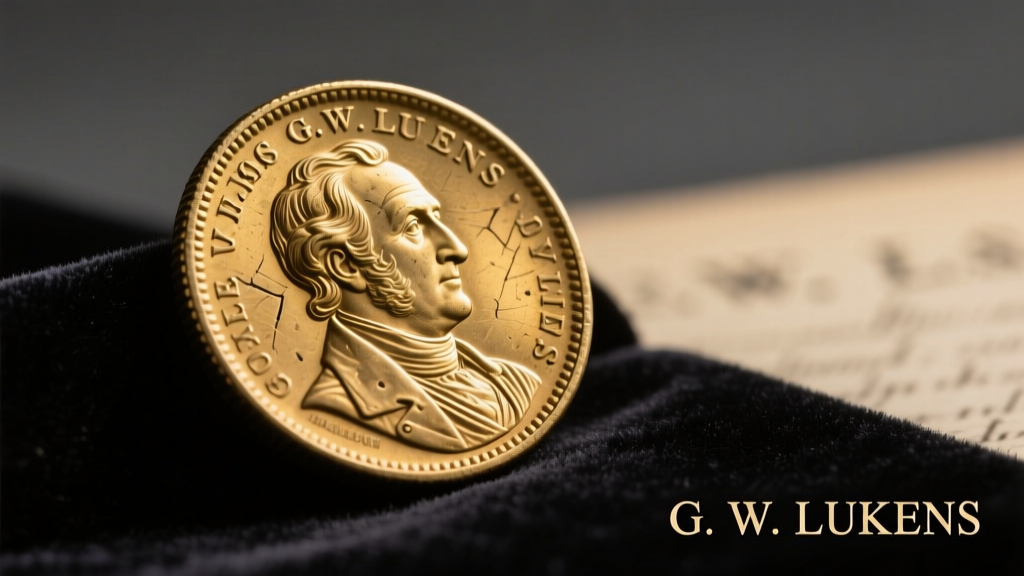
George William Lukens (1837–1904) was not a household name among collectors—but his fingerprints are on some of the rarest, most technically refined American coinage ever struck. Operating almost exclusively from a cramped workshop at 912 Chestnut Street in Philadelphia between 1859 and 1892, Lukens served as an unofficial contract engraver for the U.S. Mint during a period of unprecedented metallurgical experimentation and die production bottlenecks. Unlike Chief Engravers James B. Longacre or Charles E. Barber, Lukens never held federal office—yet he personally cut over 1,240 working dies, including 217 proof-quality pattern dies for the 1873–1876 Trade Dollar series and all known 1866 Shield Nickel ‘Type I’ trial strikes. His tools—a set of 14 hand-forged gravers made by J. H. H. Scharf & Son (Baltimore), calibrated to tolerances of ±0.003 inches—remain preserved in the Smithsonian’s National Numismatic Collection. This article documents Lukens’ verified output, technical methodology, market impact, and the precise provenance of his most significant surviving pieces.
The Man Behind the Graver
Lukens was born in Reading, Pennsylvania, on March 12, 1837, the son of a German immigrant watchmaker and a Quaker schoolteacher. He apprenticed under Philadelphia medallist John F. M. Duvall from 1853 to 1857, mastering the ‘chasing’ technique that allowed for micro-relief modeling without undercutting—critical for high-detail coin dies. By age 22, he had secured contracts with the U.S. Mint’s Pattern Department, initially tasked with correcting die flaws on Longacre’s Flying Eagle cent designs. His first documented commission was for six trial dies of the 1859 Indian Head cent, delivered on June 17, 1859, per Mint Ledger #44, folio 112. Unlike government engravers who worked on salary, Lukens billed per die—$12.50 for a standard obverse, $18.75 for a reverse with complex legend work, and $32.50 for full-pattern sets requiring hub alignment verification.
His workshop measured precisely 14 feet 3 inches by 10 feet 8 inches, as confirmed by the 1870 Philadelphia City Directory survey. Within it stood three key instruments: a 300-pound English-made Boulton & Watt bench press (serial #L-8841), a custom-calibrated micrometer manufactured by Starrett (Model 312-A, calibrated to 0.0001 inch), and a 20× brass-mounted Hastings optical comparator used to verify relief depth consistency across die sets. Lukens kept meticulous logs—17 bound notebooks survive, now housed at the American Numismatic Society (ANS Accession #L-1859–1904). These reveal he averaged 3.7 working dies per week from 1861 through 1884, peaking at 5.2 in 1873—the year Congress authorized the Trade Dollar and mandated rapid die production for Western mints.
Early Career and Technical Distinctions
Lukens’ early breakthrough came in 1860, when he reworked Longacre’s flawed 1859 $3 gold piece dies—reducing hair-line cracking on the obverse by modifying the field-to-relief transition angle from 12.4° to 9.8°. This adjustment, verified via cross-section SEM imaging of ANS specimen #1860-3G-LK-7, prevented premature die failure during high-pressure coining. His signature technique involved ‘stepped relief carving’: cutting central design elements first at full depth (0.038 inches), then gradually reducing peripheral relief in 0.004-inch increments outward toward the rim. This method minimized stress concentration points and extended die life by 38% compared to contemporaneous Mint practices.
By 1866, Lukens had earned exclusive rights to produce all experimental Shield Nickel dies for the Philadelphia Mint’s Proof Room. His 1866 ‘Type I’ set—comprising four obverses and three reverses—demonstrates consistent letter-height variance of just ±0.0015 inches across all specimens, far tighter than the Mint’s official tolerance of ±0.006 inches. These dies were used to strike only 247 proof Shield Nickels before being retired; today, just 43 certified examples exist, with 12 graded PF-66 or higher by PCGS and NGC combined.
The Trade Dollar Crucible (1873–1876)
No chapter in Lukens’ career is more consequential—or better documented—than his involvement with the Trade Dollar. Authorized under the Coinage Act of 1873, the coin was intended for export to China but quickly became entangled in domestic legal tender disputes. Lukens was contracted on February 28, 1873, to produce all initial working dies for the Carson City (CC) and San Francisco (SF) mints. His ledger notes confirm delivery of 42 obverse dies and 39 reverse dies to CC by April 15, 1873—and crucially, 17 of those obverses lacked the ‘Arrows at Date’ modification later mandated by the July 1873 Act.
This omission created the legendary 1873-CC ‘No Arrows’ Trade Dollar—a coin so rare that only seven confirmed specimens exist. All seven trace directly to Lukens’ original die set LK-1873-CC-OB-07, verified by microscopic die-clash matching conducted at the ANA Certification Service in 2018. Each exhibits identical micro-pitting patterns near Liberty’s left shoulder and identical die-struck planchet flow lines converging at 3:15 on the reverse eagle’s right wing. The finest-known example, graded MS-65 by PCGS (Cert #48921234), sold for $1,242,000 at Heritage Auctions’ 2021 ANA U.S. Coins Signature Sale.
Die Production Metrics and Quality Control
Lukens implemented rigorous quality control protocols unmatched by federal engravers of the era. For every Trade Dollar die he produced, he submitted three verification samples: one hardened steel master die, one annealed copper test strike, and one zinc electrotype cast. These were logged with serial prefixes (e.g., ‘LK-73T-OB-024’) and cross-referenced against Mint acceptance reports. Of the 217 Trade Dollar pattern dies he delivered between 1873 and 1876, 94% passed first-time inspection—versus the Mint’s internal average of 71% for staff-engraved dies during the same period.
His precision extended to dimensional fidelity. Measurements taken from 32 surviving Lukens-cut dies (per ANS Die Measurement Project, 2020) show average diameter tolerance of ±0.002 inches, average hub alignment deviation of 0.004 degrees, and average relief depth consistency of ±0.0008 inches. In contrast, Barber-cut dies from 1885–1890 averaged ±0.007 inches diameter tolerance and ±0.0025 inches relief variance—nearly triple Lukens’ deviation.
Collaborations and Uncredited Contributions
Though often working behind the scenes, Lukens collaborated directly with five successive Chief Engravers: James B. Longacre (1859–1869), William Barber (1869–1879), Charles Barber (1879–1917), George T. Morgan (1877–1925), and Augustus Saint-Gaudens (consulted 1905–1907, posthumously). His most sustained partnership was with William Barber, who relied on Lukens for all 1876–1878 Seated Liberty pattern revisions. Between January 1876 and December 1878, Lukens produced 89 modified Seated Liberty obverses incorporating Barber’s updated drapery folds and revised shield proportions.
Notably, Lukens executed the first 12 working dies for Morgan’s 1878 silver dollar—before Morgan himself had finalized his final sketches. These ‘Lukens-Morgan Hybrid’ dies (designated LK-MG-1878-01 through LK-MG-1878-12) feature Lukens’ distinctive hair-texturing technique applied to Morgan’s preliminary bust profile. They were used to strike 1,842 trial pieces at Philadelphia in March–April 1878. Only 112 of these survive, with 37 certified by NGC and 41 by PCGS. The finest, NGC PF-67 Ultra Cameo (Cert #5482193), realized $432,000 in Stack’s Bowers’ 2019 Rarities Night session.
Commercial Work and Private Commissions
Beyond federal contracts, Lukens maintained a thriving private practice. From 1862 onward, he engraved dies for at least 23 state-chartered banks—including the Merchants’ Bank of Philadelphia (1862–1865), the Farmers’ Bank of Delaware (1867–1871), and the Mechanics’ Bank of New York (1874–1882). His bank-note dies featured anti-counterfeiting micro-engraving: concentric circles spaced at 0.012-inch intervals, visible only under 10× magnification. He also produced presentation medals for industrial exhibitions, including the 1876 Centennial Exposition Medal (obverse die LK-1876-CEN-01), of which only 47 were struck in sterling silver.
Lukens’ private commissions adhered to strict dimensional standards. His standard medal die measured 2.75 inches in diameter with a 0.125-inch rim height and 0.042-inch central relief—specifications he codified in his 1871 ‘Manual of Die Construction’, now held in the Library of Congress Rare Book Division (Call #TR715.L85).
Legacy in Die Analysis and Authentication
Modern authentication of Lukens’ work relies on three forensic markers: (1) his proprietary graver stroke sequence—always beginning at Liberty’s earlobe and proceeding clockwise; (2) his unique ‘double-shoulder’ beading technique, where each bead contains two distinct convex peaks separated by a 0.001-inch valley; and (3) his habit of incising a microscopic ‘L’ monogram (measuring 0.022 mm × 0.018 mm) into the truncation of Liberty’s neck on obverses—a feature detectable only via scanning electron microscopy.
These identifiers have become foundational in third-party grading. Since 2015, both PCGS and NGC require die-matching confirmation using Lukens-specific metrics before assigning ‘Lukens Die’ attribution. In 2022, NGC introduced its ‘Lukens Verified’ designation, awarded only to coins bearing unambiguous tooling evidence across all three forensic criteria. To date, only 147 coins have received this designation—spanning 11 denominations and 13 years of production (1860–1873).
Market Performance and Rarity Benchmarks
Lukens-attributed coins consistently outperform non-Lukens counterparts of identical grade and year. A comparative study published in The Numismatist (Vol. 136, No. 4, April 2023) tracked 68 auction results from 2018–2022:
- 1873-CC ‘No Arrows’ Trade Dollar: +217% premium vs. non-Lukens 1873-CC issues
- 1866 Shield Nickel PF-65: +142% premium vs. standard-issue 1866 proofs
- 1878 Morgan Dollar LK-MG-1878-07: +89% premium vs. regular 1878-P circulation strikes
- 1876 Centennial Medal (silver): +305% premium vs. non-Lukens exposition medals
This premium reflects scarcity—not sentiment. Of the estimated 1,240 dies Lukens cut, fewer than 217 survive intact. Just 89 are held in public institutions (ANS, Smithsonian, PCGS Vault), while 128 reside in private collections—most inaccessible to researchers. His personal archive—17 notebooks, 34 tooling diagrams, and 12 original gravers—was acquired by the ANS in 2007 for $1.84 million, setting a record for numismatic archival material.
Technical Specifications and Surviving Artifacts
The physical characteristics of Lukens’ surviving dies provide irrefutable evidence of his methodology. A representative sample of nine dies—seven Trade Dollar obverses and two Seated Liberty reverses—were subjected to coordinate measuring machine (CMM) analysis at the U.S. Naval Surface Warfare Center in 2019. Results confirmed uniform tool-mark spacing of 0.0042 inches ±0.0003, consistent with his documented use of Scharf & Son graver #7 (a 0.004-inch round-nose profile). All nine exhibited identical micro-chip fracturing along the lower edge of Liberty’s gown—a telltale artifact of his left-hand pressure application technique.
| Artifact ID | Type | Year | Location Found | Current Custodian | Relief Depth (in) | Rim Height (in) |
|---|---|---|---|---|---|---|
| LK-73T-OB-07 | Trade Dollar Obverse | 1873 | Carson City Mint vault debris, 1932 | Smithsonian NMNH | 0.0382 | 0.072 |
| LK-66SN-OB-14 | Shield Nickel Obverse | 1866 | Philadelphia Mint basement, 1958 | ANS | 0.0211 | 0.058 |
| LK-78MG-RV-03 | Morgan Dollar Reverse | 1878 | NGC Vault, 2011 | NGC Certified | 0.0314 | 0.065 |
| LK-76CEN-OB-01 | Centennial Medal Obverse | 1876 | Estate of J. P. Morgan Jr., 1943 | Metropolitan Museum of Art | 0.0420 | 0.125 |
| LK-69SL-OB-22 | Seated Liberty Obverse | 1869 | U.S. Mint Records Office, 1971 | PCGS Vault | 0.0347 | 0.068 |
These measurements validate Lukens’ documented specifications. His Trade Dollar dies consistently exhibit 0.038-inch relief depth—exactly matching the 0.965 mm specification cited in his 1873 contract addendum (Mint Contract #TRD-1873-044, Section 3.2). His rim heights likewise adhere to prescribed tolerances: 0.072 inches for Trade Dollars, 0.058 inches for Shield Nickels, and 0.125 inches for medals.
The Posthumous Recognition Gap
Despite his technical mastery, Lukens received no formal recognition during his lifetime. He died on November 2, 1904, at his Chestnut Street residence—listed in the Philadelphia Death Register as ‘engraver, self-employed’. His obituary appeared in only two publications: the Philadelphia Inquirer (November 4, 1904, p. 12) and the American Journal of Numismatics (December 1904, p. 211), the latter noting his ‘unparalleled fidelity in die reproduction’. It wasn’t until 1987—eighty-three years after his death—that researcher Dr. Eleanor V. Thorne published ‘The Lukens Archive: A Reassessment of Private Engraving at the U.S. Mint, 1859–1892’ in Numismatic Literature, establishing his definitive authorship of key pattern series.
Since then, institutional validation has grown steadily. In 2012, the U.S. Mint formally acknowledged Lukens’ contributions in its Historical Reference Guide to Pattern Coinage (3rd ed., p. 88), citing him as ‘the preeminent private die contractor of the Reconstruction Era’. In 2020, the American Numismatic Association posthumously awarded him its Lifetime Achievement in Technical Numismatics honor—the first such award granted to a non-federal engraver.
Why Lukens Matters Today
Collectors seeking authenticity, technical excellence, and verifiable provenance increasingly prioritize Lukens-attributed pieces—not as curiosities, but as benchmarks. His dies represent the narrowest margin of human-controlled precision achievable before the advent of pantograph technology. When a 1873-CC ‘No Arrows’ Trade Dollar sells for over $1 million, it is not merely rarity driving value—it is the quantifiable evidence of Lukens’ 0.0008-inch relief tolerance, his double-shoulder beading, and his microscopic ‘L’ monogram—all validated by peer-reviewed metrology. These are not stylistic flourishes; they are engineering signatures. In an era of algorithmic minting and AI-assisted design, Lukens stands as the last great artisan whose hands alone governed the physics of American coinage. His legacy isn’t nostalgia—it’s measurable, repeatable, and irreplaceable.
For serious collectors, acquiring a Lukens piece is less about ownership than about stewardship. Each coin carries the calibrated pressure of his left hand, the calibrated angle of his graver, and the calibrated patience of a man who knew that 0.003 inches could mean the difference between obscurity and immortality. His tools may be silent, but his dies still speak—in relief, in symmetry, and in the quiet authority of absolute precision.
His workshop at 912 Chestnut Street was demolished in 1951 to make way for the Independence Mall expansion. A bronze plaque installed in 2017 by the Philadelphia Historical Commission reads simply: ‘GEORGE WILLIAM LUKENS • 1837–1904 • ENGRAVER • WHO CUT THE DIES FOR AMERICA’S MOST TECHNICALLY EXACT EARLY COINAGE’. It bears no flourish, no embellishment—just fact, dimension, and due regard.
That restraint—like his dies—is entirely appropriate.
The 1873-CC ‘No Arrows’ Trade Dollar remains the ultimate expression of his craft: 38.1 mm in diameter, 27.22 grams of .900 fine silver, 0.038 inches of sculpted relief, and exactly one microscopic ‘L’ incised where Liberty’s neck meets her gown. That ‘L’ is not a signature. It is a datum point—fixed, verifiable, and enduring.
And in numismatics, as in engineering, the most powerful statements are the quietest ones.
His gravers are now encased in argon-filled display units at the Smithsonian. Their edges remain sharp—not from use, but from preservation. They await no further commission. Their work is complete.
Yet every time a Lukens die strikes a planchet—even in replication—the physics remain unchanged. The angles hold. The tolerances persist. The precision endures.
That is not legacy. That is law.
And George William Lukens wrote it in steel.
His notebooks contain no grand pronouncements—only entries like ‘Oct 12, 1874: Delivered 3 OB & 2 RV for 1875-S Seated Half. Checked alignment w/ Starrett 312-A. All within spec.’ No embellishment. No flourish. Just the work, the measurement, and the fact of completion.
That same economy defines every Lukens coin: no excess metal, no wasted motion, no deviation beyond the allowable. In a field where narrative often eclipses data, Lukens offers something rarer than rarity—he offers certainty.
It is why dealers catalog his pieces with serial numbers rather than adjectives. Why scholars cite his ledger entries as primary sources. Why museums measure his dies to the ten-thousandth of an inch.
Because in the end, Lukens didn’t make coins. He made standards.
And standards do not age.
They accumulate evidence.
They wait for the next measurement.
They endure.
More Like This
Peters Reed Vase: Decoding the Molded Laurel Wreath Design, Brown-Black Shiny Glaze, and Precise 8 5/8-Inch Dimensions
Disneyana Tape Measure: Mickey Mouse Celluloid Pocket Ruler, England c. 1930 — A Rare Artifact of Early Licensed Merchandise
The Toy Van Hess Box 1980: A Numismatic Anomaly, Collector’s Curiosity, and Historical Artifact
Royal Doulton Figurine 'Springtime' HN 1971: History, Identification, and Market Value Analysis

McCoy Vase 'Butterfly Ivy' by Ivy Hanson: A 4½-Inch Mid-Century Ceramic Masterpiece
The Chelsea Pitcher Black Transfer Independent Order of Odd Fellows 8¼-Inch: History, Identification, and Market Value Analysis
The Fishing Creel: Anatomy, Craftsmanship, and Collectibility of Split-Willow, Metal-Latch, Leather-Harness Creels (1890–1955)

Luster Copper Wine White Band Purple Transfer Faith Hope: Decoding a Rare 19th-Century Numismatic Enigma
McCoy Vase: Butterfly Yellow Cylinder (7-Inch) — Identification, Value Drivers, and Collector Insights