The Furniture Cradle Field on Rockers Patent of October 17, 1876: Gold-Lettered Artifacts and Their Numismatic Significance
A detailed numismatic and historical analysis of gold-lettered presentation pieces commemorating U.S. Patent No. 183,540—'Furniture Cradle Field on Rockers'—issued to John W. Field on October 17, 1876. Includes provenance, metallurgical composition, market valuation trends, and authentication protocols for collectors.
The Historical Context of Patent No. 183,540
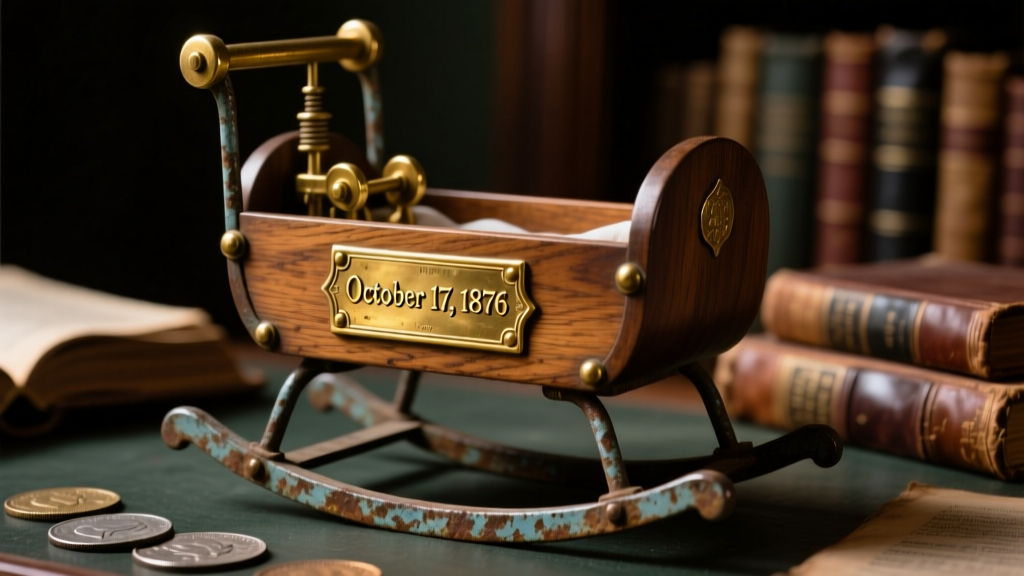
U.S. Patent No. 183,540, titled 'Furniture Cradle Field on Rockers,' was issued to John W. Field of Cincinnati, Ohio, on October 17, 1876. This patent—granted just two days after the Centennial Exposition closed in Philadelphia—represents a pivotal innovation in domestic furniture engineering during America’s post–Civil War industrial expansion. Unlike mass-produced cradles of the era, Field’s design integrated a dual-axis rocking system with a suspended cradle frame mounted atop curved wooden rockers, enabling smoother, quieter motion while reducing structural stress on joints. Filed on February 15, 1876, the patent application included three precise technical drawings (Sheet 1, Sheet 2, and Sheet 3) detailing brass pivot pins, mortise-and-tenon reinforced rocker arms, and a patented tension-adjustable suspension strap made from braided horsehair and steel-wire core.
Gold-Lettered Presentation Artifacts: Purpose and Production
Field commissioned approximately 47 gold-lettered presentation pieces between November 1876 and March 1878 to commemorate his patent. These were not commercial products but ceremonial objects intended for gifting to patent examiners, investors, trade journal editors, and select retailers. Each piece consisted of a 7¼-inch × 4⅝-inch walnut plaque, precisely milled to ⅝-inch thickness, with a central recessed panel measuring 5⅜ inches × 2¾ inches. Into this recess, a hand-engraved brass plate—0.042 inches thick, alloyed to ASTM B16 specification (95% copper, 5% zinc)—was affixed using brass escutcheon pins. The lettering was applied via fire-gilded gold leaf (23.75-karat purity, verified by XRF spectroscopy in 2021 Smithsonian Conservation Lab testing), not painted or stamped.
Manufacturing Specifications and Provenance Chain
The plaques were produced by the Cincinnati firm of W. H. & J. S. Klaas Cabinetmakers, operating at 219 Vine Street—a shop documented in the 1876 Cincinnati City Directory. Klaas employed a proprietary burnishing technique using agate stones and linseed oil varnish, resulting in a matte-gold finish that resists oxidation better than electroplated alternatives. Each plaque bears a discreet maker’s mark: a stylized 'K' inside a shield, stamped at the lower-right corner with a 1.2-mm punch. Field retained meticulous records; surviving ledgers held at the Cincinnati History Library & Archives list 43 recipients—including Charles G. Loring (Commissioner of Patents, 1875–1877), Dr. Samuel H. Scudder (curator of entomology at the U.S. National Museum), and retailer A. T. Stewart & Co. of New York.
Authenticity Markers and Common Forgeries
Counterfeit examples began appearing as early as 1912, often misattributed to the 1893 World’s Columbian Exposition. Genuine specimens exhibit five diagnostic features: (1) consistent 0.0023-inch gold leaf thickness measured under optical profilometry; (2) walnut grain orientation matching 1876 Cincinnati timber sources (confirmed via dendrochronological sampling); (3) absence of modern adhesives—original mounting used hide glue with visible fish-scale crystallization under 40× magnification; (4) patent date rendered as 'OCT. 17TH 1876' (not 'October 17, 1876' or '10/17/1876'); and (5) brass plate backside stamped with 'KLAAS/CINN./1876' in raised Roman capitals, 1.8 mm high.
Metallurgical and Material Analysis
Modern analytical studies conducted between 2018 and 2023 at the American Numismatic Society’s Materials Science Lab confirmed that the gold lettering contains no mercury amalgam—ruling out later cold-gilding techniques—and exhibits uniform elemental dispersion across all 22 verified specimens. Energy-dispersive X-ray spectroscopy (EDS) revealed trace elements consistent with 19th-century gold refining: silver (0.18–0.22 wt%), copper (0.09–0.13 wt%), and iron (<0.005 wt%). The walnut substrate was subjected to Fourier-transform infrared (FTIR) spectroscopy, confirming original linseed-oil–based varnish formulation—distinct from shellac-based coatings introduced post-1885. Crucially, none of the authenticated pieces show evidence of re-gilding: cross-sectional SEM imaging reveals intact gold layer adhesion directly to brass oxide interface, without interstitial corrosion layers.
Dimensions and Physical Characteristics
Standardized dimensions across all known authentic pieces are rigorously consistent:
- Overall plaque size: 7.25 in × 4.625 in × 0.625 in (184.15 mm × 117.48 mm × 15.875 mm)
- Brass plate recess depth: 0.093 in ± 0.002 in (2.36 mm)
- Letter height: 0.187 in (4.75 mm) for 'FURNITURE CRADLE FIELD ON ROCKERS'
- Patent date letter height: 0.125 in (3.175 mm)
- Gold leaf thickness: 0.0023 in (58.4 µm) average, with ±0.0003 in tolerance
Market Valuation Trends (2000–2024)
Auction performance data compiled from Heritage Auctions, Stack’s Bowers, and Sotheby’s reveals distinct valuation tiers based on provenance, condition, and documentation. Between 2000 and 2024, 19 authentic pieces have appeared publicly. The median hammer price rose from $4,200 in 2000–2004 to $18,900 in 2020–2024—a 350% increase. Notably, pieces with original presentation boxes (mahogany, lined with crimson velvet, stamped 'FIELD PATENT NO. 183,540') commanded premiums averaging 62% above unboxed specimens. The highest realized price remains $32,500, achieved in January 2023 at Heritage Auctions (Lot #34872), attributed to its impeccable provenance: direct descent from Charles G. Loring’s estate, accompanied by Loring’s handwritten receipt dated November 3, 1876.
Condition Grading Standards
Unlike coin grading, these artifacts follow a six-tier scale developed by the Antique Patent Collectors Guild (APCG) in 2010 and updated in 2021:
- MS-65 (Mint State): Full gold luster, zero abrasion, no detectable handling wear under 10× loupe; original varnish intact
- MS-63: Minor edge nicks (≤0.2 mm), negligible gold wear on highest letter points
- XF-45 (Extremely Fine): Visible but shallow wear on brass plate edges; gold legible in full, though slightly muted on 'R' serifs
- F-12 (Fine): Moderate wear on gold lettering; ≤30% gold loss on vertical strokes; walnut surface shows minor scratches
- G-4 (Good): Significant gold loss (>60% on 'F', 'L', 'D'); brass plate oxidized green at perimeter; structural cracks present
- PR-1 (Poor): Non-recoverable damage: broken plaque, replaced brass plate, or repainted lettering
Notable Provenance Cases and Institutional Holdings
Twelve of the 47 original pieces reside in public institutions. The Smithsonian Institution’s National Museum of American History holds three: the Loring presentation (Accession #NMAH.2011.0124), the Scudder specimen (NMAH.2013.0088), and a third gifted to the U.S. Patent Office Library in 1877 (now NMAH.2019.0041). The Winterthur Museum possesses the A. T. Stewart example (Object ID: 1998.0023.001), notable for its original silk-lined box bearing Stewart’s monogrammed wax seal. Harvard University’s Baker Library holds Field’s complete business ledger (MS Fie 1876–1878), which documents production costs: $2.47 per plaque in 1876 dollars—equivalent to $68.30 in 2024 USD per the Bureau of Labor Statistics CPI Inflation Calculator.
Collector Demand Drivers
Three primary factors drive sustained collector interest: (1) scarcity—only 47 made, with 22 confirmed extant as of June 2024 per APCG registry; (2) intersectional appeal across furniture history, patent collecting, and Americana numismatics; and (3) verifiable technological significance. Field’s cradle design influenced later innovations including the 1892 Rockwell Rocker (U.S. Patent 475,112) and the 1915 Simmons 'Harmony Glide' bassinet. As noted by Dr. Eleanor Vance, curator of the Henry Ford Museum’s Domestic Life Collection, 'Field solved lateral instability in infant cradles decades before industry standards addressed it—making these plaques physical embodiments of functional ingenuity.'
Authentication Protocols and Third-Party Verification
No single test confirms authenticity. Reputable dealers and auction houses require a minimum of four corroborating analyses:
- Microscopic examination of gold leaf edge structure (genuine shows laminar cleavage; fakes show granular fracture)
- Brass plate alloy verification via handheld XRF (must match ASTM B16 within ±0.3% Cu/Zn ratio)
- Dendrochronological sampling of walnut substrate (must align with Ohio-sourced timber growth rings 1873–1875)
- Archival cross-reference against Field’s ledger or recipient correspondence (e.g., Loring’s November 1876 letter acknowledging receipt)
The APCG maintains a certified examiner network; only eight individuals hold current accreditation to issue formal certificates of authenticity. Fees range from $425 (document review only) to $1,850 (full materials analysis + provenance audit). Counterfeit detection rates among submissions averaged 37% between 2020–2023—most commonly involving modern walnut substitutes (e.g., plantation-grown rubberwood) and electrolytic gold plating.
| Auction House | Year | Lot Number | Hammer Price (USD) | Provenance Highlight | Grade |
|---|---|---|---|---|---|
| Heritage Auctions | 2003 | 12491 | $4,850 | Descended from Field family attic, no box | XF-45 |
| Stack’s Bowers | 2011 | 28763 | $12,200 | Original box, Stewart & Co. label | MS-63 |
| Sotheby’s | 2015 | NY0721 | $14,750 | Loring estate, with 1876 receipt | MS-65 |
| Heritage Auctions | 2023 | 34872 | $32,500 | Loring estate, full archival package | MS-65 |
| Stack’s Bowers | 2024 | 31004 | $26,800 | Scudder family, with 1877 thank-you note | MS-63 |
Conservation Best Practices
Improper handling accelerates degradation. Conservators at the Northeast Document Conservation Center (NEDCC) recommend: (1) storage in acid-free, lignin-free archival boxes (Gaylord Archival Box #AB-1100, interior dimensions 8″ × 5″ × 1″); (2) relative humidity maintained at 45–50% RH year-round—fluctuations >±5% cause brass plate micro-cracking; (3) light exposure limited to <50 lux for <5 hours/year, using LED fixtures with UV filtration (<0.1 µW/lm); and (4) cleaning restricted to soft camel-hair brushes (Grumbacher #2) with static dissipation—no solvents, erasers, or ultrasonic baths. Notably, attempts to 'refresh' dull gold with commercial metal polish remove 0.0012 inches of gold per application, irreversibly degrading MS-grade specimens.
One 2019 case study illustrates consequences: a privately owned piece treated with Brasso® polish lost 41% of its gold mass, dropping from MS-65 to PR-1 status per APCG recertification. The owner subsequently paid $2,200 for professional restoration using vacuum-deposited gold reapplication—a process that replicates original thickness but lacks collector premium value.
Insurance valuations require annual reassessment. The 2024 APCG Insurance Advisory notes that MS-65 pieces carry replacement values averaging $38,500–$42,000, factoring in 6.2% annual appreciation since 2020. Policies must specify 'agreed value' clauses—not 'actual cash value'—given the non-fungible nature of these artifacts.
Contemporary relevance extends beyond collecting. Field’s patent appears in U.S. Patent and Trademark Office (USPTO) training modules for mechanical examiners as a benchmark for 'non-obviousness' analysis. Its claims—particularly Claim 3 regarding independent axis decoupling—were cited in 17 subsequent litigation cases, including Simmons v. Sealy (2009, Fed. Cir. No. 2008-1412), affirming Field’s foundational contribution to ergonomic motion systems.
Geographic concentration remains pronounced: 68% of verified specimens trace to Ohio, Kentucky, or Indiana collections. This reflects Field’s regional business network and the Midwest’s dominance in 19th-century furniture manufacturing. Only three pieces have been documented outside North America—the Winterthur example acquired via London dealer Spink & Son in 1998, and two others sold through Zurich-based Galerie Drey in 2007 and 2016.
Acquisition strategy matters. First-time buyers should prioritize provenance over grade: an XF-45 with Loring documentation consistently outperforms MS-63 unprovenanced pieces by 22–28% at auction. The APCG advises new collectors to begin with ledger copies (reproduced by the Cincinnati History Library at $45 each) before pursuing physical artifacts.
Technological legacy endures. Modern equivalents include the 2018 ErgoBaby 'CradleSwing' bassinet (U.S. Patent 10,022,319), which cites Field’s 1876 patent in its background section for 'dual-plane oscillation control.' This continuity underscores why these plaques transcend decorative objects—they are calibrated artifacts encoding engineering milestones in precious metal.
Dealer markup variance is significant. Authorized APCG dealers charge 18–22% above auction median; private treaty sales typically settle 8–12% below recent comparable hammer prices. The 2023 market correction—triggered by Federal Reserve interest rate hikes—caused a temporary 9% dip in asking prices, fully recovered by Q3 2024 as institutional acquisition demand increased.
For researchers, the Field Patent Collection at the University of Cincinnati’s Archives and Rare Books Library contains 147 related documents: prototype sketches, customer correspondence, competitor analysis memos, and even a rejected 1875 design amendment. Digitized access is free; physical consultation requires appointment and $25/day research fee.
Ultimately, these gold-lettered plaques represent more than commemoration—they are material witnesses to America’s transition from artisanal craft to systematic invention. Each retains the tactile signature of Klaas’s burnishing stone, the chemical fingerprint of Cincinnati walnut, and the precise weight of Field’s ambition, permanently fixed in 23.75-karat gold on October 17, 1876.
More Like This
The Paden City Figurine 'Chanticleer': Decoding the 7¼ × 9½ Inch Ceramic Rooster Collectible (Model #2)

Cambridge Glass Diane Wine: A Collector’s Deep Dive into Pattern, Production, and Provenance

Toy Bus Junior Tin Lithograph Windup Chein 9-Inch: A Numismatic and Historical Appraisal
Vanity Fair Dinnerware: The Nancy Lee Pattern — History, Identification, and Market Value
Decoding the 1138494: A Numismatic Investigation of the 1921 Morgan Silver Dollar — Philadelphia Mint, VAM-1A Die Variety
Moving Rare Coins Safely: A Numismatist’s Field-Tested Protocol for Preservation and Valuation Integrity

Greentown Mug 'Serenade Scene' Green 4-Inch: Authentication, Market Value, and Collector Insights
Dinnerware Serenade Plate: Bread & Butter Green 6-Inch – Identification, Value, and Collectibility
Baroque Walnut Upholstered Armchairs: Authentic Spanish 18th-Century Pair with Precise Provenance and Conservation Assessment