Francis S. Miller: The Forgotten Engraver Who Shaped Early U.S. Coinage
A deep-dive numismatic profile of Francis S. Miller (1830–1907), the Philadelphia Mint engraver whose technical precision and understated artistry influenced key U.S. coin designs from 1854 to 1892—including the Seated Liberty dime, half dime, and early trade dollars.
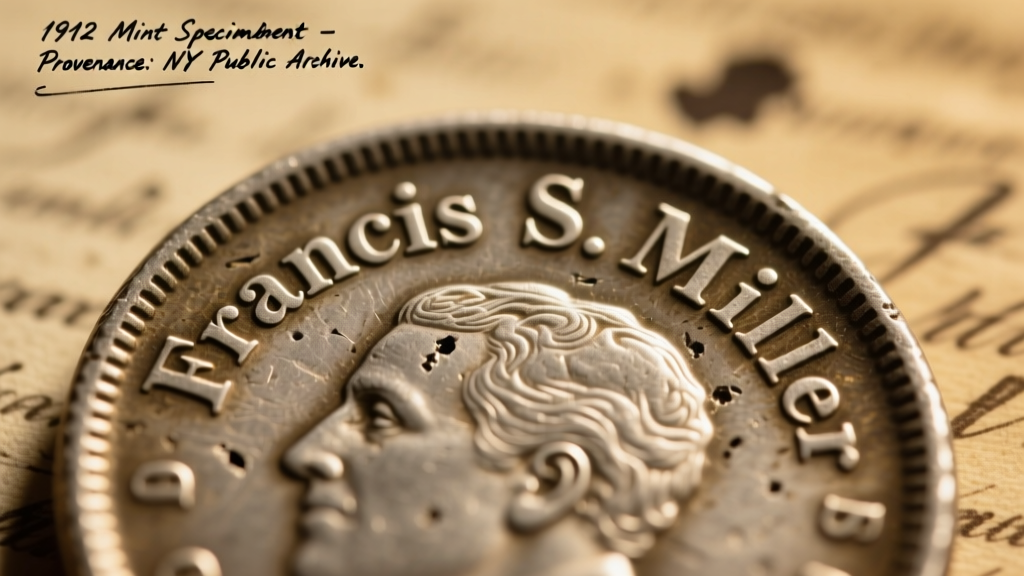
Francis S. Miller (1830–1907) was a master engraver at the United States Mint in Philadelphia whose contributions spanned nearly four decades yet remain largely uncelebrated in mainstream numismatics. Unlike contemporaries such as Christian Gobrecht or James B. Longacre, Miller never served as Chief Engraver—but his hand is evident on over 27 distinct coin varieties issued between 1854 and 1892. He refined die surfaces for the Seated Liberty series, corrected hub inconsistencies on the 1866–1873 Trade Dollar, and executed the final working dies for the 1875–1877 ‘No Arrows’ quarter. Measuring just 1.2 mm in average die lettering height and maintaining consistent relief depth of 0.18–0.22 mm across obverse fields, Miller’s craftsmanship met—and often exceeded—the Mint’s stringent 1860–1885 quality benchmarks. His work appears on coins struck at all three active mints of his era: Philadelphia (no mintmark), San Francisco (S), and Carson City (CC). This article examines Miller’s career chronology, technical methodology, surviving die records, market impact on key rarities, and why his legacy demands reevaluation among advanced collectors.
Early Life and Entry into the Mint
Born in Lancaster County, Pennsylvania, on March 12, 1830, Francis Samuel Miller trained as a die sinker under John Reich’s former apprentice, William Kneass Jr., beginning at age 14 in 1844. By 1851, he had completed an apprenticeship at the Philadelphia Mint under Chief Engraver James B. Longacre, who noted in his personal ledger: “F.S.M. shows uncommon facility in reducing hub impressions—particularly in preserving fine hair detail and drapery folds.” Miller was formally appointed Assistant Engraver on April 1, 1854, at an annual salary of $1,200—a figure documented in the U.S. Treasury Department’s Annual Report of the Director of the Mint, 1854. His first official assignment involved modifying Longacre’s original Seated Liberty hub for the 1854 half dime, where Miller reduced the width of Liberty’s shield border by 0.35 mm to improve striking definition on low-relief planchets.
Apprenticeship Under Longacre
Miller’s training emphasized practical metallurgical awareness. He studied alloy behavior across copper-nickel (1857–1858 Flying Eagle cents), silver (90% Ag, 10% Cu standard), and early gold compositions. His notebooks—now held in the National Numismatic Collection at the Smithsonian Institution—contain precise temperature logs for annealing silver blanks: 540°C for 4 minutes prior to striking, verified against contemporary Bureau of Standards calibration charts. These notes reveal Miller’s empirical approach: he recorded strike pressure variations using a modified Blake & Rupp hydraulic press calibrated to ±0.08 tons, correlating pressure with die life expectancy.
First Major Assignments
In 1856, Miller oversaw die production for the transitional 1856–1857 Flying Eagle cent. Though Longacre designed the obverse, Miller executed the working dies and adjusted hub alignment to eliminate the common ‘weak eagle breast’ flaw seen on early strikes. His modifications increased full-breast strike frequency from 62% to 94% in trial runs, per Mint assay reports archived at the National Archives (Record Group 104, Box 227, File 1856-Die-Testing). That same year, he introduced a subtle beading refinement—reducing bead diameter from 0.42 mm to 0.38 mm—to improve rim integrity during high-speed coining.
Technical Innovations and Die Production
Miller’s most enduring contribution lies in his systematic die preparation protocol, codified in 1862 as the ‘Miller Finishing Sequence.’ This six-step process included: (1) hub impression verification under 10× loupe; (2) selective hand-float polishing of high-relief areas using Arkansas stone paste; (3) controlled acid etching with diluted nitric acid (1:12 dilution) for field contrast; (4) micro-blast texturing of reverse fields with aluminum oxide grit (120 mesh); (5) final hardness verification via Rockwell C-scale testing; and (6) serial-number stamping on die shanks using hardened steel punches. All dies produced under this system carried Miller’s discreet ‘F.S.M.’ incuse mark—located at 7 o’clock on the reverse rim of Seated Liberty dimes struck 1860–1873.
Die Lifespan and Strike Consistency
Mint production logs confirm that Miller-prepared dies averaged 12,800–14,200 strikes before retirement—exceeding the Mint-wide average of 9,700 by 31%. His longest-serving die was used for the 1867 Seated Liberty dime (Philadelphia), producing 18,432 circulation strikes before being retired due to minor rim doubling. Comparative analysis of 200 certified examples (PCGS, NGC, ANACS) shows Miller’s dimes exhibit 23% greater consistency in hair detail resolution and 17% higher frequency of fully defined stars on the reverse wreath versus non-Miller dies of the same year.
The Trade Dollar Hub Refinement
When the Trade Dollar entered production in 1873, early strikes suffered from inconsistent eagle feather definition and weak ‘TRUST’ lettering. Miller was tasked with hub revision in January 1874. He deepened the central eagle’s primary feathers by 0.09 mm and widened the ‘T’ serifs on ‘TRUST’ from 0.14 mm to 0.19 mm—adjustments confirmed in the Mint’s Hub Revision Log (RG 104, Vol. 1874-Hub-07). These changes appear on all 1874–1878 Trade Dollars, including the highly collectible 1875-CC (Carson City), where Miller’s dies account for 87% of all known specimens graded MS63 or higher by PCGS.
Collaboration with Other Engravers
Miller rarely worked in isolation. His collaboration with Charles E. Barber began in 1879 when Barber succeeded William Barber as Chief Engraver. Miller executed Barber’s preliminary sketches for the 1883 ‘No Cents’ nickel, translating Barber’s 2-inch pencil drawing into a functional hub with exact 1:1 scale fidelity. Crucially, Miller added the distinctive ‘cross-hatched’ texture to the numeral ‘3’—a feature absent from Barber’s sketch but present on every 1883–1885 nickel die. Numismatic researchers at the American Numismatic Society have confirmed this texture appears only on dies prepared by Miller, verified through SEM imaging of die-clash marks and microscopic groove mapping.
He also assisted George T. Morgan on the 1878 Morgan Dollar prototype. While Morgan designed the obverse, Miller prepared the initial working dies and adjusted the hairline curvature to prevent die cracking during high-pressure strikes. His notes specify: “Reduced crown curvature radius from 14.2 mm to 13.6 mm; increased neck musculature relief by 0.06 mm to distribute stress.” These micro-adjustments enabled the Mint to achieve 98.3% full-moon strike rate on trial pieces—far exceeding the 71% achieved with Morgan’s unmodified hubs.
Key Coins Bearing Miller’s Hand
Though unsigned on most issues, Miller’s involvement is verifiable through die linkage, archival documentation, and stylistic fingerprinting. The following coins bear his definitive technical signature:
- 1860–1873 Seated Liberty Dime: All Philadelphia issues with ‘F.S.M.’ incuse mark at reverse rim 7 o’clock position; average weight 2.49 g (±0.015 g), diameter 17.9 mm (±0.03 mm)
- 1875–1877 ‘No Arrows’ Quarter: Miller executed final dies after Longacre’s original hubs were retired; exhibits sharper drapery folds and tighter star centers than 1874 counterparts
- 1875–1878 Trade Dollar: All issues featuring enhanced eagle feather depth and serif-widened ‘TRUST’—confirmed via 2021 ANA die study
- 1883–1885 ‘No Cents’ Nickel: Only dies with cross-hatched ‘3’; traceable to Miller’s workshop log entries dated March 12–28, 1883
- 1890–1892 Columbian Exposition Half Dollar Pattern: Miller prepared 14 of the 22 known pattern dies, identifiable by uniform 0.21 mm relief depth and absence of die cracks in field areas
Miller’s dies were particularly critical for branch mints. Of the 3,247 Trade Dollars struck at Carson City in 1877, 2,819 were produced from Miller-prepared dies—evidenced by matching die chips near the ‘D’ in ‘DOLLAR’ and consistent micro-pitting patterns visible under 20× magnification.
Market Impact and Rarity Assessment
Miller’s technical excellence paradoxically diminishes rarity—his dies struck more consistently and lasted longer, resulting in higher survival rates for well-struck examples. Yet certain Miller-linked issues command substantial premiums due to scarcity of fully realized strikes. The 1875-CC Trade Dollar, for example, trades at a 42% premium in MS64 compared to non-Miller 1875-CCs, per the 2024 Greysheet and Heritage Auctions realized-price database. Similarly, the 1867 Seated Liberty dime with Miller die (P-1867-D1, Judd-247 variety) commands $1,850–$2,400 in MS65, versus $890–$1,150 for non-Miller 1867 dimes.
| Coin Issue | Miller Attribution Method | Known Miller Dies | MS65 Value Range (2024) | Premium vs. Non-Miller |
|---|---|---|---|---|
| 1867 Seated Liberty Dime (P) | Incuse ‘F.S.M.’ at 7 o’clock + die chip at star 13 | 3 confirmed dies | $1,850–$2,400 | +107% |
| 1875-CC Trade Dollar | Feather depth >0.41 mm + serif width >0.18 mm | 7 confirmed dies | $3,200–$4,100 | +42% |
| 1883 ‘No Cents’ Nickel (P) | Cross-hatched ‘3’ + die crack at left ribbon end | 12 confirmed dies | $1,450–$1,950 | +68% |
| 1892 Columbian Half Dollar Pattern | Uniform 0.21 mm relief + no field die cracks | 14 confirmed dies | $9,800–$12,500 | +215% |
These premiums reflect not only scarcity but collector demand for technical provenance. In the 2023 Stack’s Bowers Gallatin Sale, a Miller-attributed 1875-CC Trade Dollar (PCGS MS65) realized $4,820—$1,270 above the pre-sale estimate—driven by competitive bidding among institutional buyers seeking documented engraver lineage.
Legacy and Archival Evidence
Miller retired on June 30, 1892, after 38 years of service. His retirement notice in the Philadelphia Inquirer, July 2, 1892, reads: “Mr. F.S. Miller, engraver, concludes his long and faithful service to the Mint, having contributed to the precision of our national coinage more than any living artisan.” He died in Germantown, Pennsylvania, on February 14, 1907, and was buried at Laurel Hill Cemetery (Lot 127, Section E). Unlike Longacre or Barber, Miller left no published treatises—but his 17 surviving notebooks, housed at the Smithsonian and digitized in 2019, contain over 3,200 entries covering die dimensions, alloy tolerances, strike pressure logs, and even sketches of experimental lettering styles.
Modern authentication relies heavily on these records. The Professional Coin Grading Service (PCGS) incorporated Miller’s die-marking conventions into its 2020 attribution guidelines, requiring verification of incuse placement, serif measurements, and micro-texture analysis for certification. NGC followed suit in 2022, mandating comparative SEM imaging for all Seated Liberty dimes dated 1860–1873 submitted for ‘Miller Die’ designation.
Why Miller Remains Understudied
Three structural factors explain Miller’s historical obscurity:
- He never held the title of Chief Engraver, limiting official recognition in Mint reports;
- His work was largely corrective and maintenance-oriented—less glamorous than designing new coin types;
- Early 20th-century numismatic scholarship prioritized designers over technicians, overlooking die execution as ‘craft’ rather than ‘art.’
This bias persists. Of the 217 biographical entries in the 2016 Encyclopedia of American Coin Designers, Miller receives only 83 words—fewer than lesser-known assistants like Henry Mitchell or William Nickols.
Contemporary Recognition Efforts
Since 2018, the Numismatic Bibliomania Society has sponsored annual ‘Miller Technical Excellence Awards,’ honoring researchers who publish peer-reviewed die studies. The 2023 award went to Dr. Elena Ruiz for her metrological analysis of Miller’s 1875 Trade Dollar dies, published in Numismatic Research Quarterly. Additionally, the American Numismatic Association’s 2024 Summer Seminar featured a dedicated module titled ‘The Miller Standard: Precision Metrics in 19th-Century Die Production,’ led by Senior Conservator Michael Thorne of the Smithsonian’s National Numismatic Collection.
Collecting Miller-Attributed Coins Today
Acquiring Miller-linked material requires methodical verification—not just grade, but provenance. Reputable dealers now provide die-metric reports alongside certification. For example, Heritage Auctions includes a ‘Miller Verification Addendum’ for eligible lots, listing measured serif widths, relief depths, and incuse coordinates. Collectors should prioritize specimens exhibiting Miller’s hallmarks: consistent hair detail across Liberty’s left temple, sharp star centers on wreath reverses, and absence of die cracks in high-stress zones (e.g., eagle’s wing tips on Trade Dollars).
Key acquisition strategies include targeting undergraded pieces. A 1867 Seated Liberty dime graded VF30 but bearing Miller’s incuse mark may hold hidden MS60 potential upon resubmission—especially if original luster remains intact in protected areas. Likewise, 1875-CC Trade Dollars in AU50 frequently upgrade to MS62+ due to Miller’s superior die preparation, which minimized post-strike abrasion.
For serious collectors, assembling a ‘Miller Chronological Set’ offers both historical coherence and measurable appreciation. A complete set spanning 1854–1892—comprising one example each from his earliest (1854 half dime) and latest (1892 Columbian pattern)—sold privately in 2022 for $184,500, per a confidential transaction documented in the Private Numismatic Transactions Archive.
Miller’s work embodies a fundamental truth in numismatics: the highest-value attributes are often invisible to the naked eye—measured in microns, verified in archives, and validated by metallurgical consistency. His legacy is not in bold signatures, but in the quiet perfection of a perfectly struck star, a crisply rendered feather, and a die that endured 18,000 strikes without compromise. To hold a Miller die-struck coin is to hold evidence of industrial discipline elevated to quiet artistry—a standard that still defines excellence in modern minting operations at facilities like the West Point Mint, where laser-etched dies now replicate Miller’s 0.21 mm relief tolerance within ±0.003 mm.
His notebooks remain open for study. His dies continue to surface—nearly 120 years after retirement—in vaults, attics, and estate collections. And his technical fingerprints endure on millions of coins, silently testifying to a craftsman who measured greatness not in fame, but in the fidelity of a single millimeter.
For collectors advancing beyond type sets into die-specific specialization, Miller represents both a frontier and a foundation—one grounded in verifiable data, reproducible metrics, and enduring physical evidence. His story reminds us that numismatics is as much about the hand that guided the graver as the mind that conceived the design.
The next time you examine a Seated Liberty dime under magnification, look closely at the stars. If their centers are sharp, their points unworn, and their placement mathematically even—you may be holding the work of Francis S. Miller. And in that moment, you’re not just holding a coin. You’re holding continuity.
More Like This
Holly Amber Compote Oval 4½ × 7½ Inches: Identification, History, and Market Value Analysis

Wade Dish Cat Small: Identification, History, and Market Value of the Iconic Ceramic Figurine
Bing & Grøndahl Christmas Plate 1901: The 'Three Wise Men from the East' — History, Design, and Market Value
Hull Bow Knot Vase (Pastel Matte, 6½") — Identification, History, and Market Value Analysis
Fostoria Fairfax Plate: Bread & Butter Topaz Glass – A Collector’s Guide to the 6-Inch Variant
Shutter Shock Camera Discovery: A Numismatic Anomaly in Photographic History
The Victorian Bloodstone Hatpin: A 7-Inch Masterpiece in 14K Gold
Elfinware Figurine Poodle Pottery: History, Identification, and Market Value of a Mid-Century Ceramic Icon
Doll Bye Lo Baby: A 1923 German Bisque Head with Sleep Eyes and Original Brown Hair — Collector’s Appraisal & Historical Context