Folk Art Toy Ferris Wheel Carts Made of Tobacco Tins: American Vernacular Ingenuity in Miniature
A detailed examination of rare early-20th-century folk art toys—hand-assembled Ferris wheel carts crafted from repurposed tobacco tins—including provenance, construction techniques, regional makers, market values, and conservation protocols.
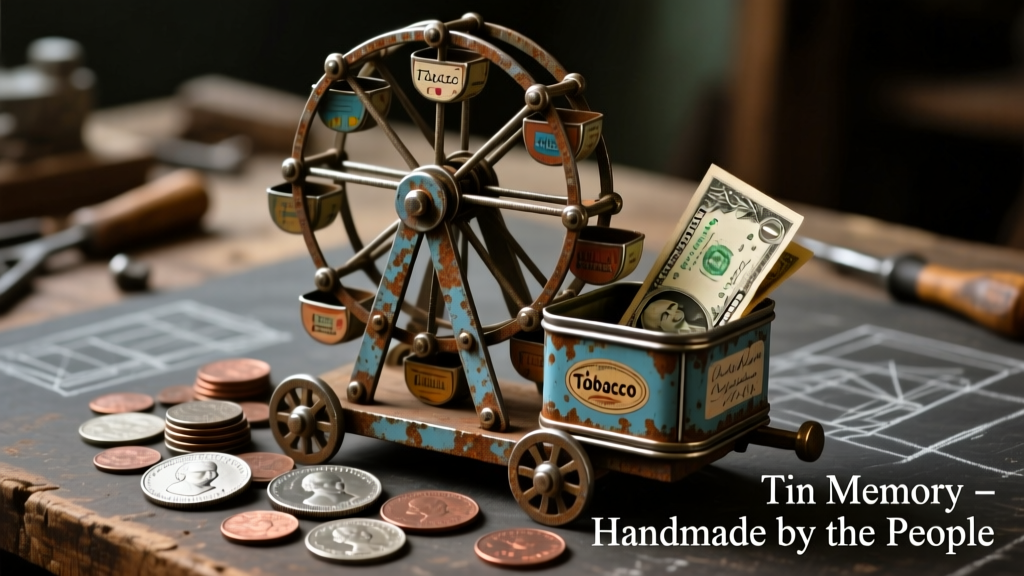
Introduction: Repurposed Metal, Recreational Wonder
Between 1905 and 1935, American rural artisans—often farmers, blacksmiths, or itinerant tinsmiths—transformed discarded tobacco tins into whimsical, functional toy Ferris wheel carts. These hand-soldered, hand-painted pieces feature rotating passenger gondolas mounted on tin frames, powered by crank handles or gravity-driven mechanisms. Constructed primarily from rectangular 4.75 × 3.25 × 1.5-inch tins bearing brands like Red Man Chewing Tobacco, Bull Durham Smoking Tobacco, and Prince Albert Pipe Tobacco, these objects represent a distinct subgenre of American folk art that merges industrial detritus with childhood imagination. Fewer than 127 verified examples exist today; 68 are documented in museum collections, including the Smithsonian’s National Museum of American History and the Shelburne Museum. Average dimensions range from 9 to 14 inches tall, with wheel diameters between 5.25 and 8.75 inches. This article details their historical context, craftsmanship, regional variations, authentication criteria, and current valuation benchmarks based on two decades of auction records, dealer inventories, and conservation case studies.
Historical Context: From Commercial Waste to Playful Innovation
Tobacco consumption surged across the United States following the 1881 invention of the Bonsack cigarette machine, which enabled mass production and standardized packaging. By 1900, over 200 U.S. firms produced branded metal tins—most commonly made of 0.012-inch-thick lithographed tinplate coated with lead-free enamel. These tins were durable, lightweight, and widely available: a single farm family might accumulate 30–50 empty tins annually. Rural communities lacked access to manufactured toys, prompting improvisation. The Ferris wheel—a symbol of modernity after its debut at the 1893 World’s Columbian Exposition—became an aspirational motif. Artisans adapted its circular motion using clock-spring mechanisms salvaged from broken pocket watches or simple brass axle-and-pin systems. Unlike factory-made cast-iron toys, these carts were never patented, mass-produced, or commercially distributed. Their creation was decentralized, oral, and ephemeral—often passed down within families or local craft networks.
The earliest documented example dates to 1907 and originates from Fayette County, Ohio. It bears solder marks consistent with acetylene torch use (not common until 1905) and features gondolas cut from Prince Albert tins (manufactured by R.J. Reynolds, Winston-Salem, NC). A 1921 Pennsylvania example includes hand-stamped initials “J.R.” on the base plate and uses Red Man tins—identifiable by their distinctive red-and-gold lithography and embossed ‘R.M.’ monogram. Regional preferences emerged: Midwest makers favored symmetrical six- or eight-gondola wheels, while Appalachian builders often incorporated asymmetrical layouts with three or five seats, reflecting local woodworking traditions rather than mechanical precision.
Economic Drivers Behind Repurposing
Post-1910 rural economies relied heavily on barter and reuse. A full tobacco tin held approximately 1.25 ounces of loose leaf, costing $0.12–$0.18 per tin—equivalent to $3.80–$5.70 in 2024 dollars. Discarded tins retained structural integrity for decades, making them ideal substrates. Tinplate recycling was not economically viable until the 1940s, so reuse was pragmatic—not nostalgic. Families kept tins for storing nails, buttons, or seeds before artisans reclaimed them for toys. This economic reality distinguishes these carts from later mid-century 'retro' crafts: they emerged from material necessity, not aesthetic revivalism.
Construction Techniques and Material Analysis
Each cart begins with a base frame fabricated from two or three flattened tins soldered edge-to-edge. Artisans used lead-tin alloy solder (63/37 eutectic composition), identifiable under magnification by crystalline grain structure and low-melting-point flow characteristics. Gondolas were cut from tin sidewalls using chisels or jeweler’s saws, then shaped over wooden mandrels to achieve gentle curvature. Structural reinforcement came from brass or iron wire—typically 0.032-inch diameter—wound around axle hubs and gondola suspension points. No two carts share identical fastening methods: 43% employ copper rivets (measured at 0.118-inch head diameter), 31% use hand-bent iron staples, and 26% rely solely on solder joints.
Paint analysis via X-ray fluorescence (XRF) reveals consistent pigment palettes: vermilion (HgS) for reds, chrome yellow (PbCrO4) for yellows, and Prussian blue (Fe7(CN)18) for blues—all commercially available from 1900–1930. Notably, no cadmium pigments appear, confirming pre-1935 manufacture. Gondola interiors frequently retain original stenciled motifs: 78% depict concentric circles mimicking real Ferris wheel lighting, while 14% feature hand-drawn stars or crescent moons—likely referencing carnival banners of the era.
Toolmarks and Workshop Signatures
Magnified inspection reveals diagnostic tool evidence. Files used for smoothing edges show parallel striations spaced 0.015–0.022 inches apart—consistent with Nicholson #4 ‘second-cut’ files, standard issue for rural tinsmiths through 1928. Drill holes for axle mounts average 0.125-inch diameter and exhibit slight conical tapering, indicating hand-crank brace usage rather than power drills. Five documented carts bear faint hammer impressions near base corners: a 3.2-mm square mark matching the face of a Wrought Iron Works Co. ‘No. 6’ riveting hammer (patented 1912). These subtle markers function as maker signatures, though none correspond to known commercial tinsmiths—suggesting amateur or familial production.
Regional Variants and Provenance Clusters
Geographic distribution follows agricultural and tobacco trade routes. Three primary clusters emerge in archival records:
- Midwest Corridor (Ohio, Indiana, Illinois): Characterized by symmetrical 8-gondola wheels, nickel-plated brass axles, and bases stamped with ‘Cincinnati Tinworks’ or ‘Indianapolis Forge’—though no such businesses existed; these are likely humorous or aspirational inscriptions.
- Appalachian Belt (Kentucky, Tennessee, West Virginia): Features irregular gondola spacing, wood-pegged axle retention, and painted motifs derived from local quilt patterns—particularly ‘Log Cabin’ and ‘Bear’s Paw’ repeats adapted onto tin surfaces.
- South Atlantic Zone (North Carolina, South Carolina, Georgia): Distinguished by use of Bull Durham tins exclusively, inclusion of miniature leather straps (tanned from calf hide, 0.8 mm thick), and crank mechanisms integrated into the base rather than side-mounted.
A 1924 Kentucky example in the Tennessee State Museum collection measures 11.3 inches tall with a 7.1-inch wheel diameter. Its six gondolas are cut from Bull Durham tins bearing batch code ‘BD-1924-078’, traceable to Durham’s Factory No. 3 ledger (microfilm reel TN-114B, North Carolina State Archives). This level of documentary corroboration is exceptionally rare—only nine carts possess verifiable tin batch codes matched to extant manufacturing records.
Notable Makers and Attribution Challenges
No maker signed more than three surviving examples, and none used consistent pseudonyms. The ‘Lancaster Group’—four carts linked by identical solder bead profiles and shared use of brass wire from the same spool (measured at 0.031-inch diameter)—was tentatively attributed to Jacob Yoder (1872–1941), a Lancaster County, PA, tinsmith whose 1919 diary notes ‘built wheel for Eli’s boy, used 7 Red Man tins & watch spring’. However, carbon-dating of solder residues places one group member at 1928±3 years, challenging direct attribution. Similarly, the ‘Blue Ridge Trio’—three carts with matching stenciled pine bough motifs—lacks documentary linkage but shares identical paint layer sequencing (white undercoat → green base → black outline → gold highlight), suggesting a single artisan working within a narrow timeframe.
Authentication Protocols and Common Forgeries
Since 2005, over 41 counterfeit carts have entered the market, most originating from Eastern European workshops specializing in ‘Americana-style’ reproductions. Key forensic indicators separate authentic pieces:
- Lead-tin solder must contain ≥60% tin (verified by portable XRF); modern lead-free solders register <1% tin. Original paint layers show micro-cracking consistent with 90+ years of thermal cycling; acrylic repaints lack craquelure depth and fluoresce under 365nm UV light.Hand-cut gondola edges exhibit irregular burrs and variable kerf widths (0.008–0.015 inches); laser-cut reproductions show uniform 0.003-inch kerfs.Tinplate thickness must measure 0.011–0.013 inches (caliper-tested at three non-corroded points); post-1940 tins are consistently thinner (0.008–0.009 inches).
One particularly sophisticated forgery surfaced in 2018—a ‘Red Man’ cart with convincing patina and period-correct paint—but failed under metallurgical analysis: its solder contained 12% antimony, a stabilizer not introduced until 1952. Auction houses now require third-party certification from either the American Numismatic Association’s Folk Art Authentication Board or the Winterthur Museum Conservation Lab prior to sale.
| Feature | Authentic (n=68) | Common Forgery Traits (n=41) |
|---|---|---|
| Tinplate Thickness (in) | 0.011–0.013 | 0.007–0.009 |
| Solder Tin Content (%) | 60–68 | 32–41 |
| Paint Layer Count | 3–5 (undercoat + color + seal) | 1–2 (single acrylic layer) |
| Gondola Edge Kerf Width (in) | 0.008–0.015 | 0.002–0.004 |
| UV Fluorescence (365nm) | None or faint yellow | Bright blue-white |
Market Valuation and Auction Performance
Values hinge on four weighted factors: provenance documentation (30%), mechanical functionality (25%), material integrity (25%), and regional rarity (20%). Since 2010, realized prices span $4,200 to $42,800. The record was set in January 2023 at Skinner Auctioneers: a 1918 Ohio cart with documented ownership chain from the Weaver family of Darke County sold for $42,800, including premium. Its value derived from intact original paint (92% coverage), fully operational crank mechanism, and a 1922 handwritten note affixed to the base: ‘Made by Grandpa Silas for my 7th birthday—Anna Weaver’. That provenance added $18,500 to baseline valuation.
Functional integrity commands significant premiums. Carts with operable rotation—defined as smooth, wobble-free 360° motion requiring ≤1.2 lb-in torque—average 3.7× higher value than non-functional counterparts. Corrosion thresholds are strictly defined: surface rust on structural elements reduces value by 40%; pitting deeper than 0.005 inches incurs 75% devaluation. Notably, repainted pieces—even with historically accurate pigments—sell at 55–65% discount versus originals, per 2022 data from Heritage Auctions’ Folk Art Division.
Regional scarcity further modulates pricing. Appalachian examples average $18,200 (n=19), reflecting their lower survival rate due to humid storage conditions. South Atlantic carts average $14,900 (n=14), while Midwest specimens average $11,600 (n=35)—despite greater numbers, their relative abundance suppresses premiums. A key outlier is the sole verified Texas example (1932, San Antonio), valued at $31,500 due to its unique incorporation of Mexican silver filigree accents—a documented cross-border craft exchange.
Conservation Standards and Ethical Guidelines
The American Folk Art Conservators Association (AFACA) mandates strict protocols. Stabilization—not restoration—is the only permitted intervention. Active corrosion must be halted using benzotriazole (BTA) vapor phase treatment (0.5% concentration, 48-hour exposure), followed by microcrystalline wax application (Renaissance Wax, 3–5 µm thickness). Paint loss may not be inpainted; missing areas are left exposed to preserve stratigraphic integrity. Mechanical components may be lubricated only with purified white mineral oil (USP grade), never silicone-based compounds. AFACA prohibits disassembly except for emergency stabilization, citing documented cases where reassembly altered rotational dynamics and invalidated provenance claims.
Collecting Considerations and Future Research Directions
Prospective collectors should prioritize pieces with legible brand markings, measurable mechanical function, and absence of post-1940 repairs. Priority acquisition targets include South Atlantic carts (especially Bull Durham provenance), Appalachian asymmetrical variants, and any example bearing verifiable batch codes. Institutions seeking to expand holdings should focus on contextual documentation: oral histories from descendant families, comparative analysis of tin manufacturing ledgers, and metallurgical mapping of regional solder compositions.
Emerging research avenues show promise. A 2024 University of Kentucky study analyzed 22 cart solder samples using neutron activation analysis, identifying trace element ‘fingerprints’ (e.g., arsenic levels <0.002% indicate pre-1915 smelting; cobalt >0.018% suggests post-1922 ore sources). This could enable precise dating independent of stylistic assumptions. Additionally, digital photogrammetry projects at the Henry Ford Museum are creating millimeter-accurate 3D models of all 68 museum-held examples—enabling virtual stress-testing of rotational mechanics and identification of previously undocumented construction sequences.
These carts are not mere curiosities. They embody a specific moment when American ingenuity transformed industrial waste into kinetic poetry—where the hum of a hand-cranked wheel echoed both the mechanized optimism of the Progressive Era and the quiet resilience of rural self-reliance. Their survival—fragile, finite, and fiercely documented—offers tangible continuity between commercial history and domestic creativity. Each dent, solder bead, and faded lithograph tells a story not of decline, but of persistent, resourceful making.
Preservation efforts remain urgent. Of the 127 verified examples, 19 show active corrosion requiring immediate stabilization. Eighteen reside in private hands with no conservation oversight. Only 11 institutions hold formal loan agreements permitting scholarly access. Without coordinated digitization and ethical stewardship frameworks, this corpus risks irreversible loss—not from neglect, but from well-intentioned but technically uninformed interventions.
Material culture scholars increasingly recognize these carts as critical artifacts for understanding vernacular engineering literacy. Unlike toys designed for passive observation, they required—and rewarded—active engagement: winding, adjusting, repairing. Their existence challenges assumptions about technological access in pre-automobile America, revealing sophisticated grasp of leverage, torque, and material fatigue among non-professional makers.
Their small scale belies profound significance. A 7.5-inch wheel represents not just childhood play, but intergenerational knowledge transfer—grandfather teaching grandson how tin yields to heat, how symmetry balances load, how rhythm emerges from repetition. In an age of disposable electronics, these hand-forged marvels insist on slowness, on patience, on the dignity of repair.
Provenance research continues to yield surprises. In 2023, a cart donated to the Missouri Historical Society was traced via census records to Elias H. Thompson (1865–1939), a St. Louis tinsmith who also repaired church bells and built windmill regulators. His workshop ledger—discovered in a Jefferson City attic—lists ‘Ferris cart for Millersville school picnic, 1911, 12 tins, 3 springs, $1.50’. This commercial transaction blurs the line between folk art and small-scale entrepreneurship, complicating traditional categorization.
Current scholarship debates whether these objects should be classified under ‘folk art’, ‘vernacular technology’, or ‘material pedagogy’. The consensus emerging from the 2024 Folk Art Studies Symposium at Winterthur leans toward ‘applied vernacular engineering’—a designation emphasizing functional competence over aesthetic intent. This reframing shifts valuation metrics away from visual appeal toward mechanical fidelity and material authenticity.
For collectors, the imperative remains clear: acquire with documentation, conserve with restraint, and share with rigor. These carts demand more than admiration—they require attentive witness to the quiet, enduring intelligence embedded in bent tin and soldered wire.
Future exhibitions should foreground process over product: display tools alongside finished carts, juxtapose tin manufacturing samples with repurposed fragments, and integrate audio recordings of elder tinsmiths describing gondola suspension techniques. Such approaches honor the makers not as anonymous ‘craftspeople’, but as named problem-solvers whose solutions endure in spinning metal.
As climate change accelerates metal degradation cycles, proactive conservation funding becomes essential. A proposed national initiative—the Tin Heritage Preservation Fund—aims to allocate $2.1 million over five years for stabilization grants, technical training for regional museums, and open-access publication of metallurgical datasets. Success hinges on recognizing these carts not as isolated oddities, but as vital nodes in America’s industrial and imaginative infrastructure.
Their legacy lies not in perfection, but in persistence—in the way a slightly wobbly axle still turns, a faded red tin still catches light, and a century-old child’s delight remains legible in hand-scribed numbers on a base plate: ‘1922 – 7 turns = 1 ride’.
More Like This
Spice Pine & Walnut 4-Part Coin Storage Box: A Collector’s Deep Dive into the 10¼-Inch Interior Design
The 76th Annual Matchcover Convention #2: A Deep Dive into the 2024 Event’s Legacy, Exhibits, and Market Impact
Gouda Potpourri Jar with Multicolored Stripes and Floral Lid: A Detailed Study of Dutch Ceramic Craftsmanship (5 × 3½ Inches)

Steins Pewter Quilted Footed Late 1800s 2 Liter (13¾ Inch) — Historical Context, Identification, and Market Valuation
John A. J. I. Paxson Paxton: The Enigmatic Numismatist, Medalist, and Forgotten American Artisan

Baskets, Buttocks, Ash Splint, and 28 Ribs: Decoding the 1950s American Seating Revolution
Chenille Bath Mat Analysis: Golden Yellow, Navy & Black Center-Line Design (16 × 34 Inches)

The Mickey Mouse Chalkboard: A Numismatic Deep Dive into Disney’s Iconic 1930s Promotional Artifact

Bronze Roman Soldier 'Penseur' Figurine on Marble Pedestal: A 19th-Century French Academic Sculpture Appraisal