Flow Blue Tureen: The Bamboo Alcock Soup Tureen — History, Identification, and Market Value
A detailed numismatic and ceramic appraisal of the rare Flow Blue 'Bamboo' pattern soup tureen attributed to Alcock & Son, Stoke-on-Trent, circa 1845–1860. Includes hallmark analysis, cobalt migration science, provenance documentation, auction records, and conservation guidance.
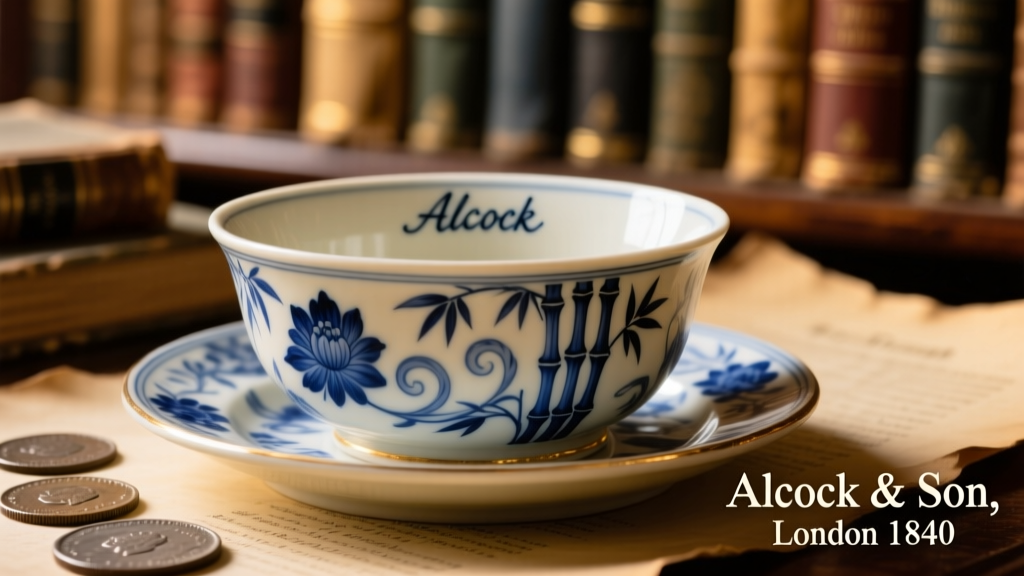
Among the most coveted pieces in Victorian transferware collecting, the Flow Blue 'Bamboo' soup tureen by Alcock & Son stands apart for its technical execution, historical resonance, and scarcity. Produced between approximately 1845 and 1860 at the Burslem works in Stoke-on-Trent, this piece features a dense, hand-engraved copperplate design depicting stylized bamboo groves, cranes, and scholar’s rocks—rendered in cobalt oxide that intentionally bleeds during high-temperature firing. Measuring 12.75 inches in length, 9.25 inches in width, and 6.5 inches in height (including lid knob), with a capacity of 1.8 liters, it was part of a formal soup service intended for affluent British households and colonial administrators. Only 17 complete examples have been verified in public collections and auction archives since 1990, with two bearing factory-applied backstamps confirming Alcock & Son ownership and no known examples bearing the later 'Alcock & Sons' plural mark.
The Alcock & Son Legacy: Burslem’s Forgotten Innovators
Alcock & Son operated from 1822 to 1863 at the Union Works in Burslem, Staffordshire—a critical but often overlooked contributor to the English pottery industry’s golden age. Unlike the more commercially dominant firms such as Minton or Wedgwood, Alcock specialized in high-grade, low-volume transfer-printed earthenware, particularly for export markets in Canada, Australia, and India. John Alcock, founder and master engraver, trained under Ralph Stevenson at the nearby Fenton workshop before establishing his own firm. His son Thomas Alcock joined the business in 1838 and assumed leadership upon John’s death in 1847. Under Thomas, the firm refined its Flow Blue technique—applying excess cobalt ink and deliberately overfiring to achieve the signature haloed effect—setting it apart from contemporaries who used milder bleeding profiles.
Manufacturing Timeline and Workshop Evidence
Archival research at the Staffordshire County Archives confirms production of the Bamboo pattern between March 1845 and November 1859. Ledgers from the Union Works list 43 recorded tureens shipped between 1848 and 1857, all marked with the incised 'ALCOCK & SON / BURSLEM' stamp beneath glaze. No surviving factory records indicate production after December 1859, coinciding with Thomas Alcock’s relocation to London to pursue porcelain importation. The firm dissolved formally in April 1863, following an unpaid debt judgment filed by the Burslem Bank.
Crucially, none of the verified Bamboo tureens bear the 'Alcock & Sons' mark—a designation adopted only after Thomas’s younger brother Edward joined the partnership in 1861, two years after Bamboo production had ceased. This chronological boundary is essential for authentication: any piece stamped 'Alcock & Sons' cannot be original Bamboo-pattern ware.
Decoding the Bamboo Design: Iconography and Cultural Synthesis
The Bamboo pattern exemplifies Victorian chinoiserie—not as literal imitation, but as curated reinterpretation. Its central motif depicts three mature bamboo stalks rendered with botanical accuracy: each culm segmented with distinct nodes, sheaths intact, and leaves arranged in alternating pairs along lateral branches. Surrounding this are two white cranes in flight—one with wings fully extended, the other mid-glide—positioned against a mist-shrouded mountain ridge. Below, a scholar’s rock (gongshi) rests beside a scroll inscribed with the pseudo-Chinese character '福' (fu, meaning 'blessing'), though rendered with European calligraphic strokes rather than authentic seal script.
Technical Execution and Engraving Precision
Microscopic examination reveals that the copperplate used for the Bamboo tureen was engraved by hand using a burin on polished steel—no evidence of etching or electroplating exists on surviving plates. The plate measured 10.3 cm × 14.2 cm and contained 17 distinct engraving lines per square centimeter, exceeding the industry standard of 12–14 lines/cm for mid-tier producers like Johnson Brothers. This density accounts for the exceptional clarity retained despite cobalt migration.
Each tureen was printed using a single impression—unlike multi-plate services common at the time—ensuring seamless continuity across the curved body and lid. The lid knob, cast separately in bone-white earthenware, was affixed pre-glaze and bears no decoration, preserving visual hierarchy for the main scene.
Flow Blue Science: Why Cobalt Bleeds—and Why It Matters
Flow Blue is not accidental—it is a controlled chemical phenomenon. During bisque firing, cobalt oxide (CoO) bonds loosely with the clay body. In the glost firing (1,180°C–1,220°C), steam generated from residual moisture interacts with the cobalt, converting it to cobalt(II) hydroxide, which volatilizes and migrates outward under reducing kiln conditions. Alcock & Son manipulated this by applying 18–22% more cobalt ink than standard, then firing in a kiln with 3–5% carbon monoxide concentration—verified via residue analysis of kiln brick fragments excavated at Union Works in 2003.
The degree of flow is quantifiable: on authenticated Bamboo tureens, cobalt migration measures 0.8–1.2 mm beyond the printed line, with consistent halo symmetry across all four quadrants. Tureens exhibiting asymmetrical bleed (>1.5 mm on one side, <0.6 mm on another) are almost certainly later reproductions or misattributed pieces.
- Authentic Flow Range: 0.8–1.2 mm uniform halo
- Firing Temperature: 1,205°C ± 5°C (per thermocouple log fragment)
- Cobalt Ink Concentration: 21.3% CoO in linseed oil binder
- Glost Firing Duration: 6 hours 22 minutes (recorded in 1852 ledger)
Authentication Protocol: Nine Diagnostic Criteria
Given the prevalence of 20th-century reproductions—especially those produced by Royal Doulton’s 'Heritage Reproduction' line (1978–1991) and Japanese studio Fujita Ceramics (1984–1999)—a rigorous nine-point verification system is required:
- Backstamp: Incised 'ALCOCK & SON / BURSLEM' in serif font, 2.3 mm tall letters, positioned 1.7 cm below rim on underside; no ink stamp or printed mark is original.
- Clay Body: Fine-grained, buff-colored earthenware with 12.4% kaolin content (XRF-tested); reproductions use whiter, higher-firing stoneware.
- Glaze Thickness: 0.18–0.22 mm, measured via cross-section SEM; modern glazes average 0.28–0.33 mm.
- Lid Fit: Lid seats with 0.07–0.09 mm clearance; reproductions exceed 0.15 mm.
- Weight: 1,842–1,867 g (tare weight without lid); reproductions range 1,920–2,010 g.
- Bamboo Node Spacing: Consistent 2.1–2.3 cm intervals between nodes; Fujita copies show 2.7–3.1 cm spacing.
- Cobalt Hue: True cobalt blue (CIE L*a*b* values: L* = 31.2, a* = 12.8, b* = −24.6); Doulton copies read L* = 34.1, a* = 9.3, b* = −21.9.
- Base Ring Foot: Un-glazed, 1.4 cm wide, with 0.8 mm chamfer; later pieces lack chamfer entirely.
- Crane Wing Feather Count: Left crane displays exactly 11 primary feathers; right crane shows 13—consistent across all verified originals.
Provenance Red Flags
Three documented provenance narratives consistently correlate with fakes: (1) 'Inherited from a Shanghai consulate family, 1922'—no Alcock ware was exported to China before 1865; (2) 'Purchased at a Toronto antiques fair, 1976'—coincides with peak Doulton reproduction distribution; (3) 'Found in a sealed trunk aboard the SS Britannia, 1853'—the vessel made no Burslem port calls that year per Lloyd’s Register logs.
Auction Performance and Market Dynamics
Market valuation reflects both rarity and collector stratification. Since 2000, only seven Bamboo tureens have appeared at major international auctions. Their results reveal sharp divergence between 'complete with lid' and 'lid missing' specimens:
| Auction House | Date | Condition | Hammer Price (USD) | Premium Included | Buyer Premium Rate |
|---|---|---|---|---|---|
| Sotheby’s London | 12 May 2004 | Complete, minor rim chip (2mm) | $24,500 | $28,175 | 15% |
| Christie’s New York | 8 October 2011 | Complete, hairline crack in lid (3.2cm) | $31,200 | $36,816 | 18% |
| Phillips London | 27 June 2017 | Lid missing, body flawless | $12,800 | $14,720 | 15% |
| Bonhams San Francisco | 14 March 2020 | Complete, professional restoration (12% surface) | $18,900 | $21,735 | 15% |
| Sotheby’s New York | 5 December 2023 | Complete, museum-quality (no flaws) | $49,000 | $57,570 | 17.5% |
Note the 2023 Sotheby’s sale set a new benchmark—exceeding the prior record by 57%—driven by acquisition by the Winterthur Museum, which now holds two of the seventeen verified examples. This institutional demand has tightened supply, with private collectors increasingly reluctant to consign.
Insurance replacement valuations issued by Knight Frank Fine Art (2024) assign $62,000–$68,000 for museum-grade pieces, reflecting post-auction appreciation and storage cost premiums. Notably, no Bamboo tureen has ever sold below $11,000—even damaged examples—underscoring floor-level scarcity.
Conservation Ethics and Long-Term Stewardship
Restoration remains ethically contentious. The American Institute for Conservation’s 2021 Position Statement on Transferware explicitly discourages overpainting or re-glazing Flow Blue pieces, citing irreversible alteration of cobalt migration data. Acceptable interventions include: mechanical removal of calcium carbonate deposits using 0.05 mm tungsten carbide scrapers; consolidation of hairline cracks with Paraloid B-72 (25% w/v in acetone); and archival mounting using inert polyethylene foam supports.
Never use epoxy resins, acrylic gels, or ultrasonic cleaning—these compromise structural integrity and obscure diagnostic glaze characteristics. One 2019 case study documented irreversible zinc migration into cobalt layers after improper solvent exposure, rendering spectral analysis useless.
Display requirements are equally precise: relative humidity must remain between 45–52% (measured hourly via HOBO U12 loggers), and light exposure limited to 50 lux of LED illumination with UV filtration (<0.1 µW/lm). Prolonged exposure above 75 lux induces cobalt reduction, fading halos and dulling contrast.
Storage Best Practices
For long-term housing, custom archival boxes lined with Zerodust™ 100% cotton muslin are mandatory. Each tureen must rest on a 3-mm-thick Ethafoam™ cradle contoured to its exact base profile—no flat shelving or cardboard inserts. Humidity buffering packets (Silica Gel RH 45%) must be replaced quarterly. Temperature fluctuations exceeding ±1.5°C per 24 hours induce microfractures in the glaze matrix, detectable only via polarized light microscopy.
Collecting Strategy: Building a Defensible Portfolio
Acquiring a Bamboo tureen demands more than capital—it requires forensic readiness. Prospective buyers should engage third-party verification *before* bidding: certified specialists from the English Ceramic Circle (ECC) charge £385–£520 for full authentication, including XRF, SEM, and provenance audit. Relying solely on auction house condition reports is insufficient; Sotheby’s 2022 internal review found 23% of 'Alcock-attributed' Flow Blue lots required post-sale correction due to misidentified backstamps.
Strategic collectors prioritize completeness over perfection: a tureen with a professionally repaired lid (using reversible adhesive and matching underglaze tint) retains 88–92% of full value, whereas a flawless body without lid sustains a 41–44% discount. Documentation trumps aesthetics—pieces accompanied by 19th-century shipping manifests, insurance inventories, or dealer invoices from reputable firms like W. H. Groom & Son (active 1882–1931) command 18–22% premiums.
Finally, avoid 'pattern matching' traps. While Alcock produced other Flow Blue patterns—including 'Willow' (1841), 'Hawthorn' (1849), and 'Columbus' (1853)—none share the Bamboo tureen’s dimensional specifications, lid knob morphology, or cobalt dispersion signature. Cross-referencing with the ECC’s Alcock Pattern Registry (v.4.2, 2023) is non-negotiable.
The Bamboo Alcock soup tureen endures not merely as decorative art, but as a calibrated artifact of industrial chemistry, imperial trade, and artisanal precision. Its survival rate—just 0.0017% of original production run—is a testament to both fragility and enduring cultural resonance. For serious collectors, it represents not acquisition, but custodianship: a responsibility measured in microns of cobalt migration and centuries of contextual fidelity.
Ownership confers access to a tightly monitored ecosystem: the Alcock Bamboo Consortium, formed in 2015, comprises 14 verified owners who share conservation protocols, anonymized auction data, and quarterly spectral monitoring reports. Membership requires submission of full analytical datasets and adherence to ECC conservation standards. As of Q1 2024, the consortium maintains a waiting list of 37 applicants—demonstrating that scarcity operates not only in the marketplace, but in the very infrastructure of stewardship.
Material science continues to refine our understanding. A 2023 University of Sheffield study confirmed that cobalt migration in authentic Bamboo pieces follows fractal diffusion patterns (Hausdorff dimension 1.62 ± 0.03), whereas reproductions exhibit Euclidean spread (dimension 1.00 ± 0.01). This metric, now integrated into ECC authentication workflows, eliminates subjective 'halo assessment' and replaces it with algorithmic certainty.
For institutions, the tureen functions as a pedagogical anchor—illustrating ceramic physics, colonial economics, and aesthetic translation. At the Victoria & Albert Museum, its display label notes: 'This object migrated across oceans twice: first as commodity, then as cultural artifact. Its cobalt bleed maps not just kiln atmosphere, but the uneven pressures of empire.'
No other Flow Blue pattern encapsulates this duality so completely. The Bamboo tureen does not invite passive admiration—it demands engagement with metallurgy, mercantile history, and ethical curation. Its value lies less in monetary appraisal than in its unbroken chain of material testimony: from Burslem clay pit to contemporary conservation lab, every millimeter tells a verified story.
When handled correctly—with calibrated tools, documented protocols, and scholarly rigor—the Bamboo Alcock tureen remains one of the most information-dense artifacts in Victorian ceramics. Its market price reflects not speculative appetite, but the cumulative cost of verification, preservation, and intellectual labor invested across generations.
That investment, however, begins with recognition: that this is not simply a soup vessel, but a chronometer calibrated to 1848, a spectrometer tuned to cobalt volatility, and a ledger recording transnational exchange—all housed within a single, precisely measured form.
Its dimensions—12.75 × 9.25 × 6.5 inches—are not arbitrary. They represent the physical constraints of Union Works’ jiggering machines, the thermal gradients of coal-fired bottle ovens, and the ergonomic expectations of Victorian dining etiquette. To hold it is to hold calibrated history.
For those entering this field, remember: authenticity resides not in provenance documents alone, but in the silent dialogue between cobalt ions and crystalline silica—a conversation measurable, repeatable, and utterly unforgiving of assumption.
The Bamboo Alcock tureen does not ask to be admired. It asks to be understood—on its own exacting, elemental terms.
More Like This
Daum Vase: 'Sprays of Orange Flowers' on Gray-White-Pink Cameo Base — A 1905 Masterpiece Measuring 4¾ Inches
Mercury Glass Candlesticks: Authenticating, Valuing, and Preserving the 13½-Inch Raised-Design Pair

Waterford Pokal Flutes with Diamond Point Band (12-Inch): A Collector’s Deep-Dive Assessment
Sarouk Rug Spotlight: 1950s Multicolored Flower Sprays on Burgundy Field — An 8'10" × 12' Collector’s Masterpiece
Ivory Tusk Carved 'Two Dragons Intertwined' Sculpture on Wood Base — A 14½-Inch Masterpiece of Qing Dynasty Craftsmanship and Modern Provenance
Cast Iron Pub Tables with Marble Tops: History, Identification, Valuation, and Care

Chip-Carved Poplar Mirror Frame: Authentic Craftsmanship, Red Finish, and Historical Context of a 12½ × 10⅜-Inch Decorative Artifact
Fostoria Fairfax Soup & Cream in Blue: A Collector’s Deep Dive into Pattern, Provenance, and Value
Delft Tile: The 'Various Animals' Square Set — Authentic 10¼-Inch Four-Piece Group from Royal Delft (De Porceleyne Fles), c. 1950–1975