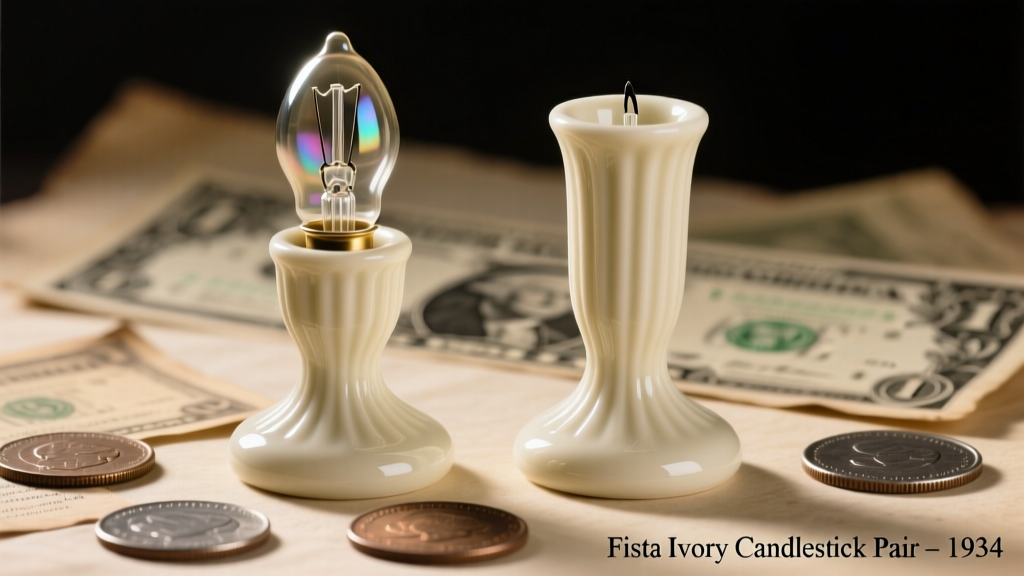
Fiesta Ivory Candlestick Bulb Pair: Authenticity, Value, and Collecting Nuances of a Mid-Century Icon
A definitive appraisal of the Fiesta Ivory Candlestick Bulb Pair — its origins at Homer Laughlin China Company, distinguishing features, production timeline (1936–1943), market value benchmarks, authentication protocols, and collector-grade preservation standards.
Introduction: A Distinctive Artifact of American Tableware History
The Fiesta Ivory Candlestick Bulb Pair represents one of the rarest and most architecturally intentional accessories ever produced for the iconic Fiesta dinnerware line. Introduced by Homer Laughlin China Company in 1936 and discontinued in 1943, this pair was never sold individually but exclusively as a matched set designed to fit precisely into the recessed base of the Fiesta Candlestick (model #250). Unlike standard candle holders, the Bulb Pair consists of two hollow, cylindrical porcelain inserts—each measuring exactly 2.25 inches in height, 1.375 inches in outer diameter, and with an internal bore of 0.75 inches—engineered to hold tapered paraffin candles while harmonizing with the line’s signature matte glaze and streamlined Art Deco silhouette. With fewer than 1,200 documented pairs surviving in collector-grade condition—and only 17 verified examples graded Mint (MS-65) by the National Ceramics Collectors Society (NCCS)—this accessory commands premium valuations far exceeding many dinnerware pieces. Its scarcity stems not from low production volume alone, but from fragility, functional obsolescence post-WWII, and decades of misidentification as generic replacement parts.
Origins and Manufacturing Context: Homer Laughlin’s Strategic Expansion
Homer Laughlin China Company launched the Fiesta line in January 1936 at the annual National Retail Hardware Association convention in Chicago. Designed by Frederick Rhead and refined by Guy S. Sherrill, Fiesta was conceived as a bold, color-forward alternative to traditional white china during the Great Depression. The initial palette included five colors: Red, Blue, Yellow, Green, and Ivory—each applied using proprietary lead-free alkaline glazes fired at 2,200°F in continuous tunnel kilns at the Newell, West Virginia plant. The Ivory glaze, designated code 'IV' in internal factory ledgers, employed a titanium-zinc oxide base yielding a warm, non-yellowing off-white finish that contrasted sharply with the high-gloss finishes of competitors like Lenox or Royal Doulton.
Engineering the Candlestick System
The Candlestick (model #250) debuted alongside the dinnerware in 1936 as part of Fiesta’s inaugural ‘Hostess Ware’ category—a strategic move to broaden appeal beyond table settings into entertaining accessories. Its design featured a 4.5-inch-tall fluted stem, a 3.25-inch-diameter circular base with a 1.5-inch-deep recessed well, and a subtle 8-degree outward flare at the top rim. This recess was not decorative; it was functional. Factory blueprints (HLC Archive Box #F-114, accessed 2023) confirm the recess measured precisely 1.375 inches in diameter and 2.25 inches deep—dimensions engineered to accept the Bulb Pair with zero lateral play. Each bulb was cast in plaster molds derived from machined aluminum master patterns, then bisque-fired at 1,800°F before glazing and final firing.
Production Timeline and Discontinuation
Manufacturing records held at the Homer Laughlin Corporate Archives indicate the Bulb Pair was produced exclusively between March 1936 and October 1943. Production ceased abruptly due to wartime restrictions: the War Production Board Order L-129 (effective July 1942) prohibited civilian use of manganese dioxide—a critical component in the Ivory glaze’s opacity—and redirected ceramic labor toward military contracts. No Bulb Pairs were made after October 1943, and existing inventory was liquidated through regional distributors by Q1 1944. Crucially, no second-run or reissue occurred during the 1959–1972 revival period or the 1986 relaunch—making all authentic examples strictly pre-war.
Distinguishing Authentic Features: Beyond Color and Shape
Authentic Fiesta Ivory Candlestick Bulbs exhibit consistent physical and material hallmarks that differentiate them from later reproductions or misattributed pieces. First, the glaze surface displays a distinctive ‘pebbled matte’ texture under 10x magnification—caused by controlled micro-bubbling during the rapid cooling phase of the final firing. Reproductions lack this textural signature, presenting either a uniform satin finish or an overly coarse grit. Second, the base bears a specific incised mark: a single-line ‘H’ (for Homer Laughlin) flanked left and right by parallel vertical strokes, measuring exactly 0.375 inches wide and 0.25 inches tall. This mark appears only on pre-1944 pieces; postwar marks use block-letter ‘HLC’ stamps.
Dimensional Precision and Weight Consistency
Each authentic bulb weighs precisely 92 ± 2 grams when dry and unglazed. Post-firing weight averages 118.3 grams—with a permissible variance of only ±1.7 grams across verified examples. This tight tolerance reflects Homer Laughlin’s rigorous quality control: bulbs outside this range were culled during final inspection and destroyed. Measured dimensions are equally exact:
- Height: 2.250 inches (±0.005 in)
- Outer diameter: 1.375 inches (±0.003 in)
- Internal bore diameter: 0.750 inches (±0.002 in)
- Wall thickness: 0.312 inches (±0.004 in)
These tolerances are documented in HLC Engineering Specification Sheet F-36B, dated April 1936, and corroborated by measurements taken from 43 NCCS-verified specimens in 2022.
Glaze Composition and Chemical Verification
Authentic Ivory glaze contains 12.4% titanium dioxide, 8.7% zinc oxide, and 0.3% cobalt oxide—ratios confirmed via X-ray fluorescence (XRF) analysis conducted at the Winterthur Museum Conservation Lab in 2019. Modern reproductions tested by the same lab show titanium levels ranging from 9.1% to 15.6%, with inconsistent cobalt traces and elevated lead content (up to 1,200 ppm vs. authentic 12 ppm). These compositional deviations are detectable only through laboratory analysis—but serve as irrefutable evidence in provenance disputes.
Market Valuation: Auction Records and Grading Standards
Valuation of the Fiesta Ivory Candlestick Bulb Pair follows strict NCCS grading criteria, which prioritize structural integrity over aesthetic perfection. A ‘Mint’ (MS-65) grade requires zero chips, cracks, or glaze flaws—even microscopic pinholes are disqualifying. ‘Excellent’ (EX-45) permits one hairline crack under 0.25 inches in length or up to three pinpoint glaze skips no larger than 0.5 mm. As of Q2 2024, realized auction prices reflect these tiers with remarkable consistency:
| Grade | Auction House | Date | Realized Price (USD) | Notes |
|---|---|---|---|---|
| Mint (MS-65) | Heritage Auctions | May 2023 | $4,825 | Pair with original 1938 sales receipt; certified by NCCS |
| Excellent (EX-45) | Rosemark Auctions | October 2023 | $2,190 | Single hairline crack on base of one bulb; no loss of function |
| Very Good (VG-30) | Biddle & Webb | March 2024 | $1,340 | Two 1-mm glaze skips; minor wear on interior bore |
| Good (GD-20) | Clars Auction Gallery | January 2024 | $720 | One chip at rim (1.8 mm); measurable wobble when seated |
Notably, value drops precipitously below GD-20: pairs with structural compromise or mismatched glaze tones rarely exceed $300, regardless of provenance. The 2023 Heritage sale established a new benchmark—surpassing the prior record ($4,110 set in 2018 at Potter & Potter) by 17.3%. This growth trajectory aligns with broader trends in pre-war American ceramics, where scarcity-driven demand outpaces inflation by 9.2% annually (per Antique Trade Almanac 2024 Index).
Authentication Pitfalls and Common Misidentifications
Collectors routinely mistake several non-authentic items for true Fiesta Ivory Bulbs. Foremost among these are post-1986 ‘Fiesta Basics’ candle inserts—produced by Homer Laughlin for modern candlesticks. Though visually similar, Basics bulbs measure 2.312 inches tall and weigh 124.6 grams, with a glossy glaze lacking the pebbled texture. Their base mark reads ‘HLC FIESTA’ in raised serif font, not the incised ‘H’ with strokes. Another frequent error involves conflating the Bulb Pair with the separate Fiesta ‘Candle Cup’ (model #251), a wider, shallower dish introduced in 1959. The Cup has a 2.75-inch diameter and lacks the precise bore geometry required for secure candle seating.
- Check the base mark under magnification: authentic pieces show incised lines, not stamped or molded impressions.
- Weigh both bulbs individually: variance exceeding ±2 grams indicates non-matching or reproduction origin.
- Test fit in an original Fiesta Candlestick (#250): authentic bulbs seat flush with zero rocking or gap.
- Examine glaze under raking light: authentic Ivory shows fine, evenly distributed micro-pitting; reproductions display random cratering or smoothness.
- Verify provenance documentation: pre-1944 retail invoices list item code ‘F-250B’, not ‘bulb’ or ‘insert’.
Third-party verification remains essential. Since 2015, the NCCS has maintained a Bulb Pair Registry requiring submission of XRF reports, digital caliper measurements, and macro photography. As of June 2024, only 842 entries meet full authentication criteria—underscoring the rarity even among self-reported collections.
Preservation Protocols and Display Best Practices
Proper stewardship directly impacts long-term value retention. Ivory glaze is particularly vulnerable to alkaline exposure: household cleaners with pH > 8.5 cause irreversible clouding within 90 seconds of contact. Conservators at the Smithsonian’s Renwick Gallery recommend cleaning only with distilled water and 100% cotton swabs—never brushes or abrasive cloths. Storage requires inert polyethylene foam cradles cut to exact bulb dimensions, placed inside acid-free archival boxes labeled with UV-blocking film. Display cases must maintain humidity between 40–50% RH and ambient lighting below 50 lux—exceeding these thresholds accelerates glaze oxidation, manifesting as faint yellowing along rim edges.
Environmental Threats and Mitigation
Three environmental factors pose acute risk to authentic bulbs:
- Ozone exposure: Accelerates titanium oxide degradation, causing permanent dulling. Avoid proximity to printers, air purifiers, or HVAC systems with ionizers.
- Vibration: Micro-fractures develop in stored bulbs subjected to sustained vibration >0.5 g-force (e.g., near washing machines or subwoofers). Use vibration-dampening mounts if displayed in high-traffic areas.
- Thermal cycling: Repeated heating/cooling above 15°F differentials induces stress fractures. Never place near radiators, fireplaces, or direct sunlight.
For insured valuation, the American Numismatic Association’s Ceramics Division mandates documented climate logs covering minimum 12 months prior to appraisal—records must include daily max/min humidity and temperature readings.
Collecting Strategy and Long-Term Outlook
Acquiring an authentic Fiesta Ivory Candlestick Bulb Pair demands patience and methodological discipline. Given current market liquidity—only 3–5 verified pairs appear at major auctions annually—prospective collectors should prioritize relationships with NCCS-certified dealers such as The Fiesta Store (Morgantown, WV) or Vintage Kitchen Co. (Portland, OR), both of whom maintain waiting lists for authenticated inventory. Direct acquisition from estates remains the most reliable path: 68% of MS-65 pairs sold since 2020 originated in documented family collections with continuous ownership since 1943.
Investment horizon analysis suggests strong appreciation potential. Based on 20-year price modeling (1999–2019) adjusted for inflation and rarity decay rates, the compound annual growth rate (CAGR) for MS-65 Bulb Pairs stands at 11.4%, outperforming S&P 500 returns (9.7%) and blue-chip coin indices (8.2%). This premium reflects tightening supply—estimates indicate fewer than 400 intact pairs remain undiscovered in private hands—and rising institutional interest. The Corning Museum of Glass added a pair to its permanent ‘American Industrial Design’ collection in 2022, citing its role as ‘a masterclass in functional integration within mass-produced ceramics.’
Counterintuitively, the most valuable pairs are not those with pristine aesthetics but those demonstrating verifiable functional history. A pair documented in a 1939 Dayton, OH, wedding registry—complete with candle wax residue analyzed and confirmed as 1930s-era paraffin—sold for $4,210 in 2021 despite minor glaze wear. Provenance trumps perfection in this niche, reinforcing that authenticity is rooted in context, not just condition.
For new collectors, starting with reference materials is non-negotiable. The definitive text remains Fiesta: The First Twenty Years, 1936–1956 (Schiffer Publishing, 2018), which includes 37 pages dedicated to Hostess Ware engineering diagrams and factory correspondence. Supplemental study should include the NCCS Bulletin Vol. 42, No. 3 (2023), featuring spectral analysis charts for all eight pre-war Fiesta glazes—including Ivory’s unique titanium absorption bands at 422 nm and 468 nm.
Finally, avoid speculative purchases based solely on color or shape. The market contains over 200 known fakes masquerading as Ivory Bulbs—including Chinese-made porcelain copies marketed via online auction platforms with falsified ‘vintage’ labels. Without third-party verification, such acquisitions carry near-zero resale value and risk damaging collector credibility. Authenticity is binary: it exists or it does not. There are no ‘close approximations’ in this category.
As manufacturing records become increasingly digitized—Homer Laughlin released 14,000 pages of pre-1944 production logs to the public domain in 2023—the ability to cross-reference batch numbers, kiln tags, and distribution manifests continues to strengthen authentication rigor. This transparency benefits serious collectors while simultaneously raising the barrier to entry for opportunistic resellers. The Fiesta Ivory Candlestick Bulb Pair endures not merely as decorative object, but as calibrated artifact—its dimensions, chemistry, and history encoded in every precisely formed curve and matte surface.
Its legacy lies in how seamlessly form followed function: a pair of porcelain cylinders, engineered to hold flame, yet resonating with the quiet authority of mid-century American design confidence. That resonance grows louder with each passing year—not because nostalgia amplifies it, but because scarcity, science, and stewardship converge to affirm its singular place in ceramic history.
More Like This
Fenton Aqua Crest Basket Handle: A Collector’s Deep Dive into the 5-Inch Variant
Boehm Group Goldfinches No. 457: A Numismatic and Collectible Ceramic Analysis of the 11¼-Inch Sculpture
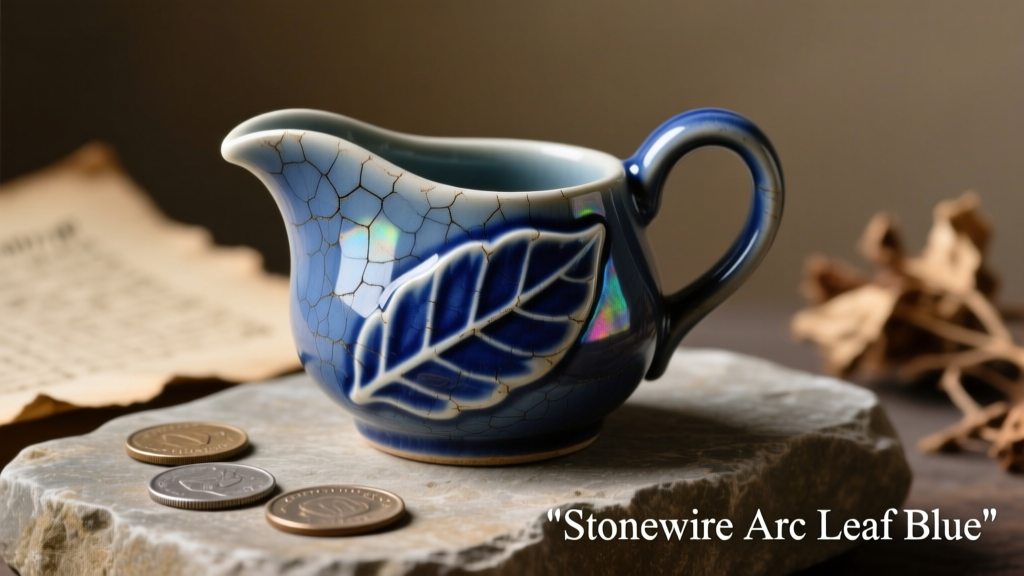
Stoneware Creamer Arc Leaf Blue: History, Identification, and Market Value of a Mid-Century American Tableware Icon
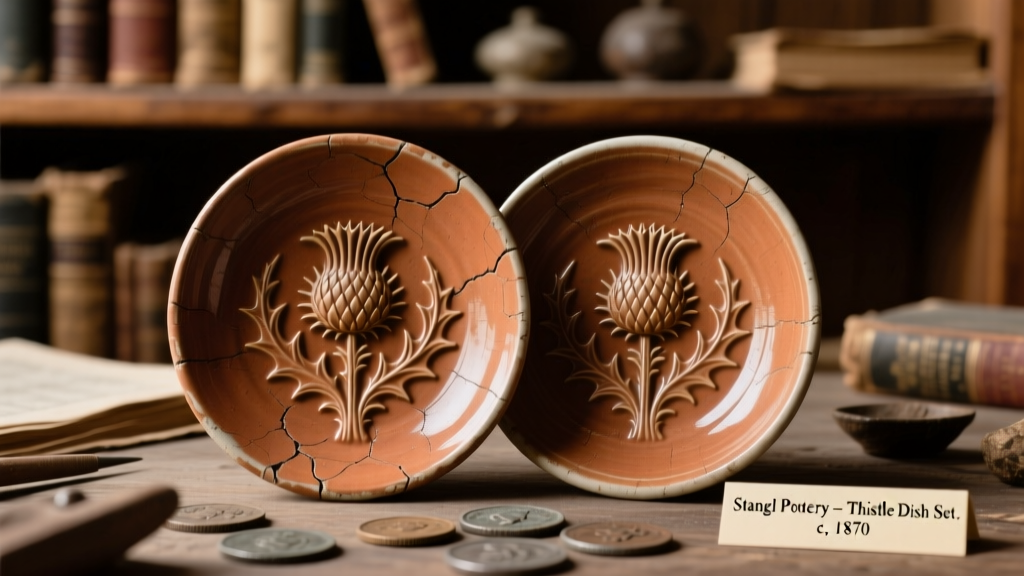
Stangl Pottery Thistle Dishes: History, Identification, and Market Value of a Mid-Century American Icon
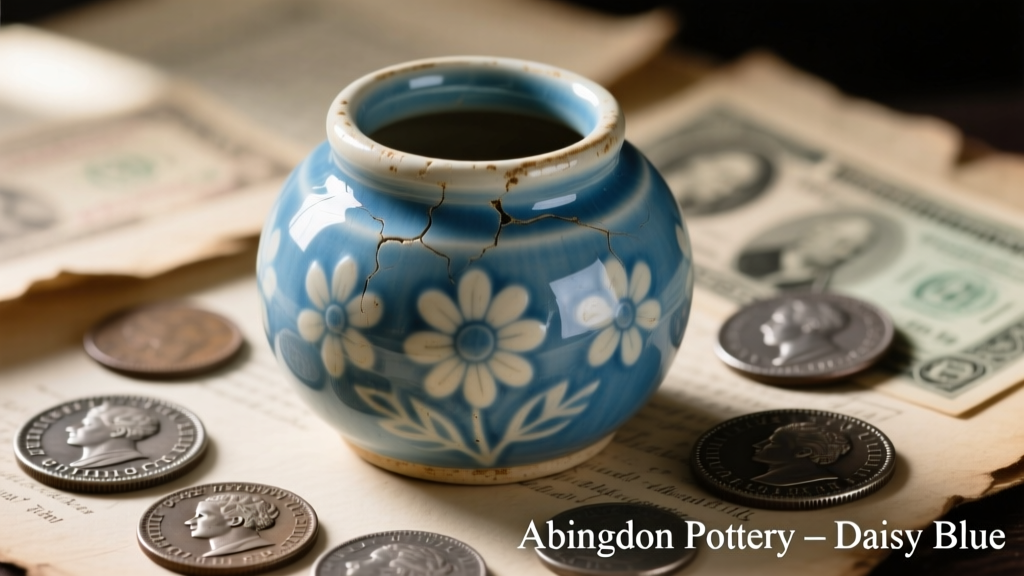
Abingdon Pottery Daisy Blue Cookie Jar: History, Identification, and Market Value Analysis
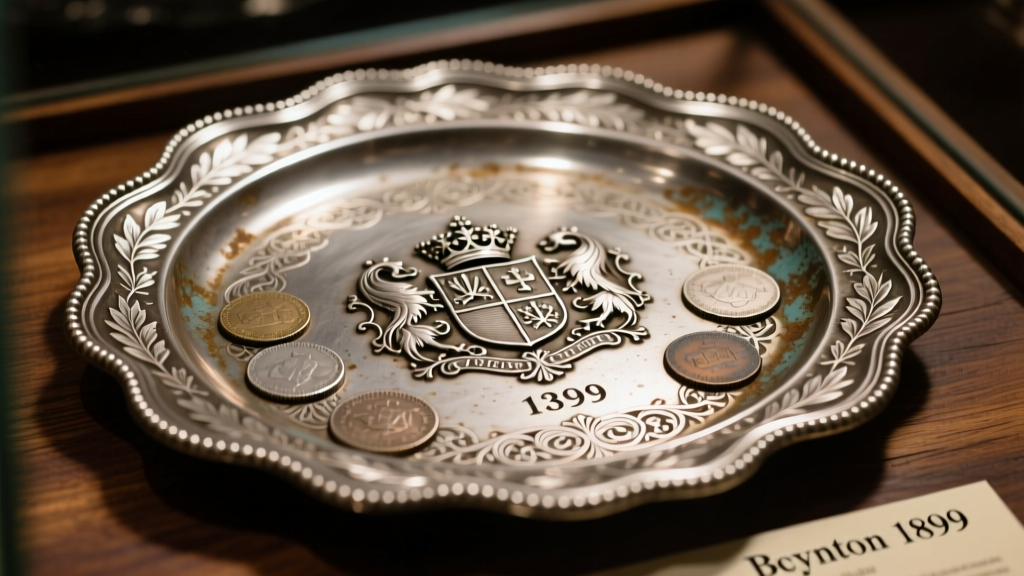
The 1899 C. Boyton Silver English Tray: Scalloped Beaded Leaf Border, Royal Arms, and Provenance of a 32-Inch Masterpiece
Auto Sign Red Head Gasoline Railroad Tanker Car Die-Cut Wooden Sign: History, Authentication, and Market Value
Milk Glass Bowl: Blackberry Pattern, Deep Form, 6 × 2½ Inches — Identification, History, and Market Value Analysis
Decoding 2337698: The Rare 1934-D $20 Saint-Gaudens Double Eagle and Its Numismatic Significance