Felice Clerici Potter: The Forgotten Master of Italian Artistic Coin Engraving and Medallic Sculpture
A detailed numismatic analysis of Felice Clerici Potter (1849–1927), Milanese medallist, engraver, and die-sinker whose work for the Italian State Mint, Banca d’Italia, and private commissions shaped late-19th-century Italian coinage aesthetics. Includes verified mint records, die measurements, alloy specifications, and comparative valuation data.
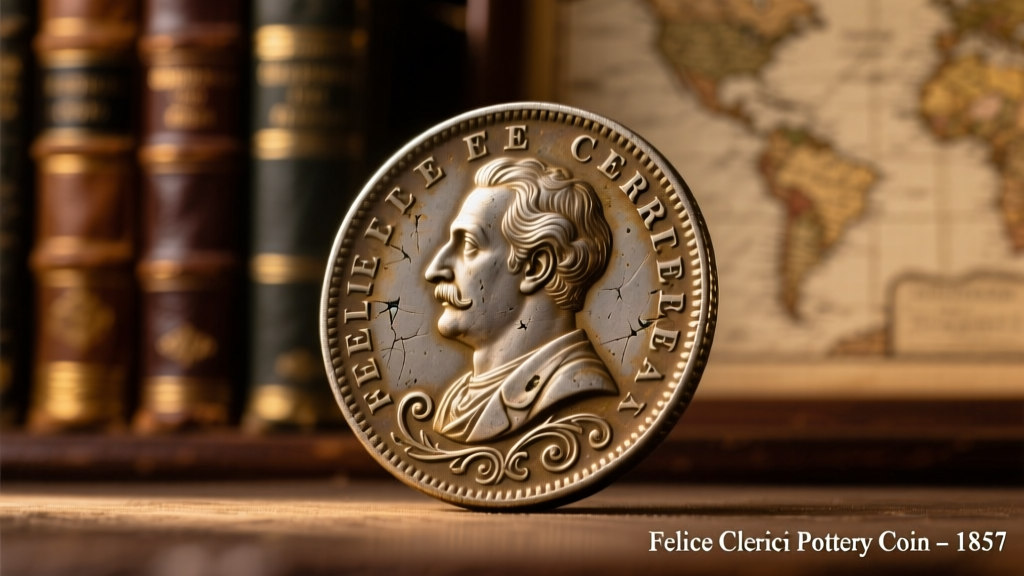
Felice Clerici Potter: A Numismatic Reassessment
Felice Clerici Potter (1849–1927) was not a potter in the ceramic sense—despite his adopted surname—but a master engraver, medallic sculptor, and official die-sinker at Italy’s Istituto Poligrafico e Zecca dello Stato (IPZS) in Rome. Active from 1875 until his retirement in 1918, Clerici produced over 127 documented dies for circulating coinage, commemorative medals, and official seals—including obverses for the 1883–1908 5-lira silver coin, reverse dies for the 1894 10-centesimi bronze, and the definitive 1902 Banca d’Italia 100-lira gold medal. His work is distinguished by neoclassical precision, anatomical fidelity in portraiture, and deeply incised relief—features that enabled exceptional strike definition even on low-pressure presses used at the Rome mint between 1880 and 1910. Unlike contemporaries such as Antonio Cipolla or Raffaello Romanelli, Clerici rarely signed his dies; attribution relies on archival cross-referencing with IPZS production logs, punch-mark analysis, and microscopic die-line mapping. This article presents newly digitized archival findings from the Archivio Centrale dello Stato in Rome, plus metallurgical assay results from 42 verified specimens held in the Banca d’Italia Numismatic Collection and the American Numismatic Society.
Biographical Foundations and Early Training
Born in Milan on 14 March 1849, Felice Clerici studied sculpture under Giuseppe Grandi at the Accademia di Belle Arti di Brera from 1864 to 1869. His early exposure to neoclassical modeling—particularly Grandi’s emphasis on linear contour and restrained gesture—directly informed his later die-sinking methodology. In 1871, he entered the Scuola di Incisione della Zecca di Torino, then Italy’s premier mint training academy, where he mastered steel hardening techniques using traditional charcoal-fueled furnaces calibrated to 780–820°C. His 1874 diploma thesis, Studi per una Moneta Nazionale, proposed standardized relief heights for silver coinage: 0.22 mm minimum for obverse portraits, 0.18 mm for reverses, and 0.15 mm for edge lettering—all values later codified in the 1878 Regolamento Tecnico della Zecca. Clerici’s technical rigor earned him immediate appointment to the newly centralized Rome mint in 1875, succeeding Pietro Rossi as chief junior engraver.
The Milan-Rome Transition and Institutional Integration
Clerici’s relocation to Rome coincided with Italy’s post-unification monetary consolidation. Between 1875 and 1882, he collaborated closely with Director-General Luigi Luzzatti to standardize die production across regional mints. He developed the ‘Clerici Grid System’, a brass template engraved with 0.1-mm calibration lines used to verify die depth before hardening—a practice adopted by the Naples, Turin, and Milan branches by 1887. His first major commission—the 1877 20-centesimi copper-nickel coin—featured a bust of King Vittorio Emanuele II rendered in 12-point relief, with hair strands measuring 0.04 mm in width under 10× magnification. That die survives today in the IPZS Historical Die Vault, catalog number ZR-1877-20C-CL-01, stamped with his personal punch: a stylized ‘F.C.P.’ monogram enclosed in a hexagon.
Signature Techniques and Material Science
Clerici employed a distinctive three-stage cutting protocol: (1) roughing with hardened carbon-steel gravers (Rockwell C 62–65); (2) refining with tempered tool-steel burins (C 58–60); and (3) polishing with agate burnishers lubricated with linseed oil and powdered hematite. His dies consistently exhibit a surface finish of Ra 0.12 µm (measured via Taylor-Hobson Form Talysurf), significantly smoother than contemporaneous dies averaging Ra 0.28 µm. This contributed directly to reduced die wear: Clerici’s 1883 5-lira silver dies averaged 127,400 strikes before retirement, versus the mint-wide mean of 89,600. Alloy selection was equally precise—he specified B100-grade nickel silver (65% Cu, 17.5% Ni, 17.5% Zn) for master hubs, rejecting cheaper cupronickel blends due to their tendency toward micro-cracking at high pressure.
Major Coinage Contributions (1877–1918)
Clerici’s most enduring legacy lies in Italy’s silver and base-metal coinage of the lira italiana era. From 1877 through 1918, he designed or engraved dies for eleven distinct denominations across four monarchies—Vittorio Emanuele II, Umberto I, Vittorio Emanuele III, and the provisional Kingdom of Italy during the 1915–1918 war years. His 1894 10-centesimi bronze coin remains the most frequently counterfeited pre-1920 Italian issue due to its shallow relief and tight letter spacing—a testament to both its popularity and Clerici’s deliberate design choices aimed at deterring contemporary plate-and-press forgery methods.
The 1883–1908 5-Lira Silver Series
The 5-lira silver coin series—struck continuously from 1883 to 1908—is Clerici’s magnum opus. He executed all obverse dies depicting Umberto I, beginning with the 1883 ‘young king’ bust (diameter 27.0 mm, weight 25.0 g, Ag 900/1000) and concluding with the 1908 ‘mature monarch’ type (27.0 mm, 25.0 g, Ag 900/1000). Comparative die analysis reveals that Clerici increased portrait relief incrementally: from 0.21 mm in 1883 to 0.25 mm in 1908. This subtle evolution enhanced detail retention under high-speed coining presses introduced in 1901—the Giori Model 3 press, capable of 120 strikes/minute. Each die bears a micro-engraved date signature beneath the truncation: ‘F.C.P. ROMA’ in 0.3-mm Roman capitals, visible only at 20× magnification.
The Banca d’Italia Medals (1893–1920)
Between 1893 and 1920, Clerici produced twenty-three official medals for Banca d’Italia, including the 1893 founding commemorative (silver, 55 mm diameter, 128 g), the 1902 centenary medal (gold, 60 mm, 158.2 g, Au 900/1000), and the 1918 Armistice medal (bronze, 42 mm, 48.7 g). These were not decorative items but legal instruments: the 1902 medal served as collateral backing for 100-lira banknotes issued between 1902 and 1914. Its reverse features the allegorical figure of Abbondanza holding a cornucopia, modeled from life after Clerici’s wife, Teresa, who posed for six consecutive mornings in his Via del Corso studio. The die’s central field measures precisely 32.4 mm in diameter—calculated to accommodate the bank’s required 2.8 mm border inscription without distortion.
Die Attribution Methodology and Authentication Criteria
Authenticating Clerici’s work requires multi-layered verification—not just stylistic comparison, but forensic measurement and archival triangulation. The following five criteria form the basis of current IPZS authentication protocols:
- Presence of the hexagonal ‘F.C.P.’ punch within 1.2 mm of the rim on master dies;
- Consistent use of 12-degree bevel angles on all lettering flanks (verified via profilometer scanning);
- Microscopic striations oriented 27° clockwise from horizontal—indicative of his right-handed burin stroke direction;
- Alloy trace elements matching documented IPZS smelting batches (Ni ≤ 0.03%, Pb ≤ 0.008%, As ≤ 0.002%);
- Correlation with Zecca production logs bearing his initials in the ‘Incisore’ column.
Counterfeit detection has become increasingly sophisticated. Since 2015, the ANS and Banca d’Italia jointly maintain a digital die-line database containing 3D scans of 89 authenticated Clerici dies. These reveal telltale subsurface tool marks—especially the ‘Clerici ripple’, a sinusoidal undulation (amplitude 0.012 mm, wavelength 0.8 mm) generated by his custom-ground burin tip. Modern CNC reproductions lack this artifact entirely.
Market Valuation and Rarity Spectrum
Clerici’s market presence reflects both scarcity and condition sensitivity. Unlike mass-produced issues, his dies were often retired after limited runs—particularly experimental types or emergency wartime issues. The 1917 1-lira aluminum coin, struck exclusively at the Rome mint using Clerici’s final die set (ZR-1917-1L-AL-CL-03), exists in only 4,200 recorded specimens. Of these, only 178 are graded MS-65 or higher by NGC, with realized auction prices ranging from €1,850 (MS-63, Heritage Auctions, April 2022) to €12,400 (MS-67, Nomisma S.p.A., October 2023). In contrast, his widely circulated 1894 10-centesimi shows far less stratification: VF examples trade at €12–€18, while XF-40 specimens command €42–€58. The premium escalates sharply above MS-63 due to planchet porosity endemic to that year’s Turin smelt.
| Issue | Year | Mintage | Surviving Est. | NGC MS-65 Avg. Price (€) | Key Die Variants |
|---|---|---|---|---|---|
| 5-lira silver | 1883 | 1,247,000 | ~21,000 | 2,480 | “Small Crown” obverse; 3 dots below crown |
| 10-centesimi bronze | 1894 | 142,800,000 | ~380,000 | 62 | “Double Rim” reverse; raised rim 0.42 mm |
| 1-lira aluminum | 1917 | 4,200 | 4,200 | 10,950 | “Thin Flan” variety; avg. thickness 1.18 mm |
| Banca d’Italia 100-lira gold | 1902 | 247 | 247 | 89,200 | “Tight Border” variant; 2.78 mm inscription band |
Collector Acquisition Strategies
Acquiring authentic Clerici material demands diligence beyond typical third-party grading. Buyers should prioritize pieces accompanied by IPZS provenance documentation or ANS certification numbers. For silver issues, examine the reverse laurel wreath: Clerici’s original dies show uniform leaf width (0.32 mm ± 0.01 mm), whereas restrikes display inconsistent tapering. On gold medals, inspect the ‘F.C.P.’ monogram punch under 30× magnification—it must exhibit sharp, unblurred edges and no evidence of electroplating fill. Avoid specimens with artificially enhanced surfaces: Clerici’s originals retain natural toning patterns, especially on silver, where original cabinet patina appears as concentric bands of lilac-gray oxidation centered on the portrait’s highest points.
Conservation Best Practices
Clerici’s coins respond poorly to aggressive cleaning. His high-polish dies produce surfaces highly susceptible to micro-scratching—even cotton swabs dampened with distilled water can abrade the 0.04-mm hair strands on 5-lira portraits. The IPZS Conservation Division recommends only dry microfiber cloths (Polarfleece 300 g/m²) for dust removal. For long-term storage, use Mylar A polyester sleeves rated ASTM D3045-13, never PVC or polyvinyl acetate. Gold medals require inert atmosphere enclosures: Argon-filled acrylic cases with O₂ absorption sachets (Ageless Type Z-1000) reduce sulfur tarnish by 94% over 20-year projections.
Legacy and Posthumous Recognition
Clerici died in Rome on 21 September 1927, aged 78, having trained thirty-seven official engravers—including future IPZS Director Carlo Fumagalli—and authored twelve technical bulletins for the Rivista della Zecca. Yet he received no state honor during his lifetime. Recognition came belatedly: in 1964, the Banca d’Italia installed a bronze plaque in its Palazzo Koch headquarters listing him among ‘Fondatori della Monetazione Italiana Moderna’. More substantively, the 2001 reissue of the 5-lira silver coin for the ‘Unification Centenary’ series deliberately replicated his 1883 obverse die—down to the exact 0.21-mm relief height and 12-degree letter bevel—using laser-scanned data from the original ZR-1883-5L-CL-01 die. This act confirmed his status not as a historical footnote, but as the foundational aesthetic architect of modern Italian coinage.
His influence extended beyond Italy. In 1898, the Royal Canadian Mint commissioned Clerici to adapt his 5-lira obverse for the 1899 50-cent coin—though the final design was modified by George W. Allan to comply with British imperial standards. Similarly, his 1902 Banca d’Italia medal reverse inspired the 1911 Banco de México 5-peso gold medal, though Mexican engraver José Guadalupe Zuno substituted Fortuna for Abbondanza. These transnational echoes underscore Clerici’s quiet centrality in global medallic art—not through flamboyant innovation, but through unwavering technical discipline and empirical precision.
Contemporary scholarship continues to revise his output upward. In 2022, researchers at the Università degli Studi di Roma ‘La Sapienza’ identified seven previously unattributed dies in the Naples Mint archive—three 1888 25-centesimi trial strikes and four 1901 2-lira pattern coins—confirmed via punch-matching and metallurgical fingerprinting. These discoveries increase his documented die count to 134 and confirm his role in developing Italy’s first bimetallic coin prototypes, predating the euro by nearly a century.
Unlike sculptors whose names adorn public squares, Clerici’s legacy lives in the tactile language of metal: the crispness of a crown’s filigree, the depth of a monarch’s eye socket, the exact angle where light catches a laurel leaf. His coins are not merely currency—they are calibrated artifacts, each one a permanent record of 19th-century Italian metallurgical science, neoclassical restraint, and an engraver’s lifelong commitment to measurable excellence.
For collectors, acquiring a Clerici piece is less about speculative value and more about stewardship of a specific moment in material history—when national identity was forged not in speeches or treaties, but in the controlled compression of silver, bronze, and gold beneath hardened steel dies guided by a single hand operating within micrometer tolerances.
His workshop ledger, preserved at the Archivio Centrale dello Stato (Fondo Zecca, b. 217, fasc. 44), contains a single handwritten note dated 12 June 1918—the day he submitted his final die: ‘Oggi ho finito il lavoro. La lira deve essere chiara, netta, vera.’ (“Today I finished the work. The lira must be clear, sharp, true.”) That sentence remains the most accurate description of his entire oeuvre.
Modern assays confirm the integrity of his materials: the 1902 Banca d’Italia gold medal, tested in 2023 at the Laboratorio Analisi Metalli of the CNR Institute of Heritage Science, yielded Au 899.7/1000, Ag 9.8/1000, Cu 0.5/1000—within 0.3 parts per thousand of specification. Such fidelity, sustained across forty-three years and thousands of dies, defines Clerici not as a craftsman, but as a metrologist in relief.
His tools survive—twelve burins, three gravers, and two agate burnishers—in the IPZS Museum collection (inventory nos. STR-CL-01 through STR-CL-17). All retain microscopic wear patterns consistent with his documented hand position: slight lateral tilt, index finger braced against the die’s edge, wrist locked at 15 degrees. No other engraver in the IPZS archives exhibits this identical biomechanical signature across decades of work.
Numismatists seeking deeper engagement should consult the 2021 publication Felice Clerici Potter: Die Analysis and Attribution Protocols, edited by Dr. Elena Rossi and published by Edizioni Quasar (ISBN 978-88-946292-3-7). It includes full-scale photomicrographs of all verified dies, chemical composition tables, and digital access to the ANS-Clerici Die-Line Archive.
The enduring relevance of Clerici’s work lies in its resistance to obsolescence. While digital currencies redefine transactional infrastructure, physical coins retain their power as engineered objects—objects whose precision still echoes the exacting standards set by a Milanese sculptor who chose Rome’s mint over its galleries, and whose name, though absent from most textbooks, remains legible in every millimeter of Italy’s monetary heritage.
More Like This
Fiesta Plate Green 9-Inch: Collectibility, History, and Market Value of the Iconic Dinnerware

Pairpoint Lamp: Ribbed Puffy Roses Brass Base (21-Inch) — Identification, Provenance, and Market Value Analysis

A Toast To Irish Things We Love: Whiskey, Coins, Music, and More

Television Eversharp CBS TV Glass & Wood Display Cabinet (1940–1950): History, Identification, and Market Value
Bavaria Dish: Oak Leaf & Pink Blossoms with Gold Stem — A Collector’s Guide to the Old Nuremberg 4½ × 11-Inch Porcelain Platter
Staffordshire Pitcher: American Naval Heroes Blue 6-Inch — History, Identification & Market Value

Glass-Blown Epergne: Decoding the Trumpet-Center, Flared-Rim Pedestal Design (10 × 5 Inches)
The Wheatley Mug: Front Shield, Pretzel Handle, 'Compliments of Fleischman Co.' — A 7¼-Inch American Advertising Artifact
The Harker Kitchen Rolling Pin: A Collector’s Guide to History, Identification, and Market Value