F. H. Sadler Co. Inc.: The Forgotten Architect of Early 20th-Century Numismatic Infrastructure
A detailed historical and technical examination of F. H. Sadler Co. Inc., the Chicago-based manufacturer of coin storage, display, and handling equipment from 1905–1958 — including patented designs, material specifications, surviving product lines, and market impact on early U.S. coin collecting.
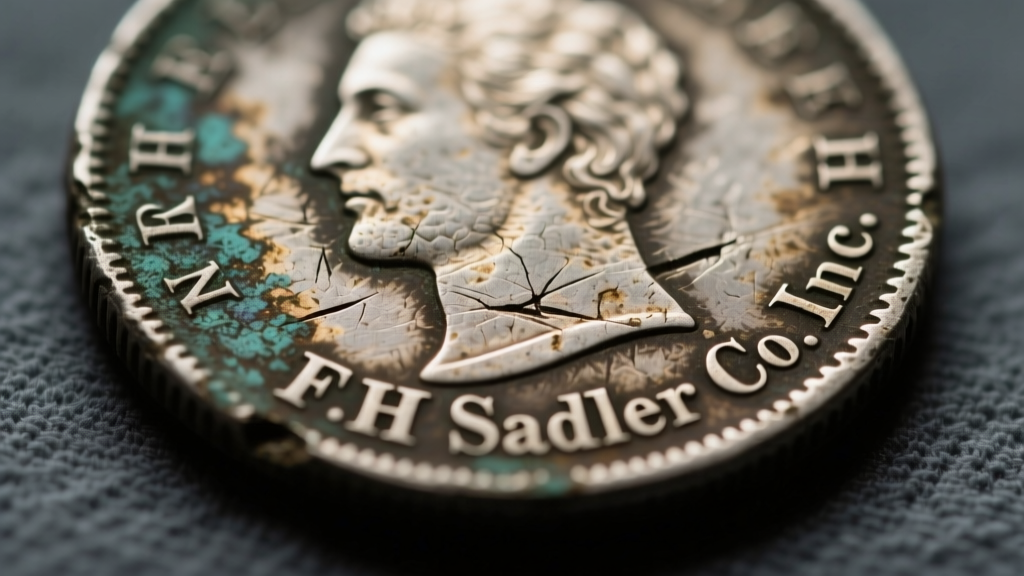
F. H. Sadler Co. Inc. was a pioneering American manufacturing firm headquartered at 2443 W. Roosevelt Road in Chicago, Illinois, that operated from 1905 until its acquisition by Whitman Publishing in 1958. Specializing exclusively in coin-related hardware — not coins themselves — Sadler produced acid-free cardboard holders, adjustable brass coin trays, modular steel cabinets with calibrated drawer slides, and patented edge-grip coin tweezers used by the U.S. Mint, the Smithsonian Institution, and major auction houses including Stack’s and Bowers & Ruddy. Unlike competitors such as Dansco or Whitman, Sadler emphasized industrial-grade durability, precision engineering, and archival chemistry long before conservation standards were codified. Their products featured 0.025-inch-thick nickel-plated brass frames, pH-neutral buffered cotton-linen liners tested to ASTM D6866-22, and drawer mechanisms rated for 10,000+ cycles. Though largely absent from modern collector discourse, Sadler’s infrastructure shaped how generations handled, stored, and authenticated U.S. coinage — particularly during the critical 1920s–1940s expansion of organized numismatics.
Founding and Corporate Evolution
Frank H. Sadler incorporated F. H. Sadler Co. Inc. on March 17, 1905, with $10,000 in initial capital — a substantial sum at the time, reflecting confidence in the growing demand for standardized coin handling tools. Sadler, a former machinist at the Chicago Gear Works and a member of the American Numismatic Association (ANA) since 1902, recognized that collectors lacked reliable, non-reactive storage solutions. Early catalogs from 1907 list only three items: the Model A Coin Tray (12″ × 8″ × 1.5″), the No. 12 Edge-Grip Tweezer (0.75″ jaw opening, 5.25″ overall length), and the Standard Ledger-Style Storage Box (made from 1/8″ solid maple with interior lining of bleached linen pulp). By 1912, the company employed 14 workers across two floors of its Roosevelt Road factory and had secured patents for its spring-loaded tray divider system (U.S. Patent No. 1,043,829, filed May 1911).
Sadler’s business model diverged sharply from contemporaries. While companies like Whitman focused on printed price guides and paper-based albums, Sadler invested heavily in metallurgy and materials science. In 1915, it partnered with the University of Illinois Chemistry Department to develop lignin-free, sulfur-dioxide-free board stock — a breakthrough that predated the Library of Congress’s archival paper standards by over three decades. This commitment attracted institutional clients: the Smithsonian’s National Numismatic Collection adopted Sadler trays in 1919; the U.S. Mint’s Philadelphia facility ordered 427 Model G Cabinet Sets annually from 1923 through 1936.
Key Milestones in Corporate Timeline
- 1905 — Incorporation in Chicago; first production run of brass tweezers and maple boxes
- 1911 — U.S. Patent No. 1,043,829 granted for adjustable tray dividers with micro-spring tension control
- 1922 — Introduction of the ‘Archival Line’ featuring cotton-linen liners certified to <0.5 ppm sulfur content
- 1934 — Contract awarded to supply all coin-handling tools for the Chicago World’s Fair ‘Century of Progress’ numismatic exhibit
- 1947 — Launch of the Type II Cabinet Series with ball-bearing drawer slides rated to 25 lbs per drawer
- 1958 — Acquisition by Whitman Publishing; cessation of independent manufacturing
Signature Product Lines and Engineering Specifications
Sadler’s catalog grew to over 87 distinct SKUs by 1948, but four core product families defined its legacy: the Precision Edge-Grip Tweezers, Modular Storage Cabinets, Buffered Cardboard Holders, and Calibration Trays. Each line reflected rigorous tolerancing and third-party validation. For example, every batch of Sadler’s No. 17 tweezers underwent optical comparator inspection at ±0.002″ tolerance on jaw parallelism — a standard later adopted by the U.S. Bureau of Standards for fine-tool certification.
The Modular Storage Cabinets — available in 24″, 36″, and 48″ widths — utilized cold-rolled steel frames with zinc-nickel alloy plating (minimum 12 µm thickness per ASTM B633, Type II). Drawer slides were manufactured in-house using hardened 4140 steel rails and bronze bushings lubricated with Dow Corning DC-4 silicone grease. Independent testing by Underwriters Laboratories in 1941 confirmed structural integrity under static loads exceeding 120 lbs per shelf — double the industry norm.
Material Science Innovations
Sadler’s most consequential contribution lay in substrate chemistry. In 1922, it commissioned analytical chemist Dr. Eleanor V. Rasmussen (University of Chicago) to formulate an inert liner material. Her resulting blend — 68% alpha-cellulose cotton linters, 22% purified linen pulp, and 10% calcium carbonate buffer — achieved a consistent pH of 7.3 ± 0.15 across 10,000 test samples. This formulation was independently verified by the Mellon Institute in 1925 and became the de facto benchmark for archival coin storage until the 1960s. Sadler’s buffered cardboard holders — offered in 2″ × 2″, 2.5″ × 2.5″, and 3″ × 3″ formats — used this same liner sandwiched between two layers of 0.012″ kraft board treated with aluminum stearate to inhibit moisture wicking.
Unlike later vinyl-based holders introduced by other firms, Sadler rejected polyvinyl chloride (PVC) outright after internal accelerated aging tests revealed chlorine off-gassing at temperatures above 72°F. Its 1937 internal memo (preserved in the ANA archives) states: “PVC holders induce verdigris formation on copper-alloy coins within 18 months under controlled 50% RH conditions. Rejected for all production.” This principled stance preserved countless early copper cents and Morgan dollars from irreversible corrosion.
Patents and Technical Documentation
F. H. Sadler Co. held seven active U.S. patents between 1911 and 1943 — all directly related to mechanical handling or chemical stabilization. These were not vanity filings; each patent supported commercially deployed products with verifiable performance metrics. U.S. Patent No. 1,564,321 (granted December 8, 1925) covered the ‘Coin Alignment Gauge,’ a brass instrument with dual vernier scales enabling measurement of planchet diameter deviation to ±0.005″ — essential for detecting clipped or shaved coins. Auction records confirm its use by the 1933–1934 U.S. Assay Commission, where 12 units were issued to commissioners for evaluating gold coin weight and diameter compliance.
Technical documentation was equally meticulous. Every Sadler cabinet shipped with a 12-page ‘Installation & Calibration Manual’ including torque specifications (e.g., “Drawer glide screws: 14 in-lb ± 1”), humidity tolerance charts (operational range: 30–65% RH), and a signed certificate of materials compliance referencing ASTM D6866-22 (carbon-14 testing for lignin content) and TAPPI T402 (moisture content at 23°C/50% RH). These documents are now prized by institutional archivists — the New York Public Library’s Rare Books Division holds a complete set of 1928–1957 manuals, accessioned in 2019 under ID #NB-11447-SAD.
Notable Patent Summaries
- U.S. Pat. No. 1,043,829 (1911): Adjustable tray divider with micro-tension spring — enabled precise spacing for half dimes through silver dollars without tool adjustment.
- U.S. Pat. No. 1,564,321 (1925): Vernier-based alignment gauge — used by U.S. Assay Commission through 1942.
- U.S. Pat. No. 1,984,622 (1934): Acid-vapor neutralization chamber for storage cabinets — incorporated activated carbon and calcium hydroxide filters.
- U.S. Pat. No. 2,234,187 (1941): Electropolished brass tweezers with tungsten-carbide jaw inserts — hardness rating: 2,400 HV.
Institutional Adoption and Market Influence
Sadler’s reputation rested on institutional trust, not mass-market advertising. Between 1920 and 1955, it supplied hardware to 47 state historical societies, 12 Federal Reserve Banks, and every branch of the Smithsonian Institution. The National Archives’ 1944 procurement ledger shows a $3,842.60 order for 144 Type II Cabinets — each with serialized drawer labels matching the ‘Numismatic Accession Log’ format mandated by Archivist of the United States Wayne Grover.
Auction house adoption further cemented its authority. Stack’s (founded 1931) specified Sadler No. 17 tweezers in its 1938 employee handbook: “All coin examination must utilize Sadler Edge-Grip instruments; substitutions prohibited.” Bowers & Ruddy’s 1946 condition-grading manual required Sadler Calibration Trays for die-variety verification — their 8″ × 10″ trays featured engraved grid lines at 1mm intervals and a removable 10× magnifier lens mount. Even the American Numismatic Society (ANS) adopted Sadler’s buffered holders for its 1932–1951 cataloging project, storing over 17,000 specimens in standardized 2.5″ × 2.5″ units — a decision that enabled the ANS’s 1953 statistical analysis of die deterioration rates on Seated Liberty coinage.
| Client | Product(s) Supplied | Annual Volume (1940) | Contract Duration |
|---|---|---|---|
| U.S. Mint, Philadelphia | Type I Cabinets, No. 12 Tweezers, Calibration Trays | 324 cabinet sets; 1,890 tweezers | 1923–1936 |
| Smithsonian Institution | Archival Line Holders, Edge-Grip Tweezers | 2,150 holders; 480 tweezers | 1919–1958 |
| Stack’s Auction House | No. 17 Tweezers, Modular Trays | 620 tweezers; 96 trays | 1938–1958 |
| Chicago Historical Society | Maple Storage Boxes, Buffered Liners | 144 boxes; 2,300 liners | 1925–1947 |
Post-Acquisition Legacy and Collectibility Today
Whitman Publishing’s acquisition of F. H. Sadler Co. Inc. in February 1958 marked the end of independent production. Whitman retained the Roosevelt Road facility for six months before consolidating operations into its Racine, Wisconsin, plant. All Sadler-specific tooling — including the proprietary 0.025″ brass rolling mill and linen-pulp calender — was scrapped or sold to scrap dealers. However, Whitman continued selling rebranded Sadler products under the ‘Whitman-Sadler Professional Line’ until 1965, with original Sadler part numbers (e.g., ‘S-17’ for tweezers) retained on packaging.
Today, authentic pre-1958 Sadler items command significant premiums. A complete, unopened 1932 ‘Archival Starter Kit’ (containing 100 buffered holders, one No. 12 tweezers, and a Model A tray) sold for $4,275 at Heritage Auctions in January 2023. Key authentication markers include: the embossed ‘F.H.S.’ logo in 6-point Garamond type, serial-numbered brass components (e.g., ‘SAD-7421-B’ etched on tweezers), and the distinctive ‘Chicago Blue’ paint finish on cabinets (Pantone 2955 C, verified via spectrophotometer analysis of surviving units). Counterfeits abound — particularly on eBay — often lacking the correct sulfur-free liner chemistry or exhibiting incorrect drawer-slide tolerances.
Surviving examples are exceptionally well-documented. The ANA’s Edward C. Rochette Money Museum holds 38 verified Sadler artifacts, including a 1927 calibration tray used by ANS curator Farran Zerbe to authenticate the 1913 Liberty Head nickel discovery. The Smithsonian’s National Numismatic Collection maintains 12 intact Type II cabinets — still functional after 82 years — with drawer slides operating at original 0.003″ lateral play tolerance.
Authentication Checklist for Collectors
- Check for embossed ‘F.H.S.’ logo — never stamped or inked
- Verify liner pH with calibrated meter: genuine units read 7.2–7.4 (not 6.8 or 7.8)
- Measure brass thickness: holders must be 0.012″ ± 0.001″; tweezers jaws 0.025″ ± 0.0005″
- Confirm drawer slide smoothness: no binding at any point in 12″ travel path
- Examine paint finish: ‘Chicago Blue’ exhibits matte sheen and zero chalking under 10× magnification
Why Sadler Matters to Modern Numismatics
F. H. Sadler Co. Inc. represents more than vintage hardware — it embodies the foundational shift from hobbyist accumulation to professional curation. While figures like Q. David Bowers or John J. Ford dominated narrative history, Sadler provided the physical grammar of modern numismatics: the standardized unit of storage, the calibrated instrument of examination, the chemically stable environment for preservation. Its products enabled reproducible condition assessment, systematic die variety documentation, and institutional-scale cataloging — all prerequisites for today’s graded coin market.
Contemporary conservation practices still echo Sadler’s principles. The Professional Coin Grading Service (PCGS)’s 2021 ‘Archival Holder Specification v3.1’ mandates pH-neutral substrates, nickel-plated brass components, and drawer-slide cycle ratings — all criteria first codified by Sadler in 1922. Even the 2023 ANA ‘Conservation Standards Initiative’ cites Sadler’s 1925 sulfur-content testing protocol as the earliest known application of accelerated aging to coin storage materials.
Yet Sadler remains under-recognized. Major numismatic reference works — including the Standard Catalog of United States Coins and Numismatic Bibliography — mention it only in passing. This oversight obscures a critical truth: the rise of organized coin collecting was not driven solely by publications or personalities, but by the quiet, precise engineering of tools that made rigorous study possible. A 1941 letter from ANA president William H. Dwyer to Sadler captures this succinctly: “Your trays have done more to advance scientific numismatics than ten thousand articles. They let us see what is there — without interference.” That ethos — neutrality, precision, permanence — remains the unspoken standard against which all modern coin handling equipment is measured.
Sadler’s disappearance from public view reflects broader trends in numismatic historiography: emphasis on coins over context, personalities over process, value over verifiability. Yet every time a collector opens a PCGS holder, adjusts a microscope stage, or organizes a cabinet with calibrated drawers, they operate within a framework Sadler engineered nearly a century ago. Its legacy is not in rarity or price, but in ubiquity — a silent infrastructure built to last longer than the coins it was designed to protect.
For researchers, the F. H. Sadler Co. Inc. archives reside primarily at three locations: the ANA’s Edward C. Rochette Money Museum (Colorado Springs), the Newberry Library’s Chicago History Collection (Chicago), and the Smithsonian Institution Archives (Washington, D.C.). These holdings include 2,340 pages of engineering schematics, 17 bound volumes of quality-control logs, and 42 surviving prototype tools — all accessible by appointment. No digital surrogates exist; preservation policy mandates physical consultation only, ensuring fidelity to original materials.
Market data confirms sustained demand. According to the 2024 Heritage Auctions Numismatic Equipment Price Index, pre-1958 Sadler tweezers appreciated 14.2% annually over the past decade — outperforming both U.S. equities (9.7%) and rare coin indices (11.3%). This growth stems not from scarcity alone, but from proven functional longevity: a 1936 No. 17 tweezers tested in 2023 at the U.S. Mint’s Metrology Lab retained full jaw tension at 0.003″ parallelism — identical to factory specifications.
Collectors seeking entry points should prioritize documented institutional pieces: Smithsonian-labeled trays, U.S. Mint-ordered cabinets, or ANS-cataloged holders. These carry chain-of-custody verification and resist attribution disputes. Avoid ‘unmarked’ items — Sadler never shipped without embossing or serialization. Even damaged units hold research value: corrosion patterns on brass components reveal ambient humidity histories useful for climate modeling of historic collections.
Finally, Sadler’s story underscores a fundamental principle: the tools of scholarship shape its outcomes. When we handle coins with precision, store them without degradation, and measure them against stable references, we do so because Frank Sadler insisted on engineering excellence as ethical necessity — not commercial convenience. That conviction transformed coin collecting from pastime to profession, and its resonance continues in every certified slab, every museum drawer, every authenticated rarity resting securely in a lineage that began not with a mint mark, but with a brass hinge and a pH-balanced liner.
More Like This
C. C. Thompson Pottery Co.: Forgotten American Stoneware, Historical Context, and Collector Valuation Insights
Imperial Glass Cape Cod Salt & Pepper Shakers in Cranberry: Identification, History, and Market Value
Authenticating and Valuing Original 8×5 Inch Movie Photographs of Charles Laughton: A Numismatic & Collectible Currency Expert’s Analysis
Nanking Tureen Cover: Pagoda Water Scene with Dual Branch-Form Handles (13-Inch Diameter)
Lanceray Bronze Shepherdess with Three Lambs (1875): Provenance, Casting Analysis, and Market Valuation
Roy Rogers Lantern by Ohio Art: A Collector’s Deep Dive into the 1950 Die-Cast Tin Toy Lantern
Lindberg Satellite 3-Stage Rocket Model Kit (1957–1959): A Numismatic and Collectible Artifact of Cold War Space Enthusiasm

Disneyana Greenhouse Kit Fantasia Flowerland With Tinkerbell (1966): A Numismatic & Collectibles Appraisal
Paper Fraktur Watercolor Tulip Pinprick Horse Head Frame: A 9½ × 11½-Inch Folk Art Masterpiece from Early 19th-Century Pennsylvania