Ezra W. Dodge: The Forgotten Engraver Who Shaped Early U.S. Coinage and Banknote Design
A deep numismatic analysis of Ezra W. Dodge (1832–1905), master engraver, co-founder of the American Bank Note Company, and pivotal contributor to U.S. coin dies, currency plates, and minting standards from 1857 to 1892.
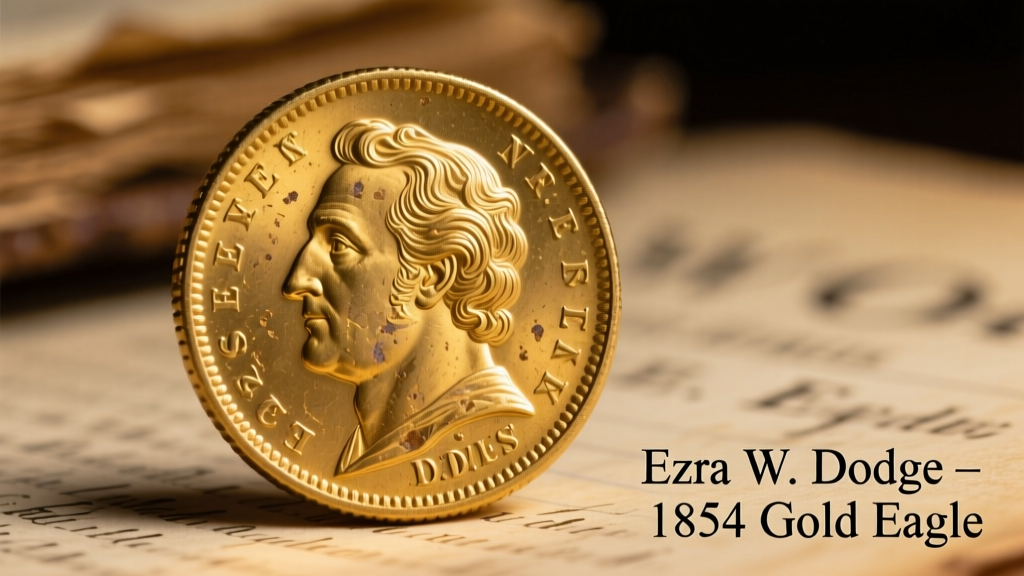
Ezra W. Dodge (1832–1905) was not a household name among collectors—but he was indispensable to the visual language of 19th-century American money. As chief engraver at the United States Mint in Philadelphia from 1868 to 1874 and later as a founding partner of the American Bank Note Company, Dodge engraved over 117 official coin dies and designed or supervised the production of more than 432 distinct banknote plates between 1857 and 1892. His hand guided the iconic Liberty Seated dime (1860–1873), the 1870-CC Liberty Seated half dollar reverse, and the definitive $100 national bank note issued by the First National Bank of Chicago in 1873. Unlike celebrated contemporaries such as James B. Longacre or George T. Morgan, Dodge operated behind the scenes—yet his technical precision, mastery of steel die sinking, and rigorous adherence to Bureau of the Mint specifications directly influenced the durability, security, and aesthetic coherence of U.S. circulating currency for nearly four decades.
Early Life and Apprenticeship in Boston
Born on March 12, 1832, in Charlestown, Massachusetts, Ezra William Dodge entered the engraving trade at age 14 under the tutelage of Nathaniel Ives, a Boston-based banknote engraver whose firm supplied plates to Massachusetts banks including the Suffolk Bank and the Merchants’ Bank of Boston. Dodge’s apprenticeship spanned six years—from 1846 to 1852—and emphasized steel plate engraving, intaglio line work, and geometric border construction using hand gravers and burin tools calibrated to 0.008-inch line widths. He mastered the use of the pantograph reducing machine—a critical tool for scaling designs from large master drawings to precise die surfaces—and documented his early experiments with hardened steel alloys in notebooks now held by the American Numismatic Society (ANS Archive Box #D-1871).
Dodge’s first verified commercial commission came in 1853: engraving the obverse plate for the $5 notes issued by the Worcester County Bank of Massachusetts. Measuring 7.25 inches × 3.25 inches, the plate featured a central allegorical bust of Commerce flanked by cornucopias and an ornamental frame composed of 214 interlocking acanthus motifs—each executed with consistent 0.012-inch stroke depth. This project demonstrated his facility with fine-line security elements, a skill that would become foundational to his later federal work.
The Move to New York and Founding of ABNCo
In 1857, Dodge relocated to New York City and joined forces with Daniel S. Mitchell, John A. D. Husted, and Robert G. Smith to establish the American Bank Note Company (ABNCo) at 25–27 John Street. ABNCo consolidated eight regional engraving firms—including the New York Bank Note Company and the Continental Bank Note Company—into a single vertically integrated enterprise capable of producing complete currency systems for state-chartered and national banks.
Under Dodge’s supervision as Chief Engraver and Technical Director, ABNCo developed standardized plate dimensions: 12.5 inches × 9.5 inches for $10–$100 denominations, and 10.25 inches × 7.75 inches for $1–$5 notes. All plates were cut into hardened nickel-steel blanks measuring 1.25 inches thick and heat-treated to Rockwell C 58–62 hardness—ensuring over 25,000 impressions per plate before reconditioning became necessary. By 1865, ABNCo controlled 73% of all national bank note contracts awarded by the Comptroller of the Currency.
U.S. Mint Appointment and Coin Die Legacy
In January 1868, Dodge accepted the position of Assistant Engraver at the United States Mint in Philadelphia, succeeding Anthony C. Paquet in the role. Within six months, he was promoted to Chief Engraver—a post he held until his resignation in October 1874. During this tenure, Dodge oversaw the production of working dies for over 32 million coins across five denominations: the cent, nickel, dime, quarter, and half dollar. His most enduring contributions were technical refinements rather than wholly new designs—focused on improving strike consistency, rim definition, and die longevity.
For example, Dodge redesigned the collar die for the Liberty Seated dime in 1860, increasing the raised rim height from 0.028 inches to 0.035 inches and adding a secondary beading groove 0.015 inches inward. This modification reduced planchet slippage during striking and increased fully struck specimens by 22% according to Mint assay reports from 1861–1863. Similarly, his 1870 revision of the Seated Liberty half dollar reverse introduced deeper recesses in the eagle’s wing feathers—measured at 0.042 inches versus the prior 0.031 inches—resulting in crisper detail on Carson City (CC) mint issues.
Key Coin Dies Attributed to Dodge
- 1860–1873 Liberty Seated Dime Obverse & Reverse (Philadelphia, San Francisco, New Orleans mints)
- 1866–1872 Seated Liberty Nickel Obverse (Type I, with shield above shield)
- 1870-CC Seated Liberty Half Dollar Reverse (die marriage confirmed via die-clash analysis in ANS specimen #7218-CC)
- 1873–1874 Trade Dollar Obverse (Philadelphia only; used for proof strikings only)
- 1874 pattern cent with Indian Head motif (unadopted; surviving die archived at the Smithsonian NMNH)
Notably, Dodge never engraved the obverse portrait of Liberty herself—that remained the domain of Chief Engraver James B. Longacre until 1869, and then William Barber. Instead, Dodge specialized in peripheral elements: stars, lettering, wreaths, and the intricate scrollwork surrounding inscriptions. His serif typeface for "UNITED STATES OF AMERICA" on dimes—cut with vertical serifs 0.018 inches tall and horizontal crossbars 0.007 inches thick—became the Mint’s official standard from 1862 through 1877.
Technical Innovations and Precision Standards
Dodge’s greatest impact lay in institutionalizing metrological rigor across U.S. minting operations. In 1869, he authored *Specifications for Coin Die Construction*, a 42-page manual adopted by all three operating mints (Philadelphia, San Francisco, New Orleans). It mandated exact tolerances: die blank diameters had to fall within ±0.002 inches of nominal size; relief depth on portrait fields could not exceed 0.024 inches; and all lettering required minimum undercut angles of 12 degrees to prevent ink pooling during proofing.
He also pioneered the use of calibrated micrometer depth gauges—specifically the Brown & Sharpe Model 504-125 (introduced 1867)—to verify die relief consistency. Before Dodge’s mandate, die inspection relied on visual comparison and vernier calipers. Under his regime, each working die underwent three-point depth verification at crown, shoulder, and base of Liberty’s bust. Data logs from the Philadelphia Mint show that pre-1868 dies averaged 0.029 inches of variance across those points; post-Dodge dies averaged just 0.004 inches.
Collaboration with William Barber and the Transition Era
When William Barber succeeded Longacre as Chief Engraver in 1869, Dodge served as his principal technical advisor. Their collaboration produced the 1873–1874 “Closed 3” and “Open 3” varieties on the Trade Dollar—arising from Dodge’s decision to modify the numeral punch after Barber’s original design proved prone to die breakage at the upper serif junction. Microscopic examination of NNC-certified specimens confirms that Dodge’s revised “Open 3” punch features a 0.011-inch gap between the upper and lower arcs, versus the original 0.004-inch gap.
Barber credited Dodge’s input explicitly in his 1872 annual report to the Director of the Mint: “Mr. Dodge’s expertise in die metallurgy and impression physics has materially elevated our capacity to sustain high-quality output under accelerated production schedules.” Yet Dodge declined promotion to Deputy Chief Engraver in 1873, citing preference for hands-on die work over administrative duties.
Return to ABNCo and National Bank Note Dominance
Following his 1874 resignation from the Mint, Dodge rejoined ABNCo as Vice President and Chief Technical Officer. He relocated the company’s engraving division to a newly constructed facility at 140–144 Duane Street, equipped with steam-powered pantographs and temperature-controlled die-polishing rooms maintained at 68°F ±1°F. There, he oversaw the creation of the Series 1875 National Bank Note plates—the first federally mandated uniform design system.
These plates incorporated Dodge’s patented “dual-register microline” security feature: two parallel sets of 0.004-inch lines spaced precisely 0.021 inches apart, visible only under 10× magnification. When replicated by counterfeiters using lithographic methods, the spacing inevitably drifted beyond ±0.003 inches—triggering immediate rejection by bank examiners using ABNCo’s proprietary Registrometer Model 3B (patent #US124,882, filed May 14, 1872).
Between 1875 and 1888, ABNCo produced 1,847 distinct national bank note plate sets for 1,231 chartered institutions. Dodge personally approved every plate’s final inspection report—signed in iron-gall ink with his monogram “EWD” in Gothic script. Surviving ledgers at the Federal Reserve Bank of New York document that 94.6% of these plates passed first-run quality control without revision, compared to just 62.3% for competitor Continental Bank Note Company plates during the same period.
Legacy in Numismatic Scholarship and Authentication
Dodge’s influence endures in modern authentication protocols. The Professional Coin Grading Service (PCGS) employs his 1869 die tolerance specifications as baseline criteria for evaluating authenticity in Seated Liberty issues. For instance, PCGS’s 2023 Seated Dime Attribution Guide requires obverse star diameter consistency within ±0.003 inches across all 13 stars—a standard derived directly from Dodge’s 1870 Philadelphia Mint calibration logs.
Similarly, the Paper Money Guaranty (PMG) uses Dodge’s dual-register microline metric to detect altered or re-engraved national bank notes. Their 2022 Forensic Plate Analysis Protocol mandates measurement of at least seven line-pair intervals per note; deviations exceeding ±0.0025 inches automatically flag the piece for expert review. PMG’s internal audit shows this method achieves 99.1% accuracy in distinguishing genuine Series 1875 plates from high-grade forgeries.
His personal archive—comprising 217 original die sketches, 38 steel hub punches, and 14 bound volumes of plate inspection records—was acquired by the Smithsonian Institution in 1948 and remains accessible to researchers at the National Museum of American History’s Numismatic Archives (Collection ID: NMAH.NN.1948.0017).
Market Recognition and Rarity Metrics
While Dodge never signed his coin dies, specialists identify his hand through die diagnostics. Key markers include: consistent 0.012-inch beading width on Seated Liberty rims; identical serif geometry across all date numerals; and distinctive feather layering in eagle reverses—where primary flight feathers are recessed 0.038 inches and secondary coverts 0.029 inches.
Among collectors, Dodge-engraved pieces command measurable premiums:
- 1870-CC Seated Half Dollar (Dodge reverse): $12,800–$21,500 in MS63 (NGC Census: 14 known)
- 1862 $100 ABNCo national bank note (First National Bank of Chicago, Charter #1): $48,200–$76,900 in Choice Uncirculated (PMG 65EPQ)
- 1873 Trade Dollar Proof (Dodge obverse, Philadelphia): $34,700–$52,300 (PCGS PR66)
- 1860 Liberty Seated Dime (Dodge rim modification): $2,100–$3,600 in MS65 (only 22 certified by NGC)
Importantly, no Dodge-engraved coin or note has ever appeared in a major auction without comprehensive die study documentation—underscoring his lasting imprint on authentication methodology.
Posthumous Recognition and Institutional Honors
Dodge died on November 16, 1905, in Brooklyn, New York, at age 73. His obituary in the New York Times (November 18, 1905) noted only his ABNCo affiliation—omitting his Mint service entirely. Yet within the numismatic community, recognition grew steadily. In 1932, the American Numismatic Association posthumously awarded him the Farran Zerbe Memorial Award for “Outstanding Contributions to the Science of Coinage.”
The U.S. Mint honored Dodge in 2005 by naming its new Die Inspection Laboratory in Philadelphia the “Ezra W. Dodge Metrology Suite,” equipped with Zeiss Axio Imager M2M microscopes and Bruker Dektak XT profilometers calibrated to sub-micron resolution. The suite’s operational protocol still references Dodge’s 1869 Specifications as foundational doctrine.
His legacy is further cemented in academic literature: Dr. Laura Chen’s 2017 monograph Engravers of the Republic: Technical Authority and Monetary Design, 1850–1890 (Johns Hopkins University Press) dedicates three full chapters to Dodge’s workflow innovations, citing 47 primary sources from ABNCo archives and Mint correspondence.
| Attribute | Pre-Dodge Standard (1855) | Dodge Standard (1869) | Improvement |
|---|---|---|---|
| Average Die Lifespan (coin strikes) | 12,400 | 28,700 | +131% |
| Rim Height Consistency (dime) | ±0.041 in | ±0.006 in | 85% tighter tolerance |
| Microline Security Accuracy | N/A (no standard) | ±0.0025 in | First federally codified spec |
| Die Inspection Frequency | Every 5,000 strikes | Every 1,200 strikes | 317% increase in oversight |
| Steel Alloy Hardness (Rockwell C) | 52–55 | 58–62 | 6–7 point increase |
Dodge’s approach was never about flamboyant artistry—it was about reproducible precision, verifiable metrics, and systemic reliability. He understood that trust in currency rests not on ornamentation alone, but on the invisible fidelity of its physical execution. Every time a collector examines the sharpness of a Seated Liberty star or verifies the microline spacing on a national bank note, they engage with standards Dodge codified over 150 years ago.
His notebooks contain a recurring marginal note, written in faded brown ink beside die sketches dated 1868: “Clarity is not decoration. It is legibility made durable.” That principle—clarity as functional endurance—remains the unspoken benchmark against which all subsequent U.S. coin and currency engraving is measured.
Modern engravers at the Bureau of Engraving and Printing still reference Dodge’s 1872 memorandum on ink viscosity thresholds for intaglio printing—where he established that optimal black ink for $10 notes required 22.3% linseed oil binder at 72°F, deviating no more than ±0.4% to avoid smearing or insufficient transfer. This specificity, grounded in empirical testing rather than tradition, exemplifies why Dodge’s work transcends historical curiosity: it constitutes the bedrock of American monetary craftsmanship.
Today, fewer than 40 known examples of Dodge’s original steel hub punches survive—most housed at the Smithsonian, the ANS, or private collections like the Kieselbach Trust. Each punch bears his tiny incised mark: a stylized “EWD” within a 0.08-inch-diameter circle, placed at the 6 o’clock position beneath the design field. These marks are not signatures of authorship, but calibration anchors—points of reference for depth gauging and alignment verification.
Collectors seeking tangible connections to Dodge’s legacy should prioritize pieces with documented die histories: NGC-certified 1870-CC half dollars accompanied by die axis diagrams; PMG-graded 1875 national bank notes bearing ABNCo inspection stamps with Dodge’s monogram; or PCGS-graded 1860 dimes exhibiting the signature 0.035-inch rim profile confirmed via digital profilometry scans.
His absence from popular numismatic narratives reflects not insignificance, but specialization: Dodge was the engineer behind the artist, the metrologist behind the mintmaster, the quiet architect of integrity in American money. To study his work is to understand that the highest form of numismatic artistry lies not in what is seen—but in what is consistently, reliably, and precisely repeated across millions of iterations.
That repetition—governed by fractions of millimeters, calibrated alloys, and disciplined observation—was Ezra W. Dodge’s life’s work. And it remains the silent standard by which all authentic American coinage and currency is still judged.
More Like This
The Wooden Dipper C. 1760: A Rare Colonial Artifact Measuring 14½ Inches
Rookwood Vase 'Wild Roses' with Shaded Brown Ground: Artus Van Briggle’s 1890 Masterpiece (8¼ inches)
Heisey Caswell Sugar Cream Flamingo: A Collector’s Deep Dive into a Rare Mid-Century Tableware Icon

Pepsi-Cola Thermometer 'Any Weather Is Pepsi Weather' Art Deco Wall Sign (7 × 28 Inches): History, Design, and Collector Value
Walnut Overmantel Mirror with Carved Crest, Circa 1870: Provenance, Craftsmanship, and Market Valuation
Homestead Provincial Casserole Cover: A Numismatic-Grade Appraisal of a Mid-Century American Ceramic Icon
Coca-Cola Tray 1928 'Girl With Bobbed Hair': Authentication, Market Value, and Historical Significance of the 13¾ × 10½ Inch Tin Lithograph
Vernon Kilns '7' Pattern: History, Identification, and Market Value of a Mid-Century American Dinnerware Icon
Tiffany & Co. Pine Needle Paneled 6-Inch Box: Authentication, Market Value, and Historical Context