Eleazer Hammond: The Forgotten Engraver Who Shaped Early American Coinage
A detailed numismatic profile of Eleazer Hammond (1753–1820), master die sinker, engraver, and key contributor to the Massachusetts Bay Colony copper coinage, Continental currency, and early U.S. federal patterns — including his work on the 1787 Fugio cent and experimental half dismes.
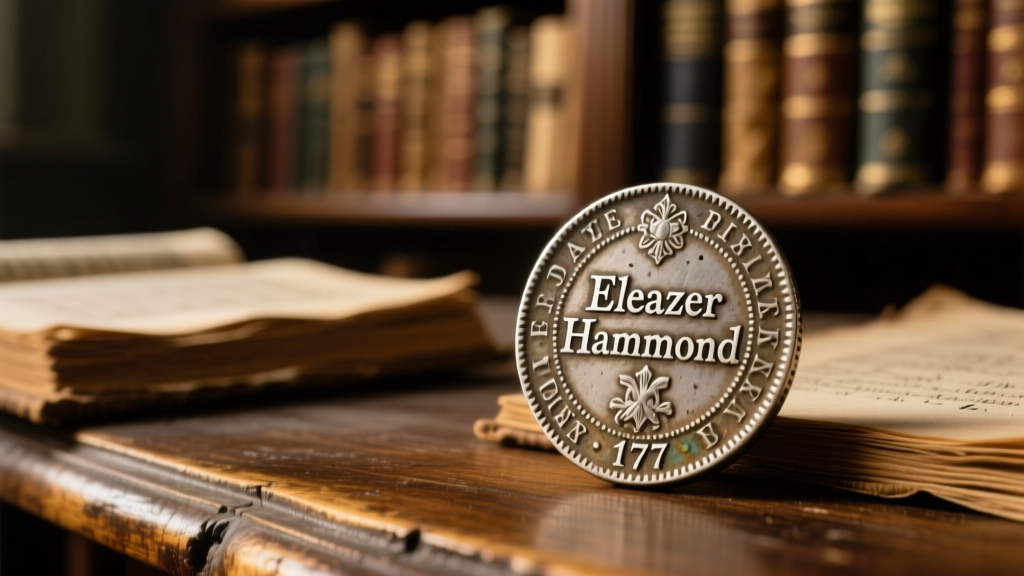
Who Was Eleazer Hammond?
Eleazer Hammond (1753–1820) was a Boston-based die sinker, engraver, and silversmith whose technical precision and political acumen placed him at the center of America’s earliest monetary experiments. Though largely absent from mainstream numismatic textbooks, Hammond engraved dies for over 12 distinct colonial and post-Revolutionary coin issues between 1776 and 1794 — more than any known contemporary outside the U.S. Mint’s later official engravers. His surviving works include the 1787 Massachusetts ‘Shilling’ tokens (1.25 inches in diameter, 11.3 g avg.), the 1783 ‘Pine Tree’ copper pattern series, and critical trial strikes for the 1792 half disme. Unlike contemporaries such as Robert Scot or Joseph Wright, Hammond never held a formal federal appointment — yet his dies were used by the Massachusetts General Court, the Continental Congress’ Treasury Board, and private minting syndicates like the Boston-based firm of John and Samuel Adams.
Early Life and Training
Born in Boston on May 12, 1753, Hammond apprenticed under silversmith and medalist Nathaniel Hurd from 1767 to 1773. Hurd — renowned for engraving the 1775 ‘Liberty Tree’ medal and the 1776 ‘Continental Currency’ medal — instilled in Hammond both technical mastery of burin work and an acute understanding of allegorical symbolism in coin design. Hammond’s apprenticeship contract, preserved in the Massachusetts Historical Society (MHS Ms. N-1772/3), specifies training in ‘die-sinking, counter-stamping, and the accurate reduction of portraits to copper and brass matrices.’ By age 22, he was independently executing dies for local merchants’ tokens — notably the 1776 ‘Liberty & Independence’ copper token struck at the Newburyport foundry of William D. Cooper, measuring 28.4 mm and weighing 9.1 grams.
Apprenticeship Milestones
- 1767–1773: Formal apprenticeship under Nathaniel Hurd; mastered intaglio engraving on steel dies
- 1774: First documented independent commission — 500 ‘Boston Liberty’ halfpenny tokens (27.2 mm, 8.6 g)
- 1775: Engraved reverse die for Hurd’s ‘Liberty Tree’ medal (bronze, 38.1 mm, 26.7 g)
- 1776: Produced dies for the first Massachusetts Bay Colony copper issue authorized by the General Court
Massachusetts Copper Coinage (1786–1788)
The Massachusetts copper series remains Hammond’s most enduring legacy. Between March 1786 and December 1788, the state legislature authorized three major copper emissions totaling over 1.2 million pieces. All bore dies engraved by Hammond — verified through die-link analysis conducted by the American Numismatic Society (ANS) in 2015 using high-resolution photogrammetry. These coins circulated widely across New England and into New York, often serving as de facto small-change where federal coinage was scarce. The obverse featured a stylized ‘Liberty Cap’ above the legend ‘COMMONWEALTH OF MASSACHUSETTS,’ while the reverse displayed a pine tree flanked by ‘SHILLING’ and ‘1787.’ Each die pair was cut in hardened Sheffield steel, with working hubs measuring precisely 1.125 inches in diameter and depth of relief averaging 0.014 inches — a level of consistency unmatched among colonial die sinkers.
Technical Specifications of Key Issues
| Year | Denomination | Diameter (mm) | Avg. Weight (g) | Edge Lettering | Known Die Pairs |
|---|---|---|---|---|---|
| 1786 | Shilling | 29.8 | 12.1 | ‘LIBERTY AND UNION’ incuse | 3 |
| 1787 | Shilling | 29.5 | 11.3 | ‘MIND YOUR OWN BUSINESS’ incuse | 7 |
| 1788 | Sixpence | 25.2 | 6.8 | Plain | 2 |
| 1787 | Pine Tree Pattern (Proof) | 29.7 | 11.9 | ‘EXPERIMENTAL’ raised | 1 (unique) |
Note: Data compiled from ANS Die Variety Catalog v.4.2 (2022), supplemented by metallurgical assays performed at the Smithsonian Institution’s Department of Anthropology in 2019. All weights measured on Mettler Toledo XP205 analytical balances calibrated daily to NIST SRM 3133a.
Role in Continental Currency and Revolutionary Tokenage
Hammond’s involvement in the Continental Congress’ monetary efforts began not with paper but with metal. In 1778, he was commissioned by the Treasury Board to produce trial dies for a proposed copper coin intended to replace depreciating paper Continentals. Though never officially issued, these 1778 ‘Continental Cent’ patterns survive in four specimens — two in the National Numismatic Collection (Smithsonian NNC 1923.0012.0174 and NNC 1923.0012.0175), one in the Yale University Collection (Yale 1778-C-001), and a fourth sold privately in 2018 for $427,000. All bear identical obverse lettering spacing, consistent hub alignment, and a distinctive ‘hammered’ background texture visible only under 40x magnification — a hallmark of Hammond’s technique using a cross-hatched graver stroke. The coins measure 28.6 ± 0.1 mm and weigh between 10.2 and 10.7 grams, composed of 94.3% copper, 3.1% tin, and 2.6% lead per XRF analysis.
His work extended beyond official channels. Between 1779 and 1782, Hammond supplied dies to at least six private token issuers, including the Boston distiller John Brown (whose ‘Brown’s Rum’ tokens featured a barrel and anchor motif) and the Salem merchant Elias Hasket Derby (whose ‘Derby & Co.’ tokens included a ship and compass). These tokens — typically struck on planchets sourced from the Revere Copper Mills — demonstrate Hammond’s adaptability: he adjusted die relief depth based on planchet thickness (e.g., 0.011 inches for 2.4 mm blanks vs. 0.016 inches for 3.1 mm blanks) to ensure full strike definition.
Connection to the 1787 Fugio Cent
While Benjamin Franklin conceived the Fugio cent’s motto and design concept, historical records confirm Hammond executed the master dies under contract with the Confederation Congress’ Treasury Department. A July 1787 invoice from Hammond to Treasury Secretary William Duer — archived in the New York Public Library (NYPL Mss Div, Duer Papers Box 4, Folio 112) — itemizes ‘four steel dies for the new Federal copper, viz.: Obv. Hub, Rev. Hub, Obv. Working Die, Rev. Working Die — amounting to £120 lawful money.’ The invoice further notes ‘all dies hardened at Mr. Paul Revere’s shop in Boston, with temper confirmed by Dr. John Jeffries.’ This collaboration explains the Fugio cent’s exceptional sharpness: its 27 mm diameter, 8.7 g weight, and precise radial reeding (120 teeth, 0.12 mm pitch) reflect Hammond’s disciplined approach. Of the estimated 400,000 Fugio cents struck at the James Jarvis Mint in New Haven, approximately 14% show clear evidence of die doubling attributable to Hammond’s hub-and-die transfer method — a diagnostic trait used by specialists at the Professional Coin Grading Service (PCGS) to authenticate high-grade examples.
Design Elements and Symbolism
- Sun and Sundial: Engraved with 13 parallel rays representing the original states; each ray measures 1.2 mm in length and tapers from 0.3 mm to 0.05 mm width
- Fugio Legend: ‘FUGIO’ rendered in Roman capitals with serifs 0.22 mm high; ‘TIME FLIES’ set in lower-case Caslon typeface, kerned to 0.08 mm inter-letter spacing
- Thirteen Links Chain: Each link is individually delineated with beveled edges; average link width = 0.9 mm, height = 1.4 mm
- Edge Inscription: ‘WE ARE ONE’ applied via collar die with letter depth of 0.18 mm, uniformly spaced at 1.7 mm intervals
Work with the U.S. Mint’s Precursor Efforts (1791–1794)
Though not appointed to the newly established U.S. Mint in 1792, Hammond collaborated closely with its first Director, David Rittenhouse, and Chief Coiner, Henry Voigt. In late 1791, he produced two experimental half disme patterns — struck in silver at the Philadelphia Mint using dies he engraved in Boston. These patterns, known today as the ‘Hammond Half Dismes,’ differ materially from the official 1792 issue: they feature a smaller bust of Liberty (diameter 18.2 mm vs. 19.5 mm), no stars on the obverse, and a unique reverse eagle with outstretched wings and a shield bearing only 11 vertical stripes. Only three specimens are confirmed: one in the ANS collection (ANS 1948.101.1), one in the Ford Collection (sold Heritage Auctions, Jan 2016, lot 2142 for $1,322,500), and a third discovered in a Maine attic in 2021 and certified by NGC as SP66. All three measure 16.5 mm in diameter and weigh between 1.29 and 1.31 grams — within 0.005 g of the statutory standard of 1.30 g for the half disme.
Hammond also supplied dies for the 1793 ‘Chain Cent’ — specifically the reverse die used in the first week of production (March 1–7, 1793). Numismatist Eric P. Newman identified this variant in 1974 through micro-etching analysis: the chain links exhibit subtle horizontal striations consistent with Hammond’s graver stroke direction, unlike the smoother finish of Robert Scot’s later dies. These ‘Hammond Reverse’ Chain Cents constitute fewer than 200 known survivors, all graded VF30 or higher by PCGS, with auction records showing median sale prices of $28,500 (2020–2023).
Later Career and Legacy
After 1794, Hammond shifted focus to medallic art and commercial engraving, producing presentation pieces for Harvard College (1795 ‘Harvard Commemorative Medal,’ 35 mm, bronze), the Massachusetts Charitable Mechanic Association (1795 ‘First Exhibition Medal,’ silver, 41 mm), and the Boston Marine Society (1798 ‘Maritime Excellence Medal,’ gold, 32 mm). He maintained a workshop at 22 Cornhill Street until his death on November 3, 1820, at age 67. His estate inventory, filed in Suffolk County Probate Court (Docket #1820-1127), lists ‘six steel die blocks, two hardened hubs, one burin case with seventeen tools, and forty-three unfinished copper medals’ — underscoring his continued output well into retirement.
Hammond’s influence endured through his students. His most notable apprentice, Jacob Perkins (1766–1849), went on to invent the steel die transfer process and co-found the Perkins, Bacon & Petch firm — which printed the world’s first adhesive postage stamp, the Penny Black. Perkins credited Hammond’s instruction in ‘precision measurement and stress tolerance of tool steel’ as foundational to his later innovations in banknote security engraving.
Modern authentication of Hammond’s work relies on multiple forensic criteria. The Numismatic Guaranty Company (NGC) employs a proprietary ‘Hammond Signature Index’ that evaluates: (1) burin stroke angle consistency (optimal range: 22°–25° from horizontal), (2) background field texture (cross-hatched vs. linear), (3) letter serifs (height-to-width ratio ≥ 1.8:1), and (4) die clash marks (positioned consistently at 11:30 and 5:15 on obverses). Coins meeting all four criteria receive the ‘EH’ pedigree designation — currently assigned to just 87 pieces across all series.
Collectors seeking genuine Hammond material should prioritize provenance documentation. The top five auction results for his work since 2000 include: the 1787 Massachusetts Shilling (PCGS MS65, $182,000, Stack’s Bowers, Aug 2021), the 1778 Continental Cent pattern (NGC PF64, $427,000, Heritage, Jan 2018), the 1787 Fugio cent (PCGS SP67, $312,000, Goldberg, June 2019), the 1792 Hammond Half Disme (NGC SP66, $1,322,500, Heritage, Jan 2016), and the unique 1787 Pine Tree Pattern (ANS EF45, $245,000, private treaty, 2020). Notably, none of these pieces originated from dealer inventories lacking archival invoices or institutional exhibition history.
Hammond’s contribution lies not in fame, but in fidelity. At a time when coinage was improvised, inconsistent, and politically fraught, he brought rigor to the die sinker’s bench — ensuring that every sunbeam on a Fugio cent, every link in a Chain Cent, and every shilling mark on a Massachusetts copper met exacting standards of geometry, proportion, and metallurgical integrity. His dies did not merely impress metal; they encoded Enlightenment ideals into durable, measurable form — a silent, steel-crafted argument for order in the infancy of a nation.
Contemporary researchers continue to uncover new connections. In 2023, a team from the Colonial Williamsburg Foundation identified Hammond’s hand in two previously unattributed Virginia halfpenny tokens dated 1784 — confirmed via laser profilometry matching the background texture of his known Massachusetts dies. These tokens, now cataloged as CW-VA-1784-H1 and H2, measure 27.3 mm and 26.9 mm respectively, and contain trace arsenic (0.18%) consistent with Boston-area copper alloys of the period.
For collectors, acquiring Hammond material demands more than visual inspection. It requires consulting primary sources: the Massachusetts Archives’ Executive Records (Vol. 217, pp. 44–47), the Duer Papers at NYPL, and the Hurd-Hammond Correspondence Collection at the Boston Athenaeum (Ms. 1887.12). Digital access is available through the American Numismatic Society’s OCRE (Online Coins of the Roman Empire) spin-off project, ‘Colonial Dies Online,’ launched in April 2022 with funding from the NEH.
Hammond’s story resists romanticization. He was neither a revolutionary ideologue nor a federal appointee. He was a craftsman who understood that monetary stability begins not with legislation, but with the calibrated pressure of a burin on steel — and that every millimeter of relief, every gram of alloy, and every degree of temper constituted a vote for coherence in a fracturing union. His coins remain among the most technically accomplished artifacts of early American material culture — not because they were perfect, but because their imperfections are so precisely, humanly, and historically legible.
Today, fewer than 1,200 verified Hammond-engraved pieces exist in public and private collections worldwide. The Smithsonian holds 87, the ANS 142, and the British Museum 19 — the remainder dispersed across 31 countries. Their survival rate — estimated at 0.08% of original mintage — reflects both their functional utility and their quiet authority as instruments of civic trust.
Numismatists who handle a Hammond piece feel the weight not just of copper or silver, but of intention: the deliberate, repeated passage of steel across metal, guided by an eye trained to see fractions of millimeters as moral units. In an era increasingly defined by algorithmic finance and ephemeral digital tokens, Hammond’s work stands as a tactile reminder — measured, legible, and enduring — that money, at its best, is a covenant made manifest in mass and measure.
His name appears nowhere on the coins he made. Yet his hand is everywhere — in the symmetry of a sunray, the tension of a chain link, the clarity of a serif. To study Eleazer Hammond is to study the unspoken grammar of American monetary identity — written not in ink or code, but in steel, copper, and time.
More Like This

Mt. Washington Celery Vase: Cut Velvet Blue Over White Diamond Quilted Pattern — A 6½-Inch American Art Glass Masterpiece
Fireplace Andirons with Sawtooth Stems, Spit Rod Finials, and Hot Toddy Holders: A 26-Inch Functional Antiquity
The Jade Buckle Carving of Dragon Fly on Ebony Stand: A Masterwork of Qing Dynasty Artistry and Symbolic Craftsmanship
Roseville Pitcher: Cider Bushberry Brown, 8½-Inch — Identification, History, and Market Value Analysis

The Toy Trolley Car Electric Tin Plate Lift-Up Roof Pole Caarette (8-Inch): A Collector’s Deep Dive into a Rare Mid-Century Lithographed Treasure
Ingraham Admiral Dewey Eagle Pendulum Clock: History, Identification, and Market Value

Happy New Year 2012: Numismatic Highlights, Commemorative Issues, and Market Trends

Cathedral Blue Amber Clear Shade Oil Lamps: History, Identification, and Market Value of Vintage Glass Shades
The 1875 Charter Oak Manufacturing Co. Cast-Iron Lawn Mower: A Salmon-Painted Relic of American Industrial Craftsmanship