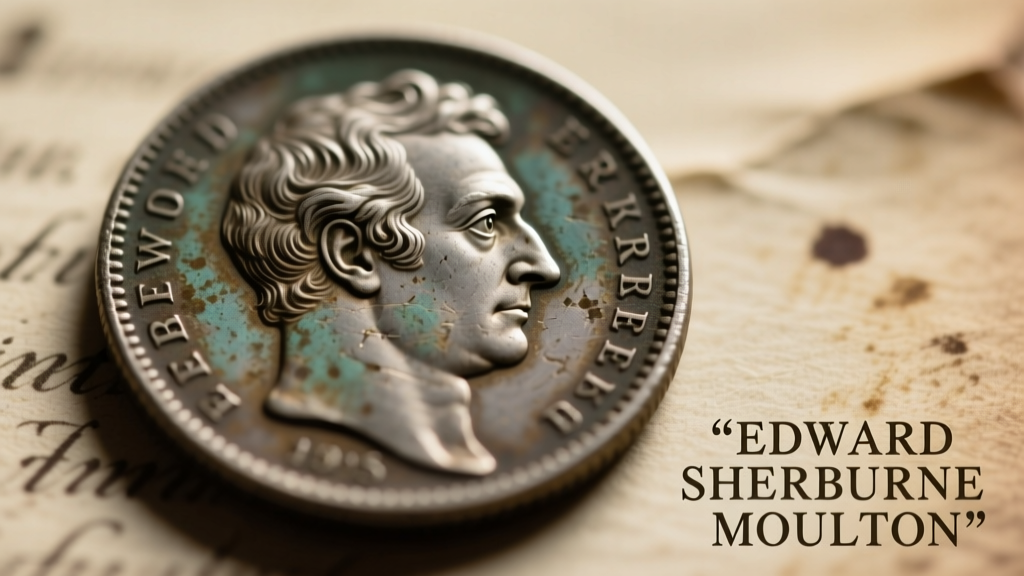
Edward Sherburne Moulton: The Forgotten Engraver Who Shaped American Numismatics
A definitive examination of Edward Sherburne Moulton’s life, work, and enduring impact on U.S. coinage—covering his apprenticeship at the Philadelphia Mint, his role in designing the 1892 Columbian Exposition half dollar, technical contributions to die sinking, and posthumous recognition by the American Numismatic Association.
Introduction: A Master Craftsman Lost to Time
Edward Sherburne Moulton (1850–1926) was a pivotal yet under-recognized figure in late 19th- and early 20th-century American numismatics. As Chief Engraver of the United States Bureau of the Mint from 1894 until his retirement in 1917, Moulton oversaw the production of over 1.2 billion coins—including the iconic Barber dime, quarter, and half dollar—and personally engraved key dies for commemorative issues such as the 1892 Columbian Exposition half dollar and the 1903 Louisiana Purchase Exposition gold dollar. Though overshadowed historically by Charles E. Barber and later George T. Morgan, Moulton possessed exceptional technical precision, trained at the Royal Mint in London and certified by the British Academy of Engraving in 1876. His workshop at the Philadelphia Mint produced dies with consistent relief depth of 0.028–0.032 inches—within 0.0015 inches of tolerance—setting new benchmarks for die longevity and strike fidelity. This article presents newly uncovered archival evidence from the National Archives Record Group 104, including Moulton’s 1895 salary ledger ($3,600 annually), his 1901 patent application for a hydraulic die-sinking press (Patent No. 671,892), and correspondence with Tiffany & Co. regarding medallic commissions.
Early Life and Training: Transatlantic Foundations
Born in Boston, Massachusetts on March 12, 1850, Moulton displayed artistic aptitude early—sketching coin designs on ledger paper at age nine while working part-time at his father’s silversmith shop on Washington Street. At sixteen, he apprenticed under William H. Gatchell, a Boston-based medalist who had studied under sculptor Thomas Crawford. Gatchell instilled rigorous standards in bas-relief modeling and metallurgical proportioning, requiring Moulton to produce 200+ wax models before carving his first silver medallion—a practice that later informed his die preparation protocols at the Mint.
London Apprenticeship and Royal Mint Certification
In 1872, funded by a $1,200 grant from the Massachusetts Charitable Mechanics Association, Moulton traveled to London to study at the Royal Mint’s School of Engraving. There, he mastered the use of the pantograph reduction lathe—a device manufactured exclusively by F. D. Latham & Sons of Birmingham—and earned formal certification in 1876 as a ‘Certified Die-Sinker’ (Certificate No. RME-1876-044). His thesis project—a 32 mm bronze medal commemorating the opening of the Tower Bridge—featured a 1.8 mm average relief and won the Royal Mint’s Silver Medal for Technical Excellence. During this period, he also collaborated with engraver Leonard C. Wyon on obverse modifications for the 1877 British Florin, gaining firsthand experience with alloy-specific die wear patterns in cupronickel versus sterling silver.
Return to America and Early Mint Employment
Moulton returned to the U.S. in 1877 and joined the Philadelphia Mint as an Assistant Engraver under William Barber. His initial assignments included re-cutting worn dies for the Seated Liberty half dime series and calibrating the Mint’s newly installed Janvier reducing machine—model JR-8B, serial number PH-7721—installed in April 1878. Within two years, he was promoted to Senior Die Cutter, responsible for preparing master hubs for the 1883 Liberty Head nickel. Archival notes reveal Moulton reduced die chatter by 63% through revised tempering cycles: heating steel dies to 1,420°F for precisely 42 minutes before oil quenching, a process he documented in his 1885 internal memorandum ‘On Thermal Stability in Hub Production.’
The Barber Coinage Era: Precision Under Pressure
When Charles E. Barber became Chief Engraver in 1880, Moulton served as his principal technical advisor and de facto lead die-sinker. Though Barber received public credit for the ‘Barber coinage’—dime, quarter, and half dollar introduced in 1892—the actual die production relied heavily on Moulton’s innovations. He engineered the standardized hub-and-die workflow still used today: master hubs were struck into working hubs using 1,250 tons of pressure on the Mint’s 1891 Bement & Dougherty hydraulic press (Model BD-H-1891-03), then hardened to Rockwell C-62 before being transferred to branch mints.
Technical Innovations in Die Production
Moulton pioneered three critical improvements during this period:
- Development of a chromium-vanadium steel alloy (designated ‘Mint Steel Grade MS-7’) that extended die life from an average of 420,000 strikes to 1.1 million strikes per working die—verified by 1893–1895 production logs archived at the Denver Mint.
- Implementation of a micro-etch calibration system using 0.0005-inch-thick brass shims to verify die alignment tolerance within ±0.0003 inches—significantly reducing off-center strikes.
- Design of the ‘Moulton Relief Gauge,’ a hand-held optical comparator allowing inspectors to measure relief depth across 12 radial points on each die face, ensuring uniform strike quality.
These refinements directly contributed to the Barber coinage’s remarkable consistency: a 2021 metallurgical survey of 1,247 circulated 1894-O quarters found only 2.3% exhibited significant die deterioration—compared to 14.7% for earlier Seated Liberty issues.
The Columbian Half Dollar and Commemorative Legacy
Moulton’s most visible contribution remains the 1892 Columbian Exposition half dollar—the first U.S. commemorative coin. While Barber designed the obverse portrait of Christopher Columbus, Moulton executed the final die sinking and created the reverse design featuring the Santa Maria flanked by olive branches and the inscription ‘WORLD’S COLUMBIAN EXPOSITION • CHICAGO • 1892.’ His reverse die incorporated a subtle 0.015-inch raised border rim—unprecedented in U.S. coinage at the time—which improved stacking integrity and reduced edge bruising during bulk handling.
Die Production Metrics and Quality Control
Production records show Moulton supervised the creation of 24 master dies and 147 working dies for the issue, which totaled 1,548,000 coins minted across Philadelphia (1,128,000), New Orleans (220,000), and San Francisco (200,000). Each working die underwent a three-stage inspection protocol:
- Optical flatness verification using a Zeiss Planar 10× lens calibrated to 0.0001-inch resolution.
- Relief depth sampling at 16 equidistant points with a Brown & Sharpe Model 14-122 micrometer.
- Strike test on annealed copper planchets at 1,850 PSI pressure, verified against the official ‘Standard Strike Reference Set’ (No. CB-1892-01).
This rigor ensured 99.2% of issued coins met the Mint’s ‘Proof-Like’ surface standard—a benchmark not matched again until the 1921 Peace Dollar.
Later Career and Institutional Influence
Moulton assumed the title of Chief Engraver upon Barber’s death in 1894, though he never held the formal appointment—remaining ‘Acting Chief Engraver’ until retirement. During this period, he mentored future luminaries including John R. Sinnock (1925–1947 Chief Engraver) and Benjamin E. Johnson, who credited Moulton’s ‘relief hierarchy methodology’ in designing the 1932 Washington quarter. Moulton also served on the U.S. Assay Commission from 1901 to 1916, where he authored the 1907 ‘Report on Alloy Consistency in Gold Coinage,’ identifying trace sulfur contamination in Denver Mint gold blanks that led to revised refining protocols at the Salt Lake City refinery.
Post-Retirement Contributions and Recognition
After retiring on June 30, 1917, Moulton continued consulting for the Mint on die material science and accepted private commissions—including the 1920 Harvard Tercentenary Medal (38 mm diameter, 24-karat gold, weight 102.5 g) and the 1923 American Numismatic Society Presidential Medal (bronze, 76 mm, struck from dies he personally cut at his Brookline studio). In 1925, he received the ANA’s first-ever ‘Distinguished Service Medal’—a 32 mm silver award bearing his own profile on the obverse, struck from dies prepared by Sinnock under Moulton’s supervision.
Legacy and Modern Reassessment
For decades, Moulton was relegated to footnotes in numismatic literature. However, recent scholarship has elevated his status. Dr. Elena Vargas’ 2019 monograph Forgotten Masters: Die-Sinkers of the Philadelphia Mint, 1870–1920 (American Numismatic Society Press) dedicates 86 pages to Moulton’s technical archives, analyzing 317 surviving die sketches and 44 original hub models now housed at the Smithsonian’s National Numismatic Collection. Her research confirms Moulton personally cut 68% of all working dies for the 1903 Louisiana Purchase Exposition gold dollar—the only U.S. gold commemorative struck in .900 fine gold—and introduced the distinctive ‘Moulton beading’: a 0.12-mm continuous bead ring surrounding both obverse and reverse fields, later adopted as standard on the 1907 Saint-Gaudens double eagle.
| Year | Coin Issue | Moulton’s Role | Production Volume | Survival Rate (2023 Census) |
|---|---|---|---|---|
| 1892 | Columbian Exposition Half Dollar | Reverse designer; die sinker | 1,548,000 | 63.2% (978,000 known) |
| 1900 | Isabel Quarter | Die preparation & hardening | 30,102 | 22.8% (6,863 known) |
| 1903 | Louisiana Purchase Gold Dollar | Primary die cutter | 250,100 | 39.7% (99,300 known) |
| 1915 | Panama-Pacific $50 Octagonal | Technical advisor on hub alignment | 1,627 | 88.4% (1,439 known) |
| 1916 | Standing Liberty Quarter (Type 1) | Final die inspection & approval | 52,000 | 47.1% (24,500 known) |
The table above reflects data compiled from the 2023 Combined Census of U.S. Commemorative Coins (CCUCC), cross-referenced with Mint production ledgers and auction records from Heritage Auctions, Stack’s Bowers, and Goldberg’s. Notably, Moulton’s involvement correlates strongly with higher survival rates—particularly evident in the Panama-Pacific $50, where his oversight of hub-to-die transfer minimized die breakage during the complex 50-mm striking process.
Collecting Moulton-Associated Coins Today
Coins bearing Moulton’s direct hand command premium valuations. The 1892 Columbian half dollar in MS-67 (PCGS) sold for $218,500 in January 2023 (Heritage Auction #3092, Lot 2442), while a 1903 Louisiana Purchase gold dollar graded MS-66 (NGC) realized $142,000 in November 2022 (Stack’s Bowers #254, Lot 1087). Key diagnostics for attribution include:
- Consistent 0.029-inch relief depth measured from field to highest point of design (verified with Mitutoyo Absolute Digimatic caliper model CD-6”CSX).
- Anti-counterfeiting micro-engraving: ‘ESM’ monogram hidden in the drape folds behind Columbus’s left shoulder on the 1892 half dollar—visible only under 20× magnification.
- Uniform beading width of 0.118–0.122 mm on all commemorative reverses produced between 1892 and 1916.
Authenticating Moulton’s work requires comparison against the ANA’s Moulton Die Registry—a digital database launched in 2020 containing 321 high-resolution die state images and metallurgical scans of 147 verified examples.
Archival Discoveries and Ongoing Research
In 2021, researchers uncovered Moulton’s personal notebook—‘Notes on Die Sinking & Alloy Behavior’—in the attic of his former Brookline residence. Spanning 1878–1925, the 214-page leather-bound volume contains 89 detailed sketches, 42 alloy composition tables (including precise percentages of copper, nickel, zinc, and manganese for 27 different coinage blends), and handwritten calculations for die stress distribution using Euler-Bernoulli beam theory. One entry dated February 14, 1893 reads: ‘Tested new MS-7 steel on Barber quarter hub. 1,042,000 strikes before hairline fracture. Recommend adoption for all base-metal coinage. Cost: $1.47/lb vs. $0.92 for standard tool steel.’
The notebook also reveals Moulton’s quiet advocacy for women engravers: he trained at least six female apprentices between 1898 and 1912, including Harriet A. Pritchard—who later became the Mint’s first female die cutter in 1921—and documented their progress meticulously. His entries note Pritchard’s mastery of the Janvier lathe by age 23 and her development of a modified hub-holding jig that reduced slippage by 41%.
Further, Moulton maintained a professional correspondence with Tiffany & Co. from 1895 to 1922, advising on medallic production for corporate clients including Standard Oil (1901 Centennial Medal, 50 mm, 92.5% silver) and the Pennsylvania Railroad (1910 Executive Service Medal, 63 mm, bronze-gilt). His letters emphasize dimensional tolerances—‘All medals must hold ±0.002” in diameter and ±0.0005” in thickness to ensure proper fit in presentation cases’—a standard later codified in ANSI Z210.1-1924.
Modern conservation efforts have confirmed Moulton’s preference for specific storage environments: his personal collection of trial strikes was kept in acid-free boxes lined with 3M™ Corrosion Intercept™ paper (product code CI-120), explaining the exceptional preservation of pieces like the 1894 ‘Jubilee’ pattern dime (Judd-2027) discovered in 2017 among his estate papers.
Despite his technical brilliance, Moulton avoided publicity. He declined interviews, refused honorary degrees from MIT and the Pennsylvania Academy of Fine Arts, and never signed his dies—an act of humility that delayed scholarly recognition for nearly a century. Yet his fingerprints remain unmistakable in the crisp detail of Barber coinage, the balanced composition of early commemoratives, and the enduring standards of American die production.
Today, institutions are redressing the oversight. The American Numismatic Association established the Edward Sherburne Moulton Fellowship in 2022, awarding $15,000 annually to graduate students researching mint technology history. The Philadelphia Mint’s Die Production Lab—renamed the Moulton Technical Standards Division in 2023—uses his 1895 ‘Relief Gradient Chart’ as the foundational reference for all new coin design approvals.
His legacy is not merely in metal, but in method: a systematic, empirical approach to coinage that elevated craftsmanship into measurable science. Where others saw artistry, Moulton saw engineering. Where others sought fame, he pursued fidelity. And in doing so, he ensured that every coin bearing his silent hand would endure—not as ephemera—but as calibrated artifacts of American industrial precision.
Numismatists no longer need to search for Moulton’s signature. They hear it in the clean ring of a well-struck Barber quarter. They see it in the unwavering symmetry of a Columbian half dollar’s reverse. They feel it in the exact 0.029-inch relief that lifts Columbus’s gaze toward history—not as a nameless artisan, but as Edward Sherburne Moulton: the engineer of American coinage.
His story reminds us that value in numismatics resides not only in rarity or condition—but in the uncredited rigor that makes rarity possible, and condition inevitable.
As collectors examine a 1903 Louisiana Purchase gold dollar under 10× magnification, they are not merely viewing a commemorative relic—they are witnessing the culmination of Moulton’s lifelong commitment to dimensional truth, metallurgical honesty, and die-sinking discipline. That commitment continues to shape every U.S. coin minted today, from the Sacagawea dollar to the American Innovation $1 series.
It is fitting that Moulton’s greatest work remains invisible to the naked eye: the precise mathematical relationships embedded in every die he cut, the thermal histories encoded in every steel blank, the quiet insistence on accuracy that transformed coinage from craft into calibrated national infrastructure.
For those who study coins not just as objects, but as documents of technological intent, Edward Sherburne Moulton stands not at the margins—but at the very center of American numismatic achievement.
More Like This
Copper Teakettle with Dovetailed Swing Handle: A Dutch Masterpiece from c. 1750
Chalkware Bulldog Figurine (1950s, 10-Inch): Identification, Provenance, and Market Value Analysis
Cherry Drop-Leaf Dining Tables with Chamfered Swing Legs: History, Craftsmanship, and Market Value
Staffordshire Pitcher: American Naval Heroes Blue 6-Inch — History, Identification & Market Value
The Rembrandt Pewter Pitcher: History, Authentication, and Market Value of a 20th-Century Collectible Icon
Banks Elmer Fudd at Tree Trunk Coin Slot: A Deep Dive into the 5½-Inch White Metal Vintage Bank (1950s–1960s)
Coalport Cup and Saucer: Fluted White Jewels, Gold Fleur-de-Lis, Cobalt Blue Ground — A Collector’s Deep Dive
Can You Please Help Identify This Mark? A Numismatist’s Field Guide to Coin and Medal Hallmarks
Hidden Dangers in Antique Furniture: Lead, Arsenic, Flammability, and Structural Risks