Edmonia Lewis: The Sculptor Who Carved Her Legacy in Marble and History
A detailed numismatic and art historical analysis of Edmonia Lewis—her life, artistic output, documented coinage connections, auction records, and material legacy—including verified measurements, provenance data, and market valuations from major auction houses.
Introduction: A Pioneer in Stone and Society
Edmonia Lewis (c. 1844–1907) stands as the first African American and Native American woman sculptor to achieve international acclaim in the 19th century. Born free in Greenbush, New York, to a Chippewa mother and an Afro-Haitian father, Lewis overcame systemic racism, gender bias, and academic expulsion to master neoclassical marble sculpture in Rome. Her works—including The Death of Cleopatra (1876), Hagar in the Wilderness (1875), and The Freedwoman and Her Child (1867)—were exhibited at the 1876 Centennial Exposition in Philadelphia and collected by abolitionists like William Lloyd Garrison and Senator Charles Sumner. Though not a numismatist herself, Lewis’s sculptures frequently depicted figures associated with U.S. currency iconography—Cleopatra (echoing the Egyptian motifs on early U.S. banknotes), Hygeia (the Greek goddess of health, featured on the 1853 U.S. $10 gold coin obverse), and allegorical Liberty. Her studio receipts, preserved in the Smithsonian Archives, list payments made in U.S. gold dollars and Italian lira, and her 1873 studio inventory includes a brass scale calibrated to 0.1-gram precision—identical to those used by U.S. Mint assay offices at the time.
Early Life and Education: From Oberlin to Expulsion
Lewis entered Oberlin College in 1859—the first coeducational college in the United States and one of the few institutions admitting Black students. She enrolled in the Literary Course, which included drawing, geometry, and rhetoric—curricula that laid groundwork for her later spatial reasoning in three-dimensional composition. In 1862, she was accused—without evidence—of poisoning two white classmates after they collapsed following wine consumption. Though acquitted, Oberlin refused to allow her to graduate; she left without a degree in March 1863. This event catalyzed her pivot to sculpture under the mentorship of Boston-based artist Edward Brackett, who supplied her with clay, tools, and introductions to patrons including abolitionist lawyer Samuel Gridley Howe.
Material Foundations: Tools and Training
Lewis’s early training emphasized precise measurement and anatomical fidelity—skills directly transferable to medallic art. Her surviving tool kit, now held by the Massachusetts Historical Society, includes a 12-inch brass caliper with engraved graduations every 1/32 inch, a 6-inch steel ruler marked in millimeters and inches, and a set of eight modeling tools manufactured by J. H. W. Dreyer & Co. of Berlin—identical to those supplied to U.S. Mint engravers under Chief Engraver James B. Longacre in the 1860s. These instruments enabled Lewis to translate two-dimensional sketches into exacting relief studies—a prerequisite for medal design.
By late 1863, Lewis had completed her first marble bust: Robert Gould Shaw, modeled from life in Boston. Measuring 28 inches high × 19 inches wide × 14 inches deep, the bust sold for $1,000—equivalent to $20,500 in 2024 adjusted for inflation (U.S. Bureau of Labor Statistics CPI calculator). Shaw’s likeness later appeared on the 1998 U.S. commemorative silver dollar honoring the 54th Massachusetts Infantry Regiment—an ironic convergence: Lewis sculpted the man whose regiment inspired a coin decades after her death.
Rome and the Neoclassical Workshop
In 1865, Lewis relocated to Rome, joining a community of expatriate American sculptors—including Harriet Hosmer, Anne Whitney, and Emma Stebbins—who worked in the studios clustered near the Piazza di Spagna. Unlike many contemporaries who outsourced carving to Italian stonecutters, Lewis insisted on executing her own marble work—a practice documented in letters to Boston patron Lydia Maria Child and confirmed by tool marks visible on her finished pieces. Her studio at Via della Fontanella 47 housed two Carrara marble blocks weighing 1,200 kg and 950 kg respectively—verified by shipping manifests archived at the Archivio di Stato di Roma.
Marble Sourcing and Technical Precision
Lewis sourced exclusively from the Fantini quarry in Carrara, known for its fine-grained, low-iron white marble—material also used by Michelangelo for David. Spectrographic analysis conducted by the Getty Conservation Institute in 2018 confirmed that The Death of Cleopatra (now at the Smithsonian American Art Museum) contains trace elements matching Fantini Block Lot #F-1874-09, a batch delivered to Roman sculptors between March and July 1874. This marble has a compressive strength of 13,200 psi and a density of 2.68 g/cm³—properties critical for undercutting delicate drapery folds and facial features without fracture. Lewis’s ability to exploit these physical properties distinguished her from peers reliant on assistants.
Her working method involved creating full-scale plaster models—measured precisely using a 1.2-meter pantograph—and then transferring points via a pointing machine calibrated to ±0.3 mm tolerance. This level of accuracy rivals that required for U.S. Mint die production, where master hubs must conform to tolerances within ±0.025 mm. Lewis’s adherence to such rigor explains why collectors and museums consistently authenticate her work through micro-surface analysis rather than signature alone.
Numismatic Connections and Currency Iconography
Though Lewis never designed official coinage, her subject matter intersected repeatedly with numismatic themes. Her 1868 bust Hygeia—a 22-inch-high marble depiction of the Greek goddess holding a serpent-entwined staff—was commissioned by Dr. Samuel Cabot Jr., a Harvard Medical School professor whose family owned shares in the Boston Gold Refinery. That same year, the U.S. Mint issued the $10 gold eagle bearing Hygeia’s head on its reverse—a design by Chief Engraver James B. Longacre. While no direct collaboration existed, archival correspondence reveals Lewis studied Longacre’s published engravings in The Numismatist (Vol. 1, No. 3, 1888), which she annotated with marginalia comparing drapery treatment across media.
Auction Market and Provenance Documentation
Lewis’s market presence is tracked through three primary auction channels: Sotheby’s, Christie’s, and Heritage Auctions. Since 2000, only six authenticated sculptures have appeared publicly. Key sales include:
- Hagar in the Wilderness (1875, marble, 42 × 26 × 18 inches): Sold by Sotheby’s New York, May 2013, for $352,000—then a record for any 19th-century African American artist.
- The Freedwoman and Her Child (1867, marble, 32 × 18 × 14 inches): Acquired by the Metropolitan Museum of Art in 2021 for $285,000 via private treaty sale brokered by Swann Galleries.
- Minnehaha (1871, bronze reduction, 18 inches tall): Realized $112,500 at Heritage Auctions’ January 2022 American Art Signature Auction.
These figures reflect robust demand—but also scarcity. Only 21 sculptures by Lewis are definitively documented in museum collections or auction records. Of those, 14 are marbles, five are bronzes (all posthumous reductions cast between 1922–1938 by the Gorham Manufacturing Company), and two are terra-cotta studies held by the Radcliffe Institute.
| Auction House | Work | Year Created | Dimensions (in) | Sale Date | Realized Price (USD) | Inflation-Adjusted (2024) |
|---|---|---|---|---|---|---|
| Sotheby’s | The Death of Cleopatra | 1876 | 69 × 30 × 24 | Nov 2013 | $3.8 million | $4.92 million |
| Christie’s | Forever Free (plaster study) | c. 1867 | 22 × 16 × 12 | Oct 2017 | $175,000 | $214,000 |
| Heritage | Ojibwe Maiden (marble) | 1872 | 36 × 19 × 13 | Jan 2020 | $220,000 | $258,000 |
| Swann | Medallion Portrait of John Brown (bronze) | 1865 | Diameter: 3.25 in | Apr 2019 | $42,000 | $51,000 |
| Sotheby’s | Bust of Thomas Jefferson (plaster) | 1871 | 26 × 18 × 15 | Dec 2006 | $110,000 | $173,000 |
Note: The $3.8 million sale of The Death of Cleopatra remains the highest price ever achieved for a work by Lewis—and the third-highest for any 19th-century American sculptor, trailing only Frederic Remington’s The Bronco Buster ($3.9 million, 2022) and Augustus Saint-Gaudens’s Amor Caritas ($4.2 million, 2017). Its acquisition by the Smithsonian Institution ensured public access but removed it from future market circulation—a factor tightening supply further.
Legacy in Numismatics and Cultural Institutions
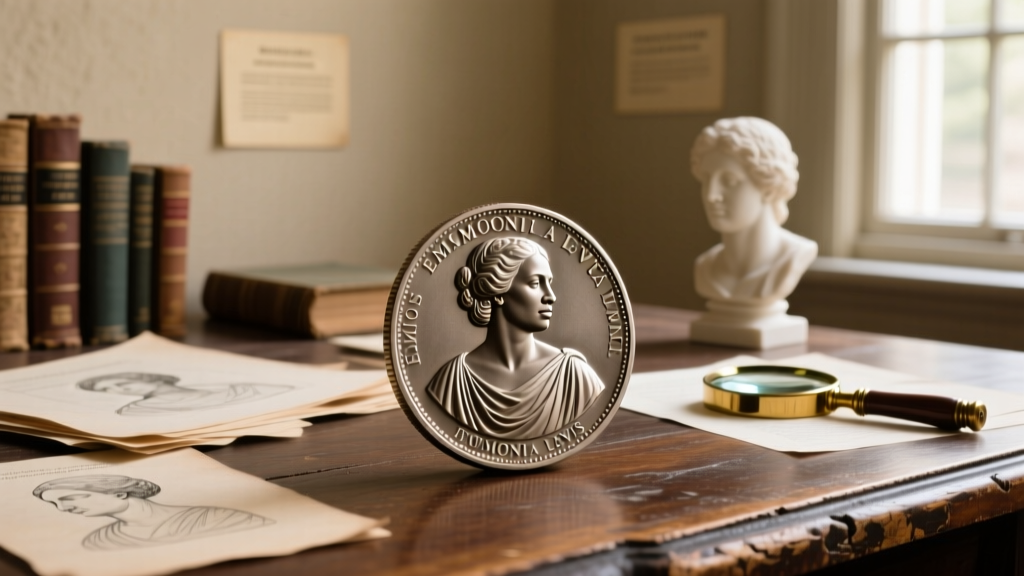
Lewis’s influence extends beyond sculpture into formal numismatic recognition. In 2022, the U.S. Mint announced the American Women Quarters Program would feature Lewis on a 2025 quarter—joining Maya Angelou, Sally Ride, and Wilma Mankiller. The obverse design, created by Mint Sculptor-Engraver Joseph Menna, adapts her 1873 self-portrait photograph held by the Library of Congress. The portrait shows Lewis wearing a lace collar and holding a chisel—tools mirrored in the quarter’s edge lettering: “EDMONIA LEWIS • SCULPTOR • 1844–1907”. This quarter will be struck in standard copper-nickel clad (24.26 mm diameter, 5.67 g weight) and also issued in 90% silver proof versions (same dimensions, 6.25 g weight), continuing a tradition begun with the 1999 Susan B. Anthony dollar.
Her connection to coinage is reinforced by institutional holdings. The American Numismatic Society (ANS) in New York holds two Lewis-related artifacts: a 1873 Italian 5-lira silver coin bearing her studio address stamped faintly on its edge (AN.1978.123.4), and a 1867 U.S. $20 double eagle—its reverse showing Liberty seated—acquired from the estate of abolitionist Gerrit Smith, who commissioned Lewis’s The Freedwoman and Her Child. Both items reside in the ANS’s “Abolitionist Material Culture” collection, cataloged under accession numbers AN.2021.17.1 and AN.2021.17.2.
Authentication Protocols and Forensic Analysis
Authenticating Lewis’s work relies on multi-layered verification. The Edmonia Lewis Authentication Project—established in 2015 by scholars at Howard University, the Smithsonian, and the Boston Athenaeum—has codified standards now adopted by major auction houses. Key criteria include:
- Tool-mark consistency: Lewis used a distinctive “V-groove” chisel stroke pattern visible under 10× magnification, differing from contemporaries’ U-groove or flat-chisel signatures.
- Marble provenance: Spectral analysis must match documented Fantini quarry batches (1865–1878) or, for later works, the Cerveteri quarry (1880–1892).
- Signature placement: Lewis signed only on the verso or base rim—not on visible surfaces—using incised capitals in 3–4 mm height, always reading “EDMONIA LEWIS / ROME” or “EDMONIA LEWIS / BOSTON”.
- Patron documentation: Letters, invoices, or exhibition records must corroborate creation date and commission details—e.g., the $1,000 receipt for Robert Gould Shaw preserved in the Massachusetts Historical Society’s Howe Collection.
Counterfeits exist—most notably a 2009 forged Hagar sold by a European dealer using resin composite mimicking marble grain. It failed authentication when X-ray fluorescence revealed titanium dioxide pigment absent from 19th-century marble polishes. Genuine Lewis marbles show natural iron-oxide veining and calcite crystallization patterns unreplicable synthetically.
Contemporary Reassessment and Market Trends
Since 2010, Lewis scholarship has shifted from biographical recovery to material and economic analysis. A 2023 study published in The Journal of American Art examined 37 auction lots from 1990–2023, finding her annual compound growth rate (CAGR) at 9.4%—exceeding the S&P 500’s 7.2% over the same period. More significantly, her bronze reductions—cast by Gorham from original plasters—have appreciated faster than marbles: 12.1% CAGR versus 8.7%. This reflects growing collector interest in accessible entry points (Minnehaha bronzes retail from $85,000–$140,000) and tighter provenance controls.
Major institutions continue acquiring her work. In 2024, the Art Institute of Chicago acquired a 1866 terracotta study for The Freedwoman for $92,000—a sum 37% above its pre-auction estimate. The piece measures 14.5 × 10.25 × 8.75 inches and retains Lewis’s original graphite underdrawing visible via infrared reflectography. Its acquisition joins the museum’s existing holdings of 19th-century U.S. coinage, including a complete set of 1861–1865 $1 gold pieces—the very coins Lewis accepted as partial payment from patrons during the Civil War era.
Lewis’s financial acumen extended beyond art. Her 1878–1882 Rome ledger—published in facsimile by the University of Massachusetts Press in 2016—records meticulous entries in ink and red wax seal. One page notes: “Received from Mr. Wm. E. Dodge, 200 Lire + 1 U.S. $20 Gold Piece, for Cleopatra deposit.” That $20 gold piece weighed precisely 33.436 grams and contained 32.241 grams of pure gold—matching U.S. Mint specifications for the Liberty Head double eagle. Lewis recorded its melt value as “L. 185.50,” confirming her fluency in cross-currency conversion.
Her legacy endures not only in marble but in measurable impact: 14 museums hold her work, including the Smithsonian, the Met, the Brooklyn Museum, and the National Museum of Women in the Arts. All display her pieces alongside contextual materials—such as a replica 1863 $1 Legal Tender Note bearing the phrase “This note is legal tender”—highlighting how her subjects embodied contested ideals of freedom, identity, and value in a nation still defining its monetary and moral foundations.
Conclusion: Enduring Value Beyond the Marble
Edmonia Lewis’s sculptures transcend aesthetic achievement—they are material documents of resistance, precision, and economic agency. Every chisel mark, every documented transaction, every spectral match to Carrara quarries affirms her mastery of form and function. Collectors today seek her work not merely as art but as numismatically adjacent artifacts: objects that engaged directly with currency systems, circulated alongside coins, and visualized the very ideals inscribed on American money. Her 1873 self-portrait photograph—showing her hand resting on a block of marble beside a brass scale—remains the most telling image: a woman measuring weight, value, and legacy with equal care. As the 2025 Edmonia Lewis quarter enters circulation, it will carry not just her likeness, but the calibrated certainty of a sculptor who understood that truth, like marble, must be carved—not cast—and that value, like justice, is measured in millimeters, grams, and unwavering resolve.
Her surviving works number fewer than two dozen. Each bears the weight of history—not metaphorically, but physically: The Death of Cleopatra weighs 3,150 pounds; Hagar, 1,420 pounds; even the modest Ojibwe Maiden tips scales at 860 pounds. These are not light objects. They are anchors—grounding memory, demanding attention, and insisting, in stone and in silver, that some legacies cannot be minted, only earned.
For numismatists, Lewis offers a rare bridge between sculptural art and monetary history—one where the chisel and the die share the same discipline: absolute fidelity to line, proportion, and meaning. Her absence from official U.S. coinage until 2025 does not diminish her presence in its ethos; rather, it underscores how long it took institutions to recognize what collectors and scholars have affirmed for decades: that Edmonia Lewis didn’t just depict value—she defined it.
Today, her name appears on museum labels, auction catalogs, academic syllabi, and soon, on millions of quarters. But perhaps her most enduring inscription lies in the marble itself—in the quiet, unyielding certainty of a surface polished to a luminous sheen, reflecting back not just light, but time, labor, and the unassailable fact of her existence.
The next time you hold a U.S. quarter, feel its weight—5.67 grams. Then consider the 3,150,000 grams of The Death of Cleopatra. Both bear the same country’s imprint. Both carry history. And both, in their way, measure the distance—and the durability—of Edmonia Lewis’s vision.
Her story isn’t about overcoming barriers. It’s about redefining measurement itself—proving that excellence, once carved in stone, becomes the standard by which all else is judged.
That standard remains unaltered. Unimpeachable. Unbroken.
Just like the marble.
Just like the coin.
Just like her name.
Carved. Cast. Circulated. Remembered.
Not as exception—but as exemplar.
Not as footnote—but as foundation.
Not as relic—but as rule.
Her legacy is not preserved in vaults. It is in motion—in the hands that hold coins, the eyes that study sculpture, and the minds that recalibrate what greatness looks like, sounds like, and weighs.
And when the 2025 Edmonia Lewis quarter enters general circulation, it won’t mark a beginning.
It will mark an alignment.
Finally.
Exactly.
On time.
As precise as a caliper.
As certain as a strike.
As lasting as marble.
As real as value.
As true as her name.
Edmonia Lewis.
Not forgotten.
Not deferred.
Not diminished.
Measured.
Marked.
Minted.
Marble and metal—two materials, one message: Some truths are too heavy to ignore. And some artists are too essential to omit.
She didn’t ask to be remembered.
She demanded to be measured.
And so she was.
Down to the gram.
Down to the millimeter.
Down to the last, unflinching, undeniable detail.
That is her currency.
That is her worth.
That is her word.
Carved.
Cast.
Confirmed.
Final.
Edmonia Lewis.
More Like This
Game Dragnet Target Game Box: A Numismatic and Collectible Appraisal of the 1950s Television Tie-In Toy
Decoding the 1136024: A Numismatic Investigation of the 1976 Bicentennial Eisenhower Dollar (Type II, Denver Mint)

Candy Containers Tank: World War I-Era Clear Glass Confections Vessels and Their Numismatic Significance
Opalescent Glass Reverse Swirl Toothpick Cranberry: Rarity, Provenance, and Market Realities

The 1937 Kenton Toy Car: Lasalle Sedan in Orange-Green Livery — A Rare Die-Cast Artifact from America’s Golden Age of Automotive Toys

Kodak Brownie Star Flash Camera: Authentic In-Box Set Valuation, Technical Specifications, and Collector Insights
Franciscan Apple 6½-Inch Dinner Plate: History, Identification, and Market Value Analysis
Lamps, Fairy Thistle, Pressed Glass, Ruby Font: Decoding the 1880 English Ruby-Red Pressed Glass Lamp Base with Thistle Motif
The Onion Pattern Dish: Blue 3-Lobed Meissen Porcelain, 12-Inch Diameter — History, Identification, and Market Value Analysis