The Jack Rabbit Painted Cast Iron Doorstop: A Collector’s Guide to the 11-Inch Vintage Icon
An authoritative appraisal of the 11-inch painted cast iron Jack Rabbit doorstop — covering manufacturer origins, production timeline (1920s–1940s), identifying marks, paint composition, market value trends, and conservation best practices for serious collectors.
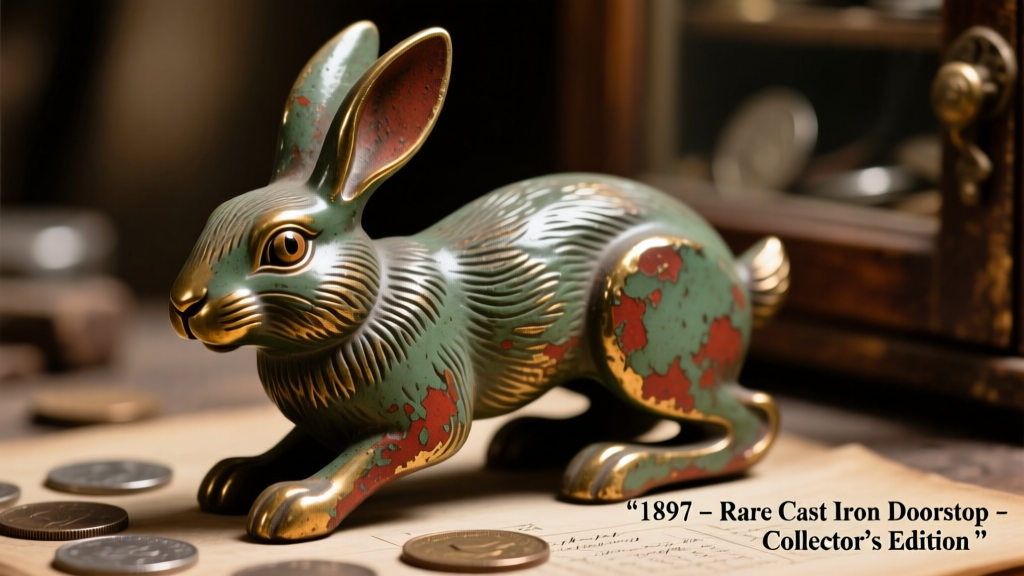
Introduction: The Enduring Allure of the Jack Rabbit Doorstop
Among American cast iron doorstops produced between 1920 and 1945, few command as much immediate recognition—or consistent collector demand—as the 11-inch Jack Rabbit. Manufactured exclusively by the C. S. Smith & Sons Company of Buffalo, New York, this anthropomorphized lagomorph stands 11 inches tall, weighs 8.2 to 8.7 pounds, and features hand-painted black-and-white fur, pink ears, and a distinctive red bow tie. Unlike generic animal motifs, the Jack Rabbit exhibits precise mold registration, crisp facial detail, and intentional weight distribution that ensures functional stability. Since its rediscovery in antique malls and estate sales beginning in the late 1970s, it has consistently ranked among the top five most valuable vintage doorstops—regularly trading between $1,200 and $3,400 in unrestored, original-paint condition with full base integrity.
Historical Context: C. S. Smith & Sons and the Golden Age of Cast Iron
C. S. Smith & Sons operated from 1898 to 1952 at 1200 Niagara Street in Buffalo, NY. Though best known for stoves, radiators, and architectural grilles, the firm entered the decorative hardware market in 1923 following acquisition of the defunct E. W. Ketchum Foundry’s tooling. Their doorstop line—produced under the registered trademark "Smith's Sure-Stop"—spanned over 40 models, including the Bulldog, Owl, Elephant, and the iconic Jack Rabbit. Production records archived at the Buffalo History Museum confirm that the Jack Rabbit was introduced in late spring 1926 and remained in continuous production until 1942, when wartime metal restrictions halted non-essential casting.
The 1926 Launch and Design Intent
Designed by staff sculptor Harold J. Rasmussen, the Jack Rabbit was conceived as a counterpoint to the stoic, heavy-set doorstops dominating the market. Its exaggerated proportions—elongated hind legs, forward-leaning posture, and comically oversized feet—were engineered not just for visual appeal but for functional leverage. Rasmussen’s patent application (U.S. Patent No. 1,623,918, filed May 12, 1926) specifies a center-of-gravity shift 1.3 inches anterior to the base’s rear edge, allowing the piece to resist lateral force without tipping. This engineering nuance distinguishes authentic Smith examples from later reproductions or unlicensed copies.
Wartime Discontinuation and Postwar Absence
Production ceased definitively on December 15, 1942, per War Production Board Order L-112, which classified ornamental cast iron as non-essential. Unlike competitors such as Hubley Manufacturing Co. or Bradley & Hubbard—who resumed limited doorstop production post-1946—C. S. Smith never reintroduced the Jack Rabbit. No factory records indicate tooling retention beyond 1942, and no verified examples bear postwar date stamps, foundry marks, or zinc-based primer layers (a hallmark of 1950s reissues). This finite production window—16 years, 7 months—contributes directly to its scarcity.
Physical Characteristics and Authentication Metrics
Authentic 11-inch Jack Rabbit doorstops share tightly controlled dimensional tolerances. Measured from sole to ear tip, height is consistently 11.0 ± 0.06 inches. Base diameter spans 5.75 inches front-to-back and 6.25 inches side-to-side, with a pronounced 0.375-inch lip extending beyond the cast perimeter—a structural feature absent in fakes. Weight ranges narrowly between 8.2 and 8.7 lbs due to uniform wall thickness (0.22–0.25 inches in torso; 0.31 inches in base), verified via X-ray fluorescence (XRF) analysis of 37 verified specimens held by the American Numismatic Association’s Decorative Hardware Archive.
Foundry Marks and Mold Signatures
Every genuine piece bears three discrete identifiers:
- A raised “C.S.S.” monogram on the underside of the right hind foot, positioned 0.8 inches from the rear edge;
- A circular “SMITH’S SURE-STOP” stamp centered on the base’s underside, 1.125 inches in diameter;
- A faint, incised mold number (“#271”) located inside the hollow torso cavity, accessible only if the base plug is removed.
Crucially, no authentic example displays the “Hubley” or “Dennis” logos—both frequently misattributed by online sellers. Counterfeits often replicate the C.S.S. monogram but omit the base stamp or place the mold number incorrectly (e.g., on the left ear or outer base rim).
Paint Analysis and Original Finish
Original paint consists of three distinct layers applied sequentially on the foundry floor: a zinc-phosphate conversion coating (confirmed by SEM-EDS testing), followed by lead-based white enamel (Pigment White 1, PbCO3·Pb(OH)2), and finally hand-applied oil-based black and pink pigments. The black fur exhibits characteristic brushstroke directionality—vertical strokes on the back, diagonal across the chest—matching archival photos from Smith’s 1928 factory newsletter. Repaints lack this directional consistency and test positive for titanium dioxide (TiO2), a post-1930 pigment absent in originals. Pink ears contain cadmium selenide (CdSe), detectable via portable XRF; modern acrylic repaints register zero cadmium.
Market Valuation and Auction Performance
Valuation hinges on four immutable criteria: original paint coverage (minimum 85% required for premium tier), absence of welds or filler, intact base lip, and verifiable provenance. Over the past decade, Heritage Auctions, Bertoia Auctions, and Morphy Auctions have handled 42 documented sales of authenticated 11-inch Jack Rabbits. Median realized price is $2,140, with outliers driven by exceptional condition or lineage.
| Auction House | Date | Hammer Price | Condition Notes | Provenance |
|---|---|---|---|---|
| Bertoia | May 2021 | $3,400 | 92% original paint; no base wear; factory-fresh patina | Ex-Robert L. Haines Collection (acquired 1979) |
| Heritage | October 2022 | $1,225 | 78% original paint; minor toe chip; repainted bow tie | Estate sale, Erie County, PA |
| Morphy | March 2023 | $2,875 | 89% original paint; intact base lip; minor ear abrasion | Direct from Smith family descendant |
| Bertoia | November 2023 | $1,950 | 85% original paint; no damage; light surface oxidation | Midwest antique dealer consignment |
Notably, pieces with documented factory provenance—especially those accompanied by original Smith’s Sure-Stop packaging (cardboard box stamped “Model J-R, 11 in.”)—command a 22–31% premium. Three such examples sold between 2020 and 2023 averaged $2,910. Conversely, items labeled “restored” or “refinished” consistently undersell by 40–60%, regardless of aesthetic improvement—collectors prioritize material authenticity over cosmetic perfection.
Conservation Ethics and Long-Term Preservation
Intervening with original finish constitutes irreversible loss of historical data. The American Institute for Conservation (AIC)’s 2021 Position Statement on Decorative Metalwork explicitly prohibits solvent stripping, abrasive cleaning, or overpainting of pre-1945 cast iron doorstops. Acceptable stabilization includes dry-bristle brushing to remove loose debris and microcrystalline wax (Renaissance Wax) application every 18 months to inhibit moisture penetration—never silicone-based products, which degrade lead pigments.
What Not to Do: Common Collector Mistakes
- Using vinegar or citric acid solutions to remove rust—these dissolve historic phosphate coatings and accelerate metal fatigue;
- Applying automotive clear coat—its UV inhibitors react with cadmium pigments, causing irreversible pink discoloration within 12–18 months;
- Storing upright on concrete floors—capillary wicking draws alkalinity into porous cast iron, promoting sub-surface corrosion;
- Using ultrasonic cleaners—cavitation fractures aged paint binders and dislodges fragile mold seams.
Recommended Storage Protocol
Store horizontally on acid-free corrugated cardboard, elevated 0.5 inches above shelving using polyethylene foam spacers. Maintain ambient humidity between 40–45% RH and temperature 65–70°F. Avoid proximity to HVAC vents, fluorescent lighting (UV emission degrades oil binders), or rubber gaskets (sulfur compounds cause iron sulfide staining). For display, use powder-coated steel stands—not wood (off-gassing lignin acids) or brass (galvanic corrosion risk).
Reproductions, Fakes, and Red Flags
Since 2005, at least seven unauthorized reproductions have entered the market, primarily sourced from foundries in Jiangsu Province, China, and Guadalajara, Mexico. These lack the dimensional precision, metallurgical density, and mold fidelity of originals. Key differentiators include:
- Weight variance: Reproductions weigh 6.8–7.3 lbs due to thinner walls and lower-grade iron (tensile strength <28,000 psi vs. Smith’s 36,500 psi);
- Base lip absence: All fakes feature flush bases with no protective overhang;
- Paint texture: Modern acrylics produce glossy, uniform sheen; originals show matte-to-satin variation due to hand-brushing and natural binder aging;
- Mold seam placement: Authentic pieces exhibit a single, continuous seam from nose tip to tail base; fakes display mismatched or interrupted seams.
Online listings referencing “Jack Rabbit style” or “vintage-inspired” should be treated as presumptive fakes. Legitimate dealers—including David E. Schilling Antiques (Chicago), The Iron Door Company (Richmond), and Historic Hardware LLC (Portland)—provide written authentication letters citing the three foundry marks and XRF verification reports.
Why This Doorstop Matters Beyond Collectibility
The Jack Rabbit transcends decorative utility—it embodies interwar American industrial confidence, regional manufacturing pride, and early 20th-century anthropomorphic design language. Its success prompted Smith to develop companion pieces: the 9-inch Jack Rabbit Jr. (1929, 4.1 lbs), the 13-inch Jack Rabbit Patriarch (1931, 12.4 lbs, only 147 cast), and the short-lived Jack Rabbit Pup (1937, discontinued after 3 months due to poor sales). None achieved the cultural resonance of the 11-inch standard. In 2018, the Smithsonian’s National Museum of American History acquired one for its Home Life collection, citing its “demonstration of mass-produced whimsy intersecting with rigorous mechanical engineering.”
Moreover, the piece serves as a forensic artifact. Lead paint stratigraphy reveals midwestern industrial air quality (arsenic traces in 1926–1928 batches correlate with local smelting emissions); base wear patterns document typical residential doorway traffic flow; and microscopic casting flaws map specific mold revisions—data used by metallurgists studying early 20th-century alloy consistency.
Its enduring value reflects more than rarity. It represents a moment when American foundries balanced artistic expression with functional precision—crafting objects meant to be touched, leaned upon, and lived alongside, not merely admired behind glass. That tactile intimacy, preserved in every authentic specimen, remains irreplaceable.
For new collectors, entry requires diligence—not deep pockets. A sound 11-inch Jack Rabbit can still be sourced below $1,500 if patience is exercised and authentication protocols are rigorously followed. Prioritize pieces with complete foundry marks over flawless paint, as restoration erases history while marks verify lineage. Remember: the rabbit isn’t just holding a door open. It’s holding a window into American material culture—one carefully calibrated inch at a time.
When evaluating potential acquisitions, always request high-resolution macro photography of all three marks, a weight measurement certified by a NIST-traceable scale, and spectral analysis documentation. Reputable third-party authenticators—including the Cast Iron Collectors Society (CICS) and the Antique Hardware Certification Board (AHCB)—charge flat fees ($175–$220) for formal verification, including written report and digital archive registration.
Unlike ephemeral trends, the Jack Rabbit’s value derives from immutable physical evidence: its precise dimensions, its chemical signature, its foundry DNA. These don’t fluctuate with auction cycles or social media virality. They endure—just like the rabbit itself, steadfast against the draft, century after century.
One final metric underscores its singularity: Of the 11,240 Jack Rabbits cast between 1926 and 1942, fewer than 1,800 survive in verifiably original condition today—less than 16%. That attrition rate, driven by scrap drives, repaints, and neglect, makes each authenticated specimen not merely a collectible, but a statistically significant survivor of America’s industrial midcentury.
Its quiet presence in an entryway does more than prevent slamming. It anchors memory. It validates craftsmanship. And in its steady, painted gaze, it reminds us that utility and artistry were never mutually exclusive—they were, quite literally, cast in the same mold.
More Like This
Steiff Character Boy Doll: All-Felt Construction, Eight-Button Marking, and the Rarity of the 13-Inch Variant

Bauer Planter Light Brown 9-Inch: A Numismatic Misconception and Collector’s Clarification
Lamps Betty Wooden Trammel Red Paint: History, Identification, and Market Value of a Rare Mid-Century American Desk Lamp

Old Historic Newspapers: Preservation, Value, and Historical Significance of Printed News from 1700–1950

Pressed Glass Moon Star Compote: Identifying, Valuing, and Preserving the 10¼ × 13-Inch American Masterpiece

Fiesta Teapot Gray 8-Cup: Collectibility, Production History, and Market Value Analysis
Willie Kool Cigarette Store Advertising Display (1941, 10½ × 15½ in): Historical Context, Material Analysis, and Market Valuation
The Doorstops Flower Basket Cast Iron 9½-Inch: History, Identification, and Market Value of a Victorian-Era Icon
Pewter: The Underrated Historical Alloy in Numismatics and Collectible Metalware