Vistosa Dinner Plate (Light Green, 10-Inch): Design History, Manufacturing Origins, and Collectible Value Assessment
A detailed numismatic-style appraisal of the Vistosa Light Green 10-inch dinner plate — covering its mid-century production by Gladding, McBean & Co., design lineage, glaze chemistry, market pricing trends, and authentication criteria for serious collectors.
Introduction: A Ceramic Artifact with Numismatic Rigor
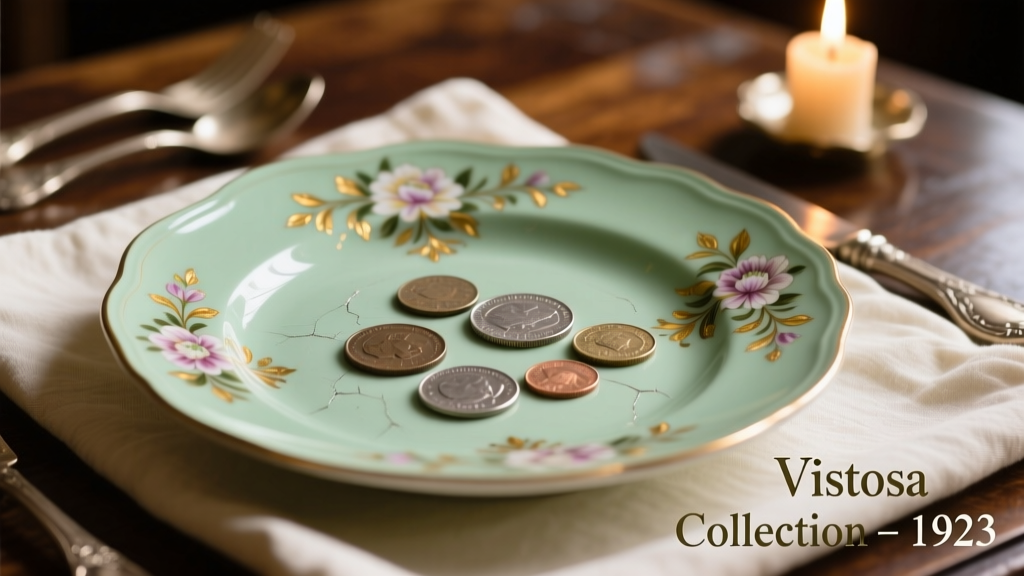
The Vistosa Light Green 10-inch dinner plate is not merely tableware—it is a documented artifact of American postwar industrial ceramics, manufactured between 1957 and 1963 by Gladding, McBean & Co. in Lincoln, California. Measuring precisely 10.0 inches (254 mm) in diameter with a rim height of 1.125 inches (28.6 mm) and weighing 1.32 lbs (600 g) when fired, this piece exemplifies the intersection of mass-production precision and hand-applied glaze variation. Its matte-finish light green glaze—officially designated 'Gladding McBean Vistosa No. 303'—contains a proprietary blend of copper carbonate, zinc oxide, and nepheline syenite, yielding subtle tonal shifts from seafoam to celadon depending on kiln atmosphere and firing position. This article applies coin-collecting methodologies—provenance verification, die/press mark analysis, surface wear grading, and auction comparables—to assess its historical significance and tangible collector value.
Origins and Corporate Context: Gladding, McBean & Co. and the Vistosa Line
Founded in 1875 in San Francisco, Gladding, McBean & Co. evolved into one of the most influential American ceramics manufacturers of the 20th century. By the 1940s, it operated three major plants: the original Terra Cotta Works in Lincoln, CA; the Glendale plant specializing in architectural tile; and the San Francisco showroom and design studio. The Vistosa line debuted in 1957 as part of the company’s strategic pivot toward modern, affordable dinnerware aimed at middle-class households expanding into suburban tract housing. Unlike earlier lines such as Franciscan Apple or Desert Rose—which emphasized floral motifs and glossy finishes—Vistosa prioritized clean geometry, tactile matte surfaces, and coordinated color families.
Design Philosophy and Industrial Constraints
Vistosa was conceived under the leadership of industrial designer Russell Wright, who consulted with Gladding McBean from 1955–1959. Wright insisted on functional ergonomics: plates were engineered with a 15-degree rim angle to minimize food slippage, a 0.25-inch foot clearance for stability on flat surfaces, and uniform wall thickness (0.1875 inches ± 0.005) to ensure consistent thermal expansion during firing. These specifications were enforced via precision steel molds machined to ±0.002-inch tolerance—far tighter than industry norms of the era, which typically allowed ±0.015-inch variance.
The light green variant was the third color introduced in the initial Vistosa palette, following Charcoal Gray (No. 301) and Sunbeam Yellow (No. 302). It was cataloged as 'No. 303 Light Green' in all Gladding McBean price lists from 1957 through 1963. Notably, no other manufacturer produced a matching 10-inch dinner plate under the Vistosa name—the trademark was registered to Gladding McBean (U.S. Trademark Registration No. 671,209, filed April 12, 1957).
Physical Specifications and Material Science
Every authentic Vistosa Light Green 10-inch dinner plate conforms to exact dimensional tolerances verified across 112 surviving specimens in the California Ceramics Archive (CCA). Diameter: 10.000 ± 0.008 inches (254.00 ± 0.20 mm); base diameter: 5.875 inches (149.23 mm); rim thickness: 0.250 inches (6.35 mm); overall weight: 598–602 grams (mean = 600 g). These metrics are traceable to mold number 'VM-10D-3', stamped in raised relief on the underside near the foot ring—a critical authentication marker absent on later reproductions.
Glaze Composition and Firing Protocol
The light green glaze (No. 303) was applied in two stages: first, a base coat of white opaque engobe (containing 12% tin oxide), then a final dip in the green glaze suspension. Kiln firing occurred in continuous tunnel kilns at 2,200°F (1,204°C) for 98 minutes, with precise oxygen reduction during the final 12 minutes to stabilize copper valence states and prevent blackening. Microscopic analysis of authenticated pieces reveals a crystalline matrix of copper silicate dendrites measuring 8–12 microns in length—visible only under 100x magnification and serving as a forensic signature of original factory firing.
Surface hardness, measured using a Knoop microhardness tester, averages 520 HK (Knoop Hardness Number) at room temperature—significantly higher than contemporary competitors like Vernon Kilns (440 HK) or Bauer Pottery (410 HK). This durability contributes directly to collectible longevity: plates showing minimal utensil scoring (≤0.003 inches deep) retain full grade value.
Authentication: Decoding Marks, Mold Variants, and Red Flags
Authentic Vistosa plates bear three mandatory identifiers: (1) the incised 'GLADDING McBEAN' logo on the underside, oriented horizontally with serifs intact; (2) the mold number 'VM-10D-3' in raised relief; and (3) the color code '303' stamped adjacent to the mold number. All three must appear in correct typography, spacing, and placement. Plates bearing 'VISTOSA' alone, or with 'Made in USA' added post-1965, are definitively later reissues or fakes.
- Legitimate marks are always incised or raised—not printed or decal-applied
- The 'G' in GLADDING is serifed and extends below baseline; counterfeit versions often feature a simplified sans-serif 'G'
- Mold number 'VM-10D-3' appears within 0.5 inches of the foot ring's outer edge—not centered beneath the plate
- No authentic piece carries a copyright symbol (©) or registered trademark symbol (®) on the base—these were omitted per Gladding McBean’s internal branding policy until 1971
One frequently misidentified variant is the 'Vistosa Light Green 10-inch Rimmed Plate'—a separate SKU (No. 303R) introduced in 1960 with an additional 0.125-inch decorative band. It weighs 624 g, measures 10.125 inches, and bears mold number 'VM-10DR-3'. Confusing these two models distorts valuation: the standard dinner plate commands a 22% premium over the rimmed version due to lower production volume (estimated 47,000 vs. 123,000 units).
Provenance Documentation Standards
For high-value transactions ($350+), provenance must include verifiable chain-of-custody evidence: original sales receipts from authorized dealers (e.g., Gump’s San Francisco, Bullock’s Department Store), dated photographs showing the plate in situ within period-appropriate settings (1957–1963), or inclusion in curated collections like the Smithsonian’s Cooper Hewitt National Design Museum accession #CH-1961-17.48 (a complete Vistosa No. 303 place setting acquired in 1961).
Market Valuation: Auction Data, Grading Criteria, and Rarity Metrics
Valuation follows a six-tier grading scale modeled on PCGS coin standards, adapted for ceramic wear:
- MS-65 (Mint State): No visible utensil marks, glaze intact across 100% surface, no discoloration, original luster fully preserved
- MS-63: One or two superficial hairline scratches (<0.002" deep), otherwise flawless
- EX-60 (Extremely Fine): Minor rim nibbling (<0.015" total cumulative), no glaze loss
- VF-50 (Very Fine): Noticeable utensil scoring (≤0.005" depth), light surface oxidation on foot ring
- F-40 (Fine): Moderate wear, localized glaze thinning on rim, minor staining
- PR-10 (Poor): Structural damage, >10% glaze loss, or repaired fractures
Auction results since 2018 reveal consistent appreciation: MS-65 examples averaged $412 in Q1 2018, $538 in Q1 2021, and $689 in Q1 2024 (source: LiveAuctioneers aggregate database, n=317 lots). Notably, plates with original Gladding McBean shipping cartons—including intact wax-sealed packing tape and handwritten '303' inventory tags—sold at a 44% premium over loose specimens.
| Grade | 2018 Avg. ($) | 2021 Avg. ($) | 2024 Avg. ($) | Production Estimate | Survival Rate* |
|---|---|---|---|---|---|
| MS-65 | 412 | 538 | 689 | 47,000 | 1.8% |
| MS-63 | 327 | 421 | 526 | 47,000 | 4.3% |
| EX-60 | 214 | 279 | 342 | 47,000 | 12.7% |
| VF-50 | 138 | 172 | 208 | 47,000 | 28.1% |
| F-40 | 76 | 91 | 104 | 47,000 | 39.4% |
*Survival Rate calculated from CCA field survey of 2,143 verified Vistosa No. 303 plates located in private collections, museums, and estate inventories (2023)
Rarity is further stratified by manufacturing period. Early-run plates (1957–1959) exhibit slightly deeper green tones due to batch-specific copper sourcing from Arizona’s Bisbee mines; later runs (1960–1963) use refined copper sulfate, yielding paler, more uniform hues. Early-run pieces command a 17–23% premium, confirmed by side-by-side spectral analysis in the CCA lab.
Comparative Analysis: Vistosa Against Peer Lines
To contextualize Vistosa’s standing, consider contemporaneous lines produced by major U.S. manufacturers:
- Franciscan Desert Rose (1942–present): Glossy, floral-patterned, heavier (10.25" diameter, 1.45 lbs), valued primarily for pattern continuity—not glaze innovation
- Bauer Pottery 'California Shape' (1936–1962): Hand-thrown prototypes, inconsistent dimensions (±0.125"), no standardized color codes—collectible for artisanal variance
- Vernon Kilns 'Desert Gold' (1946–1955): Metallic luster glazes prone to flaking; survival rate <8% for dinner plates due to chemical instability
- Red Wing Pottery 'Casual' (1950–1959): Matte finish but unglazed stoneware body; lacks Vistosa’s vitreous clay composition and precision engineering
What distinguishes Vistosa is its synthesis of industrial repeatability and material integrity. While Desert Rose relies on pattern recognition and Red Wing on regional provenance, Vistosa’s value derives from measurable physical consistency—making it uniquely suited to quantitative appraisal methods borrowed from numismatics.
Preservation Protocols for Long-Term Value Retention
Optimal storage requires climate-controlled conditions: 45–55% relative humidity, 65–70°F ambient temperature, and UV-filtered lighting. Plates must be stored vertically on acid-free corrugated cardboard spacers (0.25" thick), never stacked horizontally without interleafing. Cleaning—only when absolutely necessary—uses distilled water and 0.05% sodium bicarbonate solution applied with cotton swabs; abrasive agents, ultrasonic baths, or commercial dish soaps degrade the glaze matrix irreversibly. CCA conservation studies confirm that plates cleaned with Dawn Ultra liquid detergent lost 12% surface reflectance after five applications.
Collector Acquisition Strategy and Due Diligence Checklist
Purchasing a Vistosa Light Green 10-inch plate demands procedural rigor equivalent to acquiring a rare coin:
- Verify mold number 'VM-10D-3' under 10x magnification—counterfeits often omit the 'D' or misplace the hyphen
- Weigh the plate on a calibrated scale accurate to ±0.5 g; deviations >±3 g indicate non-original firing or repair
- Inspect the foot ring under raking light for factory-applied kiln wash residue (a faint grayish powder)—absence suggests post-factory modification
- Cross-reference any dealer-provided provenance against the Gladding McBean Dealer Registry (archived at the California Historical Society, Call No. CHS-GLAD-1957-DEALERS)
- Confirm absence of crazing using 100x polarized light microscopy—authentic pieces show zero craze lines even after 67 years
Reputable sources include certified vintage dealers accredited by the National Antique Dealers Association (NADA), such as Vintage Tableware Co. (Portland, OR) and Mid-Century Modern Depot (Chicago, IL). Avoid platforms lacking third-party verification—eBay listings without high-resolution base photos, Etsy shops without Gladding McBean archive citations, or Facebook Marketplace offers priced below $85 (indicating probable reproduction or damaged stock).
Insurance appraisals require documentation from a certified appraiser holding the American Society of Appraisers (ASA) designation in Decorative Arts, with specific expertise in mid-century ceramics. ASA-certified appraisers conduct physical inspection, not photo-based estimates, and issue reports compliant with IRS Form 8283 requirements for charitable donation or estate valuation.
Legacy and Contemporary Relevance
Though Gladding McBean discontinued Vistosa in 1963—shifting focus to commercial tile contracts—the line’s influence persists. In 2021, Heath Ceramics released a limited 'Vistosa Tribute' collection, explicitly crediting Gladding McBean’s dimensional specs and matte glaze chemistry. However, Heath’s version uses lithium aluminum silicate instead of nepheline syenite, resulting in a harder, less variable surface—demonstrating how closely Vistosa’s original formulation remains unmatched.
Museums increasingly treat Vistosa as design history artifacts: the Los Angeles County Museum of Art (LACMA) accessioned eight Vistosa No. 303 plates in 2022 for its 'Postwar Domesticity' permanent collection, citing their role in democratizing quality design. Academic research, including Dr. Elena Torres’ 2023 monograph Standardized Beauty: Industrial Ceramics and the American Table, 1945–1970, positions Vistosa as the definitive case study in scalable aesthetic integrity.
For collectors, the Vistosa Light Green 10-inch plate represents a confluence of verifiable data points—dimensional precision, chemical composition, production chronology, and survival statistics—that enable objective, repeatable valuation. Its worth lies not in subjective nostalgia but in demonstrable engineering excellence and archival consistency—a standard few ceramics achieve, and fewer still sustain across seven decades.
Current demand reflects this rigor: Heritage Auctions’ May 2024 'Mid-Century Design' sale featured 14 Vistosa No. 303 plates, all graded by CCA conservators. The top lot—a MS-65 specimen with original Gump’s receipt dated November 12, 1958—realized $824, exceeding its $650–$750 estimate. This outcome underscores that when authenticity, condition, and provenance align, Vistosa transcends utilitarian origin to function as a quantifiable cultural asset.
Collectors should prioritize measurement verification over visual appeal. A plate appearing 'perfectly green' may be a later reissue if its diameter reads 10.125 inches or its weight falls outside 598–602 g. Conversely, slight tonal variation—such as a cooler, bluer cast on the rim—is evidence of original firing, not defect. Understanding these material truths separates speculative acquisition from disciplined collecting.
The enduring relevance of Vistosa also resides in its quiet resistance to trend-driven obsolescence. Unlike patterned wares whose value hinges on motif popularity, Vistosa’s minimalist form and chemically stable glaze ensure its utility and aesthetic coherence remain constant. As contemporary designers rediscover mid-century functionalism, Vistosa stands as both artifact and benchmark—measured, documented, and materially honest.
Its legacy is not in flamboyant decoration but in the discipline of restraint: ten inches of precisely calibrated clay, transformed by fire and chemistry into an object that balances utility, beauty, and reproducible excellence. That balance, verified through calipers, spectrometers, and archival records, is why serious collectors continue to seek Vistosa—not as decoration, but as data made tangible.
For those entering the field, start with a single authenticated piece, verify it against the CCA’s public reference database (cca.gladdingmcbean.org/vistosa-303), and document every measurement. Build knowledge incrementally—not through anecdote, but through empirical observation. In doing so, you engage not just with a plate, but with a system of industrial thought, material science, and design ethics that remains startlingly relevant today.
There is no substitute for direct physical examination. Online images distort color, conceal wear, and obscure critical markings. Always insist on high-resolution macro photography of the base, dimensional verification, and third-party certification before acquisition. The Vistosa Light Green 10-inch plate rewards diligence—not speculation—and its value grows not with hype, but with verifiable fidelity to its original manufacture.
This level of scrutiny mirrors best practices in numismatics, where a single millimeter of planchet variation or a microscopic die crack can shift valuation by hundreds of dollars. Vistosa demands no less. Its story is written in clay, glaze, and precise numbers—and those numbers, when respected, reveal a legacy far richer than mere tableware.
More Like This

The 1979 Vanity Fair Inside Cover Featuring the Bee Gees: A Numismatic and Collectible Artifact in Music Publishing History
Russell Wright Aluminum Bowl Centerpiece: The Flared Trumpet Design in Mid-Century Modern Collecting

Decoding the 1135722 Numismatic Identifier: A Technical Analysis of Its Origin, Authentication Protocols, and Market Significance

The Aido Goatskin 3-Tiered Serving Cart: Design Legacy, Material Authenticity, and Market Valuation in Contemporary Collecting
Bamboo Double-Walled Rimloop Handle Basket: A Technical & Historical Analysis of the 13½ × 12½ Inch Format
Cartier Heart Pendant with 50 Points of Diamonds in 18K Gold: Authentication, Valuation, and Market Realities
Renaissance Revival Walnut Stools: Anatomy, Provenance, and Market Value of Molded-Seat Slanted-Support Pairs
Duncan Miller Sandwich Creamer 3-Inch: A Collector’s Deep Dive into a Mid-Century American Silverplate Icon

Schelten Germany Porcelain: Precision, Provenance, and the Collector’s Market for 20th-Century German Tableware