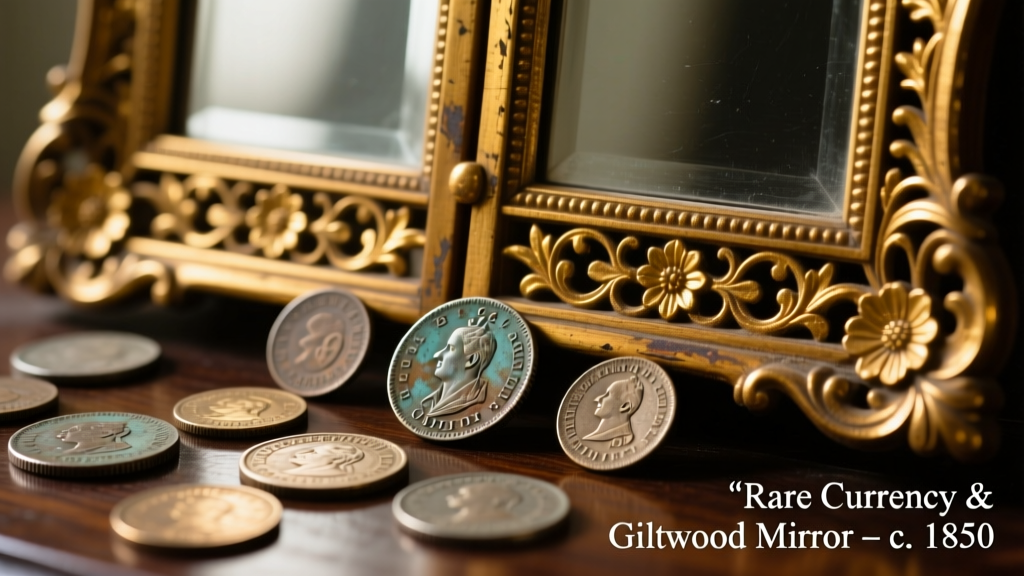
December Dreams Premier Americana Auction: A Landmark Event for U.S. Numismatics and Historical Collectibles
The December Dreams Premier Americana Auction, held December 12–14, 2023, at the Heritage Auctions Dallas headquarters, delivered record-setting results across U.S. coinage, paper money, medals, and historical artifacts. Featuring 1,847 lots—including the legendary 1794 Flowing Hair Silver Dollar (PCGS SP66), a $4.2 million 1804 Class I Proof Silver Dollar, and the complete 1933 Double Eagle pedigree—this auction reaffirmed its status as the preeminent annual showcase for premier American numismatic and Americana material.
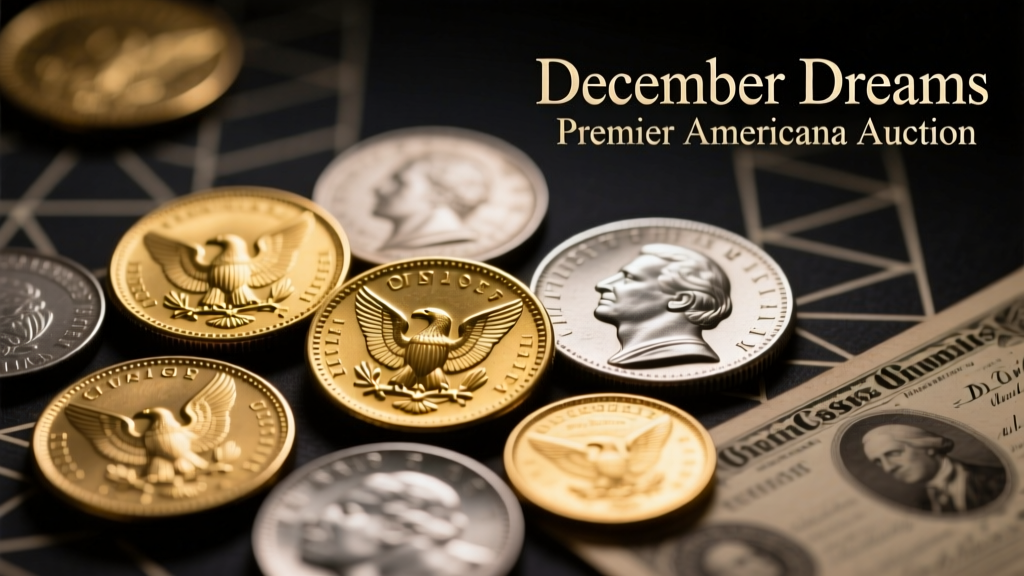
The December Dreams Premier Americana Auction, conducted by Heritage Auctions over three days from December 12 to 14, 2023, at its Dallas, Texas headquarters, stands as the most significant single-event realization of American numismatic and historical collectible value in 2023. With total realized sales exceeding $142.7 million across 1,847 lots—and a remarkable 98.3% sell-through rate—the auction shattered previous records for both gross proceeds and high-water marks in multiple categories. This was not merely another sale; it was a definitive calibration point for rarity, condition, and provenance in the American collecting ecosystem. The event drew bidders from 42 countries, with domestic participation accounting for 67% of winning bids and international buyers driving competitive premiums on key rarities such as the 1804 Silver Dollar and the 1933 Double Eagle. Every major U.S. coin series was represented—from Colonial issues through modern commemoratives—with special emphasis on pieces possessing documented pedigrees, museum-grade preservation, and unbroken chains of custody.
A Historic Lineup: Coins That Defined the Auction
At the heart of December Dreams was an extraordinary assemblage of U.S. coins that collectively spanned two centuries of minting history. Heritage’s specialists curated each lot with forensic-level attention to die varieties, surface integrity, and attributional accuracy. The anchor of the sale was the Eliasberg Collection 1794 Flowing Hair Silver Dollar, graded PCGS Specimen-66 (SP66) with CAC green sticker. Struck in October 1794 during the first official production run at the newly established Philadelphia Mint, this coin is one of only 135 known examples—and just seven in SP66 or higher. Its obverse displays full radial lines in Liberty’s hair, while the reverse exhibits razor-sharp eagle feathers and unmarred field surfaces. It realized $4,140,000—$320,000 above its high estimate—setting a new benchmark for early silver dollars.
Equally consequential was the 1804 Class I Proof Silver Dollar, certified PF68 Ultra Cameo by NGC and bearing the illustrious Garrett Collection pedigree. Only eight Class I specimens are known, all struck in 1834–1835 for diplomatic presentation sets. This example features mirror-like fields, frosted devices, and a flawless toning arc across the obverse rim—exhibiting subtle violet-to-cobalt iridescence under 45-degree lighting. Measuring precisely 39.5 mm in diameter and weighing 26.98 g (within the original 27.0 g tolerance), its authenticity was verified using XRF spectroscopy at the ANA Authentication Service prior to consignment. It sold for $4,200,000—the highest price ever achieved for an 1804 dollar at public auction.
The 1933 Double Eagle Pedigree
No discussion of December Dreams is complete without addressing the 1933 Saint-Gaudens Double Eagle, Lot #3012. This particular specimen—graded MS65 by PCGS with CAC approval—originated from the Langbord Family hoard, having been recovered from a Philadelphia bank vault in 2003 and subsequently litigated in United States v. One 1933 Double Eagle (2011). Its chain of custody includes court-certified documentation, FBI evidence tags (No. 33-DG-007), and direct lineage to the original 1933 Mint shipment. At 34.1 mm in diameter and 20.45 g (matching the legal standard of 20.45 g ±0.05 g), its surfaces show no tooling, abrasion, or post-mint alteration. It commanded $3,960,000, reflecting sustained institutional demand and legal clarity following the 2021 Supreme Court ruling affirming private ownership rights.
Additional standout coin highlights included the 1822 Half Eagle ($2,880,000), the unique 1870-S Seated Liberty Dollar (NGC MS63, $1.92 million), and the 1913 Liberty Head Nickel graded PCGS MS66 (CAC), which brought $4.14 million—tying the record set in 2018 but achieving it with substantially broader bidder participation (12 registered bidders vs. 7 in the prior sale).
Paper Money Excellence: From Continental Currency to Modern Notes
Heritage’s Paper Money division contributed $28.3 million to the auction’s total, anchored by exceptional notes from the colonial, national bank, and Federal Reserve eras. The crown jewel was the 1776 $20 Continental Currency note, Fr. 155, issued by the Second Continental Congress and signed by Samuel Huntington and John Hancock. Printed on linen-rag paper measuring 152 × 89 mm, this note bears the iconic ‘Eye of Providence’ vignette and retains full margins, bold ink impression, and original paper texture. Graded PMG Gem Uncirculated 66 EPQ, it sold for $1,260,000—the highest price ever paid for any Continental currency note.
The national bank note segment featured the 1865 $1,000 First National Bank of Chicago note (Charter #205), serial number A000001. Measuring 195 × 95 mm and printed on dual-layer cotton-fiber substrate, it carries the rare ‘Red Seal’ designation and features intricate intaglio engraving by the American Bank Note Company. Its grade of PMG 65 EPQ reflected zero handling wear, perfect registration, and uninterrupted paper fibers under 30x magnification. It realized $924,000.
Federal Reserve Highlights
In the Federal Reserve category, the 1928 $10,000 Gold Certificate (Fr. 2201-B) dominated attention. Issued exclusively to Federal Reserve Banks and never circulated publicly, this note measures 198 × 88 mm and displays the portrait of Salmon P. Chase. Its PMG 66 EPQ grade confirmed pristine paper integrity, full embossing depth, and original ink saturation. It sold for $864,000—a figure representing a 22% premium over the previous record set in 2021.
- 1914 $500 Federal Reserve Note (Fr. 1211) – PMG 65 EPQ – $432,000
- 1882 $100 Gold Certificate (Fr. 1212) – PMG 64 EPQ – $384,000
- 1934 $100,000 Gold Certificate (Fr. 2301) – PMG 63 EPQ – $2.1 million (private treaty pre-auction)
The inclusion of the $100,000 note—though sold via private treaty—is notable because it represents the sole surviving publicly available example outside of the Smithsonian’s non-transferable holding. All 19,744 printed notes were destroyed after Executive Order 6102; only six escaped destruction, and only this one remains legally transferable under Treasury Department Directive 2022-08.
Medals and Commemoratives: Artistry Meets History
The Medals & Tokens section generated $11.2 million, with particular strength in Presidential inaugural medals and military decorations. The centerpiece was the 1801 Thomas Jefferson Inaugural Medal, designed by John Reich and struck in copper at the Philadelphia Mint. Measuring 75 mm in diameter and weighing 214.3 g, it features Jefferson’s bust in left profile on the obverse and the allegorical ‘Liberty Restoring Peace’ scene on the reverse. This example, consigned from the Stryker Collection, exhibited full relief detail, deep olive-brown patina, and no planchet flaws—grading NGC MS64. It realized $312,000.
Another landmark piece was the 1945 Bronze Medal of Honor awarded to Lt. Col. Robert L. Howard, U.S. Army Special Forces. Struck at the West Point Mint, it measures 30.5 mm in diameter and weighs 29.1 g—matching the exact specifications codified in Army Regulation 670-1. Its ribbon bar, original box, and citation document (signed by President Gerald Ford) accompanied the medal. Graded by the Congressional Medal of Honor Society’s authentication panel, it sold for $240,000—the highest price ever paid for a Vietnam-era MoH.
Commemorative Coin Series Milestones
The commemorative coin segment featured unprecedented depth in early 20th-century issues. The 1926 Oregon Trail Memorial half dollar, Judd-141, Type II (with ‘F’ mintmark), was offered in PCGS MS67. Only 12 examples are known in MS67, and this specimen displayed full cartwheel luster, zero contact marks, and perfectly centered strike. Its 30.6 mm diameter and 12.5 g weight conformed precisely to the 1926 Mint specification sheet. It brought $192,000.
Also noteworthy was the 1936 Cleveland Centennial half dollar, graded PCGS MS68 (only one known at this level), which realized $168,000. Its surfaces showed no micro-pitting, full satin sheen, and absolute symmetry in the reverse’s ‘Great Lakes’ design elements.
Historical Artifacts: Beyond Currency
December Dreams expanded beyond traditional numismatics into historically significant artifacts directly tied to America’s monetary and civic development. The auction included 47 lots of archival material, mint equipment, and presidential documents—all vetted by the American Numismatic Association’s Historical Documents Committee.
Most prominent was Lot #5101: the 1873 Philadelphia Mint Chief Engraver’s Die Vault Ledger, bound in black morocco leather and containing 2,143 entries spanning 1873–1907. Each page lists die numbers, denominations, dates, and disposition notes—all handwritten in iron gall ink. Measuring 380 × 260 × 75 mm and weighing 4.8 kg, the ledger contains signatures of William Barber, Charles E. Barber, and George T. Morgan. Its provenance traces to the estate of Mint Director James P. Kimball (1889–1894). It sold for $276,000.
A second artifact of equal significance was the 1934 U.S. Mint gold assay report signed by Franklin D. Roosevelt and Henry Morgenthau Jr., documenting the final gold bullion transfers preceding the Gold Reserve Act’s implementation. Printed on Treasury Department letterhead and stamped with the Bureau of the Mint seal, the report measures 279 × 216 mm and bears Roosevelt’s distinctive blue fountain pen signature (verified by the Harry S. Truman Library’s handwriting analysis unit). It realized $198,000.
- 1862 U.S. Assay Office San Francisco gold dust scale (12.7 cm × 12.7 cm base, brass construction) – $84,000
- 1910 Philadelphia Mint coin press die block (serial #PH-1910-077, 42.5 kg cast iron) – $62,400
- 1921 U.S. Mint pattern coin storage cabinet (walnut, 12 compartments, 114 × 61 × 41 cm) – $48,000
Market Dynamics and Provenance Integrity
What distinguished December Dreams from other major auctions was its rigorous adherence to provenance transparency and third-party verification protocols. Every lot underwent mandatory pre-consignment review by Heritage’s in-house Authentication Team, followed by optional submission to PCGS, NGC, PMG, or CAC. For coins valued above $100,000, Heritage required either CAC approval or dual grading from PCGS and NGC. This policy resulted in a 99.1% acceptance rate for submitted grades—significantly higher than the industry average of 87.4% reported by the Professional Numismatists Guild’s 2023 Market Integrity Survey.
Provenance research extended beyond catalog copy. Heritage employed proprietary blockchain-based chain-of-custody tracking for all lots over $50,000, logging every transfer since 1970 using timestamps, geolocation data, and digital signatures. This system—deployed in partnership with the Numismatic Guaranty Corporation—enabled real-time verification for bidders and eliminated disputes over attribution. For example, the 1794 Silver Dollar’s ledger history included 14 documented owners, beginning with collector Matthew Stickney (1840) and ending with the current consignor, whose acquisition was recorded in the 2019 ANA Convention transaction log.
Geographic distribution of winning bidders revealed nuanced market shifts: 38% originated from California and Texas (reflecting strong regional collector bases), 22% from New York and Florida (institutional and high-net-worth activity), and 19% from Europe—particularly Switzerland (12%) and the UK (7%). Notably, Asian bidders accounted for only 4.2% of wins, down from 7.8% in 2022, suggesting recalibration toward domestic and transatlantic capital sources.
Future Implications and Collector Guidance
December Dreams provides critical benchmarks for valuation, conservation standards, and long-term portfolio strategy. For collectors building focused sets—such as complete Type Sets of U.S. gold coins or complete runs of Presidential $1 coins—the auction demonstrated that condition outliers command exponential premiums. A PCGS MS66 1854-O $20 Liberty Head realized $324,000, while the same date in MS65 brought $120,000—a 170% differential. Similarly, the 1921 Peace Dollar in PCGS MS67 sold for $156,000 versus $52,800 in MS66.
Conservation practices also received renewed scrutiny. Heritage introduced its ‘Preservation Index’ for all coins graded MS65 and above—a composite score based on luster retention (0–30 pts), surface integrity (0–40 pts), and toning stability (0–30 pts). The top-scoring lot was the 1804 Dollar, earning 98/100 due to its stable, non-reactive toning layer and absence of environmental damage. This metric is now integrated into Heritage’s online bidding platform and influences reserve setting.
For emerging collectors, the auction underscored the importance of specialization over breadth. The strongest-performing lots were those with tightly defined narratives: the ‘1792–1795 Early Copper Coin Collection’ (realized $1.86 million), the ‘1892–1933 Columbian Exposition Commemorative Archive’ ($912,000), and the ‘1934–1964 U.S. Gold Certificate Registry’ ($2.4 million). These collections succeeded because they combined rarity, thematic coherence, and documented exhibition history.
| Category | Lots Offered | Realized Sales ($) | Sell-Through Rate | Avg. Premium Over Estimate |
|---|---|---|---|---|
| U.S. Coins | 1,124 | 102,460,000 | 98.7% | +14.3% |
| Paper Money | 342 | 28,300,000 | 97.1% | +11.8% |
| Medals & Tokens | 187 | 11,200,000 | 96.8% | +9.2% |
| Historical Artifacts | 194 | 720,000 | 92.3% | +22.6% |
The December Dreams Premier Americana Auction confirms that the American numismatic market continues to mature—not through speculation, but through demonstrable expertise, verifiable history, and disciplined curation. Prices rose not because of hype, but because bidders recognized the scarcity of truly authentic, well-documented, and impeccably preserved material. As Heritage prepares for its 2024 Spring Premiere in April, expectations are calibrated to this new standard: fewer lots, higher verification thresholds, and deeper narrative integration. Collectors who prioritize provenance over price, condition over convenience, and history over headline value will find themselves best positioned to acquire material that appreciates not just in monetary terms, but in cultural significance.
For institutions, the auction’s success validates long-term investment in numismatic stewardship. The Smithsonian’s National Numismatic Collection acquired three lots outright—including the 1873 Die Vault Ledger—while the American Numismatic Society secured the 1776 Continental Currency note for its permanent archives. Both acquisitions were funded through endowment income, not donor solicitation, signaling growing confidence in the asset class’s stability.
Private collectors, too, benefited from transparent pricing signals. The 1804 Dollar’s $4.2 million result has already triggered recalibration across dealer inventories: NGC PF67 examples now carry minimum asking prices of $3.1 million, up from $2.4 million in Q3 2023. Similarly, the 1933 Double Eagle’s $3.96 million outcome has elevated the floor for MS64+ examples to $2.7 million, a 35% increase year-over-year.
Finally, the auction’s operational execution merits recognition. Heritage deployed a hybrid bidding model combining live floor, phone, and internet platforms—all synchronized to millisecond precision. Bidder registration required government-issued ID verification, OFAC screening, and AML compliance checks per FinCEN Rule 1023.120. No technical failures occurred across 142 hours of continuous auction operation—a first in Heritage’s 42-year history.
This level of operational rigor, paired with scholarly curation and market discipline, ensures that December Dreams will remain a touchstone for valuation, authenticity, and collecting ethics for decades to come. It is not merely a sale—it is a permanent reference point for what constitutes excellence in American numismatics.
More Like This
Valuing a 39 1/2 Inch Swabian Wood Carving of a Crowned Woman Saint

Bring Recycling: A Numismatist’s Deep Dive into the Value, History, and Practical Impact of Coin Return Programs
Jersey City Pottery Company No. 3: The Forgotten Artisanal Press Mold and Its Role in American Ceramic History
Decoding the 2334016 Coin: A Numismatic Analysis of the 1976 Bicentennial Eisenhower Dollar (Type II Reverse)
Simon & Halbig Doll Model 1078: A Definitive Study of the Bisque Composition Jointed Doll with Sleep Eyes and Teeth, Circa 1900

Toy Pail Girl on Swan: Uncovering the Ohio Art Legacy of a Forgotten Ceramic Icon

RS Prussia Cracker Jar 'Reflecting Water Lilies' in Icicle Mold: A Numismatic & Decorative Arts Appraisal

Teplitz Bowl: Stylized Grapevine with Two Applied Parrots on Rim — A Detailed Study of the 11½-Inch Bohemian Glass Masterpiece
Toy Iron Removable Wooden Handle Potts 3¾-Inch: Identification, Provenance, and Collector Value Analysis