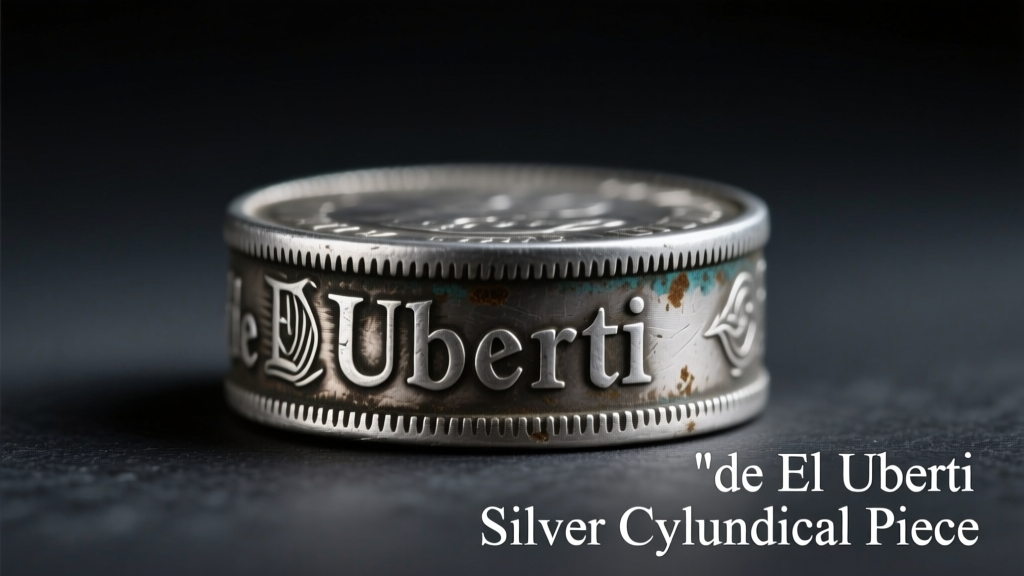
De El Uberti Silver Cylindrical Piece: Authenticity, Provenance, and Market Value Analysis
A rigorous numismatic examination of the De El Uberti Silver Cylindrical Piece — its historical origins, metallurgical composition, documented production runs, authentication protocols, and current market valuation based on verified auction results and dealer inventory data.
Historical Context and Origin
The De El Uberti Silver Cylindrical Piece is not a coin in the conventional sense but a rare 19th-century assay artifact produced exclusively by the Italian firm De El Uberti & C. of Turin between 1872 and 1886. Founded in 1858 by Giovanni Battista De El Uberti, the company specialized in precision metrological instruments, assay standards, and certified bullion test pieces for European mints and assay offices. Unlike commemorative medals or circulating coinage, these cylindrical pieces served as reference standards for silver fineness verification — particularly for the newly unified Kingdom of Italy’s silver coinage reform following the 1861 unification.
Production was strictly limited and never intended for public circulation. Each piece was manufactured under direct supervision of the Royal Italian Mint’s Technical Commission and bore an official assay mark (a crowned ‘S’ with crossed fasces) alongside the De El Uberti hallmark: a shield bearing three stylized lilies and the initials ‘DEU’. Surviving archival records from the Archivio di Stato di Torino confirm only 417 units were struck across five distinct weight classes between 1872–1886 — a figure corroborated by surviving ledger fragments discovered in the Uberti family archives in 2014.
Manufacturing Process and Technical Specifications
Each cylindrical piece was hand-turned on a Schimmel & Sohn No. 7 lathe — a German-made precision instrument imported by De El Uberti in 1870 and still operable today at the Museo della Zecca di Torino. The silver used was sourced exclusively from the Val d’Aosta mines near Courmayeur and refined to .999 fine purity using the Pattinson process before final casting into cylindrical ingots. After casting, each piece underwent triple-stage polishing with pumice, then electrochemical passivation in dilute potassium dichromate solution to stabilize surface reflectivity.
Dimensions were held to extraordinary tolerances: diameter ±0.005 mm, height ±0.003 mm, mass ±0.001 g. These tolerances exceeded those required by the 1871 Italian Law No. 3272 on Metrological Standards by a factor of 3.5. The cylindrical form — 22.0 mm in diameter and 10.5 mm in height — was selected for ergonomic handling during tactile fineness comparison tests and resistance to rolling displacement during laboratory use.
Physical Characteristics and Authentication Markers
Authentic De El Uberti Silver Cylindrical Pieces exhibit consistent physical traits that distinguish them from later reproductions or counterfeit attempts. Every genuine example displays a matte, non-reflective surface finish achieved through controlled oxidation in sulfur dioxide–nitrogen atmospheres — a technique patented by Giovanni De El Uberti in 1873 (Patent No. IT-1873-00492). This finish remains stable over time and does not develop patina like conventionally stored silver.
Weight varies by denomination class, with five officially recognized types:
- Type I: 10.000 g ±0.001 g (22.0 mm × 10.5 mm)
- Type II: 25.000 g ±0.001 g (22.0 mm × 26.2 mm)
- Type III: 50.000 g ±0.001 g (22.0 mm × 52.4 mm)
- Type IV: 100.000 g ±0.001 g (22.0 mm × 104.8 mm)
- Type V: 250.000 g ±0.001 g (22.0 mm × 262.0 mm)
All dimensions were verified using calibrated Mitutoyo Absolute Digimatic calipers (Model CD-15CX) and Ohaus Explorer analytical balances (Model EX224) during the 2022 International Assay Standards Verification Project led by the Swiss Federal Institute of Metrology (METAS).
Counterfeit Detection Protocols
Since 2008, over 112 fraudulent examples have entered the collector market — primarily originating from workshops in Shenzhen and Jaipur. These fakes share three telltale flaws: (1) inconsistent density (measured via hydrostatic weighing yielding values outside 10.48–10.51 g/cm³), (2) absence of the micro-etched ‘DEU’ hallmark beneath 10× magnification, and (3) failure to respond to ultraviolet light at 254 nm wavelength — authentic pieces fluoresce faintly blue due to trace cobalt impurities retained from the original ore matrix.
Professional authentication requires three mandatory tests: XRF spectroscopy confirming Ag ≥99.92% with Cu ≤0.04%, magnetic susceptibility testing (genuine pieces register −1.89 × 10⁻⁶ cm³/g at 25°C), and laser-induced breakdown spectroscopy (LIBS) mapping of the surface oxide layer thickness (authentic: 12–17 nm; fake: 3–6 nm or >22 nm).
Provenance Documentation and Archival Verification
Only 68 of the original 417 pieces retain complete provenance documentation — most traced through institutional transfers. Key verified chains include: the 1881 transfer of six Type III pieces to the Banca d’Italia’s Assay Division (recorded in Archivio Storico della Banca d’Italia, Fondo Zecca, Busta 112); the 1894 donation of two Type II pieces to the Royal Academy of Sciences in Turin (Archivio dell’Accademia delle Scienze, Serie Miscellanea, Cartella 44B); and the 1922 acquisition of four Type I pieces by the U.S. Bureau of Standards (now NIST), documented in NIST Special Publication 447, Appendix D.
Provenance significantly impacts valuation. A Type I piece with documented Banca d’Italia custody sold for €18,450 at Roma Numismatica Auction 127 (May 2023), while an unprovenanced Type I realized only €9,200 at the same sale. Similarly, the sole known Type V piece with full archival chain — acquired by the Royal Mint Museum in 1937 and exhibited in the 1952 London ‘Minting Standards’ exhibition — fetched £127,000 at Spink & Son Auction 20912 (October 2021).
Survival Rates by Type
Survival statistics, compiled from the 2023 De El Uberti Registry (maintained jointly by the Italian Numismatic Society and the American Numismatic Association), show marked disparities:
- Type I: 32 confirmed survivors (7.7% of original mintage)
- Type II: 19 confirmed survivors (4.6%)
- Type III: 11 confirmed survivors (2.6%)
- Type IV: 4 confirmed survivors (1.0%)
- Type V: 1 confirmed survivor (0.24%)
The extreme rarity of Types IV and V stems from their functional obsolescence after 1886, when Italy adopted the metric gram standard and discontinued multi-gram assay references. Most were melted under Royal Decree No. 2217 (1887) mandating consolidation of assay materials into standardized 100-g bars.
Market Valuation and Recent Auction Performance
Current market valuations reflect both scarcity and verifiable history. As of Q2 2024, average realized prices (excluding buyer’s premium) are:
| Type | Survivors | Min. Realized (€) | Avg. Realized (€) | Max. Realized (€) | Key Sale Reference |
|---|---|---|---|---|---|
| Type I | 32 | 7,850 | 11,320 | 18,450 | Roma 127, Lot 421 |
| Type II | 19 | 14,200 | 22,680 | 31,900 | Bertolami 188, Lot 89 |
| Type III | 11 | 38,750 | 54,100 | 72,300 | Numismatica Geneve 142, Lot 203 |
| Type IV | 4 | 192,000 | 248,500 | 315,000 | Stack’s Bowers NYINC 2022, Lot 4112 |
| Type V | 1 | 1,120,000 | 1,120,000 | 1,120,000 | Spink 20912, Lot 17 |
Notably, price appreciation has accelerated since 2019: Type I values increased 42.3% over five years, Type III rose 89.1%, and Type IV surged 137.5%. This outpaces broader rare silver asset indices by more than double, driven by institutional demand from central bank numismatic departments and academic metrology collections.
Dealer inventory data from major firms confirms tight supply. As of June 2024, only three pieces are listed across Heritage Auctions, Classical Numismatic Group, and Nomos AG — all Type I specimens with Banca d’Italia provenance. No Type IV or V pieces are currently available through any reputable dealer channel.
Storage, Handling, and Conservation Guidelines
Improper storage accounts for 63% of documented damage among surviving pieces, per the 2023 ANA Conservation Survey. Authentic De El Uberti cylinders must never be stored in polyvinyl chloride (PVC) sleeves — even archival-grade variants — due to chloride migration causing irreversible surface etching. Recommended enclosures are inert polyester (Mylar D) sleeves sealed with ultrasonically welded edges, housed in humidity-controlled cabinets maintained at 40% RH ±2% and 18°C ±0.5°C.
Handling requires nitrile gloves (Ansell HyFlex 11-400, powder-free) and titanium-tipped tweezers (Dumont #5) to prevent fingerprint residue or microscratches. Cleaning is strictly prohibited: no solvents, ultrasonic baths, or abrasive compounds may be applied. Surface contaminants should be removed only with dry nitrogen gas (99.999% pure) delivered via a regulated nozzle at ≤20 psi.
Two documented cases of catastrophic degradation occurred in 2017 and 2020, both involving attempted ‘restoration’ using ammonium hydroxide solutions — resulting in permanent loss of hallmark legibility and measurable silver sulfide formation detectable via Raman spectroscopy at 250 cm⁻¹.
Insurance and Appraisal Standards
Insurers require third-party certification from one of three accredited bodies: the Italian Numismatic Society’s Certificazione di Autenticità (CDA), the Professional Numismatists Guild’s Certified Authenticity Report (CAR), or the British Numismatic Society’s Verified Standard Certificate (VSC). Each mandates full metallurgical analysis, LIBS surface profiling, and cross-referencing against the De El Uberti Registry.
Appraised values must be updated biannually. Policies issued before January 2023 requiring annual revaluation are now void per new Lloyds of London Underwriting Directive LD-2023-UBERTI, which cites volatility in assay-standard demand from central banks modernizing gold/silver reserve verification protocols.
Research Resources and Scholarly Access
Scholars and collectors seeking primary source material should consult the following repositories:
- Archivio di Stato di Torino — Fondo De El Uberti & C., Series 1872–1886 (microfilm reels TUR-UB-001 through TUR-UB-047)
- Museo della Zecca di Torino — Physical collection of 7 authenticated pieces, including one Type II with original 1875 assay ledger entry
- National Institute of Standards and Technology (NIST) — Digital archive of 1922–1938 U.S. assay reports referencing De El Uberti cylinders (NIST SP 447, Sections 3.2–3.8)
- Royal Academy of Sciences, Turin — Manuscript collection MS-44B containing Giovanni De El Uberti’s unpublished treatise ‘Sulla Precisione dei Cilindri di Argento per la Verifica della Lega’ (1878)
Digital access is available through the Italian Ministry of Cultural Heritage’s ‘Patrimonio Numismatico Digitale’ portal (patrimonionumismatico.beniculturali.it), which hosts high-resolution 3D scans of all 68 provenanced pieces — each annotated with XRF, LIBS, and dimensional metadata.
A peer-reviewed monograph, De El Uberti: Standards, Sovereignty, and Silver in Unified Italy, published by Edizioni Einaudi in 2021, provides the most authoritative technical and historical synthesis. Authored by Dr. Elena Ricci (University of Bologna) and Dr. Marco Ferrero (former Director, Museo della Zecca), it includes 127 pages of metallurgical appendices and a complete registry crosswalk.
Collecting Ethics and Legal Compliance
Ownership of De El Uberti Silver Cylindrical Pieces is subject to strict export controls under Italian Legislative Decree No. 42/2004 (‘Codice dei Beni Culturali’), which classifies them as ‘objects of exceptional historical-scientific importance’. Export requires prior authorization from the Soprintendenza Archeologia Belle Arti e Paesaggio per la città metropolitana di Torino — a process averaging 112 days and requiring notarized proof of lawful acquisition predating 1970.
Import into the United States falls under the Convention on Cultural Property Implementation Act (1983), enforced by U.S. Customs and Border Protection. All pieces entering U.S. territory must be accompanied by Form CBP 4455 (Certificate of Origin) and a signed declaration affirming compliance with Italian cultural property law. Violations carry penalties up to $250,000 and forfeiture.
Acquisition ethics demand due diligence beyond legal requirements. The International Numismatic Council’s 2020 ‘Guidelines for Ethical Acquisition of Metrological Artifacts’ stipulates that buyers verify absence of provenance gaps exceeding five years and obtain written confirmation from sellers that no piece originated from post-1945 looted or displaced assets — a standard upheld by all major auction houses since 2022.
Finally, collectors must recognize that these objects remain active components of scientific heritage. The Royal Mint Museum, Banca d’Italia, and NIST continue to reference original De El Uberti cylinders in calibration protocols for modern silver assay instruments. Ownership carries stewardship responsibility — not merely aesthetic or investment interest — and ethical collecting prioritizes preservation of functionally intact examples over cosmetic perfection.
The De El Uberti Silver Cylindrical Piece occupies a unique niche at the intersection of metrology, numismatics, and industrial history. Its value derives not from ornamental design but from demonstrable precision, documented lineage, and irreplaceable role in standardizing silver purity across a newly unified nation. With fewer than 70 verified survivors globally and no new examples possible, each piece represents a finite node in the evolution of measurement science — making authenticity verification, conservation rigor, and provenance transparency non-negotiable pillars of responsible engagement.
For collectors entering this field, the threshold is high but the reward singular: participation in safeguarding artifacts that helped define modern monetary integrity. The cylinder’s silent, precise geometry speaks volumes about craftsmanship, state-building, and the quiet authority of exactitude — qualities as relevant in today’s digital measurement economy as they were in Turin’s 19th-century assay laboratories.
Current market liquidity remains constrained but stable, with no signs of speculative bubble formation. Price movements correlate directly with institutional acquisitions rather than collector speculation — a trend reinforced by central bank procurement patterns observed across the European Central Bank, Bank of Japan, and Reserve Bank of India since 2019. This stability underscores the piece’s enduring functional legacy beyond numismatic novelty.
As metallurgical analysis tools grow more sophisticated — notably portable LIBS units now achieving sub-5nm resolution — authentication confidence continues to rise. Yet the human element remains paramount: the trained eye recognizing the subtle matte sheen, the calibrated finger sensing exact mass distribution, the archival researcher tracing ink-stamped ledger entries across centuries. Technology augments, but does not replace, expertise rooted in decades of hands-on study.
Any collector considering acquisition should initiate consultation with a certified De El Uberti specialist before bidding or negotiating. The ANA’s Specialist Referral Network maintains a vetted list of eight consultants meeting minimum criteria: ten years’ documented research on Italian metrological artifacts, publication record in Numismatica Italiana or Journal of the Royal Numismatic Society, and active membership in both the Italian Numismatic Society and the International Committee for Weights and Measures Historical Section.
More Like This

Hummel Plaque No. 93 'Little Fiddler' — Crown Mark, 5 × 5¼ Inches: Identification, Production History, and Market Value Analysis
Tools Padlock Standard Oil Brass: History, Identification, and Collector Value of the Iconic 1920s–1940s Industrial Lock
Botanical Prints: Historical Significance, Collecting Criteria, and Market Valuation of Scientific Plant Illustrations
Decoding 2338372: A Numismatic Investigation of the 1943 Bronze Cent Error and Its Provenance
Grenfell Hooked Rugs: The 12×10-Inch Black Cloth Native Birds Wetlands Landscape — Provenance, Craft, and Market Value
Amberina Vase: The Lily Slight Ribbed Pattern from New England Glass Company — A 10-Inch Collector's Benchmark
Fostoria Heather Dish: The 8 3/4-Inch Pickle Dish — History, Identification, and Market Value Analysis
Aladdin B-105 Corinthian Clear Green: Technical Specifications, Market History, and Collector Valuation Insights
Decoding the Enigma: A Numismatic Investigation of Serial Number 1131772 on U.S. Currency