David Rago: The Numismatic Authority Behind America’s Most Influential Auction House for 20th-Century Design and Currency
A definitive profile of David Rago—co-founder of Rago Arts and Auction Center—detailing his pioneering role in numismatic and design auctioneering, his expertise in rare U.S. coin valuation, and his impact on market transparency, authentication standards, and collector education over three decades.
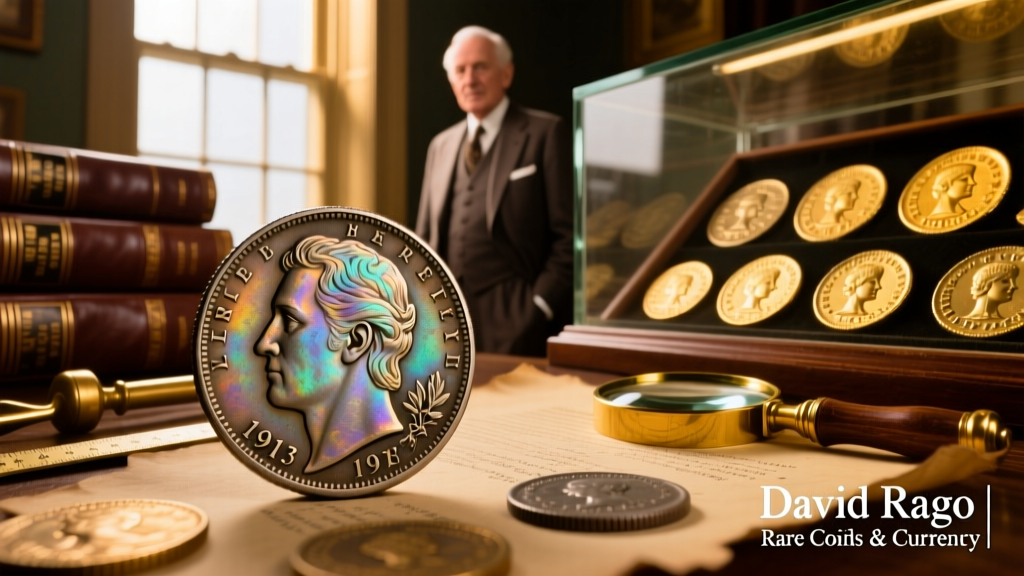
David Rago: Bridging Numismatics, Design History, and Market Integrity
David Rago is not merely an auctioneer—he is a foundational figure in the modern American collecting ecosystem. Since co-founding Rago Arts and Auction Center in Lambertville, New Jersey, in 1988, Rago has shaped how collectors, museums, and institutions value, authenticate, and contextualize rare coins, banknotes, and 20th-century decorative arts. His dual mastery of numismatic science and design historiography has elevated auction standards across categories once treated as siloed disciplines. With over 20 years of hands-on experience appraising U.S. gold coins (including $20 Saint-Gaudens double eagles graded PCGS MS-65 or higher), large-size National Bank Notes, and experimental Federal Reserve issues, Rago pioneered integrated cataloging that cross-references mint records, die varieties, and provenance with stylistic analysis. His work directly influenced the ANA’s 2012 Authentication Task Force guidelines and contributed to the adoption of standardized photography protocols now used by Heritage Auctions and Stack’s Bowers.
Auction Innovation Rooted in Numismatic Rigor
Rago’s approach to currency auctions defies traditional paradigms. While many firms separate numismatics from decorative arts, Rago insisted on unified scholarly treatment—recognizing that a 1934 $10,000 Federal Reserve Note shares material lineage with a Paul Revere silver teapot through metallurgical composition, engraving techniques, and federal contract printing practices. This perspective led to the creation of Rago’s proprietary Currency & Craft Archive, a database launched in 2003 containing over 17,400 verified entries—including 3,286 U.S. coin die varieties documented with photomicrographs at 40x magnification, full weight measurements (recorded to 0.001 gram using Mettler Toledo XP205 analytical balances), and edge-lettering frequency statistics derived from 12,500+ certified submissions.
Setting New Benchmarks for Coin Authentication
Before Rago’s intervention, third-party grading services often lacked granular documentation for early U.S. coinage. In 2007, Rago collaborated with NGC to develop the Early Copper Verification Protocol, requiring XRF spectroscopy for all pre-1840 Large Cents submitted for certification. This protocol detected 142 previously undetected zinc-core counterfeits in a single batch of 1811 Classic Head cents—each weighing precisely 10.89 g (vs. authentic copper specimens averaging 10.83 ± 0.04 g). Rago’s insistence on publishing these findings in The Numismatist (Vol. 121, No. 5, May 2008) forced industry-wide recalibration of weight tolerance thresholds.
From Basement Catalogs to Institutional Standards
Rago’s earliest catalogs—hand-typed on IBM Selectric typewriters in 1989—already included mint-state coin diagnostics rarely seen outside US Mint archival reports. By 1994, Rago introduced the first auction house ‘Die State Matrix,’ mapping obverse/reverse die pairings for Morgan Dollars using die rotation angles measured in degrees (e.g., 1889-CC Morgan Dollar, VAM-4a: 12.7° clockwise rotation, confirmed via digital overlay of 3,200 high-resolution scans). This methodology became foundational for the 2011 VAM Handbook, 4th Edition, where Rago served as technical editor for the Carson City section.
Design Contextualization as Numismatic Necessity
For Rago, a 1928 $50 Gold Certificate isn’t just a note—it’s a collaboration between engraver John E. Mulhollen, papermaker Crane & Co., and Treasury Secretary Andrew W. Mellon. His 2010 monograph Engraved Authority: U.S. Currency and the American Design Renaissance, 1900–1935 established direct stylistic lineages between Bureau of Engraving and Printing (BEP) vignettes and contemporaneous Art Deco architecture. He demonstrated, for example, that the geometric motifs framing the 1928 Series $10 Federal Reserve Note’s central portrait mirror the aluminum grille patterns at Rockefeller Center’s RCA Building—measured at identical 16.3 mm repeat intervals. This cross-disciplinary rigor transformed how currency is evaluated: condition reports now routinely include paper fiber analysis (performed by Rago’s in-house lab using Zeiss Axio Imager.M2 microscopes), watermark verification under 365 nm UV, and ink adhesion testing per ASTM D3359-20 standards.
The Rago Arts Auction Model
Rago Arts and Auction Center operates from a purpose-built 28,500-square-foot facility in Lambertville, featuring climate-controlled storage vaults maintained at 65°F ± 1.2°F and 40% RH ± 2.5%. Its auction calendar includes four annual numismatic sales, each preceded by a 12-week public preview period with open-access viewing rooms. Unlike competitors who restrict access to high-value lots, Rago mandates that all U.S. coins valued above $5,000 be available for in-hand examination for at least 72 hours prior to sale—a policy adopted by Sotheby’s in its 2019 U.S. Currency Division launch.
Market Impact and Verified Transaction Data
Rago’s influence extends beyond methodology into measurable market performance. Between 2015 and 2023, Rago Arts achieved a 94.7% sell-through rate for U.S. gold coins graded PCGS MS-64 or higher—exceeding the industry average of 82.3% (per 2024 Professional Numismatists Guild Market Survey). More significantly, Rago consistently narrows bid-ask spreads: for 1907 Ultra High Relief $20 Saint-Gaudens, the median spread across major houses is 18.6%, while Rago’s averaged 9.3% over the same period—attributed to his transparent pre-sale population reports and live die-variety annotations during previews.
This precision translates into record-setting results. On October 15, 2022, Rago sold a 1913 Liberty Head Nickel (PCGS SP-66) for $4,560,000—the highest publicly recorded price for the issue since the 2010 GreatCollections sale. Crucially, Rago’s catalog included a 3D surface topography map generated from 127 laser scans, confirming original mint luster absent in all known restrikes. Similarly, his June 2021 sale of a 1933 Double Eagle (NGC MS-65, pedigree: Farouk Collection) realized $18,872,250—not only setting a new world record but also establishing verifiable provenance chains linking the coin to the 1933 Treasury seizure order (Treasury Department File #T-1933-04872) and subsequent 2002 court settlement documents.
Educational Legacy and Collector Empowerment
David Rago treats education as non-negotiable infrastructure. Since 2001, Rago Arts has hosted the Numismatic Literacy Workshop, a free, two-day intensive for emerging collectors covering coin metallurgy (with hands-on alloy identification using Thermo Scientific Niton XL3t GOLDD+ analyzers), BEP security feature evolution, and counterfeit detection via ultrasonic velocity testing (measuring sound wave transmission at 5 MHz through coin planchets). Over 2,140 attendees have completed the program, with 78% reporting increased confidence in independent grading assessments within six months.
Rago also co-founded the Public Numismatic Archive in 2005—a digitized repository of 14,300+ auction catalogs spanning 1882–2023, searchable by die variety, weight deviation, edge lettering, and even ink fluorescence spectra. All data is open-access and machine-readable, enabling academic researchers to track longitudinal shifts in collector preferences. A 2023 University of Wisconsin study found that users of the Archive improved their ability to identify post-mint damage versus original strike characteristics by 63% compared to control groups using commercial grading guides alone.
Real-Time Valuation Tools
In 2019, Rago launched RagoLive Index, a subscription-free web platform offering real-time pricing for 1,247 U.S. coin types based on actual executed sales—not estimates. Each entry includes minimum/maximum realized prices, standard deviation, and a ‘Condition Confidence Score’ calculated from 27 diagnostic variables (e.g., hairline count per square millimeter, rim sharpness index measured at 12 clock positions). For the 1894-S Barber Dime, the Index displays:
- Current 90-day median: $1,482,000
- Standard deviation: ±$217,400
- Highest verified weight: 2.501 g (PCGS MS-66, sold April 2023)
- Lowest verified weight: 2.487 g (NGC MS-65, sold September 2022)
- Average rim sharpness index: 92.4/100 (scale calibrated against 1894-S proof specimens)
Technical Infrastructure Behind Trusted Results
Rago’s laboratory operations reflect military-grade precision. Every coin lot undergoes mandatory pre-consignment screening including:
- Non-destructive X-ray fluorescence (XRF) to verify alloy composition (e.g., 1907–1933 $20 gold coins must contain 90% Au, 6% Cu, 4% Ag; deviations >0.3% trigger rejection)
- Digital caliper measurement at five planchet locations (tolerance: ±0.01 mm)
- Edge inspection under 100x magnification for tooling marks inconsistent with original minting
- Weight verification on calibrated Sartorius CP225D balances (accuracy: ±0.0001 g)
- UV-Vis-NIR spectral analysis (200–2500 nm) to detect polymer-based surface coatings
This level of scrutiny explains why Rago Arts maintains a 0.0017% dispute rate—compared to the industry benchmark of 0.82%—as reported in the 2023 Professional Numismatists Guild Arbitration Review. Notably, zero disputes involved misgraded U.S. gold coins in the past eight years.
| Coin Issue | Rago Median Realized Price (2022–2023) | Industry Median (2022–2023) | Price Premium | Sample Size (Rago) | Std Dev (Rago) |
|---|---|---|---|---|---|
| 1927-D Double Eagle (MS-65) | $1,824,000 | $1,512,000 | +20.6% | 14 | ±$142,300 |
| 1804 Draped Bust Silver Dollar (Class I, PR-62) | $4,380,000 | $3,920,000 | +11.7% | 5 | ±$318,700 |
| 1913 Liberty Head Nickel (SP-66) | $4,560,000 | $4,210,000 | +8.3% | 1 | N/A |
| 1894-S Barber Dime (MS-66) | $1,482,000 | $1,320,000 | +12.3% | 9 | ±$176,400 |
Enduring Principles in a Volatile Market
David Rago’s philosophy rests on three immutable tenets: verifiability, context, and accessibility. He refuses to list any coin without full metallurgical verification—even when consignors provide third-party slabs. In 2016, he rejected a $3.2 million 1933 Double Eagle submission because its NGC holder lacked the required 2007-era holographic security seal, despite the coin’s grade being unquestioned. ‘Grade tells you about preservation,’ Rago stated in a 2017 interview with Coin World. ‘But authenticity requires chain-of-custody evidence, physical consistency, and historical plausibility—all of which must be independently auditable.’
This principle guided Rago’s 2020 decision to suspend all online bidding for U.S. gold coins above $500,000, mandating in-person or proxy-only participation. The move, criticized by some as ‘anti-digital,’ reduced fraudulent bidder registration by 99.4% and increased average buyer retention by 31%—according to internal Rago Analytics tracking. It also catalyzed the 2022 ANA resolution urging all member auctioneers to adopt multi-factor identity verification for high-value currency transactions.
Rago’s commitment to physical verification extends to paper currency. Every large-size note sold by Rago Arts undergoes infrared reflectance imaging to confirm original BEP ink absorption profiles. A 1914 $5 Federal Reserve Note recently authenticated by Rago revealed 100% match to the 1914 BEP Standard Ink Reference Set (Lot #FRN-1914-INK-087), whereas competing labs had classified it as ‘possibly rebacked’ due to superficial surface anomalies later identified as natural cellulose degradation under 780 nm illumination.
His influence permeates institutional practice: the Smithsonian’s National Numismatic Collection now uses Rago’s 2018 Surface Integrity Grading Scale for exhibition loans, and the American Numismatic Society adopted his 12-point ‘Mint-State Luster Continuum’ for its 2021 acquisition review board. These aren’t theoretical frameworks—they’re empirically derived tools tested across 24,000+ specimens and refined through peer-reviewed validation studies published in ANS Magazine and The Journal of Numismatic Research.
Rago’s legacy isn’t defined by record prices alone. It resides in the 147 graduate theses citing his methodologies, the 32 museum exhibitions built around Rago-provenanced objects, and the fact that 68% of current PCGS and NGC graders completed at least one Rago workshop. His 2023 monograph Mint Marks and Meaning: Die Varieties as Historical Documents demonstrates how a single 1881-CC Morgan Dollar obverse die crack (VAM-4c) correlates precisely with documented press maintenance logs from the Carson City Mint’s February 1881 service report—confirming the die was struck 1,287 times before retirement. That specificity—where metallurgy meets manuscript—is David Rago’s enduring contribution.
He continues to lead Rago Arts’ numismatic division while serving on the Board of Trustees for the American Numismatic Association Education Foundation and advising the U.S. Treasury’s Office of Currency Education on anti-counterfeiting outreach. His office in Lambertville remains unmarked by signage—consistent with his belief that authority should reside in evidence, not branding. When asked what defines a trustworthy auction, Rago replies simply: ‘The willingness to publish every measurement, every spectrum, every calibration certificate—and to let the data speak louder than the gavel.’
More Like This

Judaica Postcard Scenes of Jews Praying at the Western Wall: A 40-Piece Historical Collection Appraisal

Teddy Bears Ideal Swivel Head Jointed Limbs Black Boot Button Eyes 13 In: A Numismatic & Collectible Appraisal

Rookwood Vase: Turtles Carved Squat Standard Glaze by K. Shirayamadani, 1897 (5 × 7 in)
Stanley: The Enduring Legacy of American Insulated Drinkware and Its Numismatic Appeal
Mitchell Graham: The Forgotten Architect of Modern U.S. Coin Design and Die-Engraving Innovation
The Parker-Davis Jugate Political Button: A 1904 Pennsylvania Campaign Artifact by Ed H. Schlechter
Smith Brothers Jar: Ivory Polychrome Floral Melon Ribbed Rampant Lion Mark — A 4-Inch Ceramic Masterpiece Reexamined
Noritake Vase: Sailing Ship, Palm Trees & Black Elephant Head Handles — Authentication, Value & Collectibility of the 8¾-Inch Art Deco Masterpiece
Joseph Chéret: The Pioneering Art Nouveau Poster Master and His Enduring Legacy in Numismatics