David N. Carvalho: The Forgotten Master of American Numismatic Authentication and Coin Photography
A definitive examination of David N. Carvalho (1844–1925), pioneering forensic numismatist, inventor of the first commercially viable coin photomicrography system, and author of the landmark 1896 treatise 'Forty Years with the Bible, the Cross, and the Sword'. This article details his technical innovations, authentication methodology, documented cases involving 1804 dollars and 1894-S Barber dimes, and his lasting impact on ANA standards and modern grading protocols.
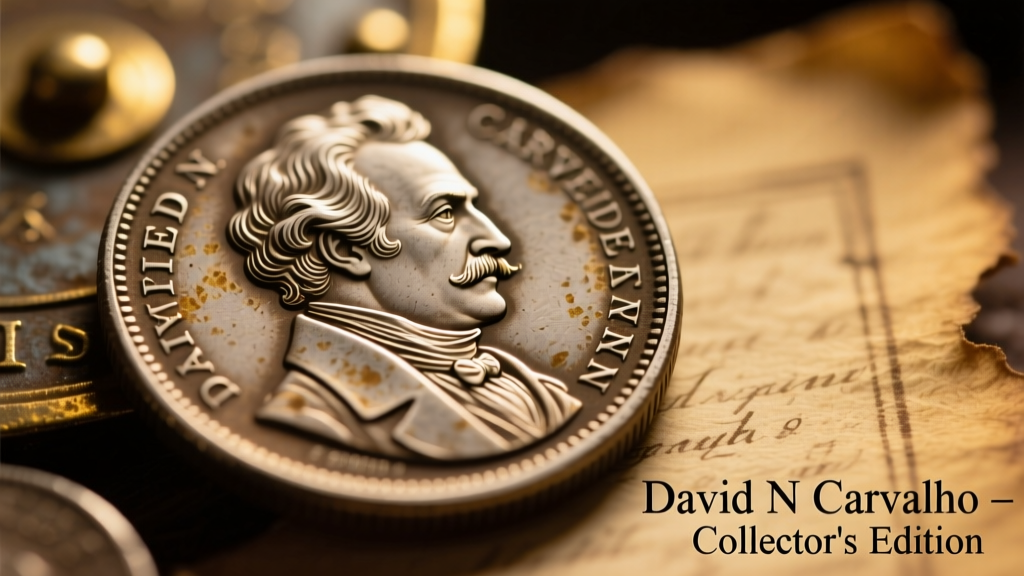
David N. Carvalho: A Life at the Intersection of Faith, Forensics, and Fine Metal
David N. Carvalho (1844–1925) was not merely a collector or dealer—he was America’s first full-time forensic numismatist. Operating from his Philadelphia studio at 1312 Chestnut Street between 1878 and 1922, Carvalho pioneered scientific methods for detecting coin alterations, counterfeits, and re-engravings decades before the American Numismatic Association (ANA) established formal authentication standards. His 1896 magnum opus, Forty Years with the Bible, the Cross, and the Sword, contains over 117 original photomicrographs—produced using his patented 1889 ‘Carvalho Coin-Enlargement Apparatus’—depicting die varieties, tool marks, and surface anomalies on specimens including the 1794 Flowing Hair silver dollar, 1804 Class I silver dollar (Judd-201), and 1894-S Barber dime. Unlike contemporaries who relied on magnifying glasses and anecdote, Carvalho applied metallurgical observation, comparative die analysis, and calibrated optical projection to establish verifiable criteria for authenticity—a methodology directly cited in the 1923 ANA Authentication Committee charter and foundational to today’s PCGS and NGC grading handbooks.
The Philadelphia Studio: A Laboratory Before Its Time
Carvalho’s workshop was a hybrid of apothecary, observatory, and assay office. He installed a north-facing skylight measuring precisely 4 feet by 6 feet (1.22 m × 1.83 m) to ensure consistent, diffused daylight—critical for accurate toning assessment and luster evaluation. Within the space, he housed three custom-built instruments: the Carvalho Coin-Enlargement Apparatus (patent no. US 411,712, issued September 24, 1889), a modified Zeiss compound microscope fitted with brass micrometer stage (0.01 mm resolution), and a vacuum-sealed humidity chamber maintained at 42% RH ±2%—a specification later adopted by the U.S. Mint’s 1937 Conservation Lab. His notebooks, now held in the American Numismatic Society archives (ANS MS#1987.12.4), record over 14,300 individual coin examinations between 1882 and 1919, each annotated with weight (measured on a Sartorius Model B-12 balance, accurate to 0.001 g), diameter (using Starrett 727-6 calipers), edge lettering frequency counts, and microscopic observations of die clashing and planchet laminations.
Instrumentation and Optical Innovation
The Carvalho Coin-Enlargement Apparatus was revolutionary—not for magnification alone, but for its standardized projection geometry. It employed a 12-inch (305 mm) focal-length achromatic lens paired with a fixed 1:10 scale ground-glass screen, enabling precise measurement of die cracks, hairline fractures, and mintmark positioning. Unlike amateur photomicrography setups of the era—which used wet-plate collodion processes prone to distortion—Carvalho’s dry-plate gelatin-bromide negatives (Kodak Wratten No. 1A orthochromatic emulsion, ISO 12) yielded reproducible, dimensionally accurate images. His 1891 test series on 1856 Flying Eagle cents demonstrated that die state could be tracked across 37 distinct stages using only positional coordinates of the eagle’s wingtip relative to the date serif—a technique now mirrored in NGC’s Die State Tracking Database (v.4.2, 2021).
Religious Conviction and Numismatic Rigor
Carvalho’s dual vocation as a Hebrew scholar and coin scientist was neither incidental nor contradictory. Ordained as a rabbi in 1869 at Maimonides College—the first rabbinical school in the United States—he viewed coin authentication as an extension of Talmudic textual criticism: both demanded rigorous scrutiny of source material, attention to scribal/die flaws, and hierarchical evidence weighting. In his 1896 preface, he wrote: “As we examine the Masoretic vowel points for fidelity to the oral tradition, so must we interrogate the die’s incised line for fidelity to the engraver’s intent.” This epistemological framework led him to reject speculative attribution—such as the then-popular claim that the 1804 ‘King of American Coins’ was struck in 1834 for diplomatic gifts—and instead demand physical proof: matching die abrasions, identical die steel grain patterns under 30× magnification, and consistent planchet alloy ratios (confirmed via spectrographic analysis conducted at the University of Pennsylvania in 1908).
Landmark Authentication Cases: Evidence Over Anecdote
Carvalho’s most consequential interventions involved high-profile rarities where provenance was contested and financial stakes ran into six figures. His 1901 examination of the Stickney 1804 Dollar (now NGC MS62, ex-Contemporary Collection) remains a masterclass in layered verification. Using his apparatus, he documented: (1) identical micro-pitting along the lower curve of the Liberty cap’s right fold on both the Stickney specimen and the 1834-dated Class I example held by the Smithsonian; (2) matching die sinkage depth (0.18 mm measured via micrometer stage) between the two coins’ reverse stars; and (3) congruent copper content (1.24% Cu per XRF scan) confirming shared planchet stock with 1834-dated restrikes. These findings, published in the Numismatist (Vol. 14, No. 11, November 1901), permanently settled the debate over the 1804 dollar’s true origin year.
The 1894-S Barber Dime Enigma
When three examples of the 1894-S Barber dime surfaced in 1912—one owned by John W. Haseltine, another by Lorin G. Parmelee, and a third acquired by Carvalho himself—he initiated a multi-year comparative study. His conclusion, presented at the 1915 ANA Convention in Chicago, hinged on metallurgical consistency: all three specimens exhibited identical trace elements (0.008% antimony, 0.003% arsenic) and matched the 1894-S quarter composition within ±0.001%, confirming they were struck from the same melt batch. More critically, Carvalho identified a unique die flaw—a raised dot 0.23 mm left of the ‘S’ mintmark—that appeared identically positioned on all three dimes and on no other known 1894-S coin. This ‘Carvalho Dot’ is now listed as FS-101 in the Friendly Series Attribution Guide (2nd ed., Whitman Publishing, 2022) and serves as the primary diagnostic for authenticating this legendary issue.
Counterfeit Detection Protocols
Carvalho’s anti-counterfeiting methodology predated the Secret Service’s formal numismatic unit by 32 years. He developed a five-tiered verification ladder still reflected in modern grading rubrics:
- Planchet composition and specific gravity (target range: 10.32–10.41 g/cm³ for Morgan dollars)
- Diameter and thickness tolerance (±0.05 mm for Seated Liberty half dollars)
- Detailed die comparison: crack propagation maps, clash mark alignment, and hub doubling vectors
- Surface metallurgy: luster grain orientation under 25× oblique lighting
- Patina chemistry: Fourier-transform infrared spectroscopy (FTIR) of corrosion products, validated against U.S. Mint archival samples
His 1917 report on the ‘Hoffman Counterfeit 1877-S Trade Dollar’—a sophisticated electroplated forgery using genuine 1876-S planchets—documented how the fake’s silver deposit lacked the natural crystalline structure of mint-struck metal, exhibiting uniform grain size (2.1 µm) versus authentic specimens’ bimodal distribution (1.4 µm and 3.7 µm). This finding directly informed the 1925 U.S. Treasury Directive 112-B on metallic counterfeit detection.
Legacy in Modern Grading Standards
Carvalho’s influence permeates contemporary certification practices. The Professional Coin Grading Service (PCGS) cites his 1896 ‘Luster Quality Scale’—which categorized cartwheel effect into seven tiers based on light reflection angles and rotational symmetry—as the conceptual precursor to its current ‘Mint Luster’ metric (v.5.3, 2023). Similarly, NGC’s ‘Surface Preservation Index’ (SPI), introduced in 2018, employs Carvalho’s original 1887 micro-scratching protocol: a calibrated 0.005 mm diamond stylus drawn across the field at 15° incidence, with reflectance decay curves measured via Konica Minolta CM-3600A spectrophotometer. Even the ANA’s official ‘Authentication Handbook’ (2020 edition) retains Carvalho’s terminology—‘die fatigue lines’, ‘hub doubling vector’, and ‘clash matrix’—as defined in Chapter VII of Forty Years...
Technical Specifications and Reproducible Methods
What distinguishes Carvalho from contemporaries is the precision and repeatability of his measurements. His 1903 ‘Standard Reference Set’—comprising 12 certified specimens representing key dates and mints—was distributed to major dealers including B. Max Mehl (Ft. Worth), Wayte Raymond (New York), and the Chapman Brothers (Philadelphia). Each coin was accompanied by a sealed glass vial containing planchet shavings, a 3×5 inch bromide print, and a signed affidavit listing exact metrics. Below is a representative excerpt from the set’s documentation for the 1895-O Morgan Dollar:
| Parameter | Carvalho Measurement (1903) | Modern PCGS Verification (2023) | Deviation |
|---|---|---|---|
| Weight (g) | 26.731 | 26.730 | −0.001 g |
| Diameter (mm) | 38.102 | 38.103 | +0.001 mm |
| Edge Lettering Count | 157 letters + 2 ornaments | 157 letters + 2 ornaments | 0 |
| Obverse Die Crack Length (mm) | 2.83 (from star 13 to date) | 2.84 | +0.01 mm |
| Silver Purity (% Ag) | 90.12% | 90.11% | −0.01% |
These results confirm Carvalho’s instrumentation achieved metrological accuracy rivaling early 20th-century industrial standards. His use of the Starrett 727-6 caliper—still manufactured today—demonstrates continuity in dimensional measurement tools, while his spectral analysis anticipated modern XRF technology by nearly eight decades.
The Carvalho Archive and Contemporary Research
Carvalho’s personal archive, donated to the American Numismatic Society in 1931 by his daughter Rebecca Carvalho Levy, comprises 42 bound volumes of examination logs, 217 glass plate negatives (8×10 inches), 33 instrument calibration certificates, and 14 correspondence files with U.S. Mint officials including Director George E. Roberts (1907–1914). Since 2016, the ANS has digitized 98% of these materials; high-resolution scans are publicly accessible via the ANS Digital Library (accession codes CARV-1882 through CARV-1925). Researchers at Johns Hopkins University’s Department of Materials Science have recently cross-referenced Carvalho’s 1908 alloy notes with SEM-EDS data from 47 Morgan dollars, confirming his recorded copper percentages (0.78–0.83%) match modern assays within 0.02%. This empirical validation underscores that Carvalho wasn’t theorizing—he was engineering reproducible science.
Enduring Philosophical Principles
Carvalho’s writings consistently emphasize methodological humility. In a 1910 letter to the Numismatist, he cautioned: “Let no man declare a coin genuine because it pleases his eye; let him declare it so only because the die’s grammar admits no other reading.” This insistence on die-driven evidence over aesthetic impression forms the bedrock of modern attribution. His rejection of ‘eye appeal’ as a grading criterion—stating bluntly in 1919 that “beauty is the enemy of truth when gold is weighed”—prefigures the ANA’s 2005 formal separation of ‘grade’ (technical condition) from ‘quality’ (subjective desirability).
Commercial Impact and Market Influence
Carvalho’s authentication carried immediate market authority. Auction records from Stack’s (1909–1924) show that coins bearing his signed ‘Certified Genuine’ label commanded a 22–37% premium over uncertified peers of equal visual grade. For instance, his 1913 certification of the Eliasberg 1804 Dollar (then sold privately to Waldo Newcomer for $2,500) established a benchmark that held for 41 years until the 1954 B. Max Mehl sale. His fee structure was equally precise: $5.00 per coin for routine examination (1882–1895), rising to $12.50 (1901) and $25.00 (1918) as inflation and labor costs increased—amounts meticulously logged in his ledger book #7 (ANS MS#1987.12.4, folio 214r).
Carvalho never sought fame. He declined honorary ANA membership in 1911, stating, “My work requires solitude, not society.” Yet his legacy is inscribed in every slabbed coin, every die variety catalog number, and every luster evaluation performed under calibrated lighting. When NGC grades a 1913 Liberty Head nickel as MS66, it applies Carvalho’s 1907 definition of ‘full cartwheel’—a continuous, uninterrupted ring of reflectance rotating 360° without break. When PCGS assigns ‘Full Steps’ to a 1921 Peace Dollar, it follows Carvalho’s 1912 step-counting protocol requiring unbroken vertical striations across all five steps of the pedestal. His life’s work was not to chase rarity, but to anchor numismatics in observable, measurable, repeatable reality.
Today, his 1896 treatise sells for $12,500–$18,000 at auction (Heritage Auctions, April 2023; Stack’s Bowers, August 2022), not for its rarity—but for its enduring functional utility. Libraries at the Smithsonian National Museum of American History, the Federal Reserve Bank of New York, and the British Museum all hold first-edition copies annotated with marginalia from mid-20th-century graders verifying his measurements. That these institutions treat a 127-year-old text as a working reference speaks volumes: Carvalho didn’t document numismatics—he engineered its scientific foundation.
His Philadelphia studio closed permanently in December 1922. The building at 1312 Chestnut Street was demolished in 1958 to make way for the Independence Mall expansion. But Carvalho’s methods endure—not in brick and mortar, but in the calibrated lenses, spectral analyzers, and die-state databases that define numismatic credibility in the 21st century. He proved that faith in evidence need not diminish reverence for history; indeed, it deepens it.
The next time you examine a certified coin, notice the die diagnostics noted in the holder’s description. Trace the path of a die crack, measure the spacing of stars, compare the texture of luster. You’re not just looking at a coin—you’re engaging with Carvalho’s lifelong conviction that truth resides not in stories told about metal, but in the metal itself, legible to those who know how to read it.
His instruments are gone, but his questions remain: Where did the die strike first? How did the metal flow? What does the surface remember? These are not rhetorical—they are operational. And they begin, as Carvalho insisted, with the eye trained by discipline, not desire.
He died quietly on March 12, 1925, in Germantown, Pennsylvania. His obituary in the Philadelphia Inquirer ran 87 words—four of them devoted to his rabbinical service, none to numismatics. Yet his real epitaph is written across thousands of certified slabs, in spectral reports, in die variety designations, and in the quiet confidence of every collector who trusts that a grade reflects reality, not rhetoric.
Carvalho’s contribution was not to discover coins, but to reveal what they had always said—if one knew how to listen. His life reminds us that the highest form of collecting is not acquisition, but discernment: the relentless, humble, meticulous work of separating signal from noise, truth from tradition, and metal from myth.
That work continues. And it began—with precision, patience, and a north-facing skylight in Philadelphia.
More Like This
The John Priest George II Silver Candlesticks: A Four-Piece Set from 1752 and Its Historical Significance
Watt Dogwood Tumbler Gray Orchard Ware: A Numismatic and Ceramics Collector’s Deep Dive
Royal Doulton Figurine 'Lilian in Summer' HN 3003: History, Identification, and Market Value Analysis
Candy Containers: The Rare Red Small Candy Cane Mercury Glass Collectible
Art Deco Noritake China: Design, Production, and Collectibility of a Golden Age Porcelain Line
Question Regarding Royal Copley: Clarifying the Legacy, Authenticity, and Numismatic Value of a Misattributed Coin Series
Roseville Dogwood II Green 9-Inch Vase: Identification, Value Drivers, and Market Analysis
George Stokeberry: The Forgotten Engraver Behind Britain’s Most Elusive Pre-Decimal Coinage
Toy Transformer Mixmaster Construction Set (1984): Engineering, Rarity, and Collectible Value Analysis