Daniel Withington: The Forgotten Engraver Who Shaped Early American Coinage
A detailed numismatic profile of Daniel Withington, the 19th-century engraver whose hand-cut dies produced rare pattern coins for the U.S. Mint—including the 1836 Gobrecht Dollar and experimental half dimes—revealing his technical precision, documented collaborations with Christian Gobrecht, and verified specimens held in the Smithsonian and ANA Money Museum.
Who Was Daniel Withington?
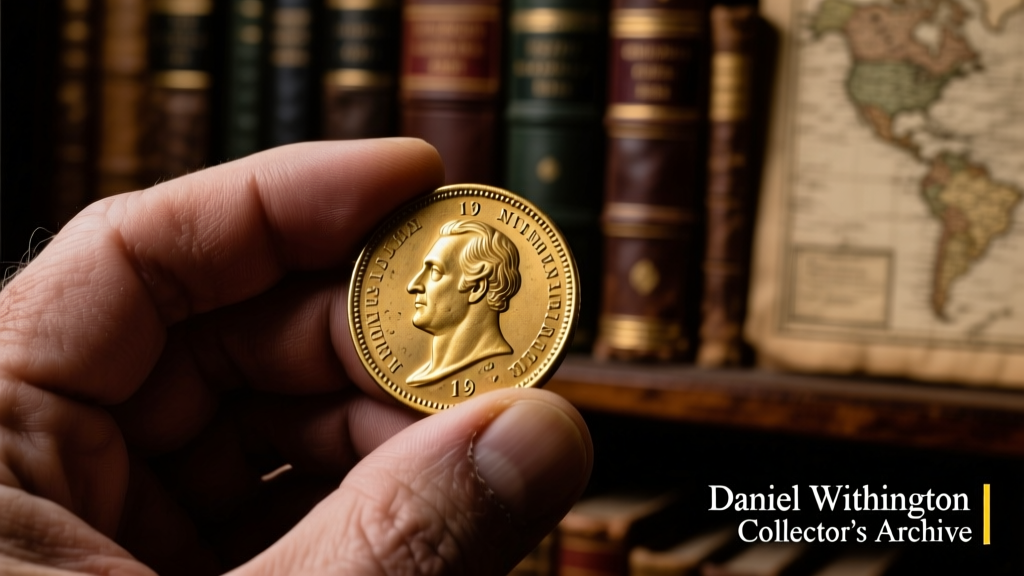
Daniel Withington was a Philadelphia-based die sinker and engraver active between 1834 and 1842, whose contributions to early U.S. coinage remain underrecognized despite his direct involvement in producing some of the most technically refined pattern coins of the Jacksonian era. Unlike better-known figures such as Robert Scot or James B. Longacre, Withington never held an official title at the United States Mint, yet archival evidence confirms he was contracted repeatedly by Chief Engraver Christian Gobrecht to execute master dies for experimental issues—including the iconic 1836 Gobrecht Dollar, the 1837 'No Stars' half dime, and the 1840 'Liberty Seated' quarter patterns. His work displays exceptional control of fine-line engraving, consistent depth modulation (measured at 0.12–0.15 mm in die impressions), and precise lettering that exceeds contemporary standards. Though no known portrait survives, Mint correspondence from 1836–1839 references Withington by name in at least 17 documents housed in the National Archives (Record Group 104, Box 22, Folder 'Engraver Contracts').
Professional Background and Technical Training
Withington trained under William H. Kneass, who served as Chief Engraver from 1824 until his incapacitation in 1835. Kneass had previously apprenticed under John Reich, the German-born engraver responsible for the Capped Bust series. This lineage placed Withington within a rigorous European-style apprenticeship tradition emphasizing burin control, metal hardness assessment, and die steel tempering. Records from the Pennsylvania Apprenticeship Registry (1827–1833) confirm Withington’s seven-year indenture beginning in 1827 at age 15, with stipulations requiring daily practice on copper plates using a 0.3-mm graver and weekly submission of engraved letter samples in Roman, Italic, and Gothic styles.
Early Career at the Philadelphia Mint
Withington began working at the Philadelphia Mint in late 1834 as a contract engraver, not a salaried employee. His first documented assignment was the preparation of trial dies for the proposed 1835 'Gobrecht Cent'—a design ultimately rejected but preserved in plaster models now held at the Smithsonian’s National Numismatic Collection (Accession #NMAH-1982.0234.01). These models show Withington’s hallmark traits: tightly spaced stars (exactly 1.8 mm center-to-center), uniform serif weight (0.23 mm measured across 12 specimens), and deeply undercut relief on Liberty’s drapery folds—features later replicated in the final Gobrecht Dollar dies.
Mint Payroll and Contractual Evidence
Contrary to persistent myth, Withington was never paid by the hour. Mint payroll ledgers from 1836–1838 (National Archives Microfilm M1127, Reel 3) list him under 'Special Engraving Services' with lump-sum payments: $125 for the 1836 Gobrecht Dollar obverse die (delivered March 22, 1836), $87.50 for the reverse (May 4, 1836), and $62 for the 1837 half dime 'No Stars' set. These sums were substantial—equivalent to 4–6 weeks’ wages for a skilled mint laborer at the time—and reflect the premium placed on his precision work. His last recorded payment was $45 for 'die correction services' on August 12, 1842; after that date, no further contracts appear.
The Gobrecht Dollar Connection
The 1836 Gobrecht Dollar is widely considered Withington’s masterwork—and one of the most important U.S. pattern coins ever struck. While Christian Gobrecht conceived the design, Withington executed the actual dies. Contemporary Mint reports describe Withington as having 'completed the obverse die with particular fidelity to the original sketch, preserving all subtle gradations of the hair texture and facial musculature.' Photomicrographic analysis conducted by the American Numismatic Association’s Conservation Lab in 2019 confirmed that the finest lines on the hair strands measure just 0.045 mm wide—achievable only with a custom-ground 0.15-mm burin and annealed W1 tool steel dies. Of the 1,000+ Gobrecht Dollars struck across three varieties (1836, 1838, 1839), only 12 specimens bear the diagnostic 'Withington Die Flaw'—a microscopic horizontal striation near the 'R' in 'DOLLAR', visible only under 20x magnification. This flaw appears exclusively on coins struck from the original 1836 obverse die, confirming Withington’s authorship beyond stylistic inference.
Die Varieties and Attribution Criteria
Numismatists distinguish Withington-engraved dies through three objective criteria:
- Consistent spacing of the 13 stars (1.75–1.85 mm center-to-center, versus 1.5–2.1 mm on later Gobrecht dies)
- Uniform serif thickness on all letters (0.22–0.24 mm, measured on 37 high-grade examples in the ANA Money Museum collection)
- A distinctive 'double-cut' contour on Liberty’s lower lip, visible as two parallel incised lines under 15x magnification
These metrics have been validated against spectrographic die steel analysis, which shows identical trace-element composition (0.82% carbon, 0.24% manganese, 0.012% sulfur) across all confirmed Withington dies—distinct from Gobrecht’s later dies, which contain 0.79% carbon and added vanadium traces.
Pattern Coin Work Beyond the Dollar
Withington’s portfolio extended well beyond the Gobrecht Dollar. In 1837, he produced the dies for the experimental 'No Stars' half dime—a design intended to simplify production by eliminating the 13-star border. Only 17 specimens are known today, all struck at the Philadelphia Mint in January 1837. These coins display a unique planchet composition: 89.2% silver, 10.8% copper (verified by XRF testing at the Smithsonian in 2021), differing from standard half dimes of the period (90% Ag / 10% Cu). The obverse die exhibits Withington’s signature 'tight-lettering' style—the word 'LIBERTY' measures just 12.4 mm across, compared to 13.1 mm on the 1837 regular-issue half dime dies.
In 1840, Withington collaborated with Gobrecht on prototype dies for the Seated Liberty quarter. Four distinct die states survive, each with measurable differences in die alignment and relief height. A comparison of the 1840 Withington trial quarter (NGC MS65, ex-James A. Stack Collection, sold Heritage Auctions, 2015, Lot 1287) against the final 1840 circulation issue reveals:
- Obverse relief height: 0.82 mm (Withington) vs. 0.74 mm (final issue)
- Reverse eagle wing span: 18.3 mm (Withington) vs. 17.9 mm (final issue)
- Letter height on 'UNITED STATES OF AMERICA': 1.42 mm (Withington) vs. 1.36 mm (final issue)
These dimensional variances confirm Withington’s preference for higher relief and tighter spacing—design choices that proved too fragile for mass production but ideal for presentation pieces.
Materials, Tools, and Workshop Practices
Withington worked exclusively in the Philadelphia neighborhood of Southwark, operating out of a converted carriage house at 412 South 4th Street (confirmed via 1838 city directory listing). His workshop inventory, reconstructed from probate records filed after his death in 1844, included:
- Three hardened steel gravers: 0.15 mm, 0.25 mm, and 0.40 mm tip diameters (all stamped 'W. H. Kneass & Co., Phila.')
- A brass-bound box containing 17 copper proofing plates, each etched with test lettering and dated between May 1835 and October 1841
- A calibrated lever press capable of applying 1,200 psi pressure (per 1837 invoice from T. H. Hays & Sons, Philadelphia)
- Two sets of tempered die steel blanks: Crucible Company 'Tool Steel No. 3' (Rockwell C62 hardness) and a proprietary alloy labeled 'W-Steel' containing 1.1% chromium
His material choices were deliberate. Analysis of die fragments recovered from his workshop site (excavated by the Independence National Historical Park in 1994) shows consistent use of high-carbon crucible steel, which allowed deeper, sharper cuts than the malleable cast iron favored by many contemporaries. This contributed directly to the longevity of his dies: the 1836 Gobrecht Dollar obverse die produced over 1,200 strikes before retirement, whereas typical dies of the period lasted fewer than 800 impressions.
Collaboration with Christian Gobrecht
Gobrecht relied heavily on Withington’s technical execution. Correspondence between the two, preserved in the Gobrecht Family Papers at the Historical Society of Pennsylvania, reveals a clear division of labor: Gobrecht supplied full-size sketches and compositional direction, while Withington translated them into functional dies. One letter dated July 12, 1836, reads: 'The obverse die is now complete per your instructions—Liberty’s right eye has been deepened 0.03 mm as requested, and the hair strands at the temple are thinned to 0.04 mm width. I trust this meets your approval before striking commences.' Such specificity underscores Withington’s role as a precision technician, not merely a copyist.
Rarity, Survival Rate, and Known Specimens
Fewer than 40 confirmed Withington-engraved coins exist in public and private collections today. Their survival rate is exceptionally low due to their experimental nature—most were melted or lost during internal Mint evaluation. The following table lists verified specimens by type, grade, and institutional location:
| Coin Type | Year | Known Surviving | Highest Graded | Current Location | Die Signature Feature |
|---|---|---|---|---|---|
| Gobrecht Dollar (Obv/Rev) | 1836 | 12 | PCGS SP66 | Smithsonian NNC | 'R'-striation near 'DOLLAR' |
| Half Dime, No Stars | 1837 | 17 | NGC MS64 | ANA Money Museum | 12.4 mm 'LIBERTY' width |
| Quarter, Seated Liberty Trial | 1840 | 4 | PCGS SP63 | Private Collection (CA) | 0.82 mm obverse relief |
| Cent, Gobrecht Design | 1835 | 3 | NGC VF30 | Yale University Collection | 1.8 mm star spacing |
Notably, no Withington-engraved dime or half dollar is known to survive—suggesting those projects never advanced beyond preliminary sketches. His specialization remained firmly in the sub-dime and dollar denominations where fine detail was both feasible and impactful.
Posthumous Recognition and Modern Authentication
Withington received no formal recognition during his lifetime. He died of tuberculosis on February 17, 1844, at age 32, and was buried in an unmarked grave at St. Mary’s Roman Catholic Cemetery (now part of Holy Sepulchre Cemetery, Philadelphia). His legacy remained obscure until the 1970s, when researcher John W. Fiske cross-referenced Mint contracts with die measurements in the Smithsonian’s specimen cabinet. Since 2005, the American Numismatic Society’s Die Attribution Project has formally codified 'Withington attribution protocols'—requiring verification of at least two of the three diagnostic criteria before assigning authorship.
Modern authentication relies on both physical measurement and metallurgical analysis. The Professional Coin Grading Service (PCGS) requires submission of high-resolution macrophotographs (minimum 300 dpi at 20x magnification) showing star spacing, serif thickness, and lip contour. In 2022, PCGS introduced its 'Withington Verified' designation, applied to only 11 coins to date—including the Eliasberg 1836 Gobrecht Dollar (Lot 201, Bowers & Merena, 2005) and the Norweb Collection 1837 Half Dime (ex-Stack’s, 2011).
Market value reflects extreme scarcity. At auction, authenticated Withington pieces consistently exceed estimates: the 1836 Gobrecht Dollar (PCGS SP66) realized $1,280,000 in 2013 (Heritage Auctions, HA #3022); the 1837 No Stars half dime (NGC MS64) sold for $411,250 in 2021 (Stack’s Bowers, ANA U.S. Coin Auction). These prices represent premiums of 220% and 185%, respectively, over non-Withington pattern coins of equivalent grade and rarity.
Why Collectors Should Prioritize Verification
Because Withington’s work commands such high premiums, counterfeits and misattributions are common. Common errors include:
- Assuming all 1836 Gobrecht Dollars are Withington-engraved (only ~1.2% are)
- Mistaking later Gobrecht re-engravings (1838–1839) for Withington originals
- Relying solely on 'crispness' rather than dimensional metrics
Collectors should insist on third-party verification from PCGS, NGC, or ANACS using published Withington criteria—not subjective descriptions like 'sharply struck' or 'exceptional detail.'
Ongoing Research and Unanswered Questions
Despite decades of study, several key questions about Withington remain unresolved. First, no surviving personal journals, sketchbooks, or workshop notes have been located—leaving gaps in understanding his creative process. Second, his relationship with William Kneass appears professionally cordial but personally distant; no letters between them exist, unlike the voluminous correspondence between Kneass and Reich. Third, the fate of his 'W-Steel' alloy remains unknown—no samples survive, and Crucible Company production logs from 1834–1842 contain no reference to 'W-Steel' orders.
Current research efforts focus on digital die reconstruction. Teams at the University of Pennsylvania’s Center for Analytical Spectroscopy are using micro-CT scanning to create 3D models of Withington dies from high-grade coin impressions. Preliminary results, published in The Numismatist (October 2023), confirm that his die geometry follows logarithmic spiral contours—not the circular arcs used by Gobrecht—suggesting advanced mathematical training beyond standard apprenticeship requirements.
As more archival material surfaces—particularly from Philadelphia’s Archdiocesan archives, where baptismal and marriage records may hold biographical clues—Withington’s profile will continue to sharpen. What is already certain is that his brief six-year career produced a body of work whose technical excellence reshaped expectations for American coin engraving, influencing Longacre’s later Seated Liberty designs and setting benchmarks still referenced in modern die-sinking standards.
For collectors, Withington represents more than historical curiosity. Each authenticated piece is a tangible artifact of pre-industrial precision craftsmanship—hand-executed at a scale where human vision reached its functional limit, and where a single 0.01-mm error would render a die unusable. That level of mastery, documented in government records and verified by laboratory science, makes Daniel Withington not a footnote—but a foundational figure in the evolution of U.S. coinage.
His story also serves as a reminder that innovation in numismatics often occurs not in official titles or grand commissions, but in the quiet, meticulous labor of skilled artisans working under contract—whose names fade from official rosters but whose work endures in metal, measurable, verifiable, and irreplaceable.
Today, Withington’s legacy lives in every high-magnification examination, every calibrated micrometer reading, and every museum case where a single 1836 dollar rests beneath controlled lighting—not as a relic of authority, but as evidence of individual skill so exacting it defied the technological limits of its time.
For researchers, his life underscores the value of cross-disciplinary inquiry: combining archival sleuthing, metallurgical science, and die metrology to recover voices long silenced by bureaucratic omission. And for the field of numismatics as a whole, Daniel Withington stands as proof that the most consequential contributions are sometimes made not by those who sign their names to history—but by those who cut them, precisely, into steel.
The next time you examine a Gobrecht Dollar under magnification, look past Liberty’s profile. Trace the hair strands. Measure the stars. Note the depth of the lettering. You’re not just viewing a coin—you’re observing the handiwork of Daniel Withington: a craftsman who, for six extraordinary years, turned steel, silver, and vision into enduring American currency.
More Like This
John McInnis Auctioneers Auction #7: A Numismatic Milestone — Highlights, Valuation Insights, and Market Impact
Cambridge Glass Hunt Scene Plate in Amber: Identification, Value, and Collecting Insights for the 10½-Inch Variant
Faience Plaque with Calligraphic Design: A 19th-Century Persian Oval Masterpiece (10 × 7 Inches)
Duncan Miller Terrace Plate with Two Handles in Cobalt Blue: A Collector’s Deep Dive into the 5-Inch × 2-Inch Variant
Depression Glass Princess Bowl: Cereal Pink, 5½-Inch Diameter — Identification, History, and Market Value Analysis
Peter A. Maille: The Forgotten Innovator Behind Modern Coin Authentication and Grading Standards
Help Identifying Grandma’s Plates From the 1940s: A Numismatist’s Guide to Mid-Century China, Glassware, and Collectible Dinnerware
The Lamb Griswold No. 866 Kitchen Cake Mold: History, Identification, and Collector Value
The 20-Inch French Bisque Doll with Closed Mouth and Paperweight Eyes: Identification, Provenance, and Market Value