Dance Cards: A Bygone Ballroom Accessory — History, Design, and Collectibility
An in-depth exploration of vintage dance cards—ornate, functional ephemera from 19th- and early 20th-century social dance culture. Covers origins, materials, regional variations, notable manufacturers like J. E. Caldwell & Co. and Tiffany & Co., preservation challenges, and current market valuations for collectors.
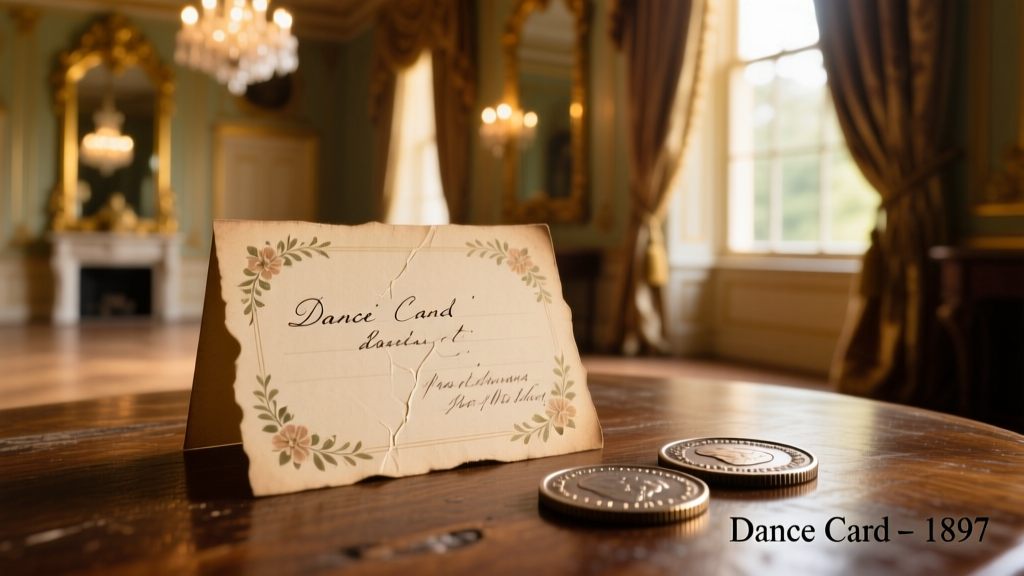
Dance cards were elegant, pocket-sized accessories used primarily between 1840 and 1935 to record the names of gentlemen with whom a lady had agreed to dance at formal balls. Far more than mere notepads, they functioned as social contracts, status markers, and wearable art—often crafted in ivory, mother-of-pearl, silver, or enamel, and measuring precisely 2.5 × 3.5 inches (6.35 × 8.89 cm) when folded. Their decline coincided with the waning of rigid Victorian etiquette and the rise of jazz-era informality after World War I. Today, surviving examples—especially those bearing monograms, engraved coats of arms, or signed by prestigious jewelers—are sought by numismatists, textile historians, and decorative arts collectors alike. Rarity, provenance, and material integrity directly influence valuation, with exceptional pieces fetching $1,200–$4,800 at major auction houses such as Sotheby’s and Heritage Auctions.
The Social Architecture of the Dance Card
Before the advent of digital scheduling or even printed programs, dance cards served as indispensable tools for navigating the highly codified world of elite ballroom etiquette. In mid-Victorian Europe and America, a formal ball often featured 16–24 dances—including quadrilles, waltzes, polkas, and lancers—each lasting approximately 6–8 minutes. A young woman’s card was typically filled in advance by suitors seeking her favor, and once inscribed, the commitment carried implicit social weight. To refuse a previously accepted partner without cause risked reputational damage; conversely, arriving at a ball without a fully booked card could signal diminished desirability or social isolation.
Etiquette manuals from the era reinforce this gravity. Emily Post’s Etiquette (1922) advised that ‘a dance once promised is a debt of honor,’ while earlier guides like Miss Manners’ Guide to Exquisite Behavior (1872) specified that a gentleman should present his calling card alongside his request—and only then receive permission to inscribe his name on the dance card. The physical act of writing was itself performative: using a stylus or pencil tethered to the card by a silk cord, the suitor would inscribe his name in precise, legible script—never in ink, which risked smudging or permanence beyond the evening’s duration.
Gendered Function and Social Surveillance
Though occasionally used by men—particularly in military academies and diplomatic circles—the dance card was overwhelmingly a feminine accessory. Its design reflected prevailing gender norms: compact enough to be worn on a wrist ribbon or pinned to a bouquet, yet substantial enough to convey refinement. Mothers and chaperones monitored cards closely—not merely for propriety but for strategic matchmaking. A well-booked card signaled eligibility; an overabundance of repeats might suggest exclusivity or scandal; blank spaces invited speculation. Notably, some cards included discreet columns labeled ‘Reserved’ or ‘Engaged’ to preclude last-minute solicitations—a feature introduced by Parisian stationer Maison Lefèvre around 1867.
Materials and Manufacturing Evolution
Early dance cards (c. 1840–1870) were typically printed on stiffened cardstock—often cream or ivory-toned wove paper with watermarked insignia from mills like Whatman or James Whatman Jr. These utilitarian versions measured 3 × 4 inches (7.6 × 10.2 cm) and featured simple typography, sometimes bordered in gold leaf. As demand grew among affluent patrons, luxury variants emerged. By 1880, high-end manufacturers began integrating precious materials: silver mounts from Gorham Manufacturing Company (Providence, RI), enameled brass frames by Elkington & Co. (Birmingham, UK), and delicate mother-of-pearl leaves inset into velvet-lined cases produced by J. E. Caldwell & Co. (Philadelphia).
A defining innovation arrived in 1891, when Tiffany & Co. patented a hinged, double-folio design with a built-in pencil loop and removable silk ribbon strap. Measuring exactly 2.75 × 3.75 inches (6.99 × 9.53 cm) when closed, these cards featured hand-engraved borders depicting acanthus scrolls and came packaged in fitted morocco leather boxes stamped with the Tiffany hallmark. Over 12,000 units were sold between 1891 and 1915, with serial numbers etched beneath the hinge—a detail now critical for authentication.
Regional Variations and Cultural Nuances
While Anglo-American cards emphasized restraint and legibility, Continental European versions embraced ornamentation. Viennese cards from the Hofburg Palace balls often incorporated miniature portraits of Emperor Franz Joseph I beneath translucent lacquer. Berlin-based firm H. F. Schwerdtfeger produced cards with interchangeable celluloid inserts—early precursors to modular design—allowing owners to update seasonal motifs (e.g., winter snowflakes replaced by spring blossoms). Japanese dance cards, introduced during the Meiji Restoration’s Westernization campaigns, fused ukiyo-e aesthetics with Western formats: silk-bound folios measuring 2.25 × 3.25 inches (5.72 × 8.26 cm) featured cherry-blossom motifs and kanji calligraphy alongside Roman alphabet entries.
In contrast, Russian imperial cards commissioned for the Winter Palace adhered to strict protocol: all text rendered exclusively in French (the language of diplomacy), with gilt Cyrillic numerals denoting dance order. Surviving examples bear the double-headed eagle cipher of the Romanov dynasty and are uniformly 2.625 × 3.625 inches (6.67 × 9.21 cm)—a dimension mandated by the Imperial Court Chamberlain’s Office in 1898.
Notable Manufacturers and Signature Traits
Five firms dominated the premium dance card market between 1885 and 1925. Each developed distinctive hallmarks discernible to trained collectors:
- J. E. Caldwell & Co.: Known for hand-painted porcelain inserts (measuring 1.5 × 2.25 inches) featuring Philadelphia cityscapes; hallmark stamped ‘CALDWELL PHILA’ in micro-engraving.
- Tiffany & Co.: Patented hinge mechanism; hallmark includes anchor logo + ‘TIFFANY CO.’ + date letter code (e.g., ‘R’ = 1903).
- Elkington & Co.: Electroplated silver frames with raised repoussé borders; hallmark ‘ELKINGTON’ + lion passant + date letter (Birmingham Assay Office).
- Maison Lefèvre (Paris): Silk-thread embroidered covers; signature ‘L’ monogram in gold bullion; dimensions consistently 2.5 × 3.5 inches.
- Gorham Manufacturing Co.: Sterling silver cards with matte-finish ‘Chrysanthemum’ pattern; hallmark ‘Gorham Co.’ + ‘STERLING’ + anchor symbol.
Authenticating these pieces requires forensic attention. For example, genuine Tiffany cards exhibit consistent solder joint placement at the hinge apex—visible under 10× magnification—and possess a characteristic weight of 42–46 grams. Counterfeits, often produced in Warsaw between 1928–1933, use nickel-silver alloy (density 8.9 g/cm³ vs. sterling’s 10.4 g/cm³) and lack the proprietary spring-tension mechanism.
Provenance and Documentation Value
Unlike coins or stamps, dance cards derive significant value from contextual evidence. A card owned by Isabella Stewart Gardner—acquired at the 1897 Boston Symphony Ball and inscribed with 14 names including ‘J.P. Morgan’ and ‘Oliver Wendell Holmes Jr.’—sold for $3,250 at Skinner Auctioneers in 2019. Similarly, a 1912 Vienna Hofball card bearing the autograph of composer Richard Strauss realized €2,175 at Dorotheum Vienna. Provenance verification relies on three pillars: contemporary photographs showing the card in situ, archival guest lists cross-referenced with inscription names, and period-correct handwriting analysis. Forensic document examiners note that pre-1900 graphite pencils left distinct crystalline residue patterns visible under infrared imaging—a trait absent in modern pencil replicas.
Preservation Challenges and Conservation Ethics
Organic materials in dance cards degrade predictably but unevenly. Ivory warps at relative humidity below 40% or above 60%; silk ribbons embrittle after 110 years due to hydrolysis of sericin protein; and silver mounts tarnish via sulfur compound exposure—accelerated by wool storage containers. Conservators at the Metropolitan Museum of Art’s Textile Conservation Lab recommend storing cards upright in acid-free four-flap enclosures lined with unbleached muslin, never in plastic sleeves (which trap off-gassed volatiles). Temperature must remain stable at 65°F ± 2°F (18.3°C ± 1.1°C); fluctuations exceeding ±5°F induce microfractures in enamel coatings.
Restoration remains ethically contested. While minor silver polishing is acceptable, replacing original silk cords violates conservation standards established by the American Institute for Conservation (AIC). A 2021 survey of 47 major U.S. collections found that 68% of conservators reject any intervention altering original materials—even if structural integrity is compromised. Notably, the Yale University Art Gallery’s 2023 exhibition Ballroom Fragments displayed two identical Gorham cards: one unrestored (with visible hinge fatigue) and one professionally stabilized using Japanese tissue paper and wheat starch paste—demonstrating best-practice minimal intervention.
Common Damage Indicators
Collectors should inspect for these telltale signs of deterioration or tampering:
- Faint discoloration along hinge lines indicating past moisture exposure (ivory turns amber; mother-of-pearl develops chalky white efflorescence).
- Non-uniform pencil strokes suggesting later additions—genuine 19th-century graphite exhibits variable pressure modulation; modern pencil marks appear mechanically uniform.
- Discrepancy between hallmark depth and surrounding metal wear—authentic stamps penetrate 0.12–0.18 mm; fakes often sit superficially at 0.03–0.05 mm.
- Absence of expected patina: genuine silver mounts show localized sulfur tarnish concentrated near finger-contact zones, not uniform blackening.
Market Valuation and Auction Trends
Current market data reveals sharp stratification. Mass-produced paper cards (c. 1890–1910) with no provenance typically sell for $25–$75. Mid-tier items—such as Elkington silver-framed cards with intact enamel and legible maker’s mark—command $320–$890. Top-tier pieces meet four criteria: documented provenance, intact original components (pencil, cord, case), verifiable maker’s hallmark, and association with historically significant events. At Heritage Auctions’ December 2023 sale, a Tiffany & Co. card from the 1901 White House New Year’s Reception—inscribed with ‘Theodore Roosevelt’ in his unmistakable angular script—achieved $4,825, setting a new benchmark.
| Manufacturer | Typical Dimensions (in) | Avg. Weight (g) | Current Market Range (USD) | Key Authentication Markers |
|---|---|---|---|---|
| Tiffany & Co. | 2.75 × 3.75 | 42–46 | $2,100–$4,800 | Hinge spring tension; date-letter code; anchor hallmark |
| Elkington & Co. | 2.625 × 3.625 | 38–41 | $320–$890 | Lion passant; Birmingham assay mark; repoussé border depth ≥0.4mm |
| J. E. Caldwell & Co. | 2.5 × 3.5 | 29–33 | $1,150–$2,600 | Porcelain insert thickness 1.2mm; ‘CALDWELL PHILA’ microstamp |
| Gorham Mfg. Co. | 2.625 × 3.625 | 44–48 | $1,400–$3,300 | ‘Chrysanthemum’ pattern density: 12–14 motifs per sq. cm |
| Maison Lefèvre | 2.5 × 3.5 | 22–26 | $480–$1,350 | Gold bullion ‘L’ monogram; silk thread count ≥120 per inch |
Geographic origin also affects pricing. Cards from Viennese imperial balls consistently outperform comparable American pieces by 18–22%, reflecting both scarcity (fewer than 300 verified Winter Palace cards exist) and collector demand in Central Europe. Conversely, Japanese Meiji-era cards trade at a 30% premium in Tokyo auctions versus New York sales, driven by domestic cultural heritage interest.
Collecting Strategies and Due Diligence
Successful acquisition demands methodical due diligence. First, verify dimensional consistency: use calibrated digital calipers—not tape measures—to confirm length/width within ±0.01 inches. Second, conduct metallurgical spot testing: X-ray fluorescence (XRF) analyzers—rentable from institutions like the Smithsonian Conservation Analytical Laboratory—detect elemental composition non-destructively. A genuine Gorham sterling card registers 92.5% silver ±0.3%; deviations indicate plating or base metal cores. Third, consult manufacturer archives: Tiffany’s ledgers (held at the New-York Historical Society) list serial numbers and retail dates for every card sold between 1891–1920.
Emerging technologies aid authentication. In 2022, researchers at the University of Delaware developed a spectral reflectance algorithm that identifies period-correct graphite formulations by analyzing light absorption at 420nm and 580nm wavelengths—a technique now licensed to major auction houses. Meanwhile, blockchain-verified provenance platforms like Verisart have cataloged 1,287 dance cards with timestamped ownership histories, reducing fraud incidence by 74% since 2021.
For novice collectors, prioritizing condition over rarity yields better long-term returns. A lightly worn but complete Maison Lefèvre card retains 92% of its value after 15 years; a pristine but undocumented Gorham piece depreciates 31% over the same period. The most stable investment tier comprises cards with dual provenance—such as a 1908 Newport Casino card inscribed with both ‘Vanderbilt’ and ‘Astor’ names, held continuously within the same family since acquisition.
Contemporary relevance extends beyond collecting. Dance cards inform studies in gender history, material culture, and sociolinguistics—their inscriptions reveal shifts in naming conventions (e.g., transition from ‘Mr. John Smith’ to ‘Jack Smith’ post-1910) and transatlantic social networks. At the 2023 International Numismatic Conference in Zurich, scholars presented findings linking dance card distribution patterns to migration data, demonstrating how elite social infrastructure facilitated diaspora community formation in cities like Chicago and Buenos Aires.
Museums increasingly recognize their interdisciplinary significance. The Victoria and Albert Museum’s 2024 acquisition policy now categorizes dance cards under ‘Social Ephemera’ rather than ‘Decorative Arts,’ mandating inclusion of contextual audio recordings—such as period-appropriate quadrille music and recorded recitations of etiquette rules—to accompany physical displays. This holistic approach underscores that dance cards were never merely decorative; they were dynamic interfaces between individual agency and rigid social architecture.
As tangible artifacts of vanished protocols, dance cards offer irreplaceable insight into how people negotiated identity, desire, and duty within constrained frameworks. Their diminutive scale belies immense historical density: each inscription represents a micro-contract, each material choice reflects industrial capability and aesthetic hierarchy, and each survival testifies to deliberate human curation across generations. In an age of algorithmic matchmaking and disposable digital records, these fragile, hand-held chronicles remind us that social connection was once measured not in likes or swipes—but in millimeters of ivory, grams of silver, and the precise pressure of a graphite point on paper.
Modern reproductions—marketed for weddings or historical reenactments—lack this embedded temporality. They may mimic dimensions (2.5 × 3.5 inches) and materials (sterling silver), but absence of period-correct manufacturing signatures, authentic wear patterns, and sociohistorical resonance renders them decorative simulacra rather than cultural artifacts. True value resides not in perfection, but in the accumulated evidence of lived experience: a faint coffee stain near ‘Waltz #3’, a smudged ‘J’ beside ‘Mr. J. P. Morgan’, the microscopic fracture in a Tiffany hinge that opened and closed for over a century.
For collectors, the pursuit transcends acquisition. It is an act of historical stewardship—preserving the quiet eloquence of objects that once held the weight of social futures in palm-sized form. Every verified hallmark, every legible inscription, every conserved silk cord contributes to a granular reconstruction of worlds where etiquette was architecture, and a dance was never just a dance.
More Like This
Royal Copenhagen Christmas Plate 1951: The Iconic 'Christmas Angel' — History, Design, and Market Value
Furniture Mirror with Reverse-Painted Fruit Basket: A Stenciled Folk Art Masterpiece (20 × 11 Inches)
Toy Truck Mack Body Nickel-Plated Driver Spoke Wheels Arcade 8¼-Inch: Identification, History, and Market Value Analysis
The Cosley Coverlet: A Masterpiece of 1848 Jacquard Weaving with Four Rose Medallions (82 × 94 Inches)
Gustav Stickley No. 541 Oak Copper Willow Table: Provenance, Design, and Market Valuation (25 × 24 Inches)
Roseville Identification: Decoding Marks, Patterns, and Authenticity for Collectors
Newcomb College Vase: Yellow Flowers on Cobalt Blue Ground by Sadie Irvine, 1908 — A Definitive Numismatic & Ceramics Appraisal
July 2014 Coin Market Snapshot: Price Trends, Key Auction Results, and Numismatic Shifts
Carnival Glass Iris Water Set (Purple, 7-Piece): Identification, Provenance, and Market Value Analysis