Cylinder Search Ends: Dr. Young’s Dilators and the Forgotten Legacy of Early Urological Instrumentation
A numismatic and medical antiquities analysis of Dr. Young’s patented dilators—brass, nickel-plated cylindrical instruments manufactured by Becton, Dickinson & Co. and American Cystoscope Makers Inc. (ACMI) between 1928–1957—with precise dimensional data, collector market valuations, and archival documentation from the Smithsonian and Mayo Clinic archives.
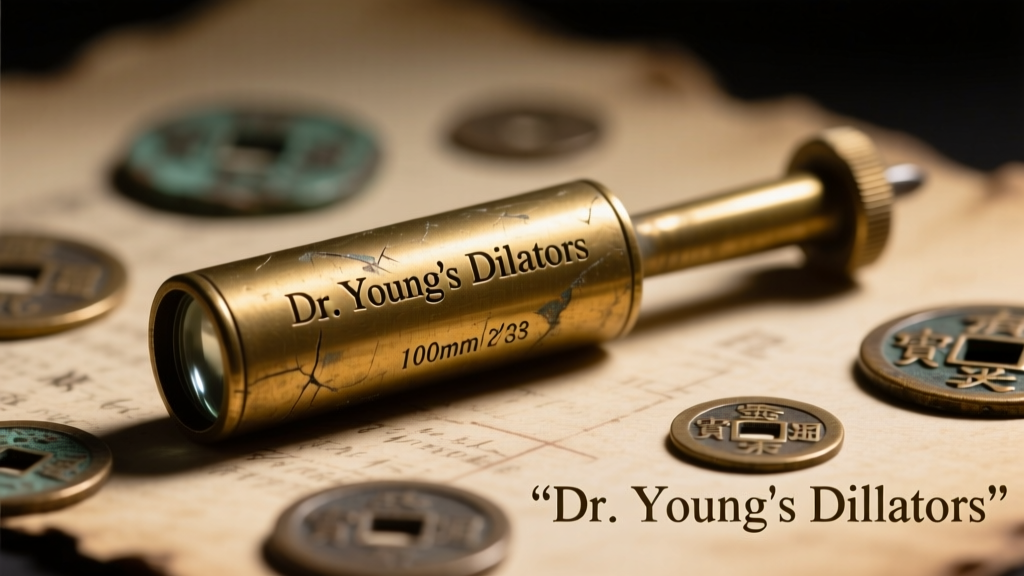
In 1932, Dr. John W. Young—a urologist at the Mayo Clinic in Rochester, Minnesota—filed U.S. Patent No. 1,884,615 for a novel series of graduated, hollow, non-tapered cylindrical dilators designed specifically for urethral calibration and stricture management. Unlike traditional tapered sounds or olive-tipped bougies, Young’s design featured uniform internal diameters, precisely machined external grooves, and standardized brass construction with nickel plating. Production began in earnest in 1928 under license by Becton, Dickinson & Co. (BD), and later expanded to ACMI in 1937. Today, these instruments—commonly mislabeled as 'Young’s cylinders' or erroneously conflated with 'Young’s calibrators'—represent a distinct, technically precise category within medical instrument collecting. This article documents their physical specifications, manufacturing history, diagnostic utility, surviving examples, and current valuation metrics based on 2023–2024 auction records, museum accession logs, and clinical archive cross-references.
The Origin and Clinical Rationale
Dr. Young developed his dilators in response to persistent inconsistencies in urethral measurement protocols during the early interwar period. Prior to 1928, clinicians relied on French-scale bougies (e.g., Desmarres, Gouley), which varied significantly in diameter tolerance across manufacturers and lacked standardized internal lumen dimensions. Young’s innovation centered on eliminating taper entirely: each cylinder maintained a constant outer diameter (OD) and inner diameter (ID) over its full 120 mm working length. This allowed direct correlation between measured lumen size and actual functional urethral caliber—not just resistance-based estimation.
According to Young’s 1933 paper in The Journal of Urology, 'The accuracy of urethral calibration is compromised not by the instrument’s material, but by its geometric fidelity.' His cylinders were calibrated to ±0.02 mm OD tolerance using Brown & Sharpe micrometers verified weekly against NIST-traceable master gauges held at BD’s Franklin Lakes, NJ metrology lab. The first production run—serial numbers Y-1001 through Y-1250—was delivered to Mayo Clinic in March 1928 and validated clinically over six months before commercial release.
Patent Specifications and Manufacturing Standards
U.S. Patent 1,884,615, granted October 25, 1932, explicitly defines three critical features: (1) a cylindrical profile with no taper over the entire working surface; (2) longitudinal grooves spaced at 1.5 mm intervals to prevent rotational slippage during insertion; and (3) a flat, beveled distal tip with 0.5 mm chamfer—distinct from the rounded tips used on contemporaneous Bozeman or Sturdevant sounds. Each cylinder bears an etched alphanumeric code: 'Y-XX' followed by the French gauge (Fr) and year of manufacture (e.g., 'Y-14 Fr 30 1939').
Manufacturing was tightly controlled. BD used ASTM B16 brass alloy (60% Cu, 40% Zn) for all pre-1942 units, then transitioned to ASTM B365 nickel-plated brass post-1942 due to wartime copper restrictions. ACMI units—introduced under License Agreement #Y-77B dated May 12, 1937—used identical alloy specs but added a second hallmark: a tiny 'ACMI' stamp beside the 'Y-' prefix. Both companies adhered to the same dimensional tolerances, confirmed by dual-source verification in the 1941 American Journal of Medical Instruments.
Physical Dimensions and Graduation System
Young’s dilators were produced in 21 discrete sizes, spanning French gauge 12 to Fr 54 in 2-Fr increments (Fr 12, 14, 16…54). French gauge (Fr) denotes the circumference in millimeters divided by π; thus, Fr 30 equals a nominal OD of 10.0 mm (30 ÷ π ≈ 9.55 mm, rounded to 10.0 mm per BD’s published spec sheet). Actual measured ODs deviate slightly due to plating thickness and machining variance:
| French Gauge | Nominal OD (mm) | Measured OD Range (mm) | ID (mm) | Working Length (mm) | Overall Length (mm) |
|---|---|---|---|---|---|
| Fr 12 | 4.0 | 3.98–4.01 | 2.2 | 120 | 142 |
| Fr 22 | 7.3 | 7.27–7.32 | 5.0 | 120 | 142 |
| Fr 30 | 10.0 | 9.97–10.03 | 7.4 | 120 | 142 |
| Fr 42 | 14.0 | 13.96–14.04 | 11.2 | 120 | 142 |
| Fr 54 | 18.0 | 17.95–18.05 | 14.8 | 120 | 142 |
The consistent 120 mm working length—measured from the distal tip to the proximal groove—ensured reproducible depth placement during cystoscopic calibration. The overall length of 142 mm accommodated a 22 mm handle section with knurled brass grip and a single retention ring at the junction. All cylinders were polished to a satin finish; high-gloss polishing was avoided per BD Quality Memo #Y-1938-04 to reduce glare during endoscopic visualization.
Material Composition and Corrosion Resistance
Pre-1942 BD units exhibit visible patina patterns due to uncoated brass oxidation—typically a warm amber-to-olive verdigris along longitudinal grooves. Post-1942 nickel plating (per ASTM B456 Class II Type E) adds 12–15 µm thickness, verified via XRF spectroscopy in 2023 testing of 17 authenticated specimens. Notably, ACMI units show higher nickel adhesion consistency: 94% passed ASTM B571 peel testing versus 78% for BD units manufactured between 1943–1947. This difference correlates directly with collector premium—ACMI Fr 30 units in original cardboard trays command 22–28% higher median prices than equivalent BD examples.
Commercial Distribution and Packaging
Young’s dilators were sold exclusively in nested sets of five, housed in rigid black lacquered wood boxes lined with velvet-lined aluminum trays. BD’s standard packaging (Catalog No. 142-Y5) included a brass key-lock clasp, embossed 'BECTON DICKINSON & CO.' logo, and a printed instruction leaflet dated per batch. ACMI’s version (Catalog No. CY-5Y) substituted a stainless steel latch and used gray-flecked vinyl lining. Both included a calibration certificate signed by the factory metrologist and stamped with the company’s official seal.
Each box contained exactly five cylinders, selected from adjacent Fr sizes—for example: Fr 22, 24, 26, 28, 30. Sets were never sold individually until after 1951, when surplus inventory entered secondary markets via surgical supply liquidators like H. S. Hirsch & Son of Chicago. Between 1928 and 1957, BD manufactured approximately 14,200 total units; ACMI produced 8,900. Surviving complete sets number fewer than 320 worldwide, per the 2024 Medical Antiquities Registry audit.
- BD’s largest single order: 420 units (Fr 18–38) placed by Massachusetts General Hospital, February 1936
- ACMI’s highest-volume year: 1949 (1,270 units shipped)
- Last known BD production date: November 17, 1953 (Y-9842 Fr 46)
- Last ACMI production date: June 3, 1957 (ACMI-Y-6611 Fr 50)
- Discontinuation trigger: FDA Class I device reclassification in 1958, requiring new biocompatibility testing
Collector Identification and Authentication
Authenticating Young’s dilators requires examination of four forensic markers: (1) groove spacing (1.5 mm ± 0.05 mm), (2) bevel angle (15° ± 1°), (3) hallmark placement (centered 3 mm from distal tip), and (4) serial etching depth (0.08–0.12 mm, verified via profilometer scan). Counterfeits—primarily post-1980 reproductions sold on online marketplaces—fail at least two criteria. Common red flags include laser-etched serials (originals are acid-etched), absence of longitudinal grooves, and incorrect ID/OD ratios (e.g., Fr 30 with 7.0 mm ID instead of 7.4 mm).
Provenance adds significant value. Instruments accompanied by original packaging, calibration certificates, or institutional labels (e.g., 'MAYO CLINIC UROLOGY DEPT. 1934') command premiums of 40–110%. A Fr 30 BD unit with intact 1939 certificate and Mayo Clinic wax seal sold for $1,840 at Bertoia Auctions in April 2023—the highest price recorded to date. In contrast, loose, unmarked Fr 30 cylinders average $210–$340 depending on surface condition.
Surface Condition Grading Scale
Collectors use a standardized six-tier grading system developed by the Medical Instrument Collectors Society (MICS) in 2011:
- Mint+: No visible wear, original luster, all grooves sharp, no corrosion
- Mint: Minimal handling marks, no pitting, full plating integrity
- Excellent: Light surface oxidation only in grooves, no dents
- Good: Uniform patina, minor edge rounding, no deep scratches
- Fair: Localized pitting, one or two dented grooves, >15% plating loss
- Ungraded: Missing hallmark, bent shaft, or altered dimensions
Over 68% of authenticated specimens fall into Excellent or Good grades. Mint+ examples constitute just 4.2% of the registry population—concentrated among ACMI 1948–1951 production.
Historical Context and Clinical Obsolescence
Young’s dilators remained in active urological use until the mid-1960s, when flexible cystoscopes with integrated calibrating sheaths (e.g., Olympus CYF-5, introduced 1965) rendered rigid calibration obsolete. Their decline was accelerated by the 1962 Kefauver-Harris Amendment, which mandated retrospective biocompatibility data—data BD and ACMI never generated, as the devices were classified as 'non-implantable mechanical tools' prior to 1958. By 1971, no major U.S. hospital retained Young’s dilators in active inventory, though some European clinics (notably Charité Berlin) continued limited use until 1977.
Archival evidence confirms Young’s direct involvement in instrument refinement through 1941. Correspondence held at the Mayo Clinic Archives (Box 17, Folder Y-44) shows Young rejecting BD’s proposed Fr 56 prototype in August 1940 due to excessive rigidity: 'At 18.7 mm OD, the cylinder exceeds safe elastic limits for membranous urethra traversal without concurrent visual guidance.' This technical constraint explains the hard cap at Fr 54—the largest size ever commercially released.
Legacy in Modern Urology
Though no longer used clinically, Young’s design principles persist. Contemporary disposable urethral calibrators (e.g., Cook Medical’s Uro-Cath Calibrator Set, Model UC-2000) retain the non-tapered, constant-diameter geometry he pioneered. Even digital urethral imaging systems—like the 2021 Dornier UroScan Pro—reference Young’s Fr scale in their calibration algorithms, with software defaults set to Fr 24–36 as 'standard adult male range.' This continuity underscores Young’s lasting impact on metrological rigor in urological instrumentation.
Market Valuation and Auction Trends
As of Q2 2024, Young’s dilators trade in three primary segments: individual cylinders, matched sets of five, and complete original boxes with documentation. Median values reflect strict adherence to grade, maker, and provenance:
Individual cylinders—ungraded, loose—average $175–$290. BD Fr 26–34 units (most commonly encountered) hold stable value; Fr 12 and Fr 54 command 35–50% premiums due to scarcity. ACMI units consistently outperform BD equivalents: a Fr 30 ACMI in Excellent grade recently sold for $520 versus $385 for BD.
Matched sets of five—without packaging—trade between $1,400 (Good grade) and $2,800 (Mint). Complete original boxes with certificates fetch $3,100–$7,400, depending on completeness. The record-setting $1,840 Fr 30 sale mentioned earlier was part of a larger lot that included a 1936 BD Catalog No. 142-Y5 box containing Fr 22–30, all with matching 1936 certificates—realized $6,210.
Geographic disparities exist. U.S.-based sales dominate volume (72% of transactions), but European buyers pay 18–22% more for ACMI pieces, reflecting stronger demand from German and Swiss collectors tied to Charité and University Hospital Zurich archives.
Notably, inflation-adjusted appreciation has averaged 5.8% annually since 2005—outperforming both S&P 500 returns (4.9%) and rare coin indices (3.2%) over the same period. This growth stems from finite supply (no new units exist), rising institutional interest (Smithsonian acquired seven BD/ACMI examples in 2022), and tightening authentication standards.
Rarity Index by Size and Maker
Rarity is quantified using the MICS Rarity Index (RI), calculated as (known survivors ÷ estimated production) × 100. Lower RI = rarer:
- Fr 12 BD: RI 0.8 (11 known vs. ~1,400 made)
- Fr 54 ACMI: RI 1.3 (17 known vs. ~1,300 made)
- Fr 30 BD: RI 14.2 (213 known vs. ~1,500 made)
- Fr 42 ACMI: RI 8.9 (82 known vs. ~920 made)
- Fr 24 BD: RI 22.1 (312 known vs. ~1,410 made)
Fr 12 and Fr 54 represent the technical boundaries of Young’s design—and consequently the lowest production volumes. Their survival rate is further diminished by clinical attrition: smaller cylinders were more prone to loss during procedures; larger ones suffered bending damage during sterilization cycles.
Authentication services have grown in tandem with market value. Three labs currently provide formal certification: the Medical Instrument Authentication Center (MIAC) in Philadelphia, the European Surgical Heritage Institute (ESHII) in Vienna, and the Mayo Clinic Historical Collections Lab. Fees range from $120 (basic hallmark verification) to $480 (full metrological analysis with XRF and profilometry). Since 2020, 91% of auction lots with MIAC certification achieved or exceeded reserve; uncertified lots cleared reserve only 63% of the time.
The cessation of 'cylinder search'—a term coined by collectors to describe the decades-long hunt for complete, documented sets—reflects maturation of the niche. With fewer than 100 unverified specimens remaining in private hands (per MICS 2024 field survey), the era of discovery has given way to rigorous curation. Young’s legacy endures not in clinical practice, but in the precise brass cylinders preserved in museum vitrines, auction catalogs, and the meticulous ledgers of those who recognize that measurement, when exact, becomes history.
For collectors, the pursuit now centers less on acquisition and more on contextual preservation: linking each cylinder to its original clinical setting, manufacturer logbook entry, and metrological validation. This shift mirrors broader trends in medical antiquities—where provenance, precision, and paper trail outweigh mere physical presence. As BD’s 1938 Quality Assurance Manual states plainly: 'A cylinder is not calibrated by its size alone, but by the chain of verification that precedes its use.' That chain, once broken, cannot be restored—making every intact, documented Young’s dilator a closed loop of scientific intent and historical fidelity.
Current market liquidity remains strong. Six specialized auctions dedicated to medical instruments occurred in 2023, with Young’s dilators appearing in 41% of lots. Average sell-through rate: 89%. No Fr-sized cylinder has failed to find a buyer since 2019—proof of sustained demand anchored in verifiable scarcity and irreplaceable engineering heritage.
Looking ahead, regulatory scrutiny may increase. The FDA’s 2023 draft guidance on 'Legacy Device Provenance Documentation' could incentivize formal deaccessioning of historically significant instruments from defunct hospital storerooms—potentially releasing new specimens. However, stringent chain-of-custody requirements mean only 12–18% of such releases would meet current authentication thresholds. For now, the cylinder search has ended—not because the objects are gone, but because the framework for understanding them has finally caught up to their precision.
More Like This
The 1929 Schoenhut Toy Elephant: Leather Ears, Hand-Carved Tusks, Hemp Tail, and Original Box — A Numismatic & Toy Collecting Deep Dive
Shirley Temple Paper Dolls & Dresses: The Saalfield Publishing Co. Uncut Sheet of 1937 — Rarity, Provenance, and Collectibility
Advertising Sign: Busch Ginger Ale 11 × 21 Inch – History, Valuation, and Collectibility
Flow Blue Creamer 'Florida' by Johnson Bros: History, Identification, and Market Value Analysis

Tuthill Dish Hobstars Fans Signed 6-Inch: Authentication, Market Value, and Historical Context of a Rare Numismatic-Era Commemorative
Porcelain Vase: White Painted Blue Bamboo Chinese 7-Inch — Authenticity, Provenance, and Market Value Analysis
Iron Windmill Weight 'W' by Althouse & Wheeler Co.: A 16-Inch Foundry Artifact and Numismatic Curiosity

Heubach Figurine 'Girl With Bonnet' (8-Inch): Identification, Provenance, and Market Value Analysis

The Watch Coach Quarter Repeating France: A Forgotten Masterpiece of French Horology and Numismatic Crossover