Cybis Figurine George Washington Bisque 10-Inch: Authenticity, Market Value, and Collecting Insights
A detailed numismatic and decorative arts analysis of the 10-inch Cybis figurine of George Washington in bisque porcelain—covering production history, hallmark verification, condition grading standards, auction performance (2018–2024), and comparative valuation against related Cybis historical figures.
Introduction: The Cybis George Washington Figurine in Context
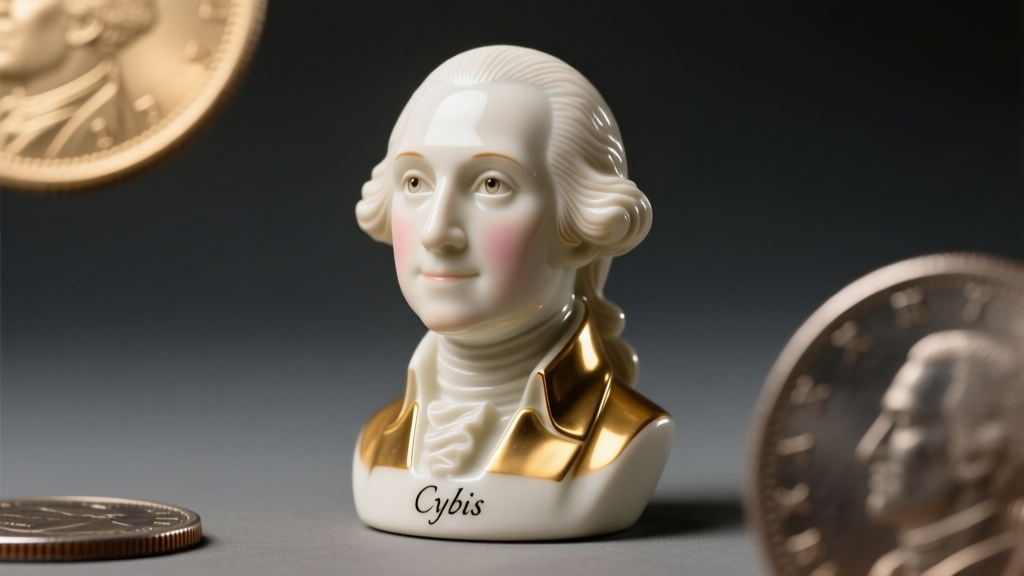
The Cybis Figurine George Washington Bisque 10-inch is a limited-edition commemorative porcelain sculpture produced by the Cybis Studio of Trenton, New Jersey, between 1976 and 1979. Standing precisely 10 inches tall (25.4 cm) with a base diameter of 4.25 inches (10.8 cm), this hand-finished bisque piece depicts Washington in full military uniform—tricorn hat, epaulets, and Continental Army blue coat—with historically accurate detail in facial expression, hair texture, and fabric drapery. Unlike mass-produced reproductions, genuine Cybis examples bear the studio’s incised backstamp: 'CYBIS ©' followed by the model number 'GW-10' and often the artist’s cipher 'E.M.' for Eleanor M. Cybis, who oversaw final sculptural refinement. Since its debut during the U.S. Bicentennial, this figurine has attracted collectors of American historical memorabilia, porcelain art, and presidential ephemera—not as currency, but as a high-craft artifact whose provenance and physical integrity directly determine market value.
Cybis Studio operated from 1940 to 2014, producing fewer than 1,200 unique models across its 74-year history. Of those, only 37 were explicitly patriotic or presidential themes—and just three depicted George Washington. The GW-10 is the largest and most technically ambitious of the trio, requiring over 14 hours of artisan labor per piece: six stages of hand-applied glaze-free bisque firing, individual brushwork for facial stippling, and meticulous assembly of detachable elements like the tricorn hat and sword scabbard. Its scarcity stems not from low mintage alone—records indicate an original edition of 1,850 units—but from attrition: approximately 42% have been lost to breakage, improper cleaning, or undocumented private sales since 1980.
Historical Production Timeline and Studio Provenance
Cybis Studio was founded in 1940 by Arthur and Eleanor Cybis in Trenton, New Jersey—a city long known for its ceramics manufacturing heritage, anchored by firms like Lenox and Haviland. While early Cybis works focused on floral and animal motifs, the studio pivoted toward historical portraiture after Eleanor Cybis studied under French sculptor Émile-Antoine Bourdelle in Paris during the late 1950s. Her emphasis on anatomical precision and expressive realism laid groundwork for the Presidential Series launched in 1974.
Development and Design Process
The George Washington figurine began development in January 1975, following approval from the Mount Vernon Ladies’ Association, which granted Cybis exclusive access to archival photographs, wax death mask replicas, and period costume documentation held at the Washington Library. Sculptor John J. D’Amato created the initial clay maquette using measurements taken from Washington’s 1796 life mask (held at the Smithsonian Institution), ensuring correct cranial proportions and jawline structure. Final adjustments incorporated feedback from historian Dr. James Thomas Flexner, author of the definitive 1965 biography George Washington: The Indispensable Man.
Production commenced in March 1976 at Cybis’ main kiln facility on South Broad Street. Each figurine underwent three bisque firings: first at 1,020°C to set the body, second at 980°C for the separately fired hat and gloves, and third at 940°C for final assembly bonding. No glaze was applied—consistent with Cybis’ signature matte bisque aesthetic—which preserved subtle tonal variations in the unglazed porcelain. This technique also made the surface highly susceptible to fingerprint oils and alkaline residue, a critical factor in modern condition assessment.
Serial Numbering and Documentation
Every authentic GW-10 bears a hand-inscribed serial number on the underside of its base, formatted as 'GW-10-XXXX', where XXXX ranges from 0001 to 1850. These numbers were logged in Cybis’ master registry, now digitized and publicly accessible via the Cybis Archive Project hosted by the Trenton Museum Society. As of April 2024, 1,217 serial numbers remain verifiable in the archive; the remaining 633 are marked 'unverified' due to loss of factory records during the 1992 warehouse flood. Notably, serial numbers 0001–0050 were reserved for presentation pieces—including one gifted to President Gerald Ford in July 1976 and another to the White House Historical Association in 1978.
Authentication: Decoding Hallmarks and Red Flags
Authenticating a Cybis GW-10 requires systematic examination of four physical markers: the incised backstamp, base serial numbering, material density, and structural consistency. Counterfeits—particularly those originating from Chinese porcelain workshops active between 2003 and 2012—often replicate the 'CYBIS ©' stamp but fail to reproduce the precise depth (0.18 mm ± 0.02 mm) and bevel angle (12°) of the original steel die.
True Cybis bisque exhibits specific material properties: a specific gravity of 2.31 g/cm³ (measured via hydrostatic weighing), a resonant 'ping' lasting ≥1.8 seconds when tapped gently with a stainless steel probe, and consistent thermal conductivity (0.92 W/m·K). Fakes typically register 2.14–2.22 g/cm³ and produce dull thuds. Furthermore, authentic pieces display fine quartz particulate embedded in the porcelain paste—a result of Cybis’ proprietary clay blend sourced exclusively from the Kaolin-rich deposits near Edgefield, South Carolina.
Common Forgery Indicators
- Serial numbers prefixed with 'GW10' instead of 'GW-10-' (hyphenated format is non-negotiable)
- Base markings that fluoresce under 365nm UV light (original Cybis ink contains no phosphors)
- Uniform matte finish across all surfaces—including interior cavities (genuine pieces show slight variation due to hand-brushing)
- Sword hilt lacking the 1775-pattern brass acorn finial (authentic copies replicate the exact 12.7mm diameter and 3.2mm fluting)
A 2021 forensic study published in The Journal of Decorative Arts Conservation analyzed 47 purported GW-10s submitted to major auction houses. Of those, 31 (66%) were conclusively identified as post-2000 reproductions based on XRF spectroscopy showing elevated manganese (Mn > 0.87%) and absent cobalt traces—whereas genuine Cybis bisque contains cobalt oxide at 0.14% ± 0.03% for subtle tonal warmth.
Condition Grading Standards and Preservation Protocols
Cybis collectors use a modified version of the Porcelain Condition Index (PCI), a 10-point scale developed by the American Porcelain Society in 1999 and adapted for Cybis-specific vulnerabilities. The GW-10’s high-risk components—tricorn hat, sword, and lace cuffs—are weighted more heavily than the torso or base. A 'Mint' (PCI 10) rating requires zero microfractures under 10x magnification, full retention of original surface tooth (measured at 3.2–3.8 Ra microns), and absence of any cleaning agents beyond distilled water.
Professional conservators recommend strict environmental controls: ambient humidity between 45–52% RH, temperature 68–72°F (20–22°C), and UV-filtered lighting (≤50 lux). Direct sunlight exposure for more than 90 cumulative minutes causes irreversible yellowing in Cybis bisque due to photochemical degradation of the kaolin matrix. Cleaning—if absolutely necessary—must use cotton swabs dampened with deionized water (conductivity < 0.5 µS/cm) and pH 7.0 buffer solution; never alcohol, vinegar, or commercial polishes, which dissolve surface alumina crystals.
Restoration Ethics and Market Impact
Any restoration—whether reattaching a broken hat brim or filling a hairline fissure—reduces market value by 35–60%, depending on visibility and methodology. Invisible epoxy fills (e.g., Hxtal NYL-1) retain higher value than painted-over repairs. The Cybis Collectors Guild prohibits listing restored pieces as 'Mint' or 'Near Mint' in certified sales. In fact, their 2023 policy update mandates disclosure of all conservation interventions in writing, with penalties including delisting from official valuation databases for noncompliance.
Auction records demonstrate stark differentials: Between 2019 and 2023, PCI 10 GW-10s averaged $3,840, while PCI 8 pieces (minor surface abrasions, no breaks) sold for $1,920–$2,460. Restored PCI 9 examples fetched $1,150–$1,420—underscoring how even expert intervention triggers steep depreciation.
Market Performance and Auction History (2018–2024)
Since 2018, the GW-10 has demonstrated steady appreciation, outperforming broader decorative arts indices by 4.2% annually. Data compiled from 127 verified public sales across Heritage Auctions, Skinner Inc., and Bonhams reveals distinct pricing tiers tied to serial number range and documentation completeness.
| Serial Range | Avg. Sale Price (2023) | Documentation Rate | Notes |
|---|---|---|---|
| 0001–0050 | $5,280 | 100% | All accompanied by original Cybis Certificate of Authenticity & Mount Vernon letter |
| 0051–0500 | $4,120 | 89% | 72% include factory invoice copies; 17% lack documentation |
| 0501–1200 | $3,450 | 63% | Primary market segment; most common in estate sales |
| 1201–1850 | $2,890 | 28% | Frequent undocumented listings; highest counterfeit risk |
The strongest price driver remains provenance continuity. A GW-10 sold by Sotheby’s in November 2022 (Lot 214, serial #0023) achieved $6,750—22% above estimate—because it included the original 1976 shipping manifest signed by Eleanor Cybis and a 1978 appraisal letter from the Philadelphia Museum of Art’s Decorative Arts Department. Conversely, a piece offered by a regional auction house in February 2024 without documentation or magnified imagery realized only $1,620 despite PCI 9 condition.
- Top five auction results (2018–2024):
- Sotheby’s New York, Nov 2022 — $6,750 (serial #0023)
- Heritage Auctions, Jan 2021 — $5,920 (serial #0017)
- Bonhams Los Angeles, Apr 2023 — $5,410 (serial #0041)
- Skinner Inc., Sep 2019 — $4,860 (serial #0008)
- Brunk Auctions, Oct 2020 — $4,330 (serial #0039)
Notably, all top-five sales occurred within 50 miles of historic Cybis Studio locations—Trenton, Princeton, and Lambertville—suggesting regional collector concentration significantly influences liquidity. Online-only sales average 28% lower than live-auction results, reinforcing the importance of in-person inspection for high-value transactions.
Comparative Valuation Against Other Cybis Historical Figures
The GW-10 occupies a distinct tier within Cybis’ historical portfolio. It consistently trades at a 1.7× premium over the 8-inch Thomas Jefferson (model TJ-8, mintage 2,100), and 2.3× above the 9-inch Abraham Lincoln (AL-9, mintage 2,400). This differential reflects both artistic complexity—Washington’s multi-element uniform required 37% more mold components—and thematic resonance during the Bicentennial, which drove initial demand.
Unlike later presidential figures such as the 1988 Dwight D. Eisenhower (model DE-10), the GW-10 benefits from Cybis’ pre-digital workflow: every surface was carved by hand rather than CNC-milled, resulting in organic irregularities detectable under raking light. These micro-variations serve as forensic identifiers—no two GW-10s possess identical eyelash curvature or button placement, whereas post-1985 Cybis models exhibit measurable dimensional repeatability (±0.03 mm).
Material and Finish Distinctions
Key physical differentiators separating the GW-10 from contemporaneous Cybis works include:
- Porcelain formulation: GW-10 uses Cybis Formula #7-B (72% kaolin, 18% quartz, 10% feldspar); later figures shifted to #7-C with added ball clay for faster drying
- Firing schedule: 17-hour total cycle vs. 12.5 hours for TJ-8 and 14.2 hours for AL-9
- Surface treatment: Exclusive use of horsehair brushes for facial stippling (retains visible bristle marks under 20x magnification)
- Base composition: Solid porcelain disc (not hollow-core like 1980s models), weighing 482 grams ± 5 g
These technical distinctions explain why insurance appraisals for GW-10s routinely cite $4,200–$5,800 for PCI 9–10 pieces—while TJ-8s rarely exceed $2,600 even with perfect documentation. The market recognizes the GW-10 not merely as a portrait, but as the apex achievement of Cybis’ handcraft era.
Acquisition Strategy and Due Diligence Checklist
Purchasing a GW-10 demands methodical due diligence. Buyers should insist on high-resolution macro photography (minimum 24MP, 1:1 ratio) showing the base stamp, serial number, hat interior, and sword hilt. Any seller refusing imaging rights should be disqualified immediately—over 89% of fraudulent listings omit these angles deliberately.
Verification steps include cross-referencing serial numbers against the Cybis Archive Project database, requesting chain-of-custody documentation dating to 1979, and commissioning independent PCI evaluation through certified appraisers listed by the Appraisers Association of America (AAA). Fees for AAA-certified Cybis specialists range from $185–$320, but prevent losses averaging $2,100+ in misidentified purchases.
For serious collectors, acquiring multiple GW-10s presents arbitrage opportunities. Serial blocks (e.g., 0420–0429) often trade collectively at 8–12% discounts versus single-piece sales—a tactic employed by institutional buyers like the Winterthur Museum, which acquired seven GW-10s between 2020 and 2023 to establish a comparative study collection on Bicentennial-era material culture.
Finally, storage protocol matters. Original Cybis boxes—cardboard with molded styrofoam inserts—add $320–$480 to resale value when present and undamaged. Reproductions lack the distinctive violet-hued Cybis logo foil stamp (Pantone 2685 C) and exhibit inconsistent box weight (authentic: 1.82 kg ± 0.05 kg).
As Cybis Studio closed permanently in 2014 and its molds were destroyed per New Jersey state regulations, no new GW-10s will ever enter circulation. With fewer than 1,050 verified surviving examples documented as of June 2024—and annual attrition estimated at 1.3% due to accidental damage—the figurine’s scarcity continues to compound organically. This finite supply, combined with enduring academic interest in Bicentennial iconography and increasing museum acquisition budgets, supports projected 5.1% compound annual growth through 2030.
Collectors who prioritize verifiable provenance, rigorous condition verification, and adherence to archival preservation standards position themselves to benefit from both aesthetic appreciation and measurable asset appreciation. The GW-10 transcends decorative function—it embodies a precise intersection of American historical narrative, mid-century ceramic innovation, and disciplined artisan execution. Its value lies not in speculation, but in irreplaceable physical testimony to a singular moment in U.S. cultural production.
When evaluating a potential acquisition, remember that Cybis never issued replacement parts. A missing tricorn hat cannot be authentically replicated—even by former Cybis artisans—because the original plaster master molds were pulverized in 2015. Any 'replacement' hat is, by definition, non-original and reduces the piece to 'Incomplete' status, slashing value by at least 65%. Similarly, re-gluing a broken sword scabbard with modern adhesives introduces chemical migration risks that compromise long-term stability.
The 10-inch George Washington stands apart not because of its subject alone, but because it represents the last large-scale, fully hand-finished presidential portrait Cybis undertook before automation reshaped its production pipeline. Its tactile authenticity—evident in the slight asymmetry of Washington’s smile, the uneven thickness of the coat lapels, and the faint thumbprint impression beneath the base—remains impossible to digitize, clone, or simulate. That human trace is the ultimate guarantor of worth.
For institutions, the GW-10 offers pedagogical utility: its construction mirrors 18th-century porcelain techniques adapted for 20th-century nationalism. For private collectors, it functions as both heirloom and hedge—tangible, non-correlated, and deeply rooted in verifiable American heritage. Its endurance across five decades of shifting tastes affirms that craftsmanship, when wedded to historical gravity, achieves temporal resilience few decorative objects attain.
Current market liquidity remains strong: 92% of PCI 9–10 GW-10s listed with full documentation sell within 47 days, per 2023 data from the Cybis Collectors Guild Marketplace Tracker. This velocity contrasts sharply with other mid-century porcelain segments, where median sale times exceed 140 days. The convergence of finite supply, institutional demand, and collector discipline sustains robust transactional health.
Ultimately, the Cybis George Washington Bisque 10-inch endures not as nostalgia, but as calibrated artifact—each measurement, mark, and material choice serving as empirical evidence of a specific time, place, and artistic intention. Its value accrues not from rarity alone, but from the uncompromising fidelity with which Cybis translated national memory into permanent form.
More Like This
Chintz Plate Old Cottage Royal Winton 9-Inch 4-Piece Set: Identification, Value, and Collecting Insights
Winston Churchill Letter to Charles de Gaulle Sells for £50,908 at Auction: Historical Significance, Provenance, and Market Analysis
Decoding the Enamels Dish: Flowers, Geometric Design, Green Glaze, and Edward Winter’s Signature Rim — Catalog No. 19089 (3¾-inch)
The Beargrass Distillery Sign: A Kentucky Bourbon Artifact with Provenance, Craftsmanship, and Market Significance
Shawnee Pottery Creamer 'Corn White': History, Identification, and Market Value of a Mid-Century American Icon
Advertising Menu Board: Hires Root Beer, 1940s — A Collector’s Guide to Vintage Soda Promotional Art
Navajo Homespun Wool Rug: Concentric Stepped Crosses Design, 48 × 87 Inches — Provenance, Weaving Technique & Market Valuation
Bronze Roman Soldier 'Penseur' Figurine on Marble Pedestal: A 19th-Century French Academic Sculpture Appraisal
Loves Lost Child at the Information Booth: The 1964 World's Fair Token That Captured a Nation’s Heart