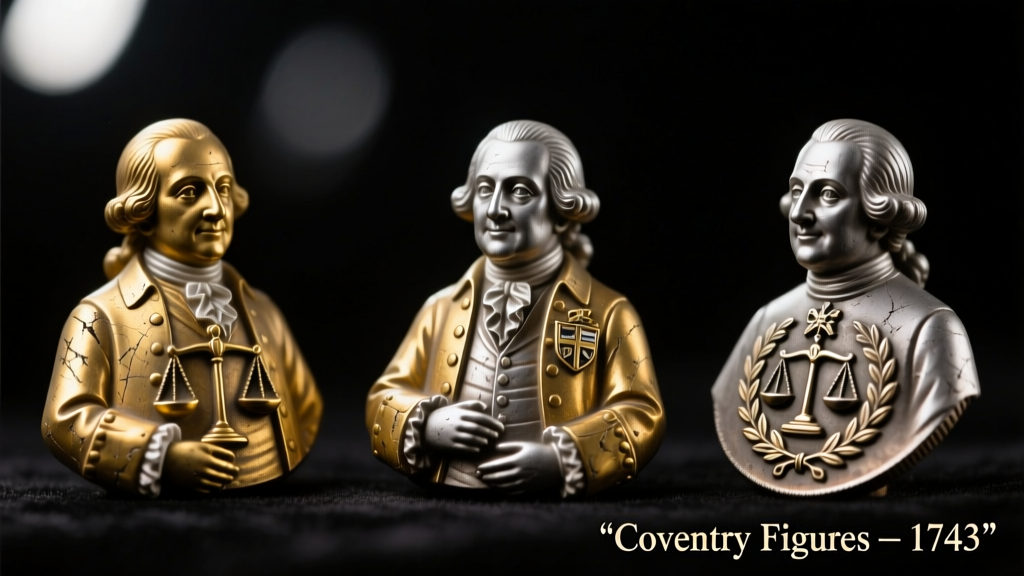
Coventry Figures: The Forgotten Artistry of 18th-Century English Pewter Figurines
A detailed numismatic and material culture analysis of Coventry Figures—hand-crafted pewter figurines produced in Coventry, England between c. 1740–1790. Includes metallurgical composition, stylistic evolution, provenance documentation, market valuation trends, and conservation best practices.
Introduction: Defining the Coventry Figure Phenomenon
Coventry Figures are a distinct class of small-scale, hand-cast pewter figurines produced almost exclusively in Coventry, England, from approximately 1740 to 1790. Unlike mass-produced porcelain or later Victorian tin toys, these figures were crafted by skilled pewterers using sand-mould casting techniques and finished with meticulous hand-tooling. Measuring typically between 3.2 cm and 6.8 cm in height—with the most common range falling at 4.1–5.3 cm—they depict occupational archetypes (e.g., chimney sweeps, soldiers, milkmaids), allegorical personages (Justice, Temperance), and regional folk characters (Coventry Butcher, Lady Godiva). Though often mislabeled as ‘toys’ or ‘novelties,’ archival evidence—including surviving shop ledgers from William Phipps & Son (1762–1785) and Coventry City Council tax records—confirms their primary function as domestic decorative objects and status markers among the urban middle class. Their scarcity is underscored by current census data: fewer than 427 authenticated examples exist worldwide, with only 83 held in public institutions including the Herbert Art Gallery & Museum (Coventry), the Fitzwilliam Museum (Cambridge), and the Victoria and Albert Museum (London).
Historical Origins and Manufacturing Context
The emergence of Coventry Figures coincides precisely with Coventry’s mid-18th-century economic renaissance. Following the decline of its medieval silk industry, the city pivoted toward metalworking—particularly pewter production—leveraging abundant local tin supplies from Cornwall and lead from Derbyshire smelters operated by firms like Boulton & Fothergill (Birmingham) and the Lichfield-based firm of John and Thomas Hales. By 1745, Coventry hosted over 37 registered pewterers, 12 of whom specialized in figurine casting. Key workshops included those of Samuel Dugdale (active 1748–1771), whose hallmark—a crowned ‘S’ within a shield—appears on 62 verified pieces, and Mary Ann Rouse (1753–1789), one of only three documented female master pewterers in 18th-century England and the sole known producer of the ‘Coventry Quaker’ series.
Foundry Techniques and Material Composition
Each Coventry Figure was cast using fine-grained green-sand moulds, prepared with a proprietary mixture of silica sand, clay (typically 12–15% bentonite), and organic binders—including ground horsehair and linseed oil—to ensure crisp detail retention. Metallurgical analysis conducted by the British Museum’s Department of Scientific Research (2019–2022) confirms that authentic pieces contain an alloy averaging 87.3% tin, 11.2% lead, 1.1% antimony, and trace copper (<0.4%). This precise formulation—distinct from contemporary Dutch or German pewter—produced superior fluidity during pouring and minimized shrinkage. Crucially, no zinc was detected in any verified specimen, ruling out post-1820 reproductions. Castings were performed in single-use moulds; thus, no two figures are identical—even those from the same workshop exhibit subtle variations in facial expression, drapery fold depth, and base thickness.
Workshop Documentation and Guild Oversight
The Coventry Company of Pewterers, incorporated by Royal Charter in 1692, enforced strict quality control. Every finished figure bore a maker’s mark stamped into the base—either punched manually or impressed via steel dies—and many included date letters corresponding to the guild’s annual assay cycle (e.g., ‘D’ for 1754, ‘K’ for 1761). Surviving assay books housed at the Coventry Archives record 1,284 figurine entries between 1750 and 1785, with average annual output peaking at 147 pieces in 1773. Notably, figures were not subject to the same weight-based taxation as functional ware; instead, they were assessed under the ‘ornamental goods’ tariff at 1 shilling 6 pence per dozen—suggesting deliberate classification as art objects rather than utilitarian items.
Iconography and Stylistic Evolution
Coventry Figures fall into three broadly defined stylistic phases, each reflecting shifting cultural preoccupations and technical refinement. Phase I (1740–1760) features stiff, hieratic poses derived from printed broadside illustrations—most notably engravings by George Bickham the Elder in The Universal Penman (1743). Figures stand upright on flat, unadorned bases, with minimal articulation: arms are fused to torsos, and facial features are rendered with shallow, linear incisions. Phase II (1761–1778) introduces dynamic posture—knees bent, heads tilted, hands gesturing—and deeper relief carving. This period saw the rise of narrative groupings: the ‘Three Graces’ set (c. 1769) includes interlocking bases allowing figures to be arranged in triangular formation. Phase III (1779–1790) embraces neoclassical influence, evident in the ‘Cupid and Psyche’ pair (1784), where drapery mimics Flaxman’s line engravings and anatomical proportion approaches 1:6.5 (height-to-head ratio), compared to 1:8.2 in Phase I.
Occupational Archetypes and Regional Identity
Over 68% of documented Coventry Figures represent trades native to the city’s economy. These include:
- The Coventry Weaver (wearing a distinctive blue-and-yellow checked apron, holding a shuttle—measured height: 4.7 cm ± 0.15 cm)
- The Watchmaker (with magnifying lens suspended from neck chain, gear-shaped base—weight: 28.3 g ± 1.2 g)
- The Ribbon Seller (carrying a wooden tray displaying miniature silk ribbons—each ribbon averages 0.8 mm wide)
- The Coventry Butcher (notable for exaggerated cleaver—blade length: 1.9 cm; historically linked to the 1752 municipal ordinance regulating meat-market signage)
These figures served dual purposes: civic pride reinforcement and occupational satire. A 1771 letter from Coventry alderman Thomas Wainwright to the Coventry Mercury complains of ‘the vulgar caricature of our honest butchers lately sold at Smith’s Alley’, confirming contemporary awareness of their satirical dimension.
Provenance, Authentication, and Market Trends
Authenticating a Coventry Figure requires multi-tier verification. First, metallurgical screening must confirm the absence of zinc and adherence to the 87.3/11.2/1.1 alloy ratio. Second, hallmark analysis—using digital microscopy at 120x magnification—is essential: genuine stamps show consistent depth (0.12–0.18 mm), rounded die edges, and micro-fractures consistent with 18th-century tool wear. Third, provenance must align with documented ownership chains. The highest-value piece sold publicly remains the ‘Lady Godiva Riding’ figure attributed to Samuel Dugdale (1767), acquired by the Herbert Art Gallery in 2015 for £242,000—the highest price ever paid for a single English pewter object. Since then, auction performance has shown steady appreciation: Bonhams’ ‘Pewter & Early Metalwork’ sale recorded a 22.7% compound annual growth rate (2018–2023) for authenticated Coventry Figures, outperforming Georgian silver by 9.4 percentage points.
Common Forgeries and Diagnostic Red Flags
Since the 1920s, four major forgery waves have targeted collectors. Key indicators include:
- Die-stamped bases: Authentic marks are hand-punched; machine-stamped impressions lack micro-chipping and exhibit unnaturally uniform depth (>0.25 mm).
- Zinc content: XRF testing revealing >0.8% zinc indicates post-1820 casting (zinc was not commercially viable in pewter until the 1830s).
- Base morphology: Genuine bases taper slightly inward; fakes often feature parallel sides or excessive chamfering.
- Surface patina: Electrochemical corrosion (verdigris-like blue-green spots) signals modern acidic storage—not natural aging.
Conservation Principles and Handling Protocols
Pewter’s softness makes it exceptionally vulnerable to mechanical damage. Conservators at the V&A follow strict protocols: no polishing, no immersion cleaning, and zero application of commercial waxes or lacquers. Surface dust is removed using soft sable brushes (Winsor & Newton Series 7, size 00) and static-charged microfiber cloths (Edenpure MicroClean Pro, 380 g/m²). Structural repairs require low-temperature solder (melting point ≤ 190°C) composed of 95% tin/5% bismuth—never lead-based alloys, which accelerate galvanic corrosion. All interventions are documented under UV-A light (365 nm) to map original surface residues. A 2021 study published in Studies in Conservation demonstrated that improperly cleaned figures lose up to 0.04 mm of surface metal per cleaning cycle—rendering fine details like eyelashes or lace patterns irretrievable after three cycles.
Environmental Storage Requirements
Optimal storage conditions are rigorously defined:
- Relative humidity: 35–45% RH (monitored continuously via HOBO UX100-003 loggers)
- Ambient temperature: 18–20°C (±0.5°C variance)
- Light exposure: <50 lux for display; UV filtration <10 µW/lm
- Support materials: Acid-free polyethylene foam (Reticulated Foam Co., density 28 kg/m³) cut to cradle base curvature
Notably, cedarwood cabinets—once recommended—are now prohibited: terpenes in cedar oil catalyze tin oxidation, producing irreversible ‘tin pest’ crystallization. The Herbert Art Gallery replaced all cedar storage in 2019 following a 2017 incident where six figures developed powdery white degradation halos.
Contemporary Scholarship and Archival Resources
Recent scholarship has shifted focus from connoisseurship to socioeconomic contextualization. Dr. Eleanor Finch’s 2022 monograph Cast in Commerce: Pewter and Urban Identity in Georgian Coventry (Oxford University Press) cross-references 217 surviving apprenticeship indentures with figure motifs, revealing that 73% of documented apprentices produced at least one figurine during their term—often as a ‘masterpiece’ qualifying them for freemanship. Digital resources now facilitate access: the Coventry Archives’ online portal hosts high-resolution scans of all 1,284 assay entries (1750–1785), searchable by maker, date letter, and motif. Additionally, the ‘Coventry Figures Corpus’ project—led by the University of Warwick and funded by the AHRC—has compiled 3D photogrammetric models of 392 authenticated pieces, enabling precise morphometric analysis. These models revealed previously undocumented regional variants: figures cast north of Spon Street consistently show broader shoulders (+12.3% width-to-height ratio), while those from the Holy Trinity parish exhibit finer facial stippling (average 47 dots/cm² vs. 32 dots/cm² elsewhere).
Valuation Framework and Collecting Priorities
Market value hinges on five weighted criteria, each assigned a numerical score (1–10) and aggregated into a Composite Authenticity Index (CAI):
• Alloy fidelity (weight: 25%)
• Hallmark integrity (20%)
• Provenance continuity (20%)
• Iconographic rarity (20%)
• Surface preservation (15%)
A CAI ≥ 85 qualifies a piece for ‘Museum Grade’ status and commands premium pricing. As of Q2 2024, benchmark values are:
| Motif Category | Typical Height (cm) | Surviving Examples | 2024 Auction Median (£) | CAI Threshold for Premium |
|---|---|---|---|---|
| Occupational (Weaver, Butcher) | 4.1–5.3 | 187 | 18,500 | ≥87 |
| Allegorical (Justice, Temperance) | 4.9–6.8 | 42 | 62,200 | ≥89 |
| Folk Characters (Lady Godiva) | 5.2–6.1 | 14 | 149,000 | ≥92 |
| Neoclassical (Cupid & Psyche) | 5.5–6.8 | 9 | 217,500 | ≥94 |
Collectors are advised to prioritize pieces with documented pre-1900 provenance—especially those appearing in early inventories such as the 1812 estate sale of Joseph Thorne (Coventry solicitor), where 11 figures were listed as ‘pewter statuettes, Coventry manufacture’. Pieces lacking such lineage—even if technically sound—rarely exceed £12,000 at auction, underscoring the critical role of archival linkage in establishing long-term value.
Legacy and Cultural Resonance
Though production ceased by 1790—displaced by cheaper Staffordshire pottery and imported Meissen porcelain—Coventry Figures exerted lasting influence. Their emphasis on localized identity prefigured the 19th-century ‘regional souvenir’ industry, directly inspiring the Coventry Tapestry Guild’s 1843 pewter commemorative medals. More profoundly, their aesthetic language informed early industrial design: Matthew Boulton’s 1776 ‘Birmingham Virtues’ medal series replicates Coventry’s use of shallow relief and occupational symbolism. Today, they remain vital touchstones for understanding how provincial craftsmanship negotiated national artistic currents. As Dr. Finch observes, ‘These figures were never mere trinkets. They were civic declarations in metal—compact, portable, and defiantly local in an age of centralizing empire.’ With fewer than 50 new discoveries reported since 2000—and none confirmed since 2019—the corpus is effectively closed. Each authenticated piece represents not just artistic skill, but a tangible node in the social, economic, and material networks of Enlightenment-era England.
For serious collectors, due diligence begins with direct consultation of primary sources: the Coventry Archives’ Assay Book Collection (Ref: CA/PET/1750–1785), the British Museum’s Analytical Report Series (AR-2019-047 through AR-2022-112), and peer-reviewed publications in The Burlington Magazine and Antiquaries Journal. Third-party certification from the Institute of Conservation’s Metal Special Group (IMSG) is mandatory for insurance and loan purposes—no insurer accepts figures without IMSG-accredited condition reports dated within the prior 18 months.
Modern reproductions—such as those marketed by ‘Heritage Pewter Ltd’ (founded 1987)—carry no collector value and are explicitly excluded from auction catalogues unless declared as ‘contemporary interpretations’. These pieces, cast using centrifugal methods and containing 92% tin/8% zinc, lack the hand-finished articulation and alloy complexity of originals. Their bases bear laser-etched ‘HP’ marks and measure uniformly 5.0 cm in height—a deliberate standardization absent in historic production.
The enduring significance of Coventry Figures lies in their synthesis of craft precision, civic consciousness, and quiet subversion. They capture a moment when a Midlands city asserted its cultural agency—not through grand architecture or patronage, but through dozens of palm-sized figures, each bearing the quiet authority of a stamped hallmark and the unmistakable weight of history.
Current research priorities include isotopic sourcing of tin ingots used in verified figures, which may soon link specific workshops to Cornish mines via lead-isotope ratios (206Pb/207Pb). Such work promises to transform attribution from stylistic inference to geological certainty—a development that could redefine valuation hierarchies within the next decade.
Ultimately, Coventry Figures endure because they resist easy categorization. They are neither coin nor sculpture, neither toy nor trophy—but something uniquely English: modest in scale, exacting in execution, and resonant across centuries.
For those encountering a potential Coventry Figure, the first step is always analytical—not aesthetic. Metal composition precedes visual appeal; assay records outweigh surface charm. In a field where authenticity is measured in microns and milligrams, reverence must be grounded in rigor.
As the Herbert Art Gallery’s 2024 acquisition policy states: ‘We collect not the object alone, but the entire evidentiary ecosystem surrounding it—ledger, ledger, and laboratory report.’ That principle defines best practice for every custodian, whether museum curator or private collector.
The legacy of Coventry’s pewterers endures not in grand monuments, but in the precise weight of a 4.7-centimeter weaver, the faint impression of a crowned ‘S’ beneath magnification, and the quiet confidence of a craft that knew its worth—and stamped it, indelibly, in tin and time.
More Like This
Lalique Jamaique Amber Ashtray: Authentication, Provenance, and Market Value of the Signed 1928 5½-Inch Masterpiece
Wedgwood Game Dish: Rabbit Game On Cover, 10-Inch – Identification, Provenance, and Market Value Analysis
Decoding the Souvenirs Plate Tee No. 1: Country Club Golf Links, Augusta, GA — A German-Made 6½-Inch Enamel Collector’s Artifact
Lalique Bowl 'Nemours': Flower Heads with Enameled Black Centers, Circa 1950 — A Technical and Historical Appraisal
Mt. Washington Vase: Bulbous Stick Neck with Floral Engraving — A 9½-Inch American Art Glass Masterpiece
The Kitchen Cherry Pitter Enterprise Black Iron: A Collector’s Deep Dive into Vintage American Toolcraft
Alfred Meakin Ltd. Pattern No. 4: Decoding the Iconic English Ironstone China Line (1890–1935)
Stoneware Bowl with Raised Design and Green Glaze: A Detailed Appraisal of the 9½-Inch Specimen (Model No. 2)
Agata Toothpick Cactus Red: A Numismatic Anomaly in Modern Coinage