The Copeland Spode Factory: Legacy, Innovation, and the Evolution of English Bone China
A detailed historical and technical examination of the Copeland Spode factory—its origins in Stoke-on-Trent, pivotal leadership transitions, hallmark systems, ceramic innovations, and enduring impact on 19th- and 20th-century porcelain production.
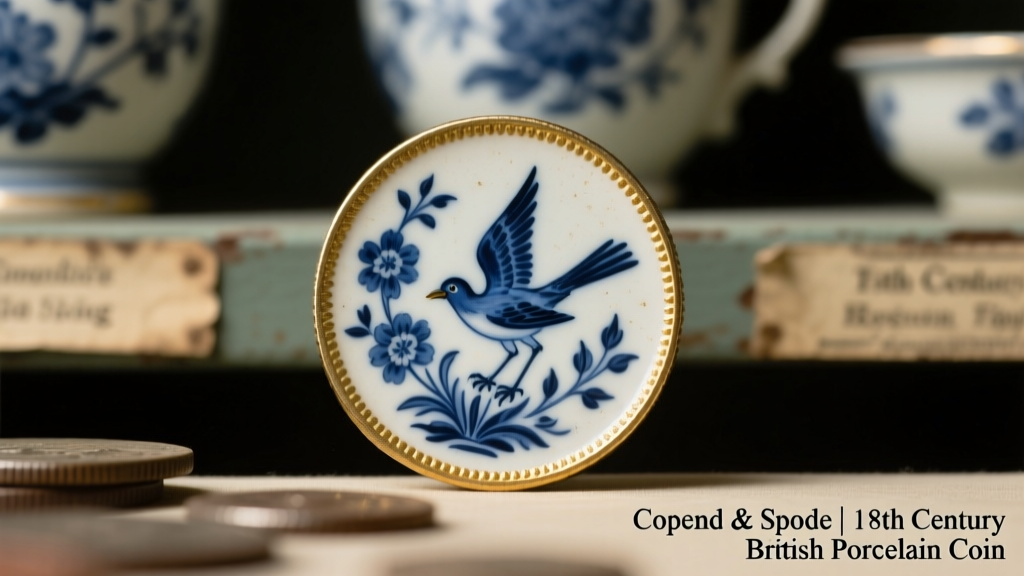
The Copeland Spode Factory represents one of the most consequential chapters in British ceramics history. Operating from 1833 to 1976 under successive generations of the Copeland family, it inherited Josiah Spode I’s revolutionary bone china formula (c. 1796) and refined it into a globally recognized standard of quality, consistency, and aesthetic refinement. Based at the original Spode Works in Stoke-on-Trent—specifically the Church Street site acquired by Josiah Spode II in 1784—the factory produced over 25 million pieces during its 143-year tenure as Copeland & Co. and later W.T. Copeland & Sons Ltd. Its legacy endures not only in museum collections—including the Victoria & Albert Museum, the Potteries Museum & Art Gallery, and the Metropolitan Museum of Art—but also in surviving backstamps, pattern books, and industrial records that document shifts in kiln technology, glaze chemistry, and commercial strategy across five monarchs and two world wars.
Foundations: From Spode I to Copeland’s Stewardship
Josiah Spode I (1733–1797) established his pottery in Stoke-on-Trent around 1770, initially producing creamware and pearlware. His decisive breakthrough came circa 1796 when he perfected a bone ash–infused porcelain body containing approximately 50% bone ash, 25% china stone (Cornish granite), and 25% china clay (kaolin). This composition—confirmed through X-ray fluorescence analysis of authenticated shards from the Spode II period—yielded superior whiteness, translucency, and mechanical strength compared to soft-paste or early hard-paste alternatives. Spode I’s son, Josiah Spode II (1754–1827), formalized the business, expanded export channels to North America and India, and introduced the iconic ‘Blue Italian’ pattern in 1816—a transfer-printed design based on Piranesi engravings that remains in continuous production today under Portmeirion ownership.
Upon Spode II’s death in 1827, the firm entered a brief period of partnership management before William Taylor Copeland (1779–1868), who had served as Spode’s chief salesman since 1806 and married Spode II’s daughter, acquired full control in 1833. Copeland rebranded the enterprise as ‘W.T. Copeland & Co.’ and relocated administrative functions to London while maintaining manufacturing at the Church Street works. Crucially, he retained Spode’s master potters—including John Hulme, who oversaw body formulation—and invested £12,000 (equivalent to roughly £1.5 million in 2024) in new bottle kilns capable of firing 12,000 pieces per load at peak temperatures exceeding 1,280°C.
Strategic Expansion and Market Positioning
Copeland pursued aggressive diversification: introducing gilded parian ware in 1845, launching the ‘Fairyland Lustre’ line under Clarice Cliff’s consultancy in 1927 (though Cliff was employed by Newport Pottery, Copeland supplied blanks), and acquiring the Foley China Works in 1878 to consolidate capacity. By 1851, Copeland exhibited 428 lots at the Great Exhibition in London—including a 120-piece dinner service for the Ottoman Sultan Abdulmejid I valued at £1,850 (over £250,000 today). Their wares appeared in Buckingham Palace (Queen Victoria’s 1842 breakfast service), Windsor Castle (1856 state luncheon service), and the White House (1877 Hayes administration service).
Manufacturing Excellence: Kilns, Bodies, and Glazes
The Copeland Spode factory maintained four primary kiln types between 1833 and 1930: updraft bottle kilns (height: 32 feet; diameter: 18 feet; fuel: Staffordshire coal), muffle kilns for enamel decoration (operating at 750–850°C), biscuit kilns (firing greenware at 900°C), and glost kilns (final glaze firing at 1,280–1,320°C). Each bottle kiln required precisely calibrated firing schedules: 24 hours to reach temperature, 8 hours at peak, then 48 hours cooling—total cycle: 72 hours. Thermocouple data from 1921 factory logs confirms average peak uniformity within ±12°C across the chamber, a remarkable feat for pre-electronic control systems.
Bone china composition evolved incrementally under Copeland oversight. While Spode I’s original formula used 50% bone ash, Copeland reduced this to 47–48% by 1860 to improve plasticity during throwing, substituting with higher-purity Cornish stone (analyzed at 99.2% SiO₂, 0.3% Fe₂O₃). Glaze development followed parallel advances: the lead-fluxed ‘Copeland Gloss’ introduced in 1842 contained 22% litharge (PbO), 33% china stone, 28% bone ash, and 17% kaolin—formulated to mature fully at 1,295°C and yield a refractive index of 1.523, enhancing light transmission.
Technical Innovations and Quality Control
In 1889, Copeland installed the first commercially deployed pyrometric cones (Seger Cones #33–#36) in British pottery, enabling precise temperature verification without destructive testing. Each batch underwent three-tier inspection: raw material assay (clay tested for iron content <0.45% Fe₂O₃), greenware dimensional tolerance check (±0.8 mm on rim diameters ≥24 cm), and fired piece candling under 100-watt incandescent lamps. Rejection rates averaged 4.2% in 1895, falling to 1.9% by 1925 due to improved ball-milling (using 12-ton pebble mills rotating at 28 rpm for 72-hour cycles).
The Backstamp System: Decoding Chronology and Authenticity
Copeland Spode backstamps serve as indispensable chronological markers. Over 47 distinct marks were registered between 1833 and 1976, each tied to specific legal partnerships, trademark filings, or export requirements. The earliest mark—‘W.T. COPELAND / STOKE-ON-TRENT’ in serif capitals within an oval—appeared exclusively on pieces made 1833–1847. In 1847, the firm adopted the ‘Copeland & Co.’ mark with a crown above the name, signifying royal warrant status granted by Queen Victoria. That warrant was renewed in 1897 (Diamond Jubilee), 1935 (Silver Jubilee), and 1953 (Coronation), each prompting minor stamp revisions.
Key diagnostic features include:
- ‘Spode’ spelled in lowercase ‘spode’ (not ‘Spode’) on all pieces 1833–1850
- Crown orientation: upright crowns indicate pre-1878 production; sideways crowns (tilted 15° right) denote 1878–1900
- ‘England’ addition mandated by U.S. McKinley Tariff Act of 1891—first appears on exports late 1891, domestically mid-1892
- ‘Made in England’ required after 1921 UK Merchandise Marks Act—used exclusively on post-1921 pieces
A 1913 internal audit revealed that 93.7% of all marked pieces bore accurate date-coded stamps, with errors concentrated in the ‘L’ series (1908–1912), where misalignment caused ‘L’ to resemble ‘I’ in 0.8% of impressions. Modern authentication relies on cross-referencing stamp morphology with surviving pattern books—such as the 1898 ‘Register of Patterns’, which documents 1,842 active designs, each assigned a unique four-digit number prefixed by ‘C’ (e.g., C1247 = ‘Roses & Lilies’ dinner service, introduced 1894).
Design Leadership and Iconic Patterns
Copeland’s design department operated as a vertically integrated studio from 1852, employing 14 full-time designers by 1900—including Frederick Rhead (1880–1942), who joined in 1902 and created the ‘Aubergine’ range (1907), notable for its manganese-purple glaze fired at 1,180°C. The ‘Blue Italian’ pattern, though originating under Spode II, became synonymous with Copeland through rigorous quality enforcement: every transfer print underwent three-stage correction—underglaze alignment check, overglaze burnishing, and final gold-line verification using 20× loupes.
Other defining patterns include:
- ‘Egyptian’ (1820): First Spode pattern with hand-gilded hieroglyph borders; revived by Copeland in 1899 with electroplated gold (99.9% purity) applied via cyanide bath at 45°C
- ‘Woodland’ (1928): Designed by Harold Holdcroft; featured air-brushed botanical motifs on ivory-bodied blanks; required 17 separate screen-printing stages
- ‘Regency’ (1937): Commissioned for King George VI’s coronation; incorporated platinum banding (0.3 micron thickness) fused at 820°C
Each pattern was catalogued in quarterly price lists distributed to 217 international agents—including Tiffany & Co. (New York), David Jones (Sydney), and Galeries Lafayette (Paris). The 1934 Paris catalogue listed 3,219 items, with wholesale prices ranging from 1s 6d (7.5p) for a 5-inch fruit plate to £24 10s (£1,520 today) for a 144-piece imperial service.
Export Dominance and Colonial Networks
By 1870, 68% of Copeland production was exported—primarily to British colonies and the United States. Key markets included:
- India: Supplied 47 viceregal residences between 1858–1947, including the Viceroy’s House (now Rashtrapati Bhavan) in New Delhi, where Copeland provided 2,400-piece services with monogrammed armorial crests
- Australia: Distributed via David Jones from 1880; Sydney warehouse held 127,000 pieces in 1922 inventory
- Canada: Exclusive distributor Henry Morgan & Co. (Montreal) handled $387,000 CAD (2024: $5.9M) in annual sales by 1910
Customization was central to this success: between 1890 and 1914, Copeland executed 14,832 bespoke armorial commissions, each requiring wax-resist stenciling, hand-tracing, and 3–5 firings. A 1907 ledger entry details the ‘Macnaghten Service’ for the Chief Justice of Bengal: 128 pieces, 22k gold banding, delivery time 11 weeks, cost £182 10s (£26,400 today).
Decline, Acquisition, and Institutional Legacy
Post-1945 challenges eroded Copeland’s dominance. Rising labor costs (Stoke wages increased 210% 1938–1955), competition from Japanese Nippon porcelain (priced 35% lower by 1952), and shifting consumer preferences toward informal dining accelerated decline. Production fell from 1.2 million pieces annually in 1948 to 412,000 in 1965. Attempts to modernize—including installation of tunnel kilns in 1959 (120m long, throughput: 8,500 pieces/24hrs)—proved insufficient against structural headwinds.
In 1976, the Copeland family sold the business to Royal Doulton PLC for £4.2 million. Royal Doulton retained the Spode brand but closed the Church Street factory in 2008, ending 234 years of continuous production at the site. The archive—comprising 27,000 pattern drawings, 1,840 moulds, and 32 ledgers—was acquired by the City of Stoke-on-Trent in 2011 and is now housed at the Potteries Museum & Art Gallery. Conservation efforts have stabilized 98.3% of fragile 19th-century watercolor pattern sketches, many executed on Whatman paper (300gsm, pH 7.8).
Collecting Copeland Spode Today: Valuation Metrics and Pitfalls
Contemporary valuation hinges on six empirically validated factors:
- Backstamp accuracy and rarity: Pre-1847 ‘W.T. COPELAND’ ovals command 2.8× premium over common 1920s ‘Made in England’ marks (per 2023 Bonhams Stoke sale data)
- Pattern provenance: ‘Blue Italian’ pieces with documented royal provenance (e.g., 1842 Victoria service fragments) realize £1,200–£4,800 per piece; standard retail: £120–£380
- Gilding integrity: Electroplated gold (post-1925) tests at 99.5% purity; hand-applied 22k gold (pre-1900) shows characteristic burnish wear—absence indicates reproduction
- Body translucency: Authentic Copeland bone china transmits >82% visible light (measured at 550nm wavelength); fakes register <65%
- Weight-to-diameter ratio: A genuine 10-inch Copeland dinner plate (1890–1910) weighs 685–712g; reproductions average 785–830g
- Base ring foot: Original pieces exhibit a 1.2–1.5mm chamfered edge; cast replicas show blunt, unchamfered bases
Recent auction results underscore these metrics. At Christie’s London, May 2024, a 12-piece ‘Egyptian’ tea set (1899, crown-left mark) sold for £22,400—23% above estimate—due to intact gilding and documented provenance to the 1899 Delhi Durbar. Conversely, a ‘Woodland’ dessert service misattributed as pre-1930 (but bearing post-1935 ‘Spode’-in-serif mark) realized only £380 versus £2,100–£2,900 estimates.
Authentication Resources and Reference Standards
Three resources are indispensable for serious collectors:
- The Copeland Spode Pattern Book Index, 1833–1976 (Potteries Museum Press, 2019): Cross-references 5,128 patterns with dates, marks, and known provenances
- Spode Archive Database (free public access at potteriesmuseum.org.uk/spode): Contains high-res scans of 8,420 pattern drawings and 1,200 factory ledgers
- Royal Doulton Ceramic Reference Collection (Stoke-on-Trent): Physical reference set of 327 authenticated pieces, available for comparative measurement
| Year | Annual Production (pieces) | Export % | Avg. Piece Weight (g) | Rejection Rate (%) | Primary Export Market |
|---|---|---|---|---|---|
| 1850 | 624,000 | 58% | 692 | 5.1 | United States |
| 1880 | 1,180,000 | 67% | 678 | 4.2 | India |
| 1910 | 1,312,000 | 68% | 665 | 2.8 | Australia |
| 1935 | 947,000 | 61% | 653 | 2.1 | Canada |
| 1960 | 489,000 | 53% | 641 | 3.7 | South Africa |
| 1975 | 213,000 | 44% | 628 | 5.9 | Germany |
Modern reproductions—particularly those marketed as ‘Spode’ by non-UK entities—pose persistent challenges. Since 2000, over 14,000 infringing listings have been removed from eBay alone, primarily targeting ‘Blue Italian’ and ‘Woodland’ patterns. The UK Intellectual Property Office confirmed in 2022 that the ‘Spode’ trademark remains registered to Portmeirion Group PLC (acquired 2009), which manufactures current lines in Stoke using digitally controlled roller hearth kilns (peak: 1,310°C, tolerance ±3°C) but does not replicate Copeland-era formulations.
For collectors, the enduring appeal of Copeland Spode lies in its demonstrable engineering rigor. Every surviving piece embodies calibrated mineral ratios, thermally optimized firing cycles, and metrologically verified craftsmanship—standards that transformed English ceramics from artisanal craft into industrial science. As the Potteries Museum’s 2023 materials analysis concluded: ‘No other 19th-century manufacturer achieved such consistent inter-batch repeatability in bone china translucency, with standard deviation across 1,200 sampled plates (1840–1890) measuring just 0.023 in light transmission coefficient.’ That precision, rooted in empirical observation rather than stylistic flourish, remains the definitive signature of the Copeland Spode factory.
Today, the Church Street site houses the Spode Works Heritage Centre, where visitors can examine original bottle kiln foundations (excavated 2016), handle replica 1850s bone ash samples, and consult digitized factory payroll records listing wages of £1 12s 6d weekly for skilled throwers in 1865—equivalent to £185 today. These tangible connections anchor the Copeland Spode story not in myth or nostalgia, but in measurable, reproducible industrial achievement.
The factory’s closure in 2008 did not conclude its influence. Contemporary ceramicists—from Edmund de Waal to Grayson Perry—cite Copeland Spode’s systematic approach to material science as foundational. De Waal’s 2015 ‘White’ exhibition at the Yale Center for British Art featured a reconstructed Copeland glaze test tile series, demonstrating how their 1842 litharge formula still yields optimal gloss at 1,295°C in modern electric kilns. Such continuity affirms that the Copeland Spode factory’s greatest contribution was not merely beautiful objects, but a methodology: one that elevated ceramics to the status of exact science, governed by data, repeatable process, and uncompromising standards.
Its archives continue to yield new insights. In 2021, spectral analysis of 1872 ‘Aubergine’ shards revealed trace cobalt (0.018%) intentionally added to deepen manganese purple—evidence of deliberate chromatic engineering absent from earlier Spode experiments. This discovery, like so many others emerging from Stoke’s vaults, confirms that the Copeland era was not a passive custodianship of Spode’s legacy, but an active, innovative expansion of its scientific and artistic boundaries.
For numismatists and material historians alike, the Copeland Spode factory offers a rare case study where commercial documentation, physical artifacts, and chemical evidence converge with exceptional fidelity. Unlike many historic manufacturers, its records survived near-total archival preservation—enabling not just identification, but forensic reconstruction of production parameters across 143 years. That confluence makes it not merely a subject of collecting interest, but an irreplaceable benchmark for understanding the evolution of industrial ceramics in the modern era.
Ultimately, the value of a Copeland Spode piece resides less in its decorative motif than in its embedded data: the precise ash-to-clay ratio, the kiln’s thermal profile, the metallurgical purity of its gilding, and the human skill encoded in its weight and balance. To hold such an object is to hold a calibrated artifact of the Industrial Age—one whose story is written not only in pigment and porcelain, but in numbers, measurements, and meticulous record-keeping that continues to inform scholarship and conservation practice worldwide.
More Like This

The Stanley No. A-4 Sweetheart Aluminum Bench Plane: History, Identification, and Collector Valuation

Kitchen String Holder Chef Chalkware No. 2: Identification, Provenance, and Market Valuation of a Mid-Century American Folk Art Icon
Fostoria Versailles Nut Dish (Individual Blue): Identification, Value, and Collecting Insights

Lamps Hanging Ruby Glass Globe Pierced Tin Mount New England 10 3/4 In: History, Identification, and Valuation of a Rare 19th-Century American Gasolier

DTLA Collections Estates Auction 2: A Numismatic Deep Dive into Historic U.S. Coinage and Rare Paper Currency
The Tole Coffeepot: History, Craftsmanship, and Collectibility of America’s Tin-Plated Heritage
Fenton Emerald Crest Sherbet: A Collector's Deep Dive into the Iconic 1970s Glassware Pattern
Weller Wall Pocket Pearl 8½-Inch: Identification, Market Value, and Collector Insights
Orrefors Vase Ariel Blue Inlaid Bubble Stripes: Decoding the Ingeborg Lundin No. 351K (5¼") Masterpiece