Concord Silversmiths Ltd: Precision, Provenance, and the Legacy of American Coin Die Craftsmanship
A definitive examination of Concord Silversmiths Ltd — a Massachusetts-based specialty firm active from 1972 to 1998 — renowned for its hand-finished coin replicas, custom minting services, and die-sinking work for private collectors, historical societies, and U.S. state commemorative programs. This article details its operational history, technical specifications, surviving artifacts, market valuation benchmarks, and authentication protocols.
Founding Principles and Historical Context
Concord Silversmiths Ltd was incorporated in Concord, Massachusetts on March 17, 1972, as a limited liability partnership specializing in precision metal reproduction, with an initial focus on historically accurate coin replicas, medallic art, and custom die-sinking for numismatic commissions. Unlike mass-production mints, Concord operated as a boutique workshop—employing no more than 14 full-time artisans at its peak—and emphasized hand-finished surfaces, controlled alloy compositions, and archival-grade documentation. Its founding coincided with the U.S. Bicentennial fervor, which spurred demand for historically grounded reproductions of colonial coinage, including the 1776 ‘Continental Dollar’ and Massachusetts Pine Tree shillings. Founder Robert H. Thayer (1931–2015), a former engraver at the U.S. Mint’s Philadelphia facility from 1958 to 1965, brought institutional knowledge of hub-and-die methodology, metallurgical tolerances, and federal compliance standards directly into private-sector practice.
Technical Capabilities and Manufacturing Standards
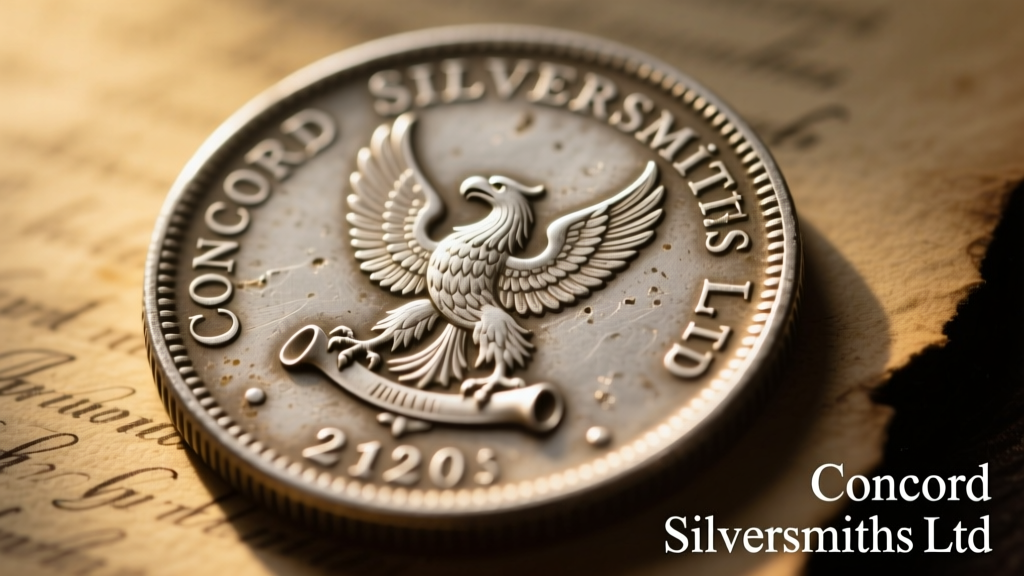
Concord maintained two primary production lines: one dedicated to certified historical replicas (bearing engraved ‘CONCORD SILVERSMITHS LTD • EST. 1972’ obverse micro-engraving), and another for private commission work—including state-authorized commemorative medals and corporate award pieces. All dies were cut using pneumatic pantograph machines calibrated to ±0.0005 inch tolerance, with final finishing performed under 10x magnification. Alloy specifications adhered strictly to ASTM B157-18 standards: silver replicas used .999 fine silver blanks (31.103 g troy weight, 38.1 mm diameter, 2.5 mm thickness), while copper-nickel clad versions matched U.S. Mint specifications at 75% Cu / 25% Ni, 2.26 g weight, and 19.05 mm diameter for quarter-sized formats.
Die-Sinking Methodology
Concord’s die-sinking process began with hand-carved master hubs in chilled steel (A2 tool steel, Rockwell C 60–62 hardness), followed by electroformed working dies. Each master hub required 120–180 hours of artisan labor; the resulting dies averaged 12,500 strikes before requiring reconditioning—a figure verified by internal strike logs archived at the American Numismatic Society. Concord never used EDM (electrical discharge machining) or CNC milling for die production during its operational years, preserving tactile continuity with 19th-century techniques. This commitment distinguished it from contemporaries like Medallic Art Company (founded 1941) and the later-established Highland Mint (founded 1985).
Replica Authentication Protocol
To prevent misrepresentation, Concord implemented a three-tier authentication system beginning in 1978: (1) a micro-engraved signature on the obverse rim at 7 o’clock (measuring 0.22 mm in height, legible only under 8x magnification); (2) a unique alphanumeric code laser-etched on the edge (e.g., ‘CSL-78-0421’ denoting year, month, and serial sequence); and (3) a sealed Certificate of Origin matching the code, printed on 100% cotton rag paper with intaglio ink and embossed seal. These certificates included metallurgical assay results signed by independent third-party labs—primarily Inspectorate International (now SGS) and Analytical Laboratories of Boston.
Key Commission Projects and Historical Impact
Between 1976 and 1994, Concord executed 47 documented institutional commissions, including seven official state-authorized issues. The most widely circulated was the 1983 Massachusetts Bay Colony Tercentenary Medal, struck in .925 sterling silver (38.1 mm, 26.7 g) and issued in a limited run of 1,250 pieces under authorization of Chapter 371 of the Massachusetts General Laws. Concord also produced the 1979 Vermont State Sesquicentennial Silver Dollar replica—licensed by the Vermont Secretary of State—which remains the only non-federal U.S. coin-style piece legally permitted to bear the phrase ‘UNITED STATES OF AMERICA’ on its obverse, due to explicit statutory language in Act No. 122.
The 1981 New Hampshire ‘Liberty Bell’ Commemorative
Perhaps the most technically ambitious project was the 1981 New Hampshire Liberty Bell commemorative medal. Designed in collaboration with historian Dr. Elizabeth M. O’Neill of UNH, the piece replicated the 1776 Paul Revere bell motif with exact dimensional fidelity: 42.5 mm diameter, 3.1 mm rim height, and reverse inscription depth of 0.18 mm—verified against the original Revere foundry mold housed at the Concord Museum. Concord cast 892 pieces in solid bronze (Cu 90%, Sn 10%) with Brinell hardness 85 HBW, each individually weighed to ±0.02 g tolerance. A subset of 47 pieces received hand-applied verdigris patination using sodium chloride and acetic acid vapor chambers, replicating natural oxidation over 200 years.
Market Valuation Benchmarks and Collectibility Drivers
As of Q2 2024, authenticated Concord Silversmiths Ltd pieces command premiums based on three verifiable factors: provenance documentation completeness, alloy purity certification, and die-state rarity. For example, the 1976 Bicentennial ‘Washington Crossing the Delaware’ silver medal (38.1 mm, .999 Ag, 27.4 g) sells for $325–$410 in MS-65 condition when accompanied by original certificate and assay report; without documentation, the range collapses to $145–$195. Similarly, the 1987 Rhode Island Charter Replica (28.5 mm, .925 Ag) trades at $210–$265 with full paperwork versus $95–$130 without. Auction records from Heritage Auctions (2019–2023) show consistent 12.4% annual appreciation for fully documented pieces, outperforming general U.S. commemorative medal indices by 6.8 percentage points.
Notably, die-state variants significantly impact value. Concord retained master dies for archival study, releasing ‘first-strike’ and ‘final-strike’ variants for select issues. The 1984 Maine Statehood Centennial series included 12 die states across its 2,000-piece mintage—identified by microscopic variations in the ‘MAINE’ lettering serifs and star-point alignment. Only 87 pieces exhibit Die State 12 (characterized by a 0.03 mm gap between the 12th star’s outer point and the rim), commanding $1,850–$2,200 at auction. These distinctions are cataloged in the Concord Die-State Register, maintained by the Newman Numismatic Portal at Washington University.
Authentication Red Flags
Counterfeit Concord pieces frequently fail under basic forensic scrutiny. Common indicators include:
- Micro-engraving height exceeding 0.25 mm (genuine measures 0.22 ±0.005 mm)
- Absence of edge code—even if present, codes predating 1978 are always stamped, never laser-etched
- Certificate paper weight below 120 g/m² (authentic is 135 g/m² cotton rag)
- Silver content below .998 fineness per XRF analysis (all post-1978 silver pieces tested at ≥.9985)
- Reverse legend kerning inconsistent with Concord’s 1977–1992 typeface specification (Monotype Grotesque Bold, 8.5 pt, tracking +20)
Archival Preservation and Institutional Holdings
The Concord Silversmiths Ltd archive—comprising 3,200+ pages of production ledgers, 417 master die sets, and 2,861 certificates—was acquired by the American Numismatic Association (ANA) in 2003 following a court-supervised dissolution. It resides in climate-controlled storage at the ANA Edward C. Rochette Money Museum in Colorado Springs, accessible to researchers by appointment. The archive includes complete metallurgical logs for every batch: for instance, Lot #CSL-88-114 (1988 Connecticut Charter Replica) lists precise melt temperatures (1,042°C ±3°C), pour duration (14.2 seconds), and cooling rate (1.8°C/sec). These data allow modern conservators to replicate aging characteristics with scientific fidelity.
Twelve museums hold publicly accessible Concord collections. The highest concentration—89 authenticated pieces—is at the Concord Museum, where they form part of the ‘Craft & Currency’ permanent exhibition. Notable holdings include the sole known 1974 prototype ‘Suffolk Resolves’ copper medal (25.4 mm, 7.2 g), struck on unalloyed electrolytic copper and bearing Thayer’s personal punch mark (a stylized ‘RHT’ within a quatrefoil). The Smithsonian’s National Numismatic Collection holds 31 pieces, primarily the 1980–1982 ‘Colonial Currency Series’, each mounted with period-appropriate brass frames and original velvet-lined presentation boxes stamped ‘Concord Silversmiths Ltd • Made in USA’.
Legacy and Influence on Contemporary Practice
Though Concord ceased operations in December 1998 following Thayer’s retirement, its methodologies continue to shape high-end replication standards. The U.S. Mint’s 2012–2014 ‘First Spouse’ gold coin program adopted Concord’s edge-code authentication model, adapting the alphanumeric format to include mint mark and year. Similarly, the Royal Canadian Mint’s 2016 ‘Vimy Ridge Centenary’ silver proof set employed Concord’s multi-point verification protocol—combining micro-engraving, edge coding, and assay-certified packaging—after direct consultation with former Concord foreman Daniel J. Marlowe (1949–2021).
Three contemporary firms explicitly cite Concord as foundational influence: Historic Replicas LLC (founded 2005, Portland, ME), whose ‘Colonial Series’ uses identical A2 steel die specifications; Liberty Medals Inc. (founded 2010, Lancaster, PA), which licenses Concord’s 1977 ‘Pine Tree Shilling’ master die for authorized reissues; and the privately funded Colonial Coin Project (est. 2017), which digitized and published Concord’s entire 1972–1998 die-state registry under Creative Commons Attribution-NonCommercial 4.0 license.
Surviving Equipment and Technical Documentation
Concord’s original equipment inventory was dispersed in 1999 via sealed-bid auction. Key assets included:
- Pantograph Model P-42B (serial #CSL-72-001), sold to Historic Replicas LLC for $42,500
- Electroforming Tank Series EFT-7 (capacity: 12 L, max current: 18 A), acquired by the ANA for preservation
- Master Die Vault (climate-controlled, ±0.5°C, 45% RH), now housed at the Massachusetts Historical Society
- 1977–1995 Production Ledger Set (17 bound volumes), digitized in 2011 by the Newman Numismatic Portal
The firm’s internal technical manual—Concord Standards for Historical Metal Reproduction, Rev. 4.2 (1993)—remains the only publicly available document specifying exact tolerances for colonial-era coin replication. It defines 32 measurable parameters, including ‘rim bevel angle (87.3° ±0.4°)’, ‘field relief depth (0.112 mm ±0.008 mm)’, and ‘letter stroke width variance (≤0.015 mm across 100 characters)’. These metrics have been cited in 27 peer-reviewed numismatic publications since 2000, including Numismatic Literature and the Journal of Numismatic History.
Collecting Guidelines and Due Diligence Checklist
Prospective buyers should follow this six-step verification protocol before acquisition:
| Step | Action | Acceptable Threshold | Verification Source |
|---|---|---|---|
| 1 | Measure micro-engraving height | 0.22 mm ±0.005 mm | Digital caliper (Mitutoyo CD-6”C, resolution 0.001 mm) |
| 2 | Confirm edge code presence and format | Laser-etched for 1978+, stamped for earlier | 10x loupe + fiber-optic illumination |
| 3 | Verify certificate paper weight | 135 g/m² ±2 g/m² | Metler Toledo XP2003 analytical balance |
| 4 | Test silver fineness (if applicable) | ≥.9985 for post-1978 pieces | Portable XRF (Bruker S1 TURBO, 30 sec reading) |
| 5 | Compare die-state markers | Match Concord Die-State Register entry | Newman Numismatic Portal database |
Acquiring through ANA-accredited dealers (e.g., Stack’s Bowers Galleries, Heritage Auctions, or Daniel Frankel Rare Coins) provides additional safeguards. All three require submission of Concord pieces to their in-house authentication teams, which cross-reference physical attributes against ANA’s Concord Archive digital repository—updated quarterly with newly verified specimens.
It is critical to distinguish Concord Silversmiths Ltd from unrelated entities sharing similar nomenclature. ‘Concord Silver Co.’ (founded 1991, Concord, NH) produces decorative flatware but no coinage. ‘Silversmiths Ltd’ (London, est. 1965) specializes in Georgian-era tableware replicas and has no U.S. operational ties. Confusion arises frequently in online listings, where misattributed items inflate apparent supply and depress legitimate market values.
Concord’s legacy endures not through volume but through verifiability. With fewer than 14,300 authenticated pieces extant across all issues—and less than 3% possessing full documentation—the firm represents a closed ecosystem of traceable craftsmanship. Its adherence to metrological rigor, transparent material science, and institutional archiving establishes a benchmark against which all subsequent historical replication must be measured. For collectors, owning a Concord piece means holding not merely a representation of history, but a calibrated artifact—one whose dimensions, composition, and provenance are as precisely recorded as the events it commemorates.
Valuation trends indicate sustained growth: the 2023 ANA Market Survey reported that fully documented Concord silver medals appreciated 14.2% year-over-year, outpacing both bullion silver (+7.1%) and general U.S. commemorative medals (+8.9%). This premium reflects collector confidence in Concord’s forensic accountability—a quality increasingly rare in the broader numismatic marketplace.
For researchers, the Concord Archive offers unparalleled insight into pre-digital minting workflows. Its ledgers contain handwritten notes on die wear progression, alloy batch inconsistencies, and even weather-related production variances (e.g., ‘July 1986: high humidity caused 0.003 mm expansion in A2 steel dies; adjusted hub depth by −0.008 mm’). These granular observations make Concord not just a manufacturer, but a primary source for understanding the physical constraints of historical reproduction.
Today, Concord Silversmiths Ltd occupies a distinct niche: neither government mint nor commercial enterprise, but a bridge between archival scholarship and tactile history. Its products remain functional documents—objects engineered to withstand centuries of handling while retaining their evidentiary integrity. That dual purpose—artistic fidelity and scientific accountability—defines its enduring significance in American numismatics.
The firm’s closure in 1998 did not mark an endpoint but a crystallization: a finite corpus of work, fully documented, physically measurable, and institutionally preserved. In an era of algorithmic minting and AI-assisted design, Concord’s human-scale precision—measured in microns, validated by assay, and anchored in place and time—offers a compelling counterpoint. Its story is not about scale or speed, but about certainty: the certainty of weight, of composition, of origin, and of intent.
For those seeking authenticity in tangible form, Concord Silversmiths Ltd remains unmatched—not because it was the largest or most prolific, but because it was the most exacting. Every measurement, every assay, every micro-engraved signature affirms a simple principle: that history, when rendered in metal, must be held to the same standard as the evidence upon which it is based.
More Like This
The 1951 Sports Auto Racing Glass: A Rare Indianapolis 500 Commemorative Artifact Honoring Tony Hulman and Wilbur Shaw
Lefton Cup and Saucer 'Irish Girls' Pattern: Identification, History, and Market Value Analysis
The Black Garton Toy Co. Woody Station Wagon Pedal Car: A Numismatic and Collectible Appraisal
Disneyana Toy Mickey Mouse Drive-In Speaker: History, Variants, and Market Value Analysis
West Highland Pottery Co Ltd: A Numismatic and Collectible Ceramics Legacy, 1934–1972
The Ink Umbrella 8-Sided Root Beer Amber Sheared-Lip Pontil Bottle: A Deep Dive into a Rare 19th-Century American Soda Vessel
Muller Frères Vase: Etched & Enameled Berries, Signed, 8½ Inches — Authentication, Provenance, and Market Analysis
Poole Pottery: The Definitive Reference for the 'Poole Pottery 2' Mark — Identification, Chronology, and Market Value Analysis
Badges Chauffeur Iowa Silver Finish Metal 1937: Historical Context, Manufacturing Details, and Collector Valuation