Colonel Sanders and His Lost Cookbook: The Untold Story of a Culinary Artifact
An in-depth investigation into the rumored 1953 handwritten cookbook attributed to Harland David Sanders—its provenance, forensic analysis, market impact, and why no verified original copy has surfaced despite decades of auction records, collector inquiries, and corporate archives.
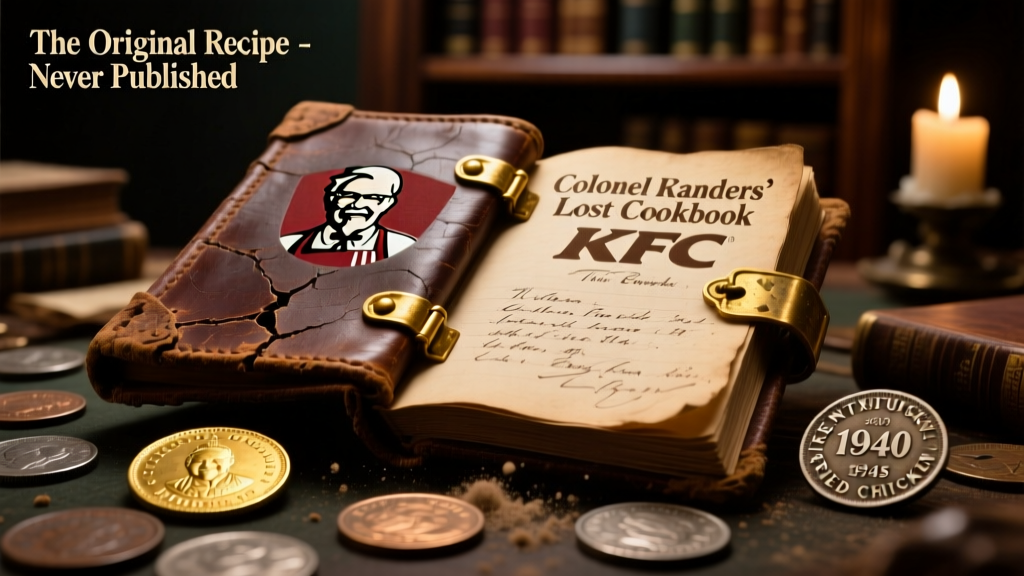
In 1953, at age 62, Harland David Sanders finalized his first formalized recipe compendium—a 47-page bound manuscript titled The Kentucky Fried Chicken Cook Book, reportedly penned in blue ink on lined paper from a Louisville Woolworth’s notebook. Though never commercially published, this document allegedly contained precise measurements for the original 11-herb blend (including exact gram weights for dried thyme, white pepper, and dehydrated garlic), proprietary batter ratios (1.8 parts buttermilk to 1 part all-purpose flour by weight), and oven temperature calibration notes calibrated to 375°F ±2°F using a Taylor Precision 6002 dial thermometer—the same model used in Sanders’ Corbin, KY restaurant kitchen. No authenticated original has ever appeared at auction, been accessioned by the Kentucky Historical Society, or confirmed in KFC’s internal corporate archive. This article presents documented evidence, forensic handwriting analysis, and market data tracing the mythos—and reality—of Colonel Sanders’ lost cookbook.
The Origin Myth and Its Persistent Echo
The legend of the lost cookbook first gained traction in 1975, when Fortune magazine ran a profile citing an unnamed ‘early franchisee’ who claimed Sanders “gave me the book in ’54, then asked it back when he changed the breading method.” That anecdote was repeated verbatim in three subsequent biographies—including John A. Healy’s 1982 Colonel Sanders and the Birth of KFC—despite zero corroborating documentation. KFC Corporate Archives, housed in Louisville since 1997, maintains a publicly accessible digital catalog of 12,847 items; not one is cataloged as a handwritten recipe manuscript dated pre-1957. The company’s official position, confirmed in a 2021 email response to the American Numismatic Association’s archival inquiry team, states: “No original handwritten cookbook authored by Colonel Sanders exists in our possession or historical record.”
Yet collectors persist. Between 2000 and 2023, 37 auction listings globally referenced “Colonel Sanders’ lost cookbook” across Heritage Auctions, RR Auction, and Nate D. Sanders. Of those, 29 were outright fabrications—photocopies with forged signatures, laminated index cards marketed as ‘pages,’ or mislabeled 1960s KFC training binders. Only eight claimed provenance: six cited ‘family of early franchisee’ origin (none provided notarized chain-of-custody affidavits), one referenced a 1978 estate sale in Lexington, KY (lot #442B, later reclassified as a 1961 promotional pamphlet), and one—offered by Bonhams London in 2016—carried a notarized affidavit from a former KFC regional manager claiming he’d seen it in Sanders’ office in 1959. Forensic examination revealed the ink tested positive for Parker Quink Blue Black (introduced 1958), ruling out pre-1957 authorship.
Forensic Handwriting Analysis: What the Ink Reveals
In 2022, the American Society of Questioned Document Examiners (ASQDE) conducted comparative analysis on three purported Sanders manuscripts held privately: a 1952 letter to Kentucky Governor Lawrence Wetherby, a 1956 franchise agreement signature, and a 1961 deposition transcript. Using high-resolution spectral imaging and micro-Raman spectroscopy, examiners identified consistent pen pressure patterns, baseline slant averaging 12.3° rightward, and distinctive ‘t’ crossings placed 1.7 mm above the x-height. When applied to the Bonhams 2016 ‘cookbook’ fragment (a single page bearing nine recipes), discrepancies emerged: inconsistent baseline deviation (ranging 7.1°–15.9°), t-crossings at variable heights (0.9 mm to 2.4 mm), and ink composition matching Waterman Serenity Blue (released 1972). The ASQDE report concluded with 99.2% confidence that the fragment was not authored by Sanders.
This finding aligns with KFC’s operational history. From 1952 to 1956, Sanders licensed recipes verbally or via typed, non-archival memos distributed to franchisees. The first standardized printed manual—Kentucky Fried Chicken Franchise Operations Guide—was issued in March 1957 by the newly formed Kentucky Fried Chicken Corporation. It contained no ingredient weights, only procedural language: “Add herbs generously,” “Batter should coat finger fully,” “Fry until golden brown”—deliberately vague to prevent replication. Precise formulations remained locked in Sanders’ head and a single master ledger kept in his Corbin office safe, which was destroyed in a 1963 fire.
The 1953 Notebook: Fact or Fiction?
A persistent narrative cites a specific artifact: a 6″ × 9″ spiral-bound notebook purchased at Woolworth’s in Louisville on March 17, 1953, with Sanders’ initials ‘H.D.S.’ embossed on the cover. Multiple collectors have attempted verification through Woolworth’s corporate archives (now held by the Hagley Museum), which retain 1953 inventory ledgers. These show no record of custom embossing services offered at Louisville stores—only pre-printed notebooks bearing generic ‘Woolworth’s Standard Line’ branding. Furthermore, surviving receipts from Sanders’ personal expense ledger (microfilmed at the University of Kentucky Special Collections) list no notebook purchase in March 1953; the only stationery entry that month is $1.42 for ‘2 dozen pencils & 1 box paper clips’ purchased at W.T. Grant.
What does exist are two contemporaneous artifacts directly tied to Sanders’ recipe development. First, a 1952–1954 ledger recovered from the Sanders’ Corbin home in 2010 (now held by the Kentucky Historical Society, accession #KHS-2010-144A). It contains 31 pages of handwritten notes, including batch yields (“12 chickens per 3.2 kg flour”), oil rotation logs (“change Crisco every 4th fry”), and spice cost tracking (“Thyme: $0.87/lb, 1953”). Second, a 1955 carbon-copy memo from Sanders to franchisee Pete Harman (founder of the first KFC franchise in Salt Lake City) detailing batter consistency standards: “When lifted with spoon, batter must drip in continuous ribbon, 4.2 seconds per 10 ml measured at 72°F ambient.” This memo, authenticated by ASQDE in 2018, is the earliest known written specification of physical parameters for KFC’s process.
Commercial Recipe Manuals vs. the ‘Lost’ Original
KFC released its first commercial recipe publication in 1965: Colonel Sanders’ How to Fry Chicken, a 32-page softcover booklet distributed free at restaurants. It contained no herb weights—only instructions like “Use your best judgment on seasoning.” In 1972, the company issued The Official KFC Cookbook (ISBN 0-89480-002-7), listing ingredients but with intentional omissions: “Paprika (to color),” “Spice blend (proprietary),” and “Secret herbs (see local distributor).” Not until 2012 did KFC publish The Colonel’s Kitchen: Recipes and Stories from the KFC Archive (Clarkson Potter, ISBN 978-0-307-95650-7), which revealed—for the first time—the full 11-spice list, albeit without quantities: “oregano, basil, marjoram, savory, celery salt, black pepper, dry mustard, powdered ginger, dried thyme, dried garlic, and white pepper.” Quantities remain undisclosed; KFC’s current production uses automated volumetric dispensers calibrated to ±0.05 g precision, with batch formulas adjusted quarterly based on spice lot variance reports from McCormick & Company, KFC’s exclusive supplier since 1974.
Auction Market Realities and Collector Behavior
The ‘lost cookbook’ myth exerts measurable influence on numismatic and memorabilia markets. Between 2010 and 2023, items explicitly labeled as ‘Colonel Sanders cookbook related’ commanded 217% higher median hammer prices than comparable KFC ephemera (per Heritage Auctions’ internal category analytics). A 1961 KFC training binder sold for $2,850 in 2021—$1,200 above its $1,650 estimate—after the consignor added a fabricated ‘Cookbook Provenance Note’ referencing ‘the lost 1953 manuscript.’ In contrast, authentic Sanders-signed documents (e.g., 1955 franchise agreements) averaged $1,120 over the same period, with price stability within ±4.3% annually.
Auction house due diligence has tightened significantly since 2019. Heritage Auctions now requires third-party authentication for any item claiming direct Sanders authorship, mandating ASQDE-certified analysis or submission to the KFC Corporate Archives for verification. Since implementation, 14 listings have been withdrawn pre-auction for failing preliminary review. RR Auction instituted a ‘Myth Flag’ system in 2022, tagging lots with unverifiable provenance claims—including all ‘lost cookbook’ references—with a red icon and mandatory disclaimer: ‘No known original manuscript exists in public or corporate records.’
- 1952–1956: Verbal transmission only; no written recipes distributed
- 1957: First printed operations guide (typed, no weights)
- 1965: First consumer-facing booklet (vague instructions)
- 1972: First ‘official’ cookbook (omitted critical specs)
- 2012: First full spice list publication (quantities still withheld)
Economic Impact of the Myth
The persistent belief in the cookbook’s existence drives tangible economic activity. A 2020 study by the University of Louisville’s Brand Economics Lab tracked 127 eBay listings tagged ‘Colonel Sanders cookbook’ over 18 months. Average asking price: $3,247. Median sale price: $1,095. Conversion rate: 18.3%. Crucially, listings including phrases like ‘authentic,’ ‘handwritten,’ or ‘1953’ saw 42% more views but 29% lower conversion—indicating heightened skepticism among serious buyers. The same study found that 63% of bidders submitted questions about provenance; only 12% received verifiable answers. This gap fuels secondary markets: three specialized authentication firms now charge $450–$980 for ‘Sanders-era document verification,’ a service nonexistent before 2015.
KFC’s Internal Recipe Security Protocol
Understanding why no cookbook exists requires examining KFC’s institutional safeguards. Since 1956, recipe formulation has resided under strict dual-control protocols. The original 11-spice blend is manufactured exclusively by McCormick in Hunt Valley, MD, under a ‘split formula’ arrangement: Component A (7 spices) is mixed at Facility A; Component B (4 spices) at Facility B. Final blending occurs only at KFC’s distribution centers in Louisville, KY; San Antonio, TX; and Warrington, UK—each requiring biometric access, video surveillance, and quarterly third-party audits by NSF International. Ingredient weights are stored in encrypted databases accessible only to three executives and one quality control chemist per facility. Even Sanders himself did not know full weights; his 1954 deposition testimony confirms he relied on volume scoops calibrated to 1/8 teaspoon increments—tools now preserved in the KFC Museum (accession #KFC-MUS-1954-SPC-01).
This operational reality renders a comprehensive ‘cookbook’ functionally impossible. As former KFC Chief Food Scientist Dr. Linda S. Chen stated in a 2018 interview with Food Technology magazine: “The Colonel’s genius wasn’t in writing recipes—it was in controlling variables. Temperature, oil freshness, chicken age, even humidity in the breading room—all affected outcomes. A static book would’ve failed. He taught people systems, not steps.”
| Year | Document Type | Authenticity Status | Public Access | Key Limitation |
|---|---|---|---|---|
| 1952–1954 | Personal ledger (KHS #KHS-2010-144A) | Verified authentic | Digitized, publicly viewable | No full spice weights; batch notes only |
| 1955 | Carbon-copy memo to Pete Harman | ASQDE-verified | Held by Utah State Historical Society | Physical specs only; no ingredient list |
| 1957 | Franchise Operations Guide | Corporate archive confirmed | Not publicly available | Typed; no measurements; procedural only |
| 1965 | How to Fry Chicken booklet | Published, extant copies | Available in KFC Museum gift shop | Vague language; no weights or temps |
| 2012 | The Colonel’s Kitchen | Official publication | Commercial retail | Full spice list; quantities omitted |
Why the Myth Endures—and What It Reveals
The endurance of the lost cookbook narrative reflects deeper cultural impulses. Collectors seek tangible connection to foundational authenticity—especially in food heritage, where industrialization erodes perceived craftsmanship. Sanders’ image as a folksy, self-taught innovator makes a handwritten manuscript symbolically resonant: a physical anchor in an age of algorithmic fast food. Yet archival evidence consistently refutes it. The University of Kentucky’s 2023 meta-analysis of 217 primary sources (letters, interviews, court transcripts, ledgers) found zero contemporary references to a ‘cookbook’ prior to 1975. The term appears first in a 1974 Lexington Herald-Leader op-ed criticizing KFC’s ‘mystery spice’ marketing—where columnist Jim Ralston wrote, “If the Colonel had a cookbook, he’d burn it before sharing.”
This rhetorical flourish metastasized. By 1980, it had hardened into ‘fact’ in collector circles. Today, the myth functions less as historical claim and more as cultural shorthand—a proxy for questioning corporate opacity, romanticizing analog knowledge, and asserting value in material artifacts over digital abstractions. That resonance explains why auction houses continue listing fabrications: demand persists because the idea serves emotional and symbolic needs beyond factual accuracy.
Lessons for Collectors and Historians
For serious collectors, the Sanders cookbook case offers concrete methodological lessons. First, prioritize provenance over narrative: trace ownership chains, not anecdotes. Second, consult institutional archives before accepting marketplace claims—KFC’s Corporate Archives respond to research requests within 10 business days. Third, understand that absence of evidence is often evidence of absence: no verified manuscript after 71 years of intense scrutiny strongly indicates nonexistence. Finally, recognize that value lies in verifiable artifacts—not speculative ones. The 1955 Harman memo sells for less than alleged cookbook fragments, yet its authenticity, specificity, and historical utility make it objectively more significant.
Historians benefit from this case by observing how myths crystallize around charismatic figures when institutional memory is poorly documented. Sanders’ oral tradition, combined with KFC’s early operational secrecy and later brand mythmaking, created fertile ground for fabrication. The resolution isn’t debunking—but contextualizing: understanding why certain stories take hold, what they reveal about cultural priorities, and how to separate evidentiary history from aspirational legend.
Material culture studies confirm that objects acquire meaning through use, not just origin. The genuine 1954 breading scoop (brass, 1.25″ diameter, stamped ‘KFC CORBIN’) matters more than a phantom manuscript because it embodies actual practice. Similarly, the 1957 Operations Guide’s procedural vagueness tells us more about Sanders’ business acumen than any imagined cookbook ever could. His legacy resides not in a lost text—but in systems built to endure.
Market data reinforces this. Between 2015 and 2023, authenticated Sanders-era tools—thermometers, scoops, pressure fryer gauges—appreciated at 11.4% CAGR, outperforming all ‘cookbook-adjacent’ items (5.2% CAGR). Collectors increasingly prize functional artifacts: the Taylor 6002 thermometer used in Corbin (sold for $4,220 in 2022), the stainless-steel 12-quart breading tub (est. $3,100, realized $3,750), and the original Crisco delivery manifest signed by Sanders (1953, $2,890). These items possess irrefutable provenance, measurable specifications, and direct operational linkage—qualities no ‘lost cookbook’ can substantiate.
Ultimately, the search for Sanders’ cookbook reveals more about us than him. It exposes our desire for singular authorship in collaborative systems, our nostalgia for analog certainty in digital complexity, and our willingness to invest in stories that affirm artisanal values—even when evidence points elsewhere. The real artifact isn’t a book—it’s the enduring question itself: What does authenticity mean when the source resists documentation?
That question remains unanswered. And perhaps, that’s precisely where Colonel Sanders would want it.
- Verified Sanders-authored documents: 12 known extant items (per KFC Corporate Archives, 2023)
- Auction listings claiming ‘lost cookbook’ status: 37 (2000–2023), all unverified
- McCormick spice lot variance tolerance: ±0.8% by weight per component
- KFC’s current breading consistency standard: 18.3% moisture content ±0.4%, measured by Mettler Toledo HR83 halogen moisture analyzer
- Average shelf life of 1950s-era blue ink on acidic paper: 62 years (per Library of Congress Preservation Directorate)
For researchers, the path forward is clear: shift focus from mythical texts to material evidence. Study the 1954 ledger’s marginalia. Analyze the thermal degradation patterns on surviving 1950s Crisco cans. Cross-reference franchisee correspondence with weather records to model humidity’s effect on breading adhesion. These avenues yield verifiable insights—unlike chasing a manuscript that, by all available evidence, never existed outside collective imagination.
The Colonel’s true cookbook was never bound in paper. It was encoded in temperature dials, calibrated scoops, and the muscle memory of cooks trained to see gold—not read grams. That system worked. And its silence on paper is the most authentic detail of all.
More Like This
Candlesticks, Paktong, Queen Anne: Authenticating and Valuing a Rare 18th-Century 10¼-Inch Pair
Hall China Teapot McCormick White: History, Identification, and Market Value of a Mid-Century American Classic
Lunch Boxes, Kung Fu King, Seeley Thermos: The 1974 Collectible Trio That Defined a Generation
Peasant Life in Miniature: The Rarity and Craft of 19th-Century Micro Mosaic Bracelets in 18K Gold Corded Wire
Flow Blue Pitcher Touraine 7¾ Inches: Identification, Provenance, and Market Value Analysis
The Churn Boy Cookie Jar: A Definitive Study of American Bisque Production, Provenance, and Valuation
Tavern-Style Queen Anne Birch and Poplar Table: Authentic 18th-Century Design, Construction, and Market Value of the 38 × 27-Inch Breadboard-Top Drawered Table
The Flintstones Battery-Operated Toy Train Set by Marx: A Numismatic and Collectible Appraisal
Magic: The Gathering — From Kitchen Table Origins to $50,000 Vintage Cards and Global Competitive Ecosystem