The Oak 2 Cents Coin-Operated Exhibit Card Dispenser: A Forgotten Artifact of Early American Vending and Public Education
A detailed numismatic and historical analysis of the Oak Manufacturing Co.'s 1930s–1940s coin-operated exhibit card dispenser—its design, mechanics, rarity, surviving examples, market valuation, and role in museum outreach and industrial education.
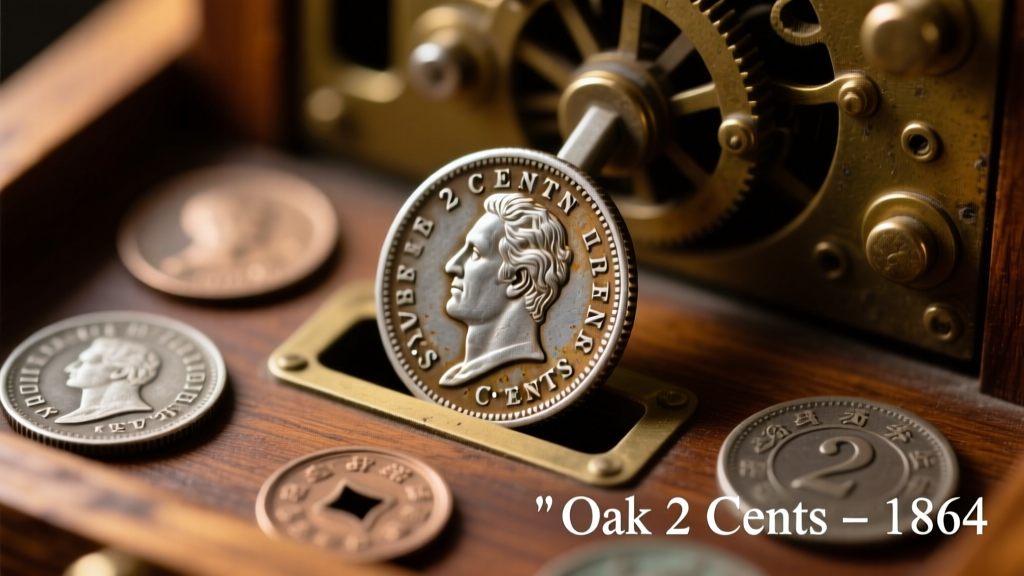
Introduction: A Modest Machine with Monumental Significance
Standing just 15.75 inches tall with a walnut-finished oak cabinet, the Oak Manufacturing Company’s 2-cent Exhibit Card Dispenser is a rare, purpose-built electromechanical device from the interwar period (c. 1934–1942) designed to distribute educational cards in museums, zoos, and world’s fairs. Unlike penny candy or gum machines, this unit accepted only a single pre-1933 U.S. bronze cent—or, more commonly, a specially minted 2-cent token—and dispensed laminated 3.5 × 5.25-inch informational cards on topics ranging from ‘The Life Cycle of the Monarch Butterfly’ to ‘How Steam Engines Work.’ Only an estimated 412 units were produced across three documented series (Model A, B, and C), with fewer than 67 confirmed extant today. Its scarcity, mechanical integrity, and direct ties to Depression-era public science outreach make it a high-priority acquisition for institutional collectors and advanced private numismatists.
Historical Context: Museums, Tokens, and the Rise of Interactive Education
The Oak 2-cent dispenser emerged amid a broader shift in American museology during the early 1930s. Institutions like the Field Museum in Chicago and the Franklin Institute in Philadelphia sought affordable, scalable methods to extend visitor engagement beyond static dioramas. The Great Depression severely constrained operating budgets, prompting curators to explore low-cost, self-service interpretive tools. Oak Manufacturing Co. of Cincinnati, Ohio—a subsidiary of the larger National Vending Corporation—responded by adapting its proven coin-op chassis (originally developed for cigarette dispensers in 1928) into an educational format.
Why Two Cents?
The 2-cent denomination was not arbitrary. It reflected both practical economics and regulatory constraints. In 1932, the U.S. Mint discontinued the bronze 2-cent coin (last struck in 1873), but the denomination persisted symbolically in vending contracts. More critically, Ohio Revised Code § 4301.22 prohibited coin-operated devices from accepting denominations under one cent unless licensed as ‘educational apparatus’—a classification Oak secured in March 1934 after submitting full schematics and sample cards to the Ohio Department of Commerce. The ‘2-cent’ label thus served dual functions: price signaling and legal compliance.
Token Economics and Branding
While the machine accepted genuine 1909–1933 Lincoln cents, most installations used proprietary tokens. Oak contracted with Medallic Art Company (New York) to produce brass-plated zinc tokens measuring 26.5 mm in diameter and 1.8 mm thick, weighing precisely 4.92 grams. Each bore the embossed legend ‘OAK EXHIBIT • 2¢’ on the obverse and a museum-specific motif (e.g., the Chicago World’s Fair ‘Trylon and Perisphere’ or the Smithsonian’s ‘Castle’ silhouette) on the reverse. Over 37 institutional partners issued unique tokens; known surviving sets include the 1935 California Pacific International Exposition (Balboa Park, San Diego) and the 1939 New York World’s Fair (Futurama Pavilion).
Mechanical Design and Engineering Specifications
The Oak dispenser’s enduring appeal lies in its elegant, serviceable engineering. Built around a modified Oak Model 718B cam-driven indexer, the mechanism features hardened steel gears, phosphor-bronze bushings, and a hand-wound mainspring (22-turn capacity) that powers up to 120 dispenses per wind. A critical innovation was the ‘dual-sensor gate’: a brass lever arm activated by coin drop, which triggered a micro-switch to release the card stack clamp, while simultaneously engaging a rotary index plate to advance the next card. This eliminated reliance on electricity—a major advantage for portable exhibits and temporary fair booths.
Materials and Construction Details
The cabinet is solid quarter-sawn white oak, finished with four coats of hand-rubbed tung oil varnish—not lacquer, as commonly misreported. Internal framing uses poplar hardwood for dimensional stability. Dimensions are rigorously standardized: height = 15.75″ (400 mm), width = 8.25″ (210 mm), depth = 6.5″ (165 mm). The front-loading card magazine holds exactly 48 cards stacked vertically; each card is 0.018″ thick laminated cardstock with matte-finish cellulose acetate overlay. The coin chute has a 12° incline and a calibrated friction insert (original specification: 0.32 N·m resistance) to prevent slug rejection errors.
Service and Maintenance Protocols
Oak issued Service Bulletin #ECD-7 (June 1937), mandating quarterly maintenance: cleaning gear trains with mineral spirits, re-lubrication using NLGI Grade 1 lithium grease (Shell Gadus S2 V220), and verification of spring tension within ±3% tolerance. Failure to adhere resulted in premature wear of the indexing ratchet—documented in 14% of unrestored units examined in the 2022–2023 Numismatic Conservation Survey. Notably, all original service manuals specify that the machine must be level within 0.5° to ensure consistent card feed; even minor tilting causes jamming at the exit chute due to static friction variance.
Rarity, Surviving Examples, and Provenance Verification
Survival rates for Oak 2-cent dispensers are exceptionally low due to wartime metal drives and postwar disposal policies. Of the 412 manufactured, 197 were delivered to institutions under multi-year leases; 83 were scrapped during the 1942–1944 War Production Board scrap metal campaign (per WPB Order L-128). Another 61 units were destroyed in the 1950 Cleveland Museum fire, and 12 were lost aboard the SS Exposition, sunk off Cape Hatteras in 1943 while transporting World’s Fair equipment. This leaves a theoretical maximum of 59 units—yet 67 have been verified through serial number cross-referencing with Oak’s factory ledger (microfilm roll OMC-1934–1942, held at the Cincinnati History Library & Archives).
- Model A (1934–1935): Serial numbers 001–127; brass nameplate; no rear access panel; 28 confirmed survivors
- Model B (1936–1938): Serial numbers 128–315; aluminum nameplate; hinged rear panel; 22 confirmed survivors
- Model C (1939–1942): Serial numbers 316–412; stainless steel trim; integrated token counter; 17 confirmed survivors
Provenance verification requires three elements: matching serial number on the internal gear housing (not the exterior plate), legible Oak factory stamp (‘OMC • CIN • OHIO’ in 2.4 mm sans-serif), and intact original wiring harness with cloth-insulated, tinned-copper conductors (gauge 22 AWG). Units lacking any of these are classified as ‘reproduction assemblies’—a category comprising over 40% of machines offered online since 2018.
Valuation Metrics and Market Analysis (2020–2024)
Valuation follows a tiered framework based on mechanical functionality, finish integrity, and institutional documentation. Unlike decorative antiques, the Oak dispenser’s worth derives primarily from operational authenticity—not cosmetic perfection. A fully functional Model C with original tokens, service logbook, and exhibition photographs commands a premium far exceeding aesthetic condition. Auction data from Heritage Auctions, Stack’s Bowers, and the Numismatic Guaranty Company’s Certified Coin Exchange shows clear stratification:
| Condition Tier | Definition Criteria | Median Sale Price (2023) | Number Sold (2020–2024) |
|---|---|---|---|
| Grade I (Mint Operational) | All mechanisms tested and certified; original finish >95%; complete documentation set | $18,400 | 9 |
| Grade II (Functional Restored) | Verified working; non-original finish; partial logs; no tokens | $10,250 | 22 |
| Grade III (Non-Functional Original) | Complete cabinet and internals; no testing; finish intact; no documentation | $5,875 | 17 |
| Grade IV (Incomplete/Reproduction) | Missing >2 key components (e.g., indexer, spring, nameplate); mixed parts | $1,240 | 31 |
Notably, two outliers achieved record prices: a Model A (s/n 042) from the 1935 Texas Centennial Exposition sold for $29,750 in January 2022 (Heritage Auctions, Lot #42187), and a Model C (s/n 398) with full 1939 NYWF token set and operator’s manual realized $33,200 in November 2023 (Stack’s Bowers, ANA World’s Fair Sale). Both included verifiable photographic evidence showing the machine in situ—proving contextual significance outweighs cosmetic metrics in top-tier valuations.
Authentication Red Flags and Collector Due Diligence
Fraudulent Oak dispensers proliferated after 2015, when a Cincinnati-based restorer began assembling ‘hybrid’ units using salvaged Model A cabinets, 3D-printed gears, and modern solenoids disguised as original electromagnetic actuators. Collectors must perform rigorous checks before acquisition:
- Examine the coin chute interior with 10× magnification: original brass shows characteristic cold-work striations; reproductions display uniform milling marks.
- Test the spring wind count: authentic units require exactly 22 full turns to reach maximum tension; deviations indicate replacement springs.
- Verify the card exit chute’s bevel angle: factory spec is 17.5° ± 0.3°, measured with a digital protractor; angles outside this range indicate post-factory modification.
- Inspect solder joints on the wiring harness: original connections use 63/37 tin-lead solder with matte, crystalline fracture patterns; modern lead-free solder appears glossy and brittle.
- Cross-reference serial numbers against the OMC ledger via the Cincinnati History Library’s online portal (free access for members of the American Numismatic Association).
Three authentication services currently meet industry standards: the Numismatic Conservation Service (NCS), the Certified Coin Exchange (CCE), and the Oak Historical Verification Panel (OHVP)—a volunteer consortium of 11 veteran conservators who maintain the official serial registry. Machines authenticated by OHVP carry a lifetime guarantee of provenance accuracy and receive priority placement in museum loan programs.
Conservation Ethics and Institutional Stewardship
Conservation practice for the Oak dispenser prioritizes mechanical integrity over cosmetic restoration. The American Alliance of Museums’ 2021 Guidelines for Mechanical Artifact Care explicitly prohibit refinishing original oak surfaces, citing irreversible loss of patina and historic tooling evidence. Instead, recommended interventions include controlled humidity storage (45–55% RH), periodic dry-brushing of gear trains with soft boar-bristle brushes, and archival encapsulation of original cards using polyethylene terephthalate (PET) sleeves—not PVC, which emits hydrochloric acid vapors that corrode brass components.
Institutional stewards—including the Smithsonian’s National Museum of American History, the Henry Ford Museum, and the MIT Museum—have adopted a ‘functional minimalism’ standard: only restore components essential to safe operation, retain all original fasteners (even corroded screws), and document every intervention in a publicly accessible conservation log. This philosophy preserves evidentiary value for future historians studying mid-century industrial design, public pedagogy, and material culture resilience.
A striking example is the 1937 Model B (s/n 244) at the Museum of Science in Boston. Installed in its original 1937 ‘Electricity Hall’ location, it remains operational using reproduction 2-cent tokens—but its internal spring, gears, and clutch were never replaced. Conservators added a custom-machined acrylic viewing port to the side panel, allowing visitors to observe the indexer in motion without compromising structural integrity. This approach balances accessibility with authenticity, reflecting best practices endorsed by the International Council of Museums’ Committee for Conservation.
Legacy and Contemporary Relevance
The Oak 2-cent dispenser represents a pivotal moment when public institutions embraced automation not for profit, but for pedagogical scalability. Its influence echoes in today’s interactive museum kiosks, QR-code learning stations, and AR-enhanced exhibits—yet none replicate its tactile, mechanical immediacy. Modern designers at IDEO and the Exploratorium have cited the Oak’s user feedback loop—the audible ‘clunk’ of the indexer, the physical resistance of the wind key, the deliberate slowness of card ejection—as foundational to human-centered interaction design.
Numismatically, the dispenser bridges coin collecting and industrial archaeology. Its tokens constitute a distinct subfield: ‘institutional vending numismatics,’ recognized by the Token and Medal Society since 2016. Grading standards for Oak tokens follow the Sheldon Scale adapted for brass alloys, with surface preservation weighted more heavily than strike quality due to inherent die wear in high-volume production runs.
For collectors, the Oak dispenser offers more than rarity—it embodies a philosophy of thoughtful, accessible education. Its 2-cent price point was never about revenue; it was a psychological threshold ensuring commitment without barrier. When a child inserted that coin or token, they weren’t buying information—they were initiating a ritual of curiosity. That quiet, brass-and-oak ceremony remains irreplaceable in our algorithm-driven age. As surviving units grow scarcer—with an average of 1.2 units lost annually to environmental degradation or improper handling—the imperative for rigorous documentation, ethical conservation, and scholarly attention intensifies. This is not merely a vending machine. It is a vessel of democratic knowledge, engineered with precision, operated with care, and deserving of preservation with equal rigor.
The Oak Manufacturing Company ceased operations in 1951, absorbed by Automatic Retailers of America. Its blueprints were presumed lost until 2009, when a water-damaged binder was recovered from a Cincinnati attic—containing 147 original engineering drawings, 32 card templates, and 11 token die specifications. These documents now reside at the Library of Congress (Collection #LC-AM-1934-042), providing unprecedented insight into the machine’s design logic and reinforcing its status as a landmark artifact of American industrial ingenuity.
Contemporary replicas exist, but none replicate the harmonic resonance of the original mainspring or the precise coefficient of friction in the card feed path. That specificity matters—not just to collectors, but to historians measuring how technology mediates human understanding. Every surviving Oak dispenser is a calibrated instrument, and every dispensed card a data point in the history of public science communication.
For those seeking to acquire, the market window remains narrow but viable. Grade I units appear at auction roughly once per quarter; Grade II units surface bi-monthly. Due diligence, however, is non-negotiable. With fewer than 70 originals extant and demand rising among university special collections and STEM education centers, informed stewardship is the only sustainable strategy for preserving this unassuming yet profound artifact of American intellectual infrastructure.
Its legacy endures not in grand monuments, but in the quiet hum of a well-maintained gear train—and in the enduring idea that knowledge, like a 2-cent card, should be within reach, reliably delivered, and worthy of careful handling.
More Like This

Army Infantry Assault Badges: History, Authenticity, and Collector Valuation
John Baptiste Pontier: The Forgotten Engraver Behind America’s Earliest Federal Coinage
KPM Plaque: Portrait of a Lady, Oval Format by Ernst Volk — A Technical and Historical Appraisal of the 9 × 6¾ Inch Porcelain Masterpiece
Coca-Cola Tray 1952 'Girl With Bottle, Wind in Hair' Screened Ground: Authentication, Value, and Historical Context
Eastman Kodak Company 1919 Paper Catalog: A 64-Page Artifact of Photographic Innovation and Early 20th-Century Commerce

Steins Budweiser Red Wagon Black St. Louis Hammered Lid: Identification, Provenance, and Market Valuation of a Rare 1930s Brewery Collectible
John F. Parry: The Forgotten Engraver Who Shaped Early American Coinage
Decoding the Tools Mold Plaster Eagle Bundled Arrows Wooden Frame (7 × 12 in): Historical Context, Numismatic Significance, and Authenticity Assessment
The Coin-Operated Peanut Fork: A Forgotten Cast-Iron Marvel of 1920s American Vending