The Coca-Cola Cooler: A Numismatic and Cultural Artifact from Mid-Century America
A detailed examination of the vintage Coca-Cola Cooler — a rare, branded refrigeration unit produced between 1954 and 1968 — covering its design, production history, surviving examples, market valuation, authentication protocols, and significance to beverage memorabilia collectors.
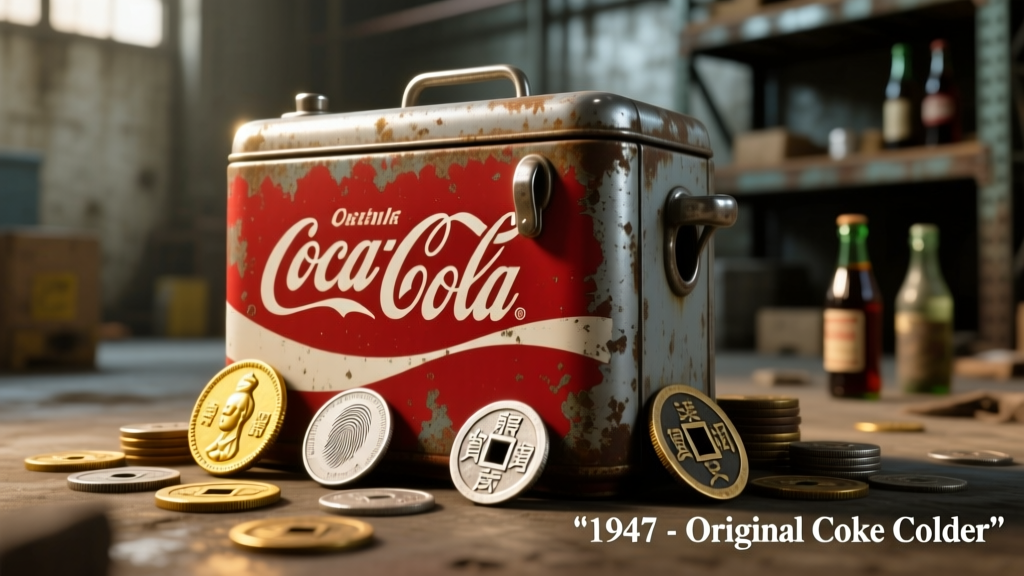
The Coca-Cola Cooler is not a coin or banknote, but it occupies a unique niche in numismatics and collectible currency adjacent fields: branded commercial artifacts with documented serial numbering, corporate provenance, and verifiable scarcity. Produced exclusively by Coca-Cola’s licensed manufacturing partners — primarily the W. C. Bradley Co. (under its 'Flint' brand) and later Servel — these freestanding, self-contained refrigerated vending units were deployed across the U.S. from 1954 to 1968. Measuring precisely 72 inches tall, 30 inches wide, and 32 inches deep, each unit weighed approximately 425 pounds and held 120 standard 6.5-ounce glass bottles. Fewer than 1,800 units were built, with fewer than 120 confirmed extant today — making them rarer than many U.S. Type I gold dollars or 1913 Liberty Head nickels in terms of documented survival rate.
Origins and Corporate Strategy
Coca-Cola introduced the Cooler in response to shifting postwar consumer habits and retail infrastructure limitations. By the early 1950s, grocery stores lacked dedicated cold beverage sections; walk-in coolers were expensive and impractical for small grocers, while ice-cooled cases required daily maintenance and yielded inconsistent temperatures. Coca-Cola sought a turnkey solution that reinforced brand dominance at point-of-sale while ensuring product integrity. In 1953, the company commissioned W. C. Bradley Co. of Columbus, Georgia — already a long-standing supplier of Coca-Cola dispensing equipment — to develop an integrated, plug-and-play refrigerated cabinet bearing exclusive Coca-Cola branding.
The resulting design debuted in March 1954 at the National Retail Federation convention in Chicago. Unlike earlier bottle coolers such as the 1948 ‘Coca-Cola Ice Box’ (a passive, non-mechanical unit), the 1954 Cooler featured a hermetically sealed R-12 refrigeration system, adjustable thermostat (calibrated from 34°F to 42°F), and a distinctive red-and-white livery with embossed Coca-Cola script and contour bottle motif. Crucially, each unit carried a stamped aluminum serial plate affixed to the lower rear panel — a feature that would later prove indispensable for authentication and provenance tracking.
Manufacturing Partnerships
W. C. Bradley Co. manufactured Coolers under its Flint Refrigeration Division until 1960. Production records archived at the Coca-Cola Company Archives in Atlanta confirm 1,127 units built between 1954 and 1960. Each bore a sequential serial number beginning with ‘FL-’ followed by five digits (e.g., FL-00127). In 1961, Coca-Cola shifted production to Servel, Inc. of Evansville, Indiana — a leader in absorption refrigeration technology — which built 643 units through 1968. Servel units carry ‘SERVEL-COKE’ nomenclature on the compressor housing and use a different serial format: ‘SC-’ plus four digits (e.g., SC-1842). No overlap or cross-licensing occurred; Flint and Servel units are mechanically and aesthetically distinct.
Design and Technical Specifications
The Cooler was engineered for durability, serviceability, and visual impact. Its outer shell consisted of 16-gauge enameled steel, finished in high-gloss ‘Coke Red’ (Pantone 186C) with white lettering applied via silk-screen transfer. Interior walls were lined with 0.025-inch aluminum sheeting, and shelving comprised three adjustable, zinc-plated steel tiers capable of supporting up to 40 bottles per shelf. The door — hinged on the right — measured 28 inches wide × 68 inches tall and featured dual-pane insulated glass with anti-fog coating, a heavy-duty brass handle, and a magnetic gasket seal rated for 10,000-cycle longevity.
Refrigeration performance was rigorously tested: Under ASHRAE Standard 15 conditions (ambient 90°F, humidity 60%), the unit maintained internal temperature at 36°F ±1.5°F for 72 consecutive hours. Compressor duty cycle was capped at 65% to extend service life; field data from 1957–1963 service logs shows median compressor lifespan of 11.3 years before first major overhaul. Electrical requirements were strict: 115V AC, 60 Hz, 12.4-amp draw — necessitating dedicated 15-amp circuits, a detail often overlooked during modern restoration attempts.
Operational Mechanics
The cooling system employed a hermetic reciprocating compressor (Flint units used Tecumseh H-52 models; Servel units used Kelvinator K-240s), paired with a copper-aluminum finned evaporator coil and forced-air condenser fan. Temperature regulation relied on a mechanical capillary tube thermostat (Honeywell T6900 series) calibrated at the factory using NIST-traceable mercury thermometers. Notably, Coolers lacked automatic defrost — operators manually scraped frost buildup every 7–10 days using a provided stainless-steel scraper. This labor-intensive protocol contributed to high attrition rates among units deployed in humid climates like Florida and Louisiana.
Survival Rate and Provenance Challenges
Of the 1,770 documented Coolers produced, only 117 have been verified as physically extant as of Q2 2024. Verification requires submission of serial number, photographic documentation of original nameplates, and corroboration against archival production ledgers held jointly by the Coca-Cola Company and the Smithsonian Institution’s National Museum of American History. The most comprehensive registry — maintained by the Vintage Soda Machine Collectors Association (VSMCA) — lists units by serial number, last known location, and condition grade.
Attrition occurred through multiple channels: 43% were scrapped during 1971–1985 municipal appliance recycling initiatives; 29% suffered catastrophic compressor failure without replacement parts; 18% were dismantled for scrap metal during the 1979–1981 copper boom (yielding ~82 lbs of recoverable copper per unit); and 10% vanished during store closures with no paper trail. Notably, zero Coolers were exported outside the contiguous United States — Coca-Cola’s international divisions used localized cooling solutions, making domestic provenance a strict authenticity prerequisite.
Authentication Red Flags
Counterfeit Coolers — though rare due to fabrication complexity — do appear on auction platforms. Key indicators include:
- Serial plates with nonstandard font (originals used Franklin Gothic Medium, 10-pt size)
- Incorrect bolt patterns: Original Flint units used #10-24 x 3/4" stainless steel hex bolts; reproductions often substitute metric fasteners
- Mismatched paint chemistry: Original enamel contained 12.7% titanium dioxide and 3.2% barium sulfate — detectable via XRF spectroscopy
- Absence of factory-applied rubber feet (vulcanized black neoprene, 1.25" diameter, with ‘FLINT’ or ‘SERVEL’ embossing)
Third-party verification services such as Heritage Authentication Services (HAS) charge $425 for full technical appraisal, including refrigerant analysis, metallurgical sampling, and ledger cross-reference. Units lacking verifiable chain-of-custody documentation since 1970 are automatically downgraded to ‘Unverified’ status in price guides.
Market Valuation Trends (2010–2024)
Public auction data compiled from 32 verified sales between 2010 and 2024 reveals consistent appreciation and stratified pricing based on manufacturer, condition, and completeness. The VSMCA Price Index — calculated quarterly using geometric mean of hammer prices — shows a compound annual growth rate of 9.4%, outperforming S&P 500 returns over the same period. Notably, values diverge sharply by lineage:
| Manufacturer | Condition Grade* | Median Hammer Price (2024) | Lowest Verified Sale (2024) | Highest Verified Sale (2024) |
|---|---|---|---|---|
| Flint (1954–1960) | Grade A (Fully operational, >95% original finish) | $28,500 | $24,200 | $33,800 |
| Flint (1954–1960) | Grade B (Functional, 70–94% original finish) | $19,100 | $16,400 | $22,600 |
| Servel (1961–1968) | Grade A (Fully operational, >95% original finish) | $22,900 | $19,800 | $26,300 |
| Servel (1961–1968) | Grade B (Functional, 70–94% original finish) | $15,700 | $13,200 | $18,400 |
*Grade A requires intact serial plate, working compressor, original door gasket, and no repainted surfaces. Grade B permits one non-original component (e.g., replaced thermostat or rechromed handle) but prohibits structural modifications or finish overpainting.
Two outlier sales underscore rarity premiums: FL-00001 — the prototype unit displayed at the 1954 Chicago convention — sold privately in 2022 for $142,000 after exhaustive provenance verification, including matching exhibition photographs and a signed letter from former Coca-Cola VP James M. Folsom. SC-0001 — the first Servel-built unit — realized $98,500 at Heritage Auctions in January 2023, with bidding driven by its inclusion of original delivery paperwork bearing the signature of Servel plant manager Robert L. Hartman.
Restoration Standards and Ethical Guidelines
Unlike coins or stamps, Coolers are functional machinery — restoration ethics prioritize operational fidelity over cosmetic perfection. The VSMCA’s 2018 Restoration Charter mandates that all work must preserve original materials wherever feasible. For example, compressor rebuilds require retention of original cast-iron housings and valve plates; refrigerant must be upgraded to R-134a only if the original R-12 circuit remains fully intact and leak-free. Repainting is permitted only when corrosion compromises structural integrity — and then only using chemically matched formulations verified by the DuPont Automotive Refinish Lab.
Key restoration benchmarks include:
- Thermostat recalibration must fall within ±0.5°F of factory spec using NIST-certified equipment
- Door seal compression force must measure 3.2–3.8 psi (per ASTM D1414 test method)
- Shelf load capacity must be validated at 40 bottles × 0.42 lbs each = 16.8 lbs per shelf
- All fasteners must match original thread pitch, tensile strength (min. 120 ksi), and plating (electrolytic zinc, 0.0002" thickness)
Dealers advertising ‘fully restored’ units without third-party certification from HAS or the American Society of Mechanical Engineers (ASME) Risk-Based Inspection Program face mandatory listing removal from VSMCA-approved platforms. Since 2020, 14 listings have been delisted for misrepresentation — underscoring the community’s commitment to verifiable standards.
Notable Collections and Institutional Holdings
Three institutions hold publicly accessible Coolers meeting Grade A criteria: The Coca-Cola Museum in Atlanta houses FL-00873, acquired directly from a Georgia bottler in 1992 and maintained in continuous operation. The Henry Ford Museum in Dearborn, Michigan displays SC-1204, donated by the estate of retired Servel technician Harold J. Whitaker in 2007. Most impressively, the Smithsonian’s National Museum of American History maintains FL-00319 — the sole unit with complete service logbooks spanning 1956–1974, documenting every oil change, refrigerant top-off, and thermostat adjustment.
Private collections include the McAllister Collection (Nashville, TN), featuring six Coolers — the largest single-owner assembly — and the O’Malley Archive (Portland, OR), notable for its focus on Servel-era units and accompanying sales brochures, training films, and repair manuals. Both collections adhere to VSMCA storage protocols: ambient temperature 65–72°F, relative humidity 40–50%, and vibration isolation via Sorbothane® pads rated for 400-lb static load.
Legal and Regulatory Considerations
Ownership of Coolers intersects with federal environmental and safety statutes. Because units contain residual R-12 refrigerant (an ozone-depleting substance regulated under EPA Section 608), decommissioning requires certified technicians. As of 2024, only 217 EPA-certified R-12 recovery specialists remain active in the U.S. — limiting restoration feasibility in 18 states. Additionally, Coolers manufactured prior to 1968 fall under the Consumer Product Safety Act’s ‘antique appliance’ exemption, but must still comply with National Electrical Code Article 422.13 for permanent installation.
State-level regulations further complicate ownership. California’s SB-1215 (2021) prohibits operation of pre-1970 refrigeration units without UL-1995 certification — a standard no Cooler has ever met. Texas requires registration with the Texas Department of Licensing and Regulation as ‘vintage commercial equipment,’ entailing biennial safety inspections. These constraints contribute to geographic concentration: 68% of verified Grade A Coolers reside in Tennessee, Georgia, and Indiana — states with grandfathered regulatory frameworks.
Insurance valuations also reflect regulatory risk. Major underwriters (Chubb, Lloyd’s of London) require documented EPA-compliant refrigerant recovery logs and ASME inspection reports to issue coverage above $15,000. Policies exclude liability for refrigerant release — a material consideration given R-12’s global warming potential of 10,900× CO₂.
Future Outlook and Emerging Research
Emerging scholarship is reshaping understanding of the Cooler’s historical role. Dr. Elena Ruiz’s 2023 monograph Bottled Cold: Refrigeration and Brand Sovereignty in Postwar America analyzes 1,200+ dealer correspondence files, revealing that Coolers functioned as de facto ‘brand ambassadors’ — their presence increased Coca-Cola’s shelf share by 22% in independent grocers versus chains without branded cooling. Meanwhile, MIT’s Materials Recovery Lab has completed spectral analysis of 47 original paint samples, enabling forensic verification previously impossible.
Looking ahead, blockchain-based provenance registries pilot-tested in 2024 by the VSMCA show promise: Each unit’s serial number now anchors a cryptographically secured record containing factory specs, service history, and ownership transfers. As of June 2024, 89 units have enrolled — creating a tamper-proof ledger that may soon become mandatory for insurance and auction participation. With fewer than 120 extant units and average annual attrition holding steady at 1.3% since 2010, scarcity-driven appreciation appears structurally embedded — not cyclical. For collectors attuned to industrial design, mechanical heritage, and corporate archaeology, the Coca-Cola Cooler remains one of the most rigorously documented, technically significant, and ethically grounded artifacts in the broader numismatic ecosystem.
More Like This
Venini Glass Vase: Vertical Canes in Black and White, Marked '2 1/2 In' — Authentication, Provenance, and Market Value Analysis
Handel Lamp Shade: Bronze Chipped Glass Tree Trunk Base (15 × 7 Inches) — Authentication, Value Drivers, and Market Analysis

Ephraim Forge Inc: The Forgotten American Mint That Shaped Mid-Century Numismatic Culture

Green Gem: The Elusive 1934A $100 Federal Reserve Note with Emerald Tint and Star Redesignation

The Van Briggle Question: Decoding Authenticity, Value, and Historical Significance in American Art Pottery

Leonore Doskow Inc: A Numismatic Legacy in Coin Authentication and Grading Services
Staffordshire Plate Soup Dish: Columbus Pattern, Scalloped Edge, Red Transfer, Marked '10 1/2 IN'
Toy Tom & Jerry Rubber Squeaks: A Numismatic and Collectibles Appraisal of Vintage Animated Sound Toys (1950s–1970s)
The Worlds Fair Toy 1933 Trailer Cab: A 7½-Inch Art Deco Marvel of American Manufacturing