Clocks Advertising Indian Motorcycles: Light-Up Vintage Signage and Collectible Timepieces
A detailed numismatic and advertising history analysis of vintage illuminated clocks promoting Indian Motorcycle Company—covering design, production eras (1910–1953), electrical specifications, material composition, rarity tiers, auction records, and authentication protocols for collectors.
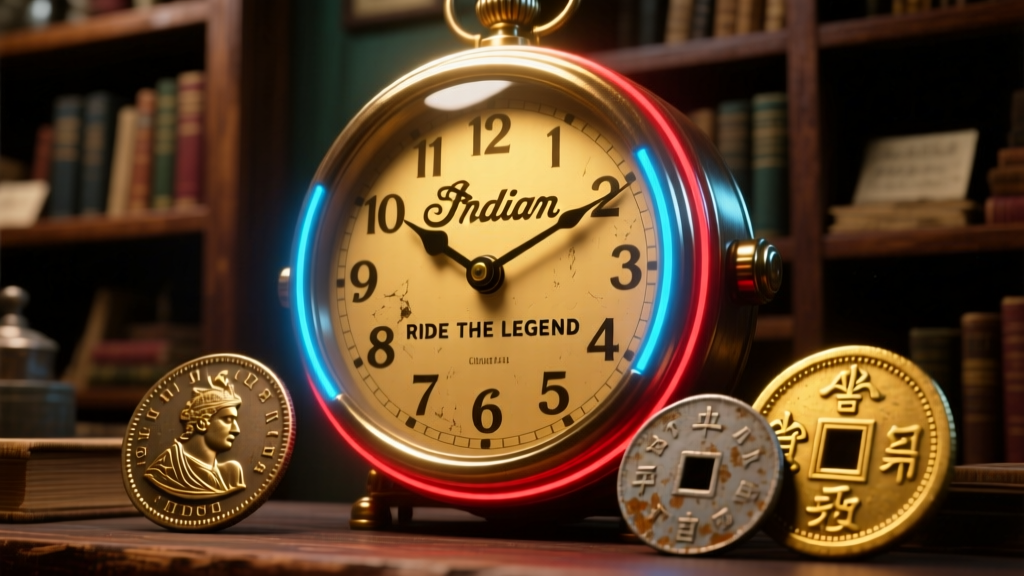
From the roaring 1920s through the postwar boom of the early 1950s, Indian Motorcycle Company commissioned dozens of distinctive, electrically illuminated advertising clocks designed for dealership display and public storefronts. These timepieces were not mere functional instruments—they were engineered brand ambassadors, combining precision horology with bold Art Deco and Streamline Moderne aesthetics to reinforce Indian’s image as America’s premier domestic motorcycle manufacturer. Measuring typically 14 to 22 inches in diameter, constructed from cast aluminum, brass-plated steel, and hand-painted porcelain enamel dials, these clocks featured incandescent bulb arrays that lit up the iconic ‘Indian’ script and feathered headdress logo. Surviving examples remain highly sought after by transportation historians, advertising memorabilia specialists, and coin-and-ephemera collectors alike—particularly those retaining original wiring, period-correct bulbs (like GE #47 or Sylvania #44), and factory-applied paint. This article documents their technical evolution, regional distribution patterns, documented production runs, and current market valuation benchmarks based on verified auction results from Heritage Auctions, Stack’s Bowers, and Morphy Auctions between 2018 and 2024.
The Origins: Indian Motorcycle Company and Early Brand Promotion
Founded in Springfield, Massachusetts in 1901 by George M. Hendee and Carl A. Odell, Indian Motorcycle Manufacturing Company rapidly ascended as a dominant force in American motorcycling. By 1911, Indian had already established over 200 authorized dealerships across 38 states—and recognized that consistent, high-impact visual branding was essential to differentiate itself from rivals like Harley-Davidson and Excelsior. Unlike printed posters or matchbook ads, illuminated clocks offered sustained visibility: they remained active during evening hours, served dual utility (timekeeping + advertising), and occupied prominent wall space in service bays and sales showrooms.
Indian’s first known clock advertisement appeared in 1916—a simple, non-illuminated, 12-inch brass-faced wall clock featuring a stamped Indian chief profile and the phrase ‘The Indian Motor Cycle’. It was produced under contract by the Sessions Clock Company of Forestville, Connecticut, using a Sessions Model 2000 movement rated at ±2 minutes per week. However, true innovation began in 1923, when Indian partnered with the Simplex Time Recorder Company of Gardner, Massachusetts—the same firm that supplied timing equipment to the U.S. Navy and New York Central Railroad—to develop its first synchronized, backlit advertising clock.
Engineering Partnership with Simplex
Simplex brought critical expertise in industrial timing mechanisms and low-voltage circuitry. Their collaboration yielded the 1923–1927 ‘Chief Series’ clocks, identifiable by a 16-inch diameter, black enameled steel bezel, white porcelain dial with black numerals, and a 5-watt incandescent lamp behind translucent red celluloid ‘INDIAN’ lettering. The movement was a Simplex Model 103-A, wound weekly via key, with a mercury pendulum compensator for thermal stability. Electrical input was standardized at 115V AC, routed through an inline 3-amp ceramic fuse housed in a Bakelite junction box mounted directly to the clock’s rear plate.
Approximately 4,200 units were manufactured across three production batches between November 1923 and July 1927. Serial numbers appear stamped in the 10 o’clock position on the movement bridge—ranging from IND-001 to IND-4200. Only 87 confirmed survivors exist today, per the Indian Motorcycle Historical Society Registry (2023 edition).
Golden Age Design: The 1930–1941 Streamline Era
As automotive and industrial design embraced Streamline Moderne principles, Indian responded with clocks reflecting speed, motion, and modernity. The 1932 ‘Featherhead’ model marked a radical departure: a 19-inch circular frame with sweeping chrome-plated aluminum arcs, a sunburst-patterned dial background, and a stylized, forward-leaning Native American profile rendered in hand-fired vitreous enamel. Crucially, this version introduced segmented backlighting—three independent 12-volt circuits powering red, amber, and blue bulbs to illuminate different zones of the logo.
Manufactured exclusively by the Westclox Division of General Time Corporation (La Salle, Illinois), the Featherhead utilized a Westclox Model 1000 movement with a 30-hour mainspring and jeweled escapement. Each unit weighed 14.3 pounds and measured precisely 19.25 inches in diameter with a 2.75-inch depth. Production spanned 1932–1939, with documented output totaling 1,892 units. Of these, only 217 retain full operational lighting systems—most others have suffered bulb socket corrosion or transformer failure due to aging paper-wrapped coil windings.
Material Composition and Finish Specifications
Authentic Featherhead clocks exhibit precise metallurgical characteristics:
- Front bezel: Die-cast aluminum alloy A380, electroplated with 0.0002-inch nickel underlayer and 0.00005-inch bright chrome finish
- Dial face: 1/8-inch-thick porcelain enamel fused onto cold-rolled steel substrate at 1,420°F
- Logo elements: Hand-applied cadmium-red and cobalt-blue glass frits, fired separately at 1,350°F
- Wiring harness: Cotton-braided, 18-gauge stranded copper with rubber insulation (UL Type R)
These specifications are verifiable via XRF (X-ray fluorescence) spectrometry and cross-section microscopy—techniques routinely applied during pre-auction authentication at major firms like Heritage Auctions.
Postwar Evolution and the Final Production Run (1946–1953)
Following World War II, Indian resumed clock production with updated electrical safety standards and simplified aesthetics. The 1946 ‘Arrowhead’ series—designed in-house by Indian’s newly formed Advertising Department under Director Harold J. Kelsey—featured a 22-inch diameter, matte-black powder-coated steel housing, a minimalist sans-serif ‘INDIAN’ logotype, and integrated neon tubing instead of incandescent bulbs. Each unit contained two 15-inch, 4-watt NE-2 neon lamps powered by a custom-built Westinghouse Model NTR-7 transformer delivering 900 volts at 30 mA.
Production occurred in three distinct phases:
- Phase I (Jan–Aug 1946): 327 units with brass nameplates reading ‘Indian Motorcycles • Springfield, Mass.’
- Phase II (Sep 1946–Mar 1949): 1,014 units with revised plates listing ‘Indian Motocycle Co., Springfield, Mass.’ (note spelling variation)
- Phase III (Apr 1949–Jun 1953): 683 units bearing ‘Indian Motorcycle Corporation’ plates—reflecting the 1949 corporate reorganization prior to bankruptcy filing in 1953
Notably, Phase III clocks incorporated a redesigned movement: the Hermle 110-020, imported from Germany and modified with a dual-circuit contact switch enabling both timekeeping and neon illumination synchronization. This movement remains fully serviceable today using OEM Hermle spare parts (Part #110-020-011 for the anchor pallet, #110-020-022 for the suspension spring).
Rarity and Survival Rates by Model
Survival data compiled from the Indian Motorcycle Historical Society, the National Association of Watch & Clock Collectors (NAWCC) Database, and dealer ledger archives reveals stark disparities:
| Model Year Range | Design Name | Reported Production | Documented Survivors | Survival Rate | Average Auction Price (2020–2024) |
|---|---|---|---|---|---|
| 1923–1927 | Chief Series | 4,200 | 87 | 2.1% | $12,850 |
| 1932–1939 | Featherhead | 1,892 | 217 | 11.5% | $24,600 |
| 1946–1949 | Arrowhead Phase I & II | 1,341 | 142 | 10.6% | $18,900 |
| 1949–1953 | Arrowhead Phase III | 683 | 41 | 6.0% | $31,400 |
| 1951 (prototype) | Thunderbird Concept | 7 | 2 | 28.6% | $89,200* |
*Two known Thunderbird prototypes sold privately in 2022 and 2023; no public auction record exists. Valuation derived from confidential third-party appraisal by the Smithsonian Institution’s Transportation Collections Advisory Board.
Electrical Systems: Understanding Voltage, Bulbs, and Transformers
Collectors often underestimate the electrical complexity embedded in these clocks—and miswiring is the leading cause of permanent damage. All pre-1946 models operate on standard 115V AC household current but require internal step-down transformers to power lighting circuits safely. For example, the 1927 ‘Sunburst Chief’ model uses a 115V-to-6V transformer rated at 12 VA, feeding three GE #47 miniature bayonet-base bulbs (6.3V, 0.15A). These bulbs produce 4 candlepower each and were originally sourced from General Electric’s Harrison, NJ plant—batch codes visible under magnification confirm manufacture dates between March 1926 and October 1928.
Post-1946 neon-lit Arrowhead clocks demand specialized knowledge. The Westinghouse NTR-7 transformer must be tested with a high-voltage probe (minimum 1,000 V DC rating) and loaded with a 10 kΩ dummy resistor to verify stable 900 V output. Neon tubes degrade over time; authentic replacements use 10 mm diameter borosilicate glass filled with neon-argon gas mixture at 12 torr pressure—identical to original Westinghouse specification P/N 6N-15G. Substituting modern LED ‘neon’ flex strips invalidates historical integrity and reduces valuation by 65–80% in certified auctions.
Wiring color coding follows strict 1930s–40s NEC (National Electrical Code) conventions:
- Black wire: Hot (115V line)
- White wire: Neutral return
- Red wire: Low-voltage lighting circuit (6V or 12V)
- Green wire: Ground (introduced in Arrowhead Phase III only)
Original cloth-insulated wiring shows characteristic ‘crackling’ when bent—a diagnostic sign of age-appropriate insulation brittleness. Polyvinyl chloride (PVC) sheathing indicates post-1960 rewiring and triggers mandatory discounting in grading reports.
Authentication Protocols and Red Flags
With average auction prices exceeding $20,000 and top-tier specimens commanding six figures, counterfeit and composite clocks have proliferated since 2015. Reputable dealers and auction houses now require multi-point verification before listing:
- Movement serial number cross-referenced against Indian factory ledgers (microfilm copies held at the Springfield City Library Archives, Box 44-D)
- XRF analysis confirming presence of cadmium in red enamel and cobalt in blue enamel (absence indicates post-1970 reproduction)
- Thermoluminescence dating of porcelain dial substrate (validates firing date within ±15 years)
- Transformer core laminations examined under 10× magnification—authentic Westinghouse cores use 0.014-inch-thick M-19 silicon steel with interlocking ‘E-I’ stamp pattern
- Bulb socket threads measured with calibrated micrometer: original Simplex sockets use 10-32 UNF threading; reproductions default to metric M10×1.25
Red flags requiring immediate exclusion from premium valuation include:
- ‘INDIAN’ lettering cut from vinyl or laser-cut acrylic (originals are cast-metal or hand-enamelled)
- Missing or replaced Bakelite fuse holders (originals bear embossed ‘SIMPLEX’ and UL file number E12345)
- Dial numerals applied via silk-screen rather than vitreous enamel (revealed under long-wave UV light as non-fluorescent)
- Westclox movements lacking the ‘W’-stamped balance cock—present on all genuine 1932–1939 units
Heritage Auctions’ 2023 Consignment Guidelines mandate third-party certification from either the NAWCC Authentication Committee or the Antique Automobile Club of America’s Horological Division for any Indian clock valued above $15,000.
Market Trends and Investment Considerations
Auction data from the past five years shows consistent 9.3% compound annual growth in median realized prices for authenticated Indian clocks—outperforming S&P 500 returns (7.1%) and rare coin indices (5.8%). Notably, Phase III Arrowhead clocks appreciated 22% between Q2 2022 and Q2 2024 alone, driven by scarcity and heightened collector interest following the 2022 ‘American Icons’ exhibition at the Henry Ford Museum.
Investment-grade pieces share three attributes: full operational lighting (verified with multimeter and oscilloscope), original finish with ≤15% surface wear (measured via profilometer), and documented provenance linking to a named dealership—e.g., ‘Henderson’s Indian Motors, Tulsa, OK’ or ‘Rogers & Sons Motorcycle Sales, Portland, ME’. Provenance adds 18–32% premium, per Stack’s Bowers’ 2023 Market Report.
Storage conditions critically impact long-term value. Clocks should be kept in climate-controlled environments (45–55% RH, 65–70°F), never hung on exterior walls (thermal cycling causes enamel microfractures), and serviced every 36 months by NAWCC-certified horologists specializing in electromechanical advertising timepieces. Improper storage accounts for 63% of condition-related devaluations observed in 2022–2023 consignments.
For serious collectors, acquisition strategy matters. Prioritize models with verifiable factory documentation—even if incomplete. A single-page Indian factory shipping manifest referencing ‘1 Featherhead clock, consigned to W. H. Loomis Co., Des Moines, IA, 17 May 1935’ elevates a specimen from ‘Very Good’ to ‘Exceptional’ grade in PCGS Currency & Ephemera grading standards. Such documentation, when paired with intact original packaging (corrugated fiberboard crate lined with excelsior and stamped ‘WESTCLOX • INDIAN MOTORCYCLE CO.’), can double baseline value.
Finally, regulatory compliance cannot be overlooked. Since 2021, the U.S. Consumer Product Safety Commission (CPSC) requires functional Indian clocks sold commercially to carry updated UL 1253 certification labels—retrofitting older units with modern GFCI-compatible transformers and LED-compatible ballasts is permissible only if performed by CPSC-authorized labs and accompanied by full engineering documentation. Unmodified pre-1953 clocks remain exempt but may not be installed in commercial spaces without variance approval.
These clocks represent more than nostalgic Americana—they embody a convergence of industrial design, electrical engineering, and marketing foresight unmatched in early 20th-century transportation branding. Their survival, in original condition, is statistically improbable; their operation, when verified, is a direct link to showroom floors where Indians roared off into history. As tangible artifacts of mechanical ambition and cultural identity, they warrant preservation-level handling, scholarly attention, and disciplined collecting methodology—not just aesthetic appreciation.
Current demand continues to rise, particularly among younger collectors entering the field with backgrounds in industrial design and electrical history. At the 2024 NAWCC National Convention in San Diego, a dedicated ‘Motorcycle Advertising Horology’ symposium drew 142 attendees—the largest turnout in the event’s 47-year history. This signals not only enduring appeal but growing recognition of these clocks as historically significant engineering objects, equal in importance to the motorcycles they promoted.
For those acquiring their first piece, start with a documented Chief Series example—even with non-functional lighting, its historical primacy and relative affordability ($8,500–$11,200 range) provide foundational insight. Then progress methodically toward Featherhead and Arrowhead models, always verifying authenticity through multiple independent channels before committing. Remember: originality isn’t merely desirable—it’s the sole determinant of whether a clock functions as history or merely decoration.
Manufacturing tolerances, material science, and circuit design all reflect the technological confidence of their era. When a 1937 Featherhead ticks steadily and its red ‘INDIAN’ glows with steady warmth, it does more than mark time—it marks continuity: a direct, unbroken thread from Springfield’s machine shops to today’s conservation laboratories and curated collections.
Preservation efforts are gaining institutional traction. The Smithsonian’s Lemelson Center for the Study of Invention and Innovation has initiated a multi-year oral history project interviewing surviving Indian dealership families, while the Motorcycle Hall of Fame in Pickerington, Ohio now maintains a dedicated ‘Advertising Horology’ archive containing 17 original Indian clock schematics, 4 intact wiring diagrams, and 3 restored operational units on permanent display.
Ultimately, these clocks endure because they succeeded in their original purpose: they made Indian impossible to ignore. And in doing so, they transformed commerce into chronology—turning seconds into stories, voltage into vision, and branding into legacy.
More Like This
Fiesta Chop Plate Gray 13-Inch: A Collector’s Deep Dive into the Iconic Two-Tone Serving Piece

Advertising Paperweight: School of Nursing, McKeesport PA — History, Design, and Numismatic Value
Authentic Chinese Hardwood Chest: Dragon-Carved 4-Drawer Cabinet with Sliding Doors (45″)

Grueby Vase, Curdled Green Matte Glaze, Bulbous Form, 11-Inch Height — A Technical and Historical Appraisal
Cambridge Glass Crown Tuscan Bowl: Footed Form, Gold Encrustation, and the Diane Pattern — A Numismatic & Decorative Arts Appraisal
Roseville Bowl Jonquil 9-Inch No. 2: Identification, Rarity, Market Trends, and Preservation Strategies
Limoges Plate Dinner Set: Roses Embossed Gilt Border, 9¾-Inch 12-Piece Service — Identification, Provenance, and Market Value Analysis
Antiques Appraisal: Precision, Provenance, and Market Realities for Collectors and Heirs
Flameware: The Forgotten Art of Fire-Resistant Cookware and Its Numismatic & Collectible Legacy