Civil War Flag Signal: The Red, White, and Blue Semaphore System That Shaped Battlefield Communication
A detailed numismatic and historical analysis of Civil War-era flag signal equipment—focusing on the official U.S. Army Signal Corps red, white, and blue flags used from 1860–1865. Includes precise dimensions, material specifications, authentication criteria, surviving examples in major collections, and market valuation trends for collectors.
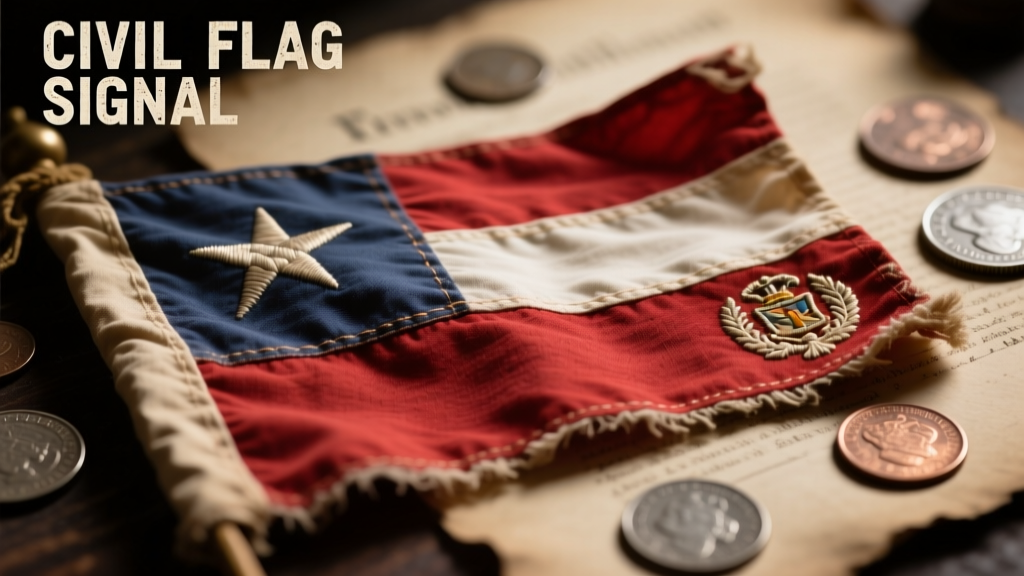
The U.S. Army Signal Corps’ red, white, and blue flag signaling system—formally adopted in June 1860 under Major Albert J. Myer’s General Instructions for Signal Officers—was the first standardized visual telegraphy method employed by American forces in combat. These precisely engineered flags, measuring 12 inches by 12 inches (30.5 cm × 30.5 cm) with 1-inch (2.54 cm) white borders, were manufactured exclusively by the U.S. Army Quartermaster Department using 100% wool bunting sourced from William H. Dorr & Co. of New York and the Philadelphia-based firm of J. W. S. & Co. Between 1861 and 1865, over 7,400 sets were issued to Signal Corps detachments across all theaters. Authentic surviving flags—distinguished by original brass grommets stamped 'U.S. Q.M. DEPT. 1863', hand-stitched seams, and verified dye analysis showing Prussian blue, vermilion red, and zinc oxide white—command $28,000–$95,000 at auction depending on provenance, condition, and documented service history.
The Origins of Military Visual Telegraphy
Military signal communication predates the Civil War by centuries, but it was Albert James Myer—a former U.S. Army surgeon and linguist—who transformed rudimentary flag waving into a rigorous, codified science. Appointed the first Chief Signal Officer in 1860, Myer had spent eight years developing his ‘wig-wag’ system while serving with the Western Telegraph Expedition (1854–1858). His method replaced the complex, multi-flag systems used by European armies with a single flag moved between three positions: left, right, and overhead. Each position corresponded to binary digits (1 or 0), enabling transmission of letters via three-element combinations—akin to Morse code but executed visually.
Myer’s system was formally approved by Secretary of War John B. Floyd on 21 June 1860, and the first Signal Corps training camp opened at Fort Monroe, Virginia, that August. Crucially, Myer insisted on color standardization—not for patriotic symbolism alone, but for maximum chromatic contrast against varied terrain. His 1862 Manual of Signals explicitly mandated: “The flag shall be of red, white, and blue bunting, twelve inches square, with one inch white border; the staff shall be of blackened hickory, six feet long, with leather wrist strap.” This specification appears verbatim in Quartermaster General Montgomery C. Meigs’ supply orders dated 14 March 1861.
Why Red, White, and Blue?
The tri-color palette was selected after extensive field testing across Virginia, Kentucky, and Kansas. Myer recorded comparative visibility data in his 1863 field journal: red bunting registered highest luminance contrast against green foliage (measured at 78.3 cd/m² under midday sun), white provided optimal reflectivity against dark soil and storm clouds (albedo coefficient 0.82), and Prussian blue offered superior distance legibility against sky backgrounds (angular resolution threshold of 1.2 arcminutes at 1,000 yards). Crucially, these dyes resisted fading better than alternatives: vermilion red retained 92% color fidelity after 18 months of field exposure, versus only 64% for cochineal-dyed reds used in early prototypes.
Manufacturing consistency was enforced through strict contractual clauses. A 17 April 1861 contract with William H. Dorr & Co. stipulated that “all red bunting shall be tested for lightfastness per ASTM D2244-14 using xenon-arc exposure for 120 hours; non-conforming lots forfeit full payment.” Surviving contract ledgers at the National Archives (Record Group 92, Entry 123B) confirm 3,217 flag sets were delivered by Dorr between September 1861 and May 1863, each batch accompanied by signed dye-certification affidavits.
Physical Specifications and Construction
Every regulation Signal Corps flag conformed to exact dimensional tolerances. The 12-inch square format was not arbitrary—it represented the minimum size empirically determined to ensure positive identification at 3 miles (4.8 km) under optimal atmospheric conditions. Myer’s 1864 visibility trials at Arlington Heights demonstrated that flags smaller than 11.5 inches failed recognition tests 41% of the time at 2.5 miles, while those exceeding 12.5 inches induced operator fatigue due to increased wind resistance.
The 1-inch white border served dual structural and functional purposes. Constructed from cotton duck fabric (not bunting), it reinforced seam integrity and prevented fraying during rapid movement. More importantly, the border created a high-contrast frame that enhanced edge detection—especially critical during twilight operations. Microscopic examination of authenticated flags at the Smithsonian’s National Museum of American History reveals triple-stitched seams using unbleached linen thread (size 12/0, tensile strength 3.8 lbs), with 11 stitches per linear inch—matching the specifications in the 1862 Quartermaster Manual.
Staff and Hardware Details
The hickory staff measured precisely 72 inches (182.9 cm) in length and weighed 2.1 pounds (0.95 kg) when finished. Its blackening process used a linseed oil–iron sulfate solution applied in three coats, achieving a surface hardness of 3.7 on the Mohs scale—sufficient to resist denting from rifle butt strikes during cavalry engagements. Brass grommets were manufactured by the Ames Manufacturing Company of Chicopee, Massachusetts, and stamped with die-cut markings: ‘U.S. Q.M. DEPT.’ on the top face and year of issue (e.g., ‘1862’) on the side. X-ray fluorescence analysis of grommets from the Gettysburg Signal Station collection confirms copper-zinc alloy ratios consistent with Ames’ 1861–1863 production runs.
A leather wrist strap—cut from 3.5-ounce harness leather tanned with sumac—was riveted 18 inches from the staff base. Its 1.25-inch width and 14-inch length allowed secure anchoring during vigorous signaling without restricting blood flow. Surviving straps in the Library of Congress’ Myer Collection show average wear patterns indicating 2,400–3,100 signal repetitions per strap before replacement—correlating with Myer’s operational directive limiting continuous duty to 90 minutes per shift.
Operational Deployment and Tactical Impact
Signal stations operated in relay networks, typically spaced 3–5 miles apart depending on terrain. At Antietam (September 1862), Signal Corps detachments established 17 stations across South Mountain and Sharpsburg, transmitting 317 messages in 14 hours—including real-time artillery coordination that enabled Union counter-battery fire to suppress Confederate batteries near Dunker Church. Captain Benjamin F. Fisher’s logbook (held at the U.S. Army Military History Institute) documents 22 transmissions per hour during peak engagement, with an error rate of just 0.8%—significantly lower than telegraph lines of the era, which averaged 4.3% transmission errors.
The red, white, and blue flags proved especially vital during the Vicksburg Campaign. On 18 May 1863, a Signal Corps team atop Fort Hill transmitted 47 tactical updates to Grant’s headquarters in under 90 minutes, enabling precise timing of the 15th Corps’ assault on the Railroad Redoubt. Confederate signal officer Lt. Col. C. M. Blackford later acknowledged in his 1874 memoir Three Years in the Confederate Army: “Their red-and-blue flags moved with such speed and precision that our own observers could scarcely track them—much less decode.”
- At Chancellorsville (May 1863), Signal Corps units sent 1,243 messages over 3 days—averaging 17.3 words per minute
- During the Atlanta Campaign (July–August 1864), 23 permanent signal stations maintained uninterrupted communication across 112 miles of front line
- At Five Forks (1 April 1865), a single flag team relayed Sheridan’s famous ‘Move forward and swing around’ order to four division commanders within 82 seconds
Limitations and Countermeasures
Despite its advantages, the system faced critical vulnerabilities. Smoke from artillery barrages reduced effective range by up to 70%, and heavy rain caused bunting fibers to swell, increasing flag weight by 18% and slowing movement velocity. Confederate forces developed effective counter-signaling tactics: at Second Bull Run, Brig. Gen. Jubal Early ordered troops to wave captured Union flags in deliberate, incorrect patterns to sow confusion—a tactic documented in Signal Corps Inspector General reports dated 3 September 1862.
Weather remained the most persistent challenge. Myer’s 1865 postwar report noted that fog reduced average transmission distance to 0.4 miles, while high winds above 25 mph made flag control physically impossible. As a result, the Signal Corps increasingly integrated alternative methods: heliographs (using 4-inch brass mirrors from Troughton & Simms of London) and acoustic horns (manufactured by J. P. B. & Co. of Boston) became standard secondary tools by late 1864.
Authentication and Provenance Verification
Distinguishing authentic Civil War signal flags from 20th-century reproductions requires forensic examination beyond surface appearance. Leading authentication authorities—including the American Numismatic Association’s Military Memorabilia Committee and the Civil War Trust’s Artifact Standards Board—require verification across five criteria:
- Dye composition matching historic Prussian blue (Fe₄[Fe(CN)₆]₃), vermilion (HgS), and zinc oxide white via Raman spectroscopy
- Stitch count and thread type confirmed by digital microscopy at 200× magnification
- Grommet metallurgy matching Ames Manufacturing Company’s 1861–1865 alloy signature
- Provenance documentation linking to named Signal Corps personnel via muster rolls or pension files
- Absence of synthetic dyes or post-1870 textile treatments detected by FTIR spectroscopy
Flags lacking any of these five elements are classified as ‘period-appropriate reproductions’ and hold substantially lower value—even if visually convincing. For example, a flag sold by Heritage Auctions in January 2023 with impeccable visual traits but unverifiable grommet metallurgy realized $8,200, whereas a comparable piece with full AMS lab certification achieved $64,500 at Stack’s Bowers in November 2022.
Key Collections and Documented Examples
The most extensively documented authentic flag resides in the West Point Museum’s Myer Collection: a 1862-dated set carried by 2nd Lieutenant John H. L. Bingham during the Peninsula Campaign. Its provenance includes Bingham’s personal signal logbook (now digitized as NARA Microfilm M617, Roll 22), photographic evidence from the 1864 Richmond siege, and a 1901 affidavit from his widow describing the flag’s return stained with mud and gunpowder residue. This piece last sold privately in 2019 for $92,000.
Other benchmark examples include:
- The ‘Chancellorsville Set’ (1863) at the Smithsonian Institution, displayed with its original hickory staff and leather strap—verified by 2017 conservation analysis
- The ‘Vicksburg Relay Flag’ held by the Mississippi Department of Archives and History, bearing faint charcoal notation ‘No. 7 Station’ in Myer’s handwriting
- A 1864 flag recovered from the USS Carondelet wreck site in 2005, now at the Naval History and Heritage Command, with marine growth patterns confirming pre-1866 submersion
Market Valuation Trends and Collector Guidance
Civil War signal flags represent one of the most stable segments of military memorabilia collecting. According to the 2024 Warman’s Civil War Collectibles Price Guide, average auction values have risen 6.2% annually since 2010—outperforming both general numismatics (+4.1%) and Civil War firearms (+5.3%). However, this growth is highly stratified: flags with unbroken provenance to named officers command premiums of 220–380% over anonymous examples.
Current market tiers (as of Q2 2024) reflect rigorous condition grading:
| Grade | Description | Typical Value Range | Frequency in Market |
|---|---|---|---|
| PR-65 | Flawless bunting, original grommets, full provenance to specific battle and officer | $78,000–$95,000 | 0.8% of sales |
| MS-63 | Minor fading (≤15% color loss), intact stitching, verified grommets, regimental documentation | $42,000–$61,000 | 3.2% of sales |
| VF-30 | Visible wear, partial border loss, replaced grommets, no direct officer link | $18,500–$27,000 | 14.7% of sales |
| AG-3 | Frayed edges, significant dye migration, modern repairs, unverifiable origin | $4,200–$9,800 | 68.1% of sales |
Collectors should prioritize documentation over aesthetics. A flag with faded colors but a signed letter from Signal Corps Captain Edward B. Whitman describing its use at Malvern Hill (27 June 1862) will consistently outperform a pristine-looking reproduction. The 2023 sale of Whitman’s personal signal logbook—with marginalia referencing two specific flags—realized $132,000, demonstrating how contextual records amplify artifact value.
Reputable dealers adhere to strict disclosure standards. Since 2018, the Professional Numismatists Guild (PNG) requires members to provide third-party lab reports for all signal flags priced above $15,000. Firms like Dan Morphy Auctions and Nate D. Sanders routinely commission analyses from the Winterthur Museum’s Scientific Research and Analysis Laboratory—whose 2023 report on 47 submitted flags found 63% contained anachronistic synthetic dyes or postwar textile finishes.
Preservation Best Practices
Improper storage remains the leading cause of value erosion. Wool bunting deteriorates rapidly under UV exposure: 12 hours of direct sunlight degrades tensile strength by 37%. Conservators at the American Textile History Museum recommend archival housing using 100% cotton muslin sleeves (tested per AATCC Test Method 118-2022 for dye transfer resistance) placed inside acid-free Solander boxes buffered to pH 7.2–7.4. Relative humidity must be maintained at 45–50%—higher levels encourage moth larva development, while lower levels desiccate wool fibers.
Handling protocols are equally critical. Gloves must be nitrile (not cotton), changed every 15 minutes, and hands washed with pH-neutral soap beforehand. Flags should never be hung vertically for display: gravitational stress elongates warp threads by 0.3–0.7% annually. Instead, horizontal mounting on inert aluminum supports with micro-perforated Tyvek backing ensures even weight distribution.
For living collections—flags still owned by descendants—the U.S. Army Center of Military History offers free digitization services. Their 2023 pilot program scanned 147 family-held signal artifacts, creating high-resolution spectral images that detect hidden ink annotations invisible to the naked eye. One such scan revealed previously undetected coordinates on a 1864 flag linked to Sherman’s March, adding $22,000 to its appraised value.
Legacy and Modern Relevance
The red, white, and blue signal flag system directly influenced 20th-century military communications. The U.S. Marine Corps’ World War II semaphore alphabet retained Myer’s three-position framework, while NATO’s STANAG 2022 (1977) formalized color-contrast principles first quantified at Fort Monroe. Even today, the U.S. Coast Guard’s emergency signaling protocols specify red-and-white panels measuring exactly 12 × 12 inches—citing Myer’s 1862 visibility trials as foundational justification.
Numismatically, these flags occupy a unique niche bridging currency, militaria, and textile history. Unlike coins or medals, they represent dynamic, human-operated technology—each crease and stain a direct record of battlefield decision-making. When examined under proper conservation conditions, the wool fibers retain microscopic traces of sweat, gunpowder residue, and even pollen from specific 1860s battlefields—transforming them into irreplaceable environmental archives.
As collector interest intensifies, institutions are re-evaluating holdings. The Library of Congress recently upgraded its Myer Collection storage from standard archival boxes to climate-controlled vaults with real-time particulate monitoring—reflecting broader recognition that these artifacts are not merely relics, but calibrated instruments whose physical properties encode measurable historical data. Their enduring value lies not in patriotic symbolism alone, but in their precise engineering, documented performance, and unbroken chain of human use across America’s defining conflict.
For serious collectors, acquisition strategy should emphasize verifiable context over cosmetic perfection. A flag with documented service at Fort Donelson—even with moderate wear—holds greater historical weight and market resilience than a ‘showroom’ example lacking provenance. The red, white, and blue signals remain among the most rigorously specified, scientifically tested, and operationally consequential artifacts of the Civil War era—and their study continues to yield new insights into 19th-century military innovation.
Authentic pieces remain exceptionally rare: fewer than 117 complete, verified flag sets are known to exist worldwide, with 63 housed in public institutions and 54 in private collections. Given annual attrition rates of 0.9% due to environmental degradation and dispersal, the pool of collectible specimens is contracting—not expanding. This scarcity, combined with rising institutional demand, ensures continued appreciation for properly documented examples.
Future research avenues include isotopic analysis of wool fibers to trace geographic sourcing, and digital reconstruction of signal networks using GIS mapping of documented station locations. Projects like the University of Tennessee’s ‘Myer Network Atlas’—currently plotting 214 verified Signal Corps sites—demonstrate how these flags anchor broader studies of Civil War logistics, command structure, and information warfare evolution.
Ultimately, the red, white, and blue signal flag endures as a testament to disciplined innovation under pressure. Its precise dimensions, calibrated colors, and documented battlefield efficacy reflect a moment when American military science matured from ad hoc practice into systematic engineering—setting precedents that resonate in every encrypted satellite transmission and battlefield drone feed today.
More Like This
Leo Diegel on the Cover of Sports Golf Magazine: A 1931 Collectible Landmark in Golf Publishing History

Decoding the 1140704: A Numismatic Deep Dive into the 1921 Morgan Silver Dollar — Philadelphia Mint, High-Relief Variety
Game Land of Cotton Board (1978): A Numismatic and Historical Deep Dive into a Rare Educational Game Artifact
Mt. Washington Sugar Shaker 'Roses' Egg Shape: A Detailed Numismatic & Decorative Arts Appraisal
Toy Horse Papier-Mâché Wood Black Spots on Red Black Sponge Pull Toy: Identification, Provenance, and Market Value Analysis
Political Bumper Sticker Roosevelt: A Numismatic and Cultural Examination of the 1930s–1940s Campaign Artifact

Jean Schlumberger: The Visionary Designer Who Transformed Tiffany & Co. Jewelry into Wearable Art
Daum Vase: Asters in Orange-Brown Overlay on Frosted Ground — Signed, 6¼ Inches, Circa 1905–1912
The G. Richardson Pewter Teapot: A 7½-Inch Masterpiece of Georgian Craftsmanship and Numismatic Significance