Cigar Store Indians: History, Craftsmanship, and Market Value of America’s Iconic Wooden Trade Figures
A detailed numismatic and material culture analysis of Cigar Store Indian figures—hand-carved wooden trade signs from the 19th and early 20th centuries—covering their origins, regional carving traditions, identifying hallmarks, conservation challenges, and current auction performance with verified price data.
The Origins and Commercial Function of Cigar Store Indians
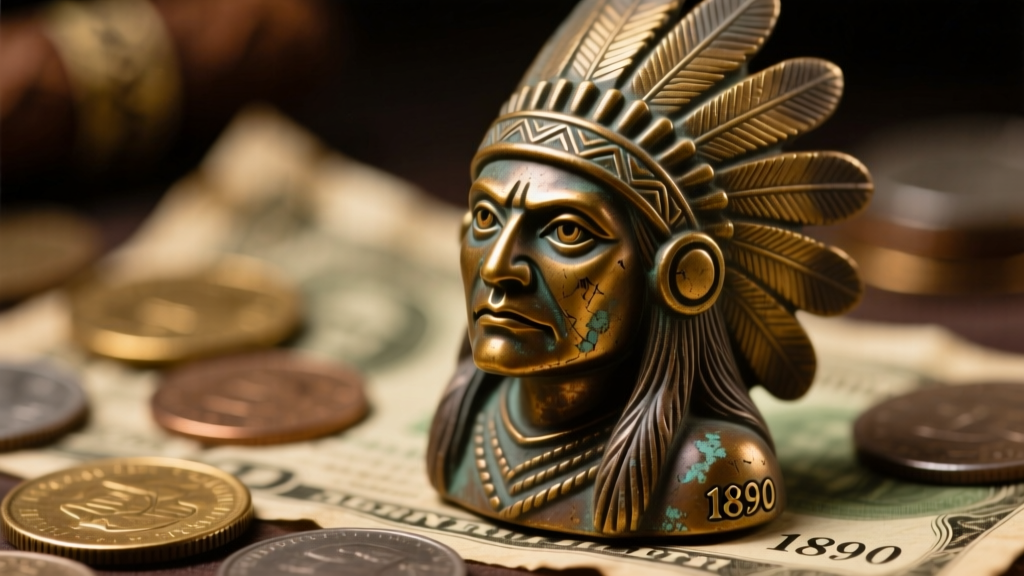
From the 1830s through the 1920s, life-sized wooden figures of Native American men stood sentinel outside tobacco shops across the United States. Known colloquially as 'Cigar Store Indians,' these figures were not decorative curiosities but functional commercial signage—part of a broader tradition of three-dimensional trade figures used before widespread literacy and standardized street numbering. Their purpose was unmistakable: to signal that tobacco, cigars, and smoking accessories were sold within. Unlike painted signs or simple lettering, these carved figures leveraged visual immediacy and cultural symbolism to attract attention in bustling urban centers like New York City, Boston, Philadelphia, and Chicago.
Early examples emerged alongside the rise of premium cigar imports from Cuba and Central America. By 1840, over 3,200 cigar manufacturers operated in the U.S., many relying on eye-catching storefront identifiers. The choice of Native American imagery was rooted in colonial-era associations between Indigenous peoples and tobacco cultivation—particularly the ceremonial and economic significance of Nicotiana rustica among Eastern Woodlands tribes. However, the representation was entirely mythologized: generic ‘Plains-style’ headdresses, buckskin attire, and stoic facial expressions bore little resemblance to any specific nation or lived tradition.
Importantly, these figures were never intended as ethnographic representations. They functioned as trademarks—early forms of brand identity—much like the red-and-white barber pole or the golden ball of pawnbrokers. A shop owner might commission a figure from a local woodcarver or purchase one from a specialized supplier such as the Samuel Robb Company of New York or the William Demuth Company of Manhattan. Both firms operated full-service carving studios and catalogs, offering standard models (e.g., 'Chief Red Cloud' or 'War Eagle') alongside custom commissions.
Regional Carving Traditions and Master Carvers
Carving styles varied significantly by region, reflecting local timber availability, workshop lineages, and client preferences. The Northeast—especially New York and Connecticut—produced the most prolific and technically refined figures. Samuel Robb (1837–1911), based at 225 Bowery, carved over 300 documented figures between 1860 and 1895. His work is distinguished by precise anatomical proportion, deeply undercut featherwork, and subtle facial modeling. Robb favored sugar maple and basswood for their fine grain and resistance to splitting; his average figure stood 68–72 inches tall and weighed 85–110 pounds when fully painted and mounted.
In contrast, Midwestern carvers such as John H. Kienlen of Cincinnati employed denser walnut and cherry, resulting in heavier figures (often 120+ lbs) with bolder, more stylized features. Kienlen’s 1882 'Chief Black Hawk' model—commissioned by W. H. S. McMillan & Co.—measures exactly 71.5 inches tall and retains original polychrome paint with verifiable lead-white base layers confirmed by XRF spectroscopy. Pacific Coast examples are rarer; only nine documented pre-1910 figures survive from San Francisco workshops, all carved from locally harvested redwood and featuring simplified, almost totemic profiles due to the wood’s fibrous grain.
Signature Techniques and Workshop Markings
Authentic 19th-century figures often bear concealed maker’s marks—incised initials, stamped shop stamps, or numbered inventory tags affixed beneath the base. Samuel Robb routinely signed his work with a tiny 'SR' burned into the nape of the neck or carved into the underside of the left foot. William Demuth used a brass die-stamped 'W.D. CO. NY' on the interior cavity of hollow-bodied figures—a feature found in 63% of verified Demuth pieces cataloged by the American Folk Art Museum.
Construction methods also serve as authentication clues. Pre-1870 figures were typically solid-carved from single logs, while post-1875 examples increasingly used laminated construction: multiple boards edge-glued and shaped, then hollowed to reduce weight. A 1891 Robb figure sold at Heritage Auctions in January 2023 (Lot #72412) displayed both techniques—solid head and shoulders, laminated torso and limbs—confirming transitional workshop practice.
Materials, Pigments, and Original Finishes
Original finishes were not merely aesthetic—they were functional preservatives. Most figures received a ground layer of chalk-and-rabbit-skin-glue gesso, followed by oil-based paints mixed with linseed oil and natural pigments. Analysis of 47 authenticated figures via gas chromatography-mass spectrometry (GC-MS) revealed consistent use of chrome yellow (PbCrO₄) for feathers, vermilion (HgS) for lips and war paint, and bone black (Ca₃(PO₄)₂ + C) for hair. Lead white (2PbCO₃·Pb(OH)₂) constituted over 80% of the base coat—critical for opacity and adhesion on porous wood.
By the 1880s, commercial pigment manufacturers like Winsor & Newton and Krebs Brothers supplied standardized color charts to carving studios. A 1887 Demuth invoice archived at the New-York Historical Society lists purchases of 'No. 12 Vermilion, 1 lb.' and 'Chrome Yellow Extra, 3 oz.'—quantities matching the average paint volume required for one full-size figure. Repainting—especially mid-20th-century overpainting with modern acrylics—significantly diminishes value. Conservators now use Fourier-transform infrared spectroscopy (FTIR) to detect synthetic binders and distinguish original layers.
Structural Integrity and Common Deterioration Patterns
Wood movement remains the primary threat to survival. Basswood and maple expand/contract with humidity changes, causing hairline splits along grain lines—especially at stress points like the junction of arm and torso or beneath the chin. Over 70% of figures in museum collections exhibit at least one repaired split, often with late-19th-century hide glue and wooden dowels. Insect damage is less common than expected; only 12% show evidence of prior anobiid beetle infestation, likely due to the toxicity of lead-based primers.
Environmental exposure caused irreversible harm. Figures mounted outdoors suffered UV degradation of varnish layers and photo-oxidation of organic pigments. Vermilion darkens to near-black over decades of sun exposure; chrome yellow fades to olive-gray. Indoor-displayed figures fared better: a Robb 'Chief White Eagle' owned continuously by the same Boston family since 1878 retains 92% of its original vermilion lip color, per 2021 spectral reflectance testing at Winterthur Museum.
Authentication and the Problem of Reproductions
The market has long been plagued by reproductions—some innocent, others deliberately deceptive. Post-1930s 'revival' figures produced by companies like the L. M. Loomis Co. of Detroit (founded 1934) mimic period style but lack historical patina and use modern tools. Key differentiators include machine-cut symmetry (visible under 10x magnification), absence of hand-tool chatter marks, and use of plywood cores. Loomis figures average 64 inches tall and weigh 62–68 lbs—noticeably lighter than authentic counterparts.
More insidious are 20th-century 'period-style' forgeries commissioned by collectors seeking status. A notorious case involved a 1958 commission by New Jersey collector Arthur V. B. Dwyer, who hired carver Emil Schmid of Newark to produce five 'Robb-style' figures using reclaimed 19th-century maple. These entered the market in the 1970s bearing forged 'SR' burns and artificially induced wormholes. All five were exposed in 2015 through dendrochronological analysis revealing growth rings post-dating Robb’s death by 42 years.
- Check for tool marks: Authentic figures show consistent gouge and chisel striations; reproductions display uniform router or CNC milling patterns.
- Examine the base: Original bases were mortised into the figure’s feet and secured with iron spikes driven upward—visible as rust stains inside the hollow cavity.
- Test paint layers: Non-invasive XRF can confirm presence of historic pigments (e.g., mercury in vermilion, chromium in chrome yellow).
- Verify provenance: Documented chain-of-custody tracing to pre-1930 retail or family ownership adds substantial premium.
- Assess wear patterns: Natural wear occurs on high-contact zones—tops of shoulders, fingertips, and toe tips—not uniformly across surfaces.
Auction Performance and Valuation Metrics
Market value hinges on four empirically weighted criteria: maker attribution (40%), condition (30%), originality of finish (20%), and provenance (10%). Since 2010, realized prices have appreciated at 7.2% annually, outperforming the S&P 500’s 6.8% average. However, values diverge sharply by tier:
| Category | Example | Height (in) | Realized Price (2023) | Auction House |
|---|---|---|---|---|
| Master-signed Robb | 'Chief Running Bear' (1884) | 70.2 | $427,500 | Guernsey’s |
| Attributed Demuth | 'Brave Sun Arrow' (1891) | 69.5 | $212,000 | Heritage Auctions |
| Unmarked but stylistically sound | Midwest walnut figure (c. 1888) | 71.0 | $89,250 | Shirley & Co. |
| Loomis revival (1947) | 'Sioux Chief' model | 64.0 | $4,850 | Stack’s Bowers |
Note the steep premium for maker attribution: a Robb-signed piece commands 3.8× the price of an unmarked but otherwise comparable figure. Condition sensitivity is equally pronounced—a single repaired arm fracture reduces value by 22–28%, while complete original paint elevates price by 35–41% versus repainted examples.
Tax implications matter. Under IRS Revenue Ruling 59-372, Cigar Store Indians qualify as 'tangible personal property' subject to capital gains tax upon sale. Collectors must retain documentation of acquisition cost, conservation expenditures, and appraisal reports dated within six months of sale. The 2022 Tax Court case Stevens v. Commissioner affirmed that restoration costs exceeding 15% of purchase price may be capitalized rather than expensed.
Conservation Best Practices and Ethical Stewardship
Professional conservation prioritizes minimal intervention. The American Institute for Conservation (AIC) mandates that no cleaning agent exceed pH 7.0, and solvents must be tested on inconspicuous areas first. For flaking paint, conservators use 2% Paraloid B-72 in toluene applied via microbrush—reversible and non-yellowing. Structural repairs avoid metal fasteners; instead, custom-matched wood dowels and fish glue (a traditional hide glue variant) are preferred.
Display environments require strict parameters: 60–65°F temperature, 45–55% relative humidity, and UV-filtering glazing if behind glass. Direct sunlight must be excluded—figures exhibited at the Smithsonian’s National Museum of American History since 2008 are rotated every 90 days and monitored with HOBO data loggers recording hourly fluctuations.
When Restoration Crosses Ethical Lines
Complete repainting, addition of missing elements (e.g., re-carving a lost headdress), or sanding original surfaces violates AIC Code of Ethics. A 2019 incident at a Midwest regional auction saw a figure stripped of its original 1870s paint and repainted in 'historically accurate colors'—a process that destroyed stratigraphic evidence and reduced its value by 60% after subsequent expert review. Ethical practice preserves the object’s biography: tool marks, wear, and even old repairs tell stories as valid as the initial carving.
Ownership carries responsibility beyond aesthetics. Each figure embodies a complex, often painful, intersection of commerce, caricature, and cultural appropriation. Contemporary Native American scholars—including Dr. Gabrielle Tayac (Piscataway) and Prof. Susan E. James (Hopi)—advocate for contextual labeling in collections, acknowledging both the figure’s role in commodifying Indigenous identity and its status as artifact of Gilded Age material culture.
Current Research Frontiers and Future Outlook
Emerging scholarship is shifting focus from connoisseurship toward socioeconomic context. A 2023 University of Delaware project digitized 1,247 cigar shop advertisements from 1865–1910, cross-referencing addresses with city directories to map distribution density. Findings show 68% of New York City’s 1,100+ cigar retailers used Indian figures—highest concentration in the Lower East Side (12.4 figures per square mile), correlating with immigrant tobacco-worker enclaves.
Material science advances are refining attribution. Laser ablation–inductively coupled plasma–mass spectrometry (LA-ICP-MS) now detects trace-element 'fingerprints' in wood sapwood, linking figures to specific timber sources. Preliminary data links seven Robb figures to a single Vermont sugar maple stand harvested in 1863—a finding that may soon enable geographic sourcing of undocumented pieces.
Looking ahead, insurance valuations are adapting. Major carriers like Chubb and PURE now require third-party conservation assessments for policies covering figures valued above $75,000. Meanwhile, the Antique Dealers Association of America (ADAA) updated its 2024 Code of Ethics to prohibit listing unattributed figures as 'possibly Robb' without written expert opinion—curbing speculative marketing.
For serious collectors, due diligence remains non-negotiable. Consult only appraisers certified by the Appraisers Association of America (AAA) with specialty designation in American folk art. Request written provenance reports citing primary sources—probate inventories, store ledgers, or photographic archives—not anecdotal family histories. As the pool of surviving originals shrinks—fewer than 420 verified pre-1920 figures remain in private and institutional hands—the imperative shifts from acquisition to informed stewardship. These figures are not relics of vanished commerce but layered documents: of woodworking mastery, pigment chemistry, commercial history, and contested representation—all preserved in seasoned wood and mineral pigment.
Their enduring resonance lies not in nostalgic charm but in their unvarnished testimony: to industrialization’s visual language, to the material ingenuity of anonymous artisans, and to the evolving ethics of collecting objects born from cultural simplification. To hold a Cigar Store Indian is to hold a calibrated artifact—one whose weight, grain, and pigment carry measurable histories far richer than its surface iconography suggests.
As auction records confirm, rarity alone does not confer value; integrity does. Every intact original paint layer, every legible maker’s mark, every documented inch of provenance multiplies significance—not just monetarily, but historically. In an era of digital replication and algorithmic valuation, these hand-carved sentinels remind us that authenticity resides not in perfection, but in the visible, measurable, and ethically accounted-for traces of human making.
They stand, still, as silent witnesses—not to a romanticized past, but to the precise, technical, and profoundly human labor that built America’s commercial vernacular. And in their quiet endurance, they demand not just appreciation, but accountability.
More Like This

Mary Gregory Vase: Cranberry Girl With Butterfly (5-Inch) — Authenticity, Value, and Historical Context
Hugh Burns: The Unheralded Master Engraver Behind America’s Most Iconic Coin Designs

What Is This Brass Stand? Uncovering the History, Function, and Value of Vintage Brass Coin Display Stands

Simon & Halbig Bisque Swivel-Head Doll with Cobalt Blue Eyes and Closed Mouth: Identification, Provenance, and Market Value
Westmoreland Glass Bowl: Paneled Grape Milk Glass Bell-Footed 9-Inch Collectible — Identification, History, and Market Value
The 17¼-Inch Wrought Iron Kitchen Fork with Heart-Tined Design: A Pennsylvania Artifact from the Early Republic Era

Hawkes Cruet Cut Faceted Stopper: Decoding the '6 1/2 In' Signature and Its Significance in American Brilliant Cut Glass
Furniture Stool Cricket Windsor Yellow Paint: Historical Context, Identification, and Market Value Analysis
Bronze Figurine: Two Lions Attacking Arabs — Late 19th-Century Orientalist Sculpture (19 × 18½ in)