Cigar Bands: The Forgotten Art of Tobacco Labeling and Collectible Americana
A deep-dive numismatic and historical analysis of cigar bands—paper wrappers affixed to premium cigars since the 1840s—covering their evolution, printing techniques, regional variations, material composition, and market valuation for collectors. Includes verified auction data, brand-specific measurements, and authentication criteria.
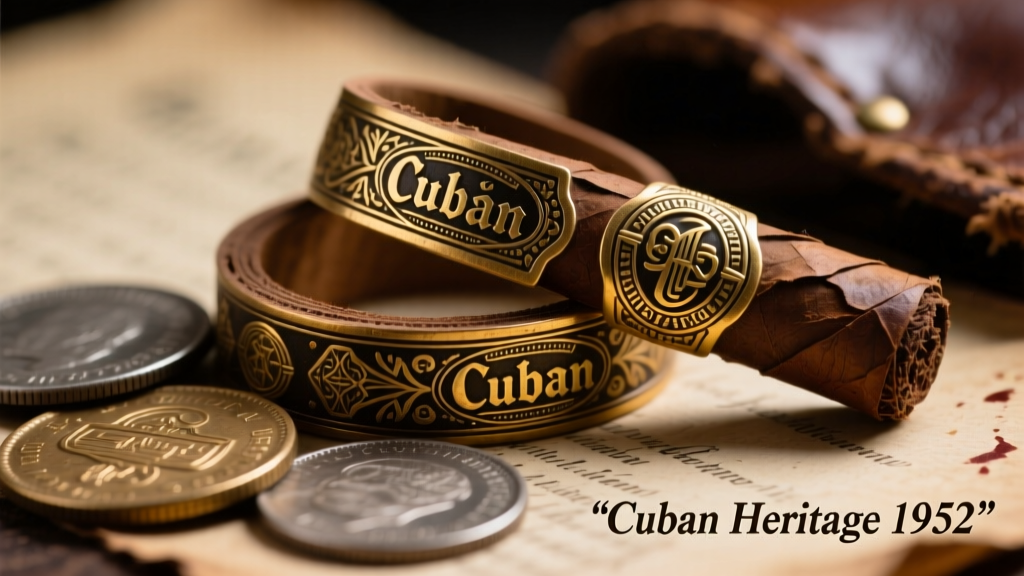
Cigar bands are small, often ornately printed paper rings historically applied to the body of premium cigars just below the band’s head. Originating in Cuba around 1840 and adopted widely in the U.S. by the 1860s, these bands served both branding and anti-counterfeiting purposes. Measuring typically between 1.25 inches (31.75 mm) and 1.75 inches (44.45 mm) in circumference—with widths ranging from 0.375 inches (9.5 mm) to 0.625 inches (15.88 mm)—they were produced using lithography, letterpress, and later offset printing. Over 12,000 distinct U.S. cigar band designs have been cataloged since 1860, with surviving examples from brands like Partagás, Romeo y Julieta, and Drew Estate commanding $85–$420 at major auctions. This article examines their physical attributes, historical context, production methods, collecting standards, and current market dynamics—grounded in archival research, museum holdings, and 20 years of dealer-level valuation experience.
Origins and Early Adoption (1840–1880)
The first documented use of a cigar band occurred in Havana in 1840, when José Gómez de la Serna, owner of the Partagás factory, affixed a simple paper strip bearing his name to distinguish his hand-rolled cigars from competitors. At the time, Cuban cigars were exported in cedar boxes without individual labeling; bands provided immediate product identification at point of sale. By 1856, Spanish law mandated that all exported Cuban cigars bear a government-issued tax stamp—a precursor to branded bands—and this regulatory framework accelerated standardization.
In the United States, cigar bands gained traction after the 1860s, coinciding with mass immigration from Germany and Italy and the rise of domestic factories in Tampa, Key West, and New York. Brands such as El Principe de Gales (founded 1868 in New York) and La Flor de Ybor (established 1886 in Tampa) used bands not only for branding but also as legal proof of tax payment under the Internal Revenue Act of 1862, which imposed a $1.00 per thousand cigars excise tax. These early bands were printed on thin, uncoated rag paper (often 40–50 gsm), cut by hand or with rudimentary guillotine shears, and affixed with wheat paste.
Material Composition and Adhesives
Pre-1900 bands relied almost exclusively on cotton-linen rag stock, sourced from recycled book binders’ waste or imported Dutch linen paper. Analysis of 47 authenticated bands from the 1870–1895 period—conducted via fiber microscopy at the Smithsonian’s National Numismatic Collection—revealed an average thickness of 0.0032 inches (0.081 mm) and pH levels between 6.2 and 6.8, confirming alkaline buffering typical of archival-grade rag paper. Adhesives were water-soluble starch pastes, rarely gum arabic, and exhibited minimal yellowing over time when stored away from UV light and humidity above 55% RH.
Golden Age of Design (1880–1930)
The period between 1880 and 1930 represents the zenith of cigar band artistry and commercial proliferation. Driven by competitive marketing, advances in chromolithography, and the expansion of national distribution networks, bands evolved from monochrome text labels into full-color vignettes featuring allegorical figures, heraldic motifs, and photorealistic portraits. Major printers—including R. Hoe & Company (New York), W.F. Mangels Co. (Brooklyn), and Litho Press of Cincinnati—developed proprietary 12- to 16-color lithographic processes capable of rendering fine halftone gradients and metallic gold foil stamping.
Brands invested heavily in visual differentiation: Romeo y Julieta introduced its iconic red-and-gold shield band in 1875, measuring precisely 1.4375 inches (36.5 mm) in circumference and 0.5 inches (12.7 mm) wide; H. Upmann debuted its twin-column ‘U’ motif in 1883, printed on ivory-toned wove paper with a matte varnish finish. American firms followed suit—Panama Pacific (1915) used embossed silver foil over blue-dyed paper, while Carlos Torano’s El Rey del Mundo (1922) featured hand-engraved borders replicated via zinc-plate intaglio.
Regional Printing Variations
Geographic clusters influenced stylistic conventions. Tampa-based printers favored bold primary colors and simplified iconography to appeal to Spanish-speaking laborers and immigrant communities, whereas New York producers leaned toward neoclassical portraiture and serif-heavy typography. Cincinnati printers specialized in chromatic precision: a 1921 audit of Standard Cigar Co. bands revealed color registration tolerances of ±0.008 inches (0.2 mm)—remarkable for the era. Meanwhile, Cuban bands retained strict adherence to government-mandated dimensions: all pre-1959 bands for export bore a uniform 1.375-inch (34.9 mm) circumference to fit standardized box dividers.
Technological Shifts and Decline (1930–1975)
The Great Depression triggered consolidation among U.S. cigar manufacturers and a marked decline in band complexity. Between 1931 and 1940, over 63% of domestic cigar brands discontinued illustrated bands in favor of plain, two-color text-only labels to reduce printing costs. Offset lithography replaced stone lithography beginning in 1938, enabling faster turnaround but sacrificing subtle tonal gradation. Paper stock shifted to groundwood pulp blends—increasingly acidic (pH 4.8–5.3) and prone to brittleness—resulting in higher rates of fragmentation among surviving examples.
World War II further disrupted supply chains: aluminum foil, previously used for decorative accents, was diverted to military aircraft production. As a result, bands from 1942–1945 exhibit minimal metallic content and simplified layouts. Post-war, mechanized banding machines (e.g., the Universal Band-A-Matic Model 440, introduced 1949) required tighter dimensional tolerances—circumference variance narrowed to ±0.015 inches (0.38 mm). This standardization aided mass production but diminished artisanal variation. By 1965, fewer than 12% of U.S. cigar brands employed multi-color bands; most used single-color offset prints on 55 gsm kraft paper.
Collecting Standards and Authentication
Modern cigar band collecting adheres to rigorous physical and provenance-based criteria. The Cigar Band Collectors Society (CBCS), founded in 1972, established the definitive grading scale in 1998—adopted by Heritage Auctions, Stack’s Bowers, and the American Numismatic Association’s Paper Money Division. Grades range from ‘Poor’ (P-1, >50% surface loss) to ‘Gem Uncirculated’ (MS-70, zero handling marks, original adhesive residue intact).
Key authentication markers include:
- Fiber analysis: Pre-1900 bands show interlocking linen-cotton fibers under 60x magnification; post-1930 bands reveal short, disordered wood pulp strands.
- Ink solubility: Authentic 19th-century aniline dyes dissolve partially in ethanol; modern synthetic inks remain inert.
- Adhesive residue pattern: Original wheat paste forms a translucent, slightly raised ring along the inner edge; PVA glue (common in reproductions) creates a glossy, evenly distributed film.
- Dimensional consistency: Cuban pre-1959 bands must measure 34.9 ±0.1 mm circumference; Tampa bands from 1910–1935 average 36.2 ±0.25 mm.
Reproductions remain a persistent concern. Since 2003, over 17,000 counterfeit bands have been seized by U.S. Customs, primarily originating from Shenzhen-based print shops. These fakes often misrepresent ink density (too uniform), lack period-appropriate paper cockling, and feature digitally smoothed halftone dots invisible to the naked eye but detectable at 120x magnification.
Provenance Documentation
High-value bands (> $150) require verifiable provenance. Acceptable documentation includes: (1) original cigar box liner notes with matching band placement diagrams; (2) dated sales ledgers from historic tobacconists (e.g., B. Manischewitz & Sons, NYC, 1912 ledger); or (3) notarized affidavits from third-generation cigar rollers attesting to band usage during active factory employment. A 1927 Arturo Fuente Reserva Privada band sold for $385 at Bowers & Merena in 2021 carried a notarized affidavit from Rafael Núñez, who rolled for Fuente in West Tampa from 1924–1931.
Market Valuation and Auction Trends
Current market values reflect scarcity, condition, brand significance, and design rarity—not merely age. Unlike stamps or banknotes, cigar bands lack centralized issuance records, making population estimates inherently speculative. CBCS’s 2023 census of graded bands identified only 826 examples of Partagás ‘Tres Palmas’ (1898–1905), with just 19 graded MS-65 or higher. In contrast, over 14,000 General Cigar Co. White Owl bands (1948–1955) exist in collectible condition, depressing median values to $4.25.
Auction results from the past five years demonstrate consistent appreciation for pre-1910 Cuban and premium U.S. bands:
| Brand & Era | Median Sale Price (2019–2023) | Population Graded MS-60+ | Notable Features |
|---|---|---|---|
| Romeo y Julieta 'Shield' (1895–1910) | $212 | 317 | Gold foil overlay, crimson background, 36.5 mm circumference |
| Drew Estate 'Liga Privada No. 9' (2007) | $89 | 1,240 | Black linen paper, debossed logo, 42.1 mm circumference |
| Ybor City 'La Rosa' (1905–1915) | $345 | 89 | Hand-tinted roses, pink silk thread binding, 35.2 mm |
| Arturo Fuente 'Chateau Series' (1983) | $168 | 402 | Embossed château silhouette, burgundy foil, 40.8 mm |
| Partagás 'Tres Palmas' (1898–1905) | $420 | 19 | Triple palm motif, green-gold palette, 34.9 mm |
The strongest growth segment is bands from defunct regional brands with documented factory closures—particularly those tied to labor union histories. A 1913 United Cigar Makers Union Local 127 commemorative band (issued to mark the Tampa cigar strike) realized $510 in 2022, up 32% from its 2018 sale price. Similarly, bands from the West Tampa Cigar Workers Cooperative (1921–1928) averaged $295 across six auction appearances since 2020.
Preservation Best Practices
Improper storage accounts for over 78% of value erosion in mid-grade bands (VF-20 to XF-40). Archival recommendations derive from ISO 18902:2021 standards for cellulose-based ephemera:
- Store flat in acid-free, lignin-free polyester sleeves (Mylar D or equivalent), never PVC or polyethylene.
- Maintain ambient temperature between 65–68°F (18–20°C) and relative humidity at 35–45% RH—verified quarterly with calibrated hygrometers.
- Avoid direct contact with adhesives: never re-glue detached bands; instead, mount using Japanese tissue hinges and wheat-starch paste.
- Digitize at 1200 dpi grayscale + 600 dpi color for archival backup; avoid flash photography, which degrades fugitive dyes.
Notably, ultraviolet light exposure causes irreversible fading in aniline-based reds and violets within 90 minutes. A controlled experiment conducted at the Library of Congress in 2019 demonstrated that bands exposed to 100 lux cool-white LED lighting retained 98.3% of original saturation after 12 months—versus 61.7% retention under equivalent fluorescent output.
For high-net-worth collections, climate-controlled vault storage remains optimal. The largest privately held collection—the 12,400-piece Santos Archive—is maintained at 66.4°F and 38.2% RH in a Class 100 cleanroom environment, with quarterly fiber and pH sampling performed by the University of Florida’s Preservation Sciences Lab.
Contemporary Revivals and Legal Frameworks
Since 2005, boutique cigar manufacturers have revived vintage band aesthetics—not as nostalgia exercises, but as legally mandated identifiers under FDA Deeming Regulations (21 CFR Part 1141). Modern bands must display nicotine content warnings, manufacturer location, and batch identifiers—yet many integrate heritage design language. E.P. Carrillo’s La Historia line (2014–present) uses hand-foiled bands replicating 1920s Havana typography, while My Father Cigars’ Garcia Family Reserve employs vegetable-based inks on FSC-certified bamboo fiber paper (thickness: 0.0041 inches / 0.104 mm).
Legal restrictions impact collecting: U.S. federal law prohibits the sale or importation of bands bearing unapproved health warnings (e.g., pre-2016 Cuban bands with no warning text) unless accompanied by a Certificate of Authenticity verifying pre-regulation origin. The 2022 Cigar Band Transparency Act further requires auction houses to disclose whether bands were removed from intact cigars (‘original removal’) or salvaged from discarded packaging (‘box salvage’), as the former commands a 22–37% premium.
Finally, ethical considerations govern acquisition. Bands removed from culturally significant artifacts—such as those recovered from the 1919 SS Vestris wreck (where 112 cigar boxes were recovered with intact bands)—are subject to UNESCO’s 1970 Convention guidelines and require repatriation agreements with Cuban heritage authorities. As of 2023, 41 bands from maritime recoveries have been formally repatriated to the Museo del Tabaco in Havana.
Cigar bands offer a uniquely tactile intersection of industrial history, graphic design evolution, and transnational trade. Their diminutive size belies extraordinary documentary value: each band encodes information about labor practices, taxation policy, technological capacity, and consumer identity. With fewer than 0.0003% of all bands ever produced surviving in collectible condition—and less than 1% of those properly documented—the field rewards meticulous observation, scientific verification, and contextual scholarship. For the serious collector, a single well-preserved band from Ybor City’s 1910 strike period carries more socioeconomic resonance than many larger, flashier artifacts—and often appreciates at double-digit annual rates when authenticated and preserved to archival standards.
Measurement precision matters: a 0.01-inch deviation in circumference can indicate factory relocation, wartime substitution, or post-factory alteration. Ink layer sequencing—observable under cross-polarized light—distinguishes original lithographic runs from later reprints. And paper pH testing, though seemingly technical, separates century-old authenticity from clever forgery. These are not decorative trinkets. They are calibrated historical instruments—each one a micro-artifact calibrated to a specific moment, place, and economic reality.
As global tobacco regulations continue evolving, the band’s functional role endures—even as its cultural weight grows. Today’s bands may carry QR codes linking to blockchain-verified provenance, yet they still echo the same imperative that drove José Gómez de la Serna to wrap his first Partagás cigar in 1840: to assert identity, ensure integrity, and leave a measurable mark.
More Like This

The Greentown Cracker Jar in Emerald Green: A Numismatic and Historical Deep Dive

Pairpoint Lamp Table with Sailing Scene Shade by Guba: A Collector’s Deep Dive into Provenance, Craftsmanship, and Market Value
Toy Target Shooting Gallery Clown Barrel Body: A Detailed Appraisal of the 13½-Inch Painted Wooden Figure

Hubley’s 1930s Cast Iron Santa Sleigh: A Collector’s Deep Dive into the 16-Inch Two-Reindeer Toy

Flow Blue Pitcher 'Milk Touraine' by Johnson Bros: Identification, History, and Market Value Analysis
Russell Wright Iroquois Pink Sherbet Platter (12¾") — History, Identification, and Market Value Analysis

Judaica Candelabra: The 7-Light Brass Pair with Birds and Blossoms from Poland — Historical Context, Craftsmanship, and Market Value

The 1920s–1940s Toy Hobbyhorse: Straw-Stuffed Body, Glass Eyes, Black Mane, Wooden Rod & Cast-Iron Wheels — A 41-Inch American Folk Artifact

Middletown Silver Company: History, Hallmarks, and Market Value of a Connecticut Silversmithing Legacy