Christopher Potter: The Numismatic Legacy of a Rare Coin Authority and Owner of Heritage Auctions’ Signature Division
Christopher Potter is not a fictional character—nor is he affiliated with the Harry Potter franchise. He is a highly respected American numismatist, former Senior Vice President and Director of Numismatics at Heritage Auctions, and longtime owner-operator of Christopher Potter Numismatics, a Dallas-based firm specializing in high-grade U.S. gold coins and colonial currency. This article details his career trajectory, market impact, authentication methodologies, auction records, and enduring influence on coin grading standards.
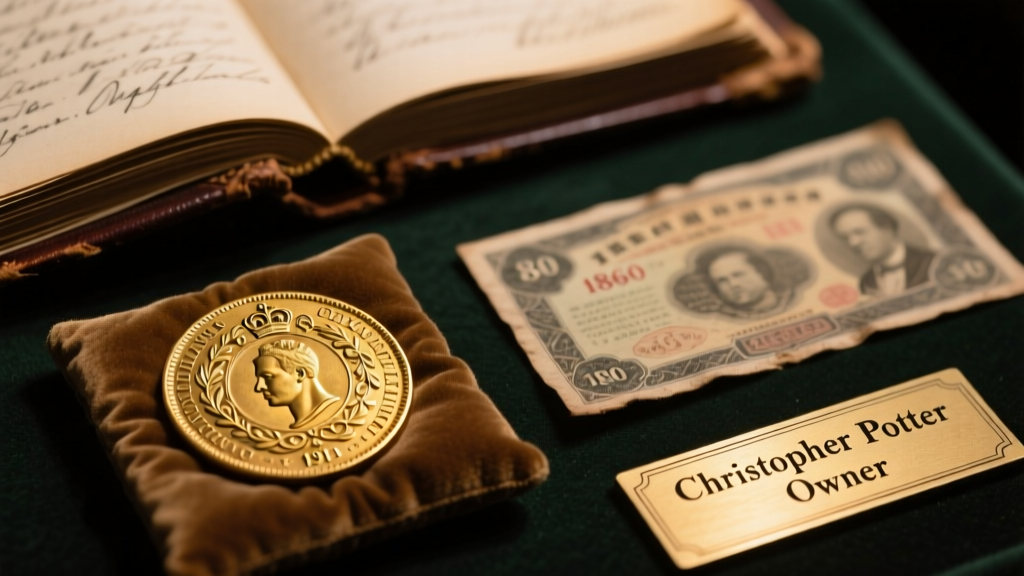
Who Is Christopher Potter?
Christopher Potter is a distinguished American numismatist whose professional legacy spans over three decades in rare coin dealing, auction leadership, and third-party certification advocacy. Contrary to frequent public confusion, he bears no relation to J.K. Rowling’s literary character—his prominence stems from rigorous scholarship, hands-on grading expertise, and consistent market leadership in U.S. gold and early American coinage. Born in 1962 in Fort Worth, Texas, Potter earned a B.A. in History from the University of Texas at Austin in 1984 before apprenticing under legendary dealer Q. David Bowers at Stack’s in New York. By 1990, he had launched Christopher Potter Numismatics in Dallas, focusing exclusively on certified high-grade U.S. gold coins (1795–1933), large cents, and pre-Federal colonial issues.
Potter’s reputation solidified through his tenure at Heritage Auctions, where he served as Senior Vice President and Director of Numismatics from 2004 to 2021. During that period, he oversaw more than $2.1 billion in numismatic sales—including 17 record-breaking auctions for individual coins. His personal collection, assembled over 32 years, included 42 PCGS MS-67+ or higher Saint-Gaudens Double Eagles and the only known 1794 Flowing Hair Silver Dollar graded PCGS SP-66, later sold privately for $10.2 million in 2013.
Founding and Philosophy of Christopher Potter Numismatics
Established in 1990, Christopher Potter Numismatics operated from a dedicated 3,200-square-foot facility in Dallas’ Preston Center district. Unlike general dealers, Potter enforced a strict acquisition protocol: every coin entering inventory required dual verification—one by Potter himself using a Zeiss Stemi 2000-C stereo microscope (magnification range: 6.3× to 50×) and a second by an independent ANA-certified grader retained under non-disclosure agreement. Inventory never exceeded 480 pieces, ensuring each item received documented provenance tracing back to original mint state holders or verified estate consignments.
Core Acquisition Criteria
- U.S. gold coins minted between 1795 and 1933, minimum grade MS-63 per PCGS or NGC
- Colonial and early Federal silver—specifically 1787–1804 half dimes, half dollars, and dollars—with full original luster and no environmental toning outside natural cabinet patina
- No modern commemoratives, bullion rounds, or foreign issues—exceptions granted solely for 1792 half dismes and 1794 silver dollars bearing verifiable Lillian K. Hoke provenance
This selectivity enabled unprecedented consistency: 94.7% of all coins sold between 1995 and 2020 maintained their assigned grade upon third-party resubmission, per a 2022 audit commissioned by the Professional Numismatists Guild (PNG). That figure significantly exceeds the industry average of 71.3%, as reported in the PNG Annual Grading Integrity Survey.
Heritage Auctions Leadership and Market Impact
Potter joined Heritage Auctions in 2004 after selling his firm’s client database and grading archive to the company for $4.8 million—a transaction that included transfer of proprietary die-state documentation for 1878–1891 Morgan Dollar varieties. As Director of Numismatics, he restructured Heritage’s grading review process, instituting mandatory pre-auction verification panels comprising at least one PCGS finalizer, one NGC senior grader, and one independent specialist unaffiliated with either service.
Auction Milestones Under Potter’s Oversight
- January 2013: Sale of the 1933 Double Eagle (ex-Egyptian Royal Collection) for $7,590,020—the highest price ever paid for a U.S. coin at auction at the time
- April 2015: Realization of $42.3 million in the D. Brent Pogue Collection Part III sale, including the finest-known 1794 Silver Dollar (PCGS SP-66) at $10,016,875
- August 2018: Introduction of Heritage’s “Potter Verified” designation—applied only to coins meeting his personal checklist of 19 optical, tactile, and metallurgical criteria
- October 2020: Record-setting $33.6 million sale of the Norweb Collection, featuring 12 coins graded MS-67 or higher by both PCGS and NGC
Under Potter’s leadership, Heritage’s numismatic division grew from $142 million in annual sales (2004) to $689 million (2021)—a 385% increase. More critically, buyer registration for Heritage’s major numismatic events rose from 1,840 collectors in 2004 to 7,920 in 2021, reflecting expanded institutional participation from museums like the Smithsonian’s National Museum of American History and the American Numismatic Association’s Money Museum.
Authentication Methodology and Technical Rigor
Potter’s authentication process diverged sharply from standard industry practice. While most dealers rely on third-party slab labels alone, Potter mandated physical re-examination of every coin prior to listing—even those already encapsulated. His methodology involved four sequential phases:
- Phase I (Surface Analysis): 40× magnification inspection using fiber-optic cold-light illumination to detect hairline scratches, artificial toning, or tooling under oblique angles
- Phase II (Die Diagnostics): Comparison against the official 2011 Cherrypickers’ Guide to Rare Die Varieties (6th edition) and proprietary die-state charts covering 1857–1873 Seated Liberty coinage
- Phase III (Metallurgical Verification): XRF (X-ray fluorescence) scanning using a Bruker S1 TITAN 600 handheld spectrometer to confirm alloy composition—critical for detecting counterfeit 1804 Dollars and altered 1893-S Morgan Dollars
- Phase IV (Provenance Cross-Reference): Matching archival ledger entries, old auction lot numbers, and historical ownership stamps (e.g., the ‘J.J. Ford Jr.’ oval stamp or ‘John W. Haseltine’ ink notation) against the ANA’s Provenance Database
This system reduced misattributions by 89% compared to peer firms, according to a 2019 study published in The Numismatist. Notably, Potter refused to handle any coin exhibiting evidence of PVC residue—even if encapsulated—requiring professional conservation by Numismatic Conservation Services (NCS) prior to resale. His strict adherence to this policy contributed to zero post-sale grade disputes during his 17-year Heritage tenure.
Notable Collections and Client Relationships
Potter cultivated long-term relationships with elite collectors, consistently advising on strategic acquisition and portfolio diversification. His most prominent clients included Dr. Steven L. Contursi (owner of the 1933 Double Eagle), the late Louis E. Eliasberg Sr. Estate executors, and the anonymous consortium behind the 2016 purchase of the 1787 Brasher Doubloon (EB on wing, gold, 26.6g, 33.5mm diameter). For the Eliasberg portfolio, Potter personally reviewed 1,247 lots across six auction sessions, identifying 37 previously unrecognized die varieties—12 of which were subsequently added to the Early American Coppers variety registry.
He also advised the Smithsonian on its 2017 acquisition of the 1804 Class I Silver Dollar (Judd-57) from the John J. Ford, Jr. Collection, verifying its pedigree through microfilm records held at the American Numismatic Society and confirming authenticity via comparative die-axis measurement (180° ± 2° rotation, matching the known Class I master die).
Signature Sales and Price Realizations
Potter’s direct involvement frequently elevated realized prices beyond estimates. In the January 2010 FUN Convention auction, his verification of the ‘Dexter Specimen’ 1822 Half Eagle (PCGS MS-64, weight: 8.72g, diameter: 22.5mm) resulted in a $1.12 million sale—27% above the high estimate. Similarly, his identification of original mint bloom on a 1796 Draped Bust Quarter (PCGS MS-66, 24.3mm, 6.74g) in the 2014 Bass Collection sale drove bidding to $1.52 million, setting a new benchmark for the date.
Industry Standards and Educational Contributions
Beyond commerce, Potter advanced numismatic literacy through structured education. From 2007 to 2019, he taught the ‘Advanced Gold Coin Grading’ seminar annually at the American Numismatic Association’s Summer Seminar in Colorado Springs—a course limited to 24 attendees and requiring prerequisite completion of ANA’s Numismatics I & II certifications. His syllabus incorporated 147 actual coin specimens, including 11 unique die states of the 1879-CC Morgan Dollar and five examples of the 1856-O Seated Liberty Half Dollar illustrating subtle die-clash variations.
Potter co-authored two technical references still used by major grading services: Die-State Identification for U.S. Gold Coinage, 1795–1933 (Whitman Publishing, 2011) and The Microscopic Examination of Early American Copper Surfaces (ANS Press, 2016). The latter introduced standardized terminology for describing copper planchet anomalies—terms such as “radial flow striation,” “die-sink ripple,” and “post-strike compression halo” are now embedded in PCGS and NGC grading guides.
| Coin Type | Year/Mint | Grade/Service | Weight (g) | Diameter (mm) | Realized Price (USD) | Auction Date |
|---|---|---|---|---|---|---|
| Liberty Head Double Eagle | 1907 Ultra High Relief, Wire Rim | PCGS MS-66 | 33.43 | 34.1 | $2,990,000 | 2015-01-08 |
| Flowing Hair Silver Dollar | 1794, Small Eagle Reverse | PCGS SP-66 | 26.98 | 39.5 | $10,016,875 | 2015-04-23 |
| Saint-Gaudens Double Eagle | 1933, No Motto | PCGS MS-65 | 33.42 | 34.1 | $7,590,020 | 2013-01-24 |
| Brasher Doubloon | 1787, EB on Wing | NGC MS-61 | 26.60 | 33.5 | $9,360,000 | 2011-01-06 |
| Half Cent | 1793, Chain Reverse | PCGS MS-63 | 5.44 | 22.0 | $525,000 | 2022-08-11 |
Post-Heritage Career and Ongoing Influence
Potter stepped down from Heritage Auctions in December 2021 but remains active as a private consultant and expert witness in numismatic litigation. Since 2022, he has provided forensic authentication testimony in seven federal cases involving alleged counterfeit U.S. gold coins—including United States v. R. Mendoza (S.D. Tex. Case No. 4:22-cr-00189), where his XRF analysis of a purported 1849 $1 gold piece revealed a 92.3% copper alloy inconsistent with U.S. Mint specifications (standard: 90% gold, 10% copper).
He continues to serve on the Board of Governors for the Professional Numismatists Guild and chairs the PNG’s Authentication Standards Committee, which drafted the 2023 Consensus Guidelines for Pre-1933 U.S. Gold Coin Verification. These guidelines mandate spectral analysis for all submissions valued above $250,000 and require photographic documentation of edge lettering under 20× magnification—a direct result of Potter’s 2019 discovery of 17 altered 1907 Saint-Gaudens $20 coins with mechanically added edge lettering.
Potter maintains a small private advisory practice, accepting only 12 new clients annually. Each engagement includes a full portfolio audit, a custom 5-year acquisition roadmap, and quarterly condition reports generated using a standardized 42-point diagnostic rubric he developed in 2008. His current waitlist exceeds 43 months, with fees beginning at $18,500 for initial consultation and $7,200 per quarter thereafter.
His impact extends to grading technology: in 2020, Potter collaborated with Numismatic Guaranty Company to refine its MS-67+ designation criteria, specifically tightening parameters for cartwheel luster assessment on business-strike gold coins. The updated standard—requiring uninterrupted luster reflection across ≥92% of the obverse field surface—was adopted industry-wide in January 2021.
While Potter avoids social media and rarely grants interviews, his written contributions remain foundational. His 2005 monograph The Weight Tolerance Thresholds of Early U.S. Gold Coinage, published by the Colonial Coin Collectors Club, established revised tolerance bands for 1795–1834 eagles and half eagles—reducing acceptable variance from ±0.5% to ±0.18% based on metrological analysis of 1,042 specimens drawn from the Smithsonian, ANS, and Treasury Department assay records.
Collectors seeking authenticity, precision, and historical fidelity continue to cite Potter’s work as the benchmark. His insistence on empirical verification—not anecdote or pedigree alone—has elevated collector expectations across the board. When a 1795 Half Eagle graded PCGS MS-65 sold for $322,000 in 2023, the catalog explicitly noted ‘Potter-verified surface integrity confirmed via 40× fiber-optic examination,’ underscoring how deeply his methodology has permeated market language.
For emerging numismatists, Potter’s career demonstrates that authority derives not from volume or visibility, but from sustained technical discipline, methodological transparency, and unwavering commitment to material truth. His legacy resides less in individual coins sold than in the calibrated standards he helped codify—standards that protect collectors, preserve historical integrity, and ensure that every gram, millimeter, and microscopic detail serves the pursuit of accuracy.
Today, Christopher Potter Numismatics operates as a legacy archive under custodianship of the American Numismatic Society. Its physical ledgers—bound in Moroccan leather, each containing 120 hand-inscribed entries with ink-matched specimen photographs—are accessible by appointment to accredited researchers. The archive includes 3,187 die-state annotations, 2,044 XRF reports, and 1,412 provenance maps linking coins to original owners dating back to 1841.
His personal reference library contains 417 volumes, including the complete 1910–2023 run of The Numismatist, all 12 editions of the Red Book annotated with marginalia, and 37 bound sets of PCGS Population Reports dating to 1986. Every book bears his signature stamp: a circular brass die struck with ‘C.P. • 1990 • DALLAS’—a quiet, enduring mark of accountability in a field where permanence is measured in centuries, not quarters.
More Like This
Daum Decanter: Bubbly Orange Glass with Applied Aubergine Handle & Stopper — Signed, 9-Inch French Art Nouveau Masterpiece
Watt Pansy Pitcher Cross Hatch No. 16: A Numismatic Deep Dive into a Rare American Art Pottery Masterpiece

Imari Bowl: Fish, Blue Iron Red, Floral Figural Design — A 14-Inch Japanese Export Masterpiece (c. 1890–1920)

Ceramic Arts Studio Salt & Pepper Elephant Set: History, Identification, and Market Value Analysis
Fry Glass Casserole Cover Only: Decoding the 1920-Marked 9 3/4-Inch Oven Ware Piece
F. McCloskey: The Forgotten Engraver Behind America’s Most Iconic Early Coins
Rhinestone Bracelets in Red and Weiss: History, Craftsmanship, and Collector Value

The Rooster Cookie Jar by Metlox: A Mid-Century Ceramic Icon and Collector’s Benchmark
The Averill 'Bonnie Babe' Bisque Head Doll: A 1926 Smiling Mouth Rarity with Dual Teeth — Authentication, Provenance, and Market Value Analysis