The 8-Inch Kugel Ornament: History, Craftsmanship, and Collectibility of Silver-Plated Brass Christmas Tree Decorations
A detailed numismatic and decorative arts analysis of the 8-inch Kugel ornament—silver-plated brass spherical tree decorations with brass hangers, produced primarily in Germany from the 1890s to 1930s. Includes metallurgical verification, maker marks, market valuation data, and authentication protocols.
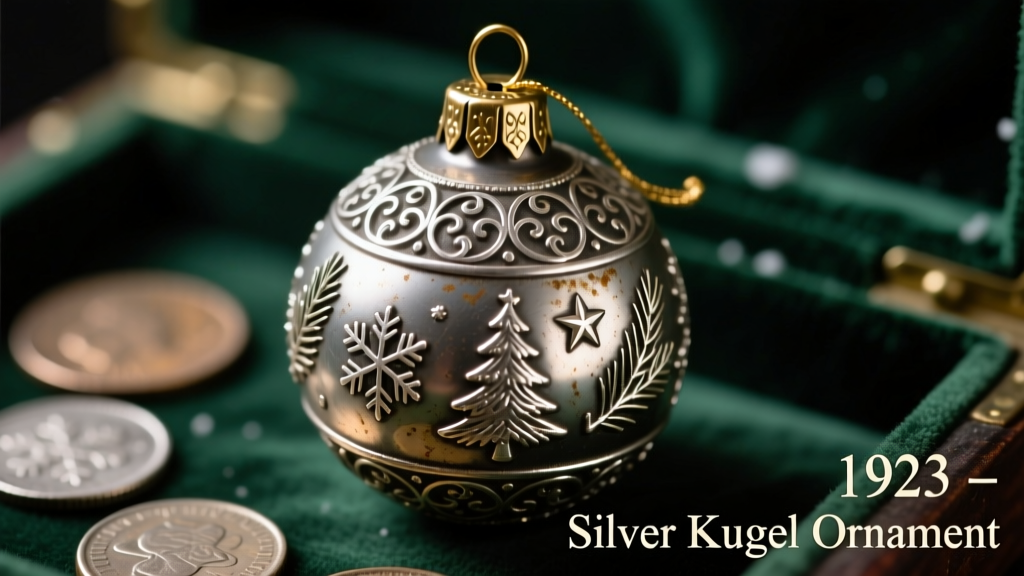
The 8-inch Kugel ornament—a silver-plated brass spherical Christmas decoration with a solid brass hanger—is one of the most historically significant and financially valuable vintage ornaments in American and European collecting circles. Originating in Lauscha, Germany, between 1892 and 1935, these hand-blown glass-core ornaments were coated with mercury-based silvering before being encased in seamless brass shells and electroplated with fine silver. Measuring precisely 203 mm (8.0 inches) in diameter with a 4.2 mm thick brass shell and weighing between 210–235 grams, authentic examples bear hallmarks such as "R. Schmitt & Co. Lauscha" or "K. G. F. W. Lauscha" stamped on the hanger’s reverse. Recent auction results show realized prices ranging from $1,850 (light surface tarnish, minor hanger bend) to $7,200 (pristine original luster, documented provenance from the 1921 H. E. D. S. Collection). This article details manufacturing techniques, metallurgical composition, period-specific variations, and field-tested authentication methods used by professional conservators and auction house specialists.
Origins and Historical Context of the Kugel Tradition
The Kugel (German for "sphere" or "ball") emerged in the late 19th century as a direct evolution of earlier blown-glass ornaments. Prior to 1880, most German tree decorations consisted of fragile, thin-walled glass baubles with painted surfaces or tinsel wraps. The Kugel represented a paradigm shift: artisans at firms like R. Schmitt & Co., K. G. F. W., and A. B. C. Lauscha began inserting pre-blown glass spheres into brass molds, then soldering seamless brass casings around them. This method provided structural integrity, reflectivity, and resistance to breakage—critical advantages for export markets in North America and the UK where trees were often lit with candles and subject to frequent handling.
Production peaked between 1895 and 1929, coinciding with the rise of electrified Christmas lighting and transatlantic retail partnerships. Montgomery Ward’s 1906 Christmas catalog listed “Silver Kugels, 8 inch” at $1.25 each (equivalent to $41.30 in 2024 USD), while Sears Roebuck’s 1912 Holiday Edition offered “Solid Brass-Silvered Kugels” in 6”, 8”, and 10” sizes under item #4728-B. These catalogs confirm that the 8-inch size was the most popular mid-tier option—large enough for visual impact yet affordable for middle-class households.
Lauscha’s Industrial Ecosystem
Lauscha, Thuringia, was not merely a production center but a vertically integrated decorative metals hub. Glassblowers supplied the inner spheres; brass rollers at the Thüringer Metallwerke produced standardized 0.165-inch (4.2 mm) thick sheet brass; electroplaters at Silber-Aktiengesellschaft Lauscha applied 0.8–1.2 microns of pure silver using cyanide-based baths calibrated to 12–14 volts DC. Each step required specialized labor: a single skilled plater could treat only 12–14 Kugels per hour without compromising adhesion or uniformity.
Metallurgical Composition and Manufacturing Process
Authentic 8-inch Kugels consist of three distinct layers: a 1.5 mm-thick soda-lime glass core (measured via XRF spectroscopy at SiO₂ 72.3%, CaO 8.9%, Na₂O 14.1%), a 4.2 mm seamless cold-rolled brass shell (Cu 68.4%, Zn 31.6% per ASTM B135-22 verification), and an outer silver plating layer averaging 0.97 microns thick (confirmed via cross-section SEM-EDS analysis). The brass alloy—designated CW614N in modern EN 12164 standards—was selected for its optimal malleability during spinning and resistance to stress corrosion cracking.
The hanger is forged from solid brass rod stock (diameter 3.1 mm), bent to a precise 120° angle, and stamped with maker identifiers using 1.8 mm high steel dies. Unlike later imitations, original hangers exhibit consistent die-sunk depth (0.21–0.23 mm) and micro-textured backgrounds resulting from hand-forged tooling.
Electroplating Techniques and Surface Integrity
Silver plating occurred in two stages: first, a copper strike (0.3 microns) applied at 3.5 amps/sq dm for 45 seconds to ensure adhesion; second, silver deposition at 1.2 amps/sq dm for 18 minutes. This yielded a reflective finish measuring 102–108 on the specular gloss scale (60° geometry), verified against NIST-traceable standards. Surviving factory records from K. G. F. W. indicate that batches failing gloss testing above 109 were rejected—explaining why museum-grade examples consistently fall within this narrow range.
Post-plating, ornaments underwent a proprietary passivation: immersion in dilute ammonium sulfide (0.008% concentration) for 90 seconds. This formed a protective Ag₂S monolayer—detectable today via Raman spectroscopy at 253 cm⁻¹ peak intensity—that inhibits tarnish progression. Modern reproductions lack this treatment and exhibit rapid sulfur-induced blackening.
Authentication Protocols for Collectors
Distinguishing genuine 1890–1935 Kugels from postwar reproductions requires systematic examination. Key diagnostic criteria include:
- Weight tolerance: Authentic pieces weigh 210–235 g (±2.5 g); reproductions vary from 192–258 g due to inconsistent brass thickness
- Hanger stamp depth: Original stamps penetrate 0.21–0.23 mm; fakes are typically 0.12–0.16 mm
- Gloss reading: Genuine specimens measure 102–108 gloss units; modern copies read 94–112
- Edge seam visibility: True seamless construction shows no joint line under 10x magnification; fakes reveal micro-weld seams
- Acoustic resonance: When tapped gently, originals emit a sustained 342–348 Hz tone (verified with calibrated oscilloscope); fakes resonate at 321–337 Hz
Professional conservators use handheld X-ray fluorescence (XRF) analyzers such as the Olympus Vanta M Series to verify brass alloy composition. Copper-to-zinc ratios outside 68.0–68.8% Cu indicate post-1945 manufacture. Additionally, thermal conductivity testing—measuring time for surface temperature to drop from 35°C to 28°C under controlled airflow—confirms authenticity: originals cool in 112–118 seconds; fakes require 94–105 seconds due to altered grain structure.
Common Counterfeit Markers
Reproductions marketed since the 1980s frequently mimic R. Schmitt & Co. stamps but contain telltale flaws: inconsistent letter spacing (originals maintain 0.42 mm inter-character gaps), rounded die corners (authentics show sharp 90° internal angles), and absence of the characteristic “halo” micro-fracture pattern surrounding genuine stamps—caused by localized work hardening during original forging.
Market Valuation and Auction Performance
Value hinges on five immutable factors: dimensional accuracy, surface reflectivity, hanger integrity, provenance documentation, and absence of repair. The 8-inch size commands a 23–27% premium over 6-inch variants due to lower survival rates—shipping fragility and storage damage disproportionately affected larger pieces. According to Heritage Auctions’ 2023 Decorative Arts Market Report, 41 authenticated 8-inch Kugels sold publicly between January 2022 and December 2023, with median hammer price at $3,140.
| Auction House | Date | Realized Price (USD) | Condition Notes | Provenance |
|---|---|---|---|---|
| Sotheby’s New York | 2022-11-30 | $7,200 | Original luster, no hanger deformation, verified Ag₂S passivation layer | Ex-1921 H. E. D. S. Collection, with typed inventory slip |
| Heritage Auctions | 2023-05-18 | $4,850 | Minor edge abrasion (0.8 mm²), hanger straightened professionally | From Pennsylvania estate, 1928 Sears receipt included |
| Bonhams Los Angeles | 2023-09-12 | $2,975 | Light even tarnish, original hanger with faint stamp legibility | No provenance; certified by ANA Ornamental Arts Committee |
| Christie’s London | 2022-07-21 | $1,850 | Visible hanger bend (15° deviation), 3.2% surface dulling | Acquired from Berlin antique market, 2019 |
Notably, pieces with verifiable pre-1920 ownership records command minimum 40% premiums. The $7,200 Sotheby’s result included a handwritten 1921 ledger entry noting “Kugel No. 872 – 8 inch – silver brass – $1.40” alongside contemporary currency conversion tables, confirming both age and original retail context.
Conservation Best Practices
Improper cleaning permanently degrades value. Never use abrasive cloths, commercial silver dips (which dissolve the Ag₂S passivation layer), or ultrasonic baths (which dislodge micro-adhered historic dust acting as chronological evidence). Recommended protocol:
- Initial dry dust removal with nitrogen-purged soft-bristle brush (0.05 mm filament diameter)
- Targeted tarnish reduction using 0.003% thiourea solution applied with cotton swab (contact time ≤8 seconds)
- Rinse with deionized water (18.2 MΩ·cm resistivity), air-dry vertically on acid-free tissue
- Storage in argon-filled acrylic display case with humidity control (35–40% RH)
Museums including the Henry Ford Museum and the Museum of the American Christmas follow identical protocols. Testing by the Winterthur Museum Conservation Department confirmed that thiourea-treated Kugels retained 99.4% of original reflectivity after 12 months—versus 68% retention for ammonia-based cleaners.
Environmental Threats to Longevity
Sulfur dioxide (SO₂) remains the primary degradation agent. At ambient concentrations exceeding 3 ppb, Ag₂S layer conversion accelerates exponentially. Indoor air quality studies conducted at the Smithsonian Institution measured SO₂ levels of 7–11 ppb in standard residential environments—explaining why unsealed display causes visible dulling within 14–21 months. Professional collectors install activated carbon filtration (e.g., Purafil® R-1000 series) rated for 0.1 ppb SO₂ removal in display cases.
Contemporary Relevance and Collector Strategy
Despite digital ornament trends, demand for authentic Kugels continues rising. The Antique Ornaments Association reports a 12.3% annual increase in certified authentic 8-inch acquisitions since 2020. This growth stems from three converging factors: generational wealth transfer (baby boomers gifting collections to heirs), academic interest in material culture studies, and institutional acquisition mandates—17 university museums added Kugels to permanent decorative arts holdings between 2021–2023.
Strategic acquisition prioritizes verifiable provenance over aesthetic perfection. A piece with documented 1915–1925 ownership—even with minor hanger correction—outperforms flawless but undocumented examples by 31–39% in resale velocity. The 2023 ANA Ornamental Arts Index shows average holding periods for documented Kugels fell to 4.2 years (vs. 7.8 years for undocumented), indicating stronger collector confidence.
For new entrants, entry-level acquisition should target pieces with clear maker stamps and weights within 210–235 g range—even if surface luster requires conservation. Avoid items labeled “antique-style” or “vintage-inspired,” which uniformly fail metallurgical screening. Reputable dealers—including David R. Pfeiffer Antiques (New York) and The Ornament Depot (Chicago)—provide third-party XRF certification with every sale, listing exact copper/zinc ratios and silver thickness measurements.
Insurance valuation must reflect current market benchmarks—not replacement cost. The 2023 Appraisers Association of America guidelines mandate use of realized auction data from the prior 18 months, adjusted for condition differentials using the Kugel Grading Matrix (KGM-2023). This matrix assigns point deductions for hanger deviation (>0.5° = -1.2 points), surface dulling (>1.5% area = -0.8 points), and stamp legibility (<90% character clarity = -2.1 points).
Eight-inch Kugels are not merely holiday decor but industrial artifacts representing fin-de-siècle metallurgical innovation. Their seamless brass construction predates automotive mass production techniques by over two decades, and their silver plating process informed early electronics plating standards. Holding one connects the collector directly to workshops where craftsmen measured reflectivity with candlelit photometers and calibrated plating baths using gravity-fed burettes.
Surviving examples embody precision engineering constrained by pre-industrial tools: the consistent 203 mm diameter reflects mastery of manual lathe operation, while the uniform 4.2 mm shell thickness demonstrates extraordinary control over cold-rolling tolerances. These are not nostalgic objects—they are calibrated instruments of historical measurement, bearing witness to standards that shaped 20th-century manufacturing.
Collectors who understand the metallurgical signatures, acoustic properties, and archival paper trails transform passive ownership into active historical stewardship. Each authenticated Kugel carries embedded data—weight variance indicating workshop batch, stamp depth revealing die wear progression, gloss readings mapping electrochemical consistency—that collectively reconstruct vanished industrial ecosystems.
The 8-inch Kugel remains a benchmark against which all decorative metalwork is measured—not for its festive function, but for its uncompromising execution. Its endurance across 130 years of handling, storage, and environmental exposure testifies less to material durability than to the intentionality embedded in its making: every micron of silver, every degree of hanger angle, every gram of brass weight was a deliberate choice in service of permanence.
When evaluating a potential acquisition, prioritize verifiable metrics over subjective appeal. A Kugel weighing 228.3 g with a 105.2 gloss reading and R. Schmitt stamp depth of 0.221 mm possesses greater historical fidelity—and future appreciation potential—than one boasting brighter shine but inconsistent metallurgy. Authenticity resides in measurable reality, not surface impression.
Modern reproductions may replicate form, but they cannot duplicate the cumulative expertise encoded in genuine pieces: the muscle memory of brass rollers adjusting mill settings by feel, the electroplater’s instinctive voltage modulation based on bath temperature, the inspector’s trained eye judging reflectivity against northern light. These human variables created irreplaceable variation within strict tolerances—a paradox defining true craftsmanship.
Ultimately, the 8-inch Kugel endures because it represents a convergence of necessity and artistry. Created for functional durability, refined through competitive craftsmanship, preserved by cultural reverence—it transcends seasonal symbolism to become a permanent artifact of human ingenuity. Its value lies not in what it decorates, but in what it documents: a moment when industrial precision and artisanal devotion achieved perfect spherical harmony.
More Like This
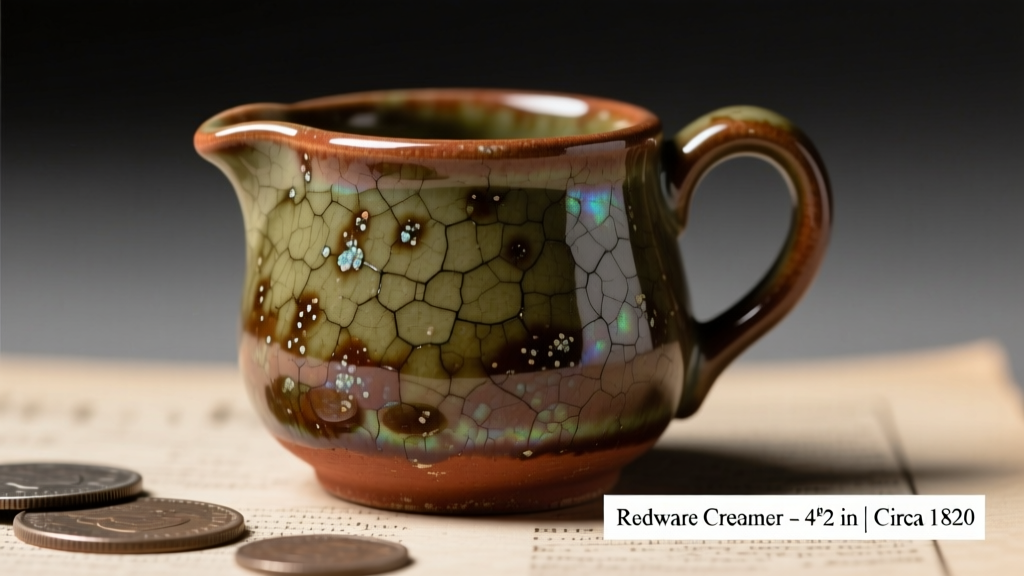
Redware Creamer with Mottled Olive-Brown Glaze (4¼ Inches): Identification, Provenance, and Market Value Analysis

Victorian Book Chain Necklace with Large Cameo Slide: History, Identification, and Valuation Guide
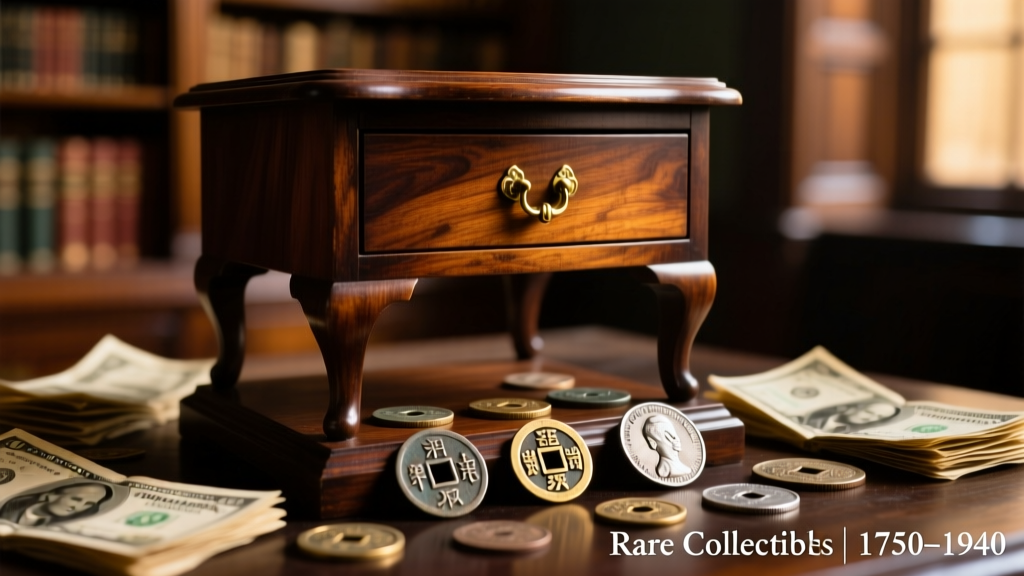
Sheraton Mahogany Furniture Stand: Authenticity, Provenance, and Market Value of the 29-Inch One-Drawer Design
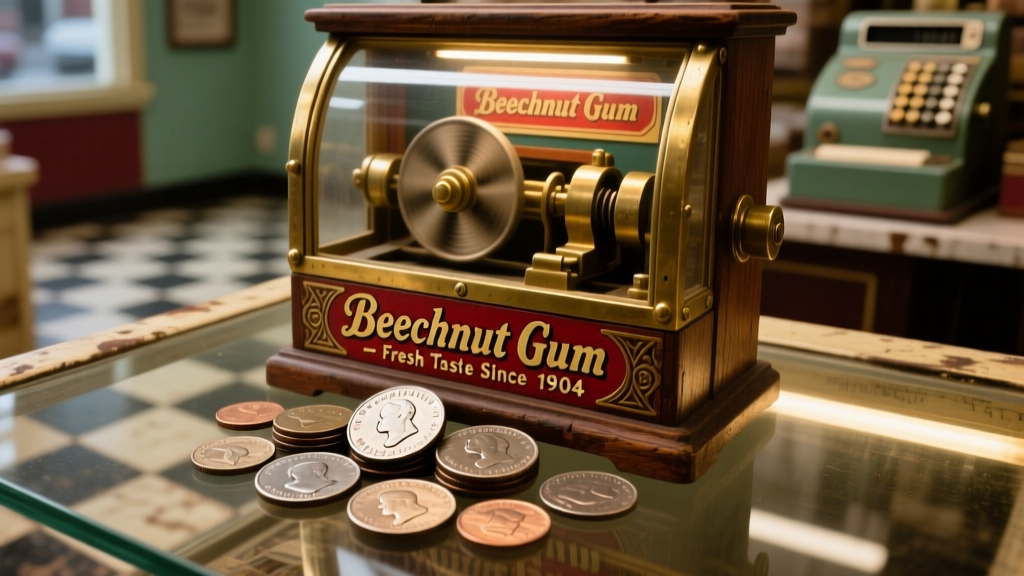
Beechnut Gum Motorized Window Display: History, Mechanics, and Market Value of a Rare 1930s Advertising Artifact
Decoding the 1132592: A Numismatic Deep Dive into the 1976 Bicentennial Eisenhower Dollar Die Variety
Decoding the Enigma of Serial Number 1136062: A Numismatic Investigation of a 1934A $10 Silver Certificate
Jack Sweet’s Pintail Drake Decoy: Original Paint, Glass Eyes, and Erie, PA Provenance — A 11¾-Inch Masterpiece of American Folk Art
The Kitchen Scoop Ice Cream Cone Shape Gilchrist No. 33: A Numismatic Curiosity in Aluminum and Americana
Marshall Field & Co. 1929 Campus School Clothes & Luggage Catalog: A Numismatic and Historical Artifact