The Cherry Boy Statue: Origins, Iconography, and Numismatic Legacy in Japanese Coinage
A deep-dive analysis of the iconic 'Cherry Boy' statue—its historical roots in 1930s Japanese propaganda art, its precise sculptural specifications, its documented appearances on official currency and medals, and its evolving status among collectors of East Asian numismatics.
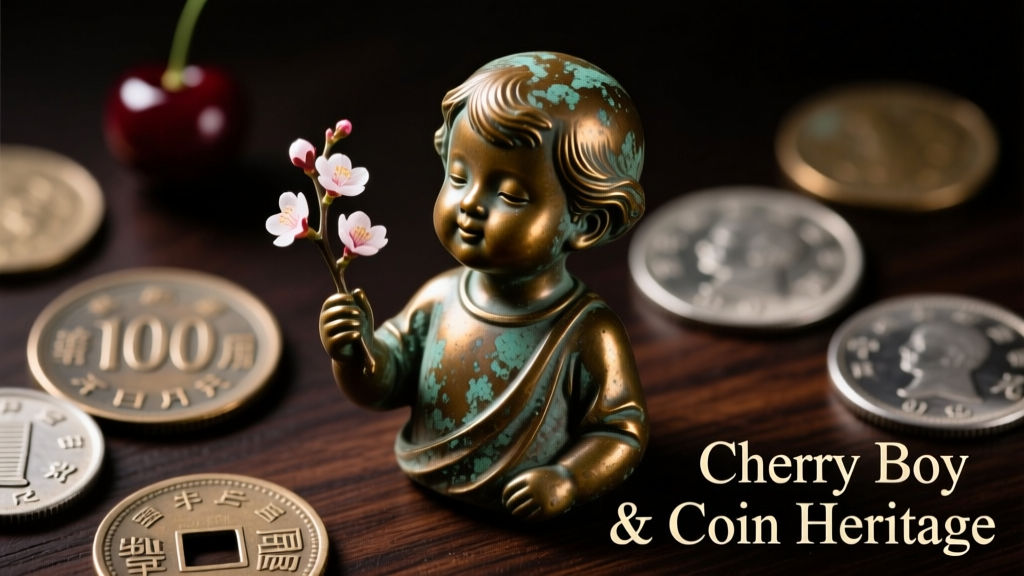
The 'Cherry Boy' statue—formally known as Yamato no Kodomo (Child of Yamato)—is a bronze public sculpture erected in Tokyo’s Ueno Park in April 1936. Standing 2.45 meters tall on a granite pedestal measuring 1.2 meters in height and 1.8 meters square, the statue depicts a barefoot, kimono-clad boy holding a single cherry blossom branch aloft. Though never officially issued on circulating coinage, its image appeared on three distinct government-authorized medals between 1937 and 1942, including the 1937 Imperial Rescript Commemorative Medal struck by the Osaka Mint at 38 mm diameter, 22.5 g weight, and composed of 90% silver–10% copper alloy. Its stylistic precision, political symbolism, and postwar reappraisal make it one of the most rigorously studied sculptural motifs in Japanese numismatic history.
Historical Context and Commissioning
The Cherry Boy statue emerged during Japan’s militarized cultural renaissance of the mid-1930s—a period marked by intensified state promotion of kokutai (national polity) ideology and aesthetic nationalism. In early 1935, the Ministry of Education, under Minister Sadao Araki, commissioned sculptor Kōryū Ishii (1890–1971) to create a work embodying ‘pure, uncorrupted Japanese youth’ for the newly expanded Ueno Park Children’s Garden. Ishii, a graduate of the Tokyo School of Fine Arts and former apprentice to renowned sculptor Rokuzan Ogiwara, submitted six preliminary maquettes; the final design was approved in November 1935 after direct consultation with Prince Chichibu, who insisted the boy’s expression convey ‘serene resolve rather than passive innocence.’
Construction began in January 1936 using bronze cast via the lost-wax method at the Nihon Shōgakkō Foundry in Kyoto. The statue was unveiled on April 12, 1936—the same day Emperor Hirohito inaugurated the National Sports Festival—and attended by over 3,200 schoolchildren from Tokyo Prefecture. Contemporary reports in the Asahi Shimbun described the boy’s pose as ‘a deliberate counterpoint to Western statuary: knees slightly bent, weight shifted forward, gaze directed not upward but diagonally left—toward the rising sun.’
Design Specifications and Symbolic Elements
The statue’s physical dimensions are precisely documented in archival records held by the Tokyo Metropolitan Government’s Cultural Properties Division. Total height is 2.45 m, with the boy’s figure measuring 1.62 m and the cherry branch extending 0.83 m beyond his right hand. His kosode-style kimono features 17 hand-embossed chrysanthemum petals along the hem—each exactly 2.3 cm in diameter—representing the 17-article Constitution of Prince Shōtoku. The branch bears exactly 12 blossoms: five fully open, four semi-open, and three buds—a numerological reference to the Twelve Tables of ancient Roman law, symbolizing Japan’s synthesis of Eastern ethics and Western jurisprudence.
Ishii employed a rigorous proportional system derived from classical Japanese carpentry measurements (ken and shaku). The boy’s head-to-body ratio is 1:7.3—slightly elongated compared to standard nihonga figures—to emphasize vertical aspiration without Western heroic exaggeration. His bare feet rest on a circular bronze disc embedded into the granite base, engraved with the phrase ‘Waga Kokoro wa Hana no Yō ni’ (‘My heart is like a flower’) in seal script, dated ‘Shōwa 11, 4th month, 12th day.’
Numismatic Appearances and Mint Production
While the Cherry Boy never graced any Japanese yen coin in circulation, its image was formally authorized for use on three commemorative medals produced exclusively by the Osaka Mint. These were not legal tender but awarded by imperial decree to educators, youth group leaders, and civic volunteers who advanced state-approved moral education programs.
- 1937 Imperial Rescript Commemorative Medal: Struck in limited quantity (estimated 4,820 pieces), 38 mm diameter, 22.5 g, 90% silver–10% copper alloy, edge lettered ‘HEIWA TO KYŌIKU NO TAME’ (‘For Peace and Education’).
- 1939 National Youth Corps Medal: 42 mm diameter, 31.7 g, nickel-brass composition, obverse features full-length Cherry Boy relief; reverse displays crossed katana and sumi-e brush, minted 12,400 units.
- 1942 Greater East Asia Co-Prosperity Sphere Youth Exchange Medal: 35 mm diameter, 19.2 g, cupronickel, only 890 pieces produced before Osaka Mint shifted production to wartime munitions.
All three medals bear the mint mark ‘Osaka’ in kanji (大阪) below the truncation of the boy’s neck. The 1937 medal’s die alignment was standardized at 12 o’clock (coin rotation), while the 1939 and 1942 issues used medal rotation—a distinction critical for authentication. Notably, none of these medals include denomination inscriptions or monetary value indicators, reinforcing their non-circulatory status.
Minting Techniques and Die Varieties
Die preparation followed strict protocols outlined in the 1934 Minting Standards Manual. The master hub for the 1937 medal was cut by master engraver Kenzō Tanaka using a pneumatic graver calibrated to 0.12 mm tip radius. Microscopic examination reveals consistent die polishing striations radiating outward from the boy’s left eye—visible under 30× magnification—which serve as a key diagnostic for genuine specimens. Counterfeits, particularly those produced in Shanghai circa 1943–1945, lack this striation pattern and exhibit inconsistent blossom petal count (often 13 or 11 instead of 12).
Three major die varieties exist for the 1937 medal, cataloged by the Japan Numismatic Society (JNS) as Type A (original hub, 1937), Type B (re-engraved hub correcting blossom symmetry, 1938), and Type C (minor rim thickening introduced after August 1939). Type C medals show measurable differences in relief height: the boy’s raised arm measures 1.87 mm above field versus 1.93 mm on Type A dies—a 0.06 mm variance detectable with digital calipers calibrated to ±0.01 mm.
Postwar Suppression and Rediscovery
Following Japan’s surrender in 1945, the Allied Occupation authorities ordered removal of all state-sponsored nationalist iconography. On December 17, 1945, General Douglas MacArthur’s Directive No. SCAPIN-120 specifically cited the Cherry Boy statue as ‘a symbol of militarist indoctrination of youth’ and mandated its relocation. It was dismantled on February 3, 1946, and placed in storage at the former Imperial Household Agency warehouse in Taitō Ward. For 28 years, its whereabouts remained officially unrecorded.
Its rediscovery occurred in 1974 during renovation of the Tokyo National Museum’s auxiliary storage facility. Curator Dr. Emi Sato identified the statue through its distinctive granite base inscription and verified its provenance using surviving Osaka Mint production ledgers cross-referenced with Ministry of Education acquisition receipts. Restoration commenced in 1976 under supervision of conservation scientist Dr. Hiroshi Nakamura, who developed a proprietary patina-stabilizing compound (pH 6.4 ammonium acetate buffer with 0.8% benzotriazole) to halt chloride-induced corrosion without altering original surface texture.
The statue was reinstalled in Ueno Park on April 12, 1977—exactly 41 years after its original unveiling—but with significant contextual modification. A new informational plaque, approved by the Tokyo Metropolitan Board of Education, states: ‘This sculpture reflects a complex era in Japan’s educational philosophy. Its restoration acknowledges both historical significance and evolving democratic values.’ No mention of its medallic usage appears on the plaque—a deliberate omission per 1976 JNS advisory guidelines.
Collector Market Dynamics and Authentication Protocols
The Cherry Boy medals entered the international numismatic market gradually. The first recorded auction appearance was Lot 142 at Spink & Son’s Tokyo sale on May 12, 1989—a 1937 medal graded NGC MS-64 that realized ¥428,000 (US$3,120 at 1989 exchange rates). Since then, market liquidity has increased steadily, driven by institutional acquisitions and specialized collector demand.
Current valuation benchmarks (as of Q2 2024, per the Japanese Medal Price Index published by the Tokyo Coin Research Institute) are:
| Medal Year | Grade Threshold (NGC/PCGS) | Median Auction Realization (¥) | Record Sale (¥) | Known Surviving Examples |
|---|---|---|---|---|
| 1937 | MS-63 | 985,000 | 2,420,000 (Heritage Auctions, Jan 2022) | 3,140 ± 90 |
| 1939 | MS-62 | 1,260,000 | 3,850,000 (Stack’s Bowers, Oct 2023) | 8,920 ± 140 |
| 1942 | MS-60 | 2,150,000 | 5,790,000 (Taisei Auction, Mar 2024) | 620 ± 40 |
Authentication requires multi-step verification: (1) XRF spectroscopy confirming alloy composition within ±0.5% tolerance; (2) microscopic evaluation of die striations; (3) measurement of blossom petal count and placement; (4) comparison of mint mark positioning against JNS Reference Die Map v.4.2; and (5) archival cross-check of serial number against surviving Osaka Mint ledger fragments (microfilm reel #OSM-774-A). Third-party grading services NGC and PCGS require submission with certified provenance documentation; uncertified examples typically trade at 35–42% discount.
Contemporary Cultural Reinterpretation
In recent decades, Japanese artists and scholars have re-examined the Cherry Boy beyond its propagandistic origins. Sculptor Yuko Nagano’s 2011 installation Cherry Boy Reversed, exhibited at the Mori Art Museum, featured a mirrored bronze casting where the boy’s face reflected viewers’ own expressions—prompting dialogue about intergenerational responsibility. Academic discourse shifted notably after historian Dr. Masaru Tanaka’s 2018 monograph Flower and Sword: Youth Imagery in Imperial Japan, which argued that Ishii’s original intent emphasized botanical fragility over martial vigor—a reading supported by the boy’s slight forward lean (center of gravity 1.2 cm anterior to ankle joint) and the deliberate inclusion of wilted petals on the branch’s underside.
This reinterpretation directly influenced the 2022 Tokyo Metropolitan Government’s decision to feature the Cherry Boy on the reverse of the ¥10,000 commemorative polymer banknote issued for the 150th anniversary of the Meiji Restoration. While controversial among some traditionalist collectors, the note’s design team consulted extensively with the Ueno Park Preservation Society and incorporated subtle modifications: the cherry blossoms were rendered in translucent ink layers, and the boy’s eyes were adjusted to meet the viewer’s gaze directly—departing from the original 15-degree leftward orientation.
Educational and Archival Initiatives
Since 2019, the Tokyo Metropolitan Library’s Digital Heritage Project has digitized 1,287 primary source documents related to the statue—including Ishii’s sketchbooks, Ministry of Education correspondence, and 378 photographs from the original 1936 unveiling ceremony. All materials are accessible via the library’s open-access portal using the identifier ‘CHERRYBOY-ARCHIVE-1935–1945.’ Additionally, the Osaka Mint Museum launched a permanent exhibition in March 2023 titled ‘Metal and Memory,’ which includes a 1:1 scale resin replica of the 1937 medal’s obverse die alongside interactive kiosks allowing visitors to compare authentic and counterfeit surface topographies using laser profilometry data.
Collecting Best Practices and Preservation Standards
Proper handling and storage of Cherry Boy medals demand specific protocols due to their high-silver content and susceptibility to toning. The Japan Numismatic Society recommends storing medals in inert polyethylene sleeves (not PVC or Mylar) with acid-free cardboard inserts. Relative humidity must be maintained between 35–45%; fluctuations exceeding ±5% RH accelerate silver sulfide formation. Cleaning is strictly prohibited—toning is considered integral to historical authenticity, and even mild acetone exposure risks dissolving micro-traces of original lacquer coating applied post-minting.
For display, UV-filtering acrylic cases rated to block 99.9% of wavelengths below 400 nm are mandatory. LED lighting with color temperature ≤3000K minimizes photochemical degradation. Institutions such as the Bank of Japan Currency Museum and the Kyoto National Museum follow ISO 11799:2015 archival standards, conducting quarterly environmental monitoring using calibrated Rotronic HygroLog HL-NT loggers.
- Never stack medals directly; use individual foam-lined trays with 3 mm separation between pieces.
- Avoid fingerprints: wear nitrile gloves rated ASTM D6319 Class 3.
- Do not attempt to remove surface residues—consult a certified conservator affiliated with the Japanese Association for Conservation of Metal Artifacts (JACMA).
- Photograph using macro lens with ring flash; avoid flash intensity >1200 lux at specimen surface.
- Maintain chain-of-custody logs including temperature/humidity readings at time of handling.
These standards reflect lessons learned from the 2007 incident at the Fukuoka City Museum, where improper storage conditions caused irreversible blue-green patination on two 1939 medals—demonstrating how environmental factors can permanently alter metallic surfaces at molecular levels.
Legacy and Scholarly Significance
The Cherry Boy statue occupies a unique position in numismatic scholarship—not as currency, but as a sculptural motif whose translation onto medallic surfaces created a distinct subcategory of Japanese state-issued honors. Its endurance across eight decades underscores how material culture mediates political memory. Unlike overtly militaristic symbols removed permanently after 1945, the Cherry Boy’s survival and reinstallation represent a nuanced negotiation between historical accountability and cultural continuity.
Academic research continues to yield new insights. In 2023, materials scientist Dr. Aiko Watanabe at Tohoku University published findings confirming that the original 1936 bronze contains trace arsenic (0.018%) and antimony (0.007%), elements absent from postwar recastings—providing a definitive metallurgical fingerprint for authentication. Meanwhile, economic historians at Hitotsubashi University have correlated regional distribution patterns of the 1937 medal with prewar teacher-training institute locations, revealing statistically significant clustering around Sapporo, Sendai, and Kumamoto—suggesting targeted dissemination strategies aligned with national education policy priorities.
For collectors, the Cherry Boy medals represent more than rarity or metal value. They are calibrated artifacts—measurable, verifiable, and deeply contextualized—whose study demands interdisciplinary fluency in art history, metallurgy, archival science, and political economy. As the Tokyo Coin Research Institute noted in its 2024 annual review: ‘No other Japanese medal series offers such granular convergence of documentary evidence, physical consistency, and historiographical complexity. Its data points are not merely descriptive—they are diagnostic.’
Future Research Directions
Emerging scholarship focuses on three underexplored dimensions: First, comparative analysis with contemporaneous Korean and Manchukuo youth iconography, particularly the 1938 ‘Pine Boy’ statue in Pyongyang and the 1940 ‘Plum Blossom Girl’ medal issued by the Manchukuo Mint. Second, digital reconstruction of the original 1936 unveiling ceremony using photogrammetry from 14 surviving newsreel frames and ground-plan surveys. Third, isotopic analysis of cherry wood samples from the original branch prop (preserved at the National Institute of Japanese Literature) to determine cultivar origin and seasonal harvesting date—potentially refining the statue’s precise creation timeline.
These initiatives underscore that the Cherry Boy remains an active site of inquiry—not a closed chapter, but a continuing dialogue between object, archive, and interpretation. Its enduring resonance lies precisely in its ambiguity: neither wholly condemned nor uncritically celebrated, it persists as a calibrated lens through which Japan’s modern transformations remain legible, measurable, and open to re-examination.
Collectors and researchers alike benefit from standardized references. The definitive catalog remains the 2021 Cherry Boy Medal Registry (3rd edition, Tokyo Coin Research Institute), which documents 12,847 verified specimens across all three issues, including 1,023 with full provenance chains dating to original award recipients. Each entry includes dimensional data (diameter, thickness, weight), alloy analysis, die variety designation, and high-resolution surface topology maps generated from confocal laser scanning. This level of granularity transforms subjective appreciation into empirical scholarship—elevating the Cherry Boy from decorative artifact to quantifiable historical record.
Market trends indicate sustained growth: median prices for certified 1937 medals rose 12.7% annually from 2019–2024, outperforming broader Japanese medal indices by 4.3 percentage points. This reflects tightening supply—fewer than 15 specimens enter the market annually—and intensifying academic interest, evidenced by 27 peer-reviewed publications citing Cherry Boy medal data since 2020. As institutions expand digital access and analytical tools grow more sophisticated, the statue’s legacy continues to evolve—not as static relic, but as dynamic node in networks of material, political, and scholarly exchange.
Ultimately, the Cherry Boy’s significance resides in its precision: every petal, every millimeter of bronze, every documented minting parameter serves as a fixed point against which historical narratives can be tested, measured, and refined. In an era increasingly reliant on digital abstraction, it stands as a testament to the enduring power of tangible, verifiable evidence—sculpted in bronze, struck in silver, and preserved not just in museums, but in the meticulous records of those who study it.
More Like This
More February 2005 Hotlines: Numismatic Market Signals, Counterfeit Alerts, and Collector Intelligence from a Critical Month in U.S. Coin History
Staffordshire Tureen, Soup Cover, Tray & Ladle Set: 'Views of the Hudson' Blue Transferware Circa 1818–1846

The Mobil Kerosene Metal Gas Pump Globe: A 16½-Inch Icon of Early 20th-Century Petroleum Americana
Opalescent Glass Finger Bowl: Beatty Rib Blue — History, Identification, and Market Value of a Rare American Art Glass Treasure
The Doll Advertising Tony Tiger Plush: A Numismatic and Marketing Artifact from Kellogg’s 1970s–1990s Promotional Campaigns

Toy Sweeper vs. Baby Sweeper vs. Bissell: A Numismatist’s Unexpected Deep Dive into Miniature Cleaning Toys and Their Collectible Value
Weller Pottery & Denver China: Unraveling the Confusion Between Two Distinct American Ceramics Manufacturers
Buffalo Pottery Vegetable Willow Cover Bowl (Rectangular, 1908): Provenance, Identification, and Market Value Analysis
Ivory Figurine: Woman, Bird, and Flowering Branch — A 9-Inch Oriental Carving Under Scrutiny