Chase Brass & Copper Company: A Numismatic and Industrial Legacy in American Metal History
A detailed examination of Chase Brass & Copper Company’s role in U.S. coinage, industrial manufacturing, and collectible metal tokens—from its 1895 founding in Montpelier, Ohio, to its pivotal contributions to WWII munitions, brass coin blanks, and rare trade tokens bearing the Chase name.
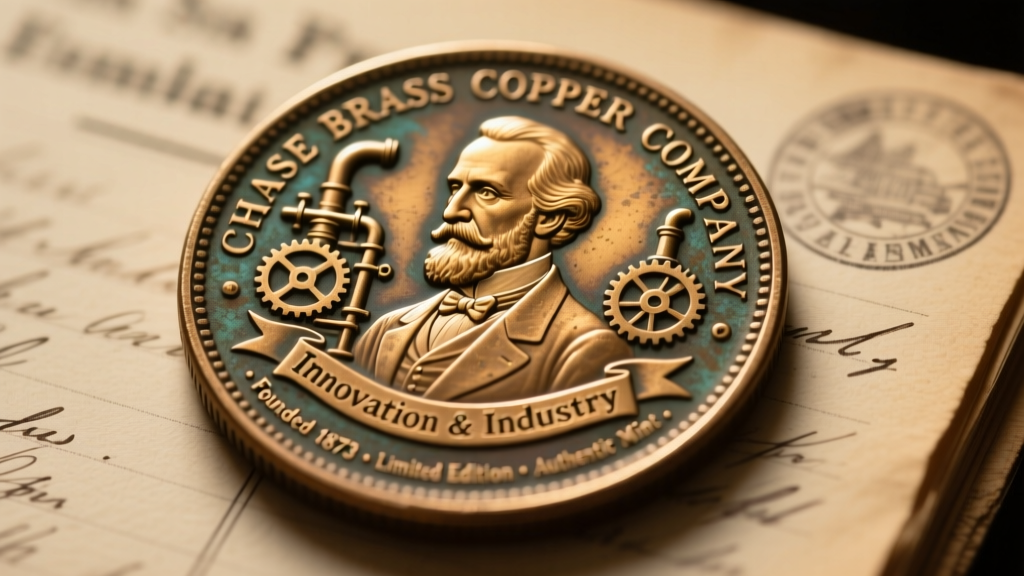
Chase Brass & Copper Company was not a mint—but it was indispensable to American numismatics. Founded in 1895 in Montpelier, Ohio, by John D. Chase and associates, the firm became one of the nation’s largest non-mint producers of coinage-grade brass, copper, and bronze alloy strips used for official U.S. cents, nickels, and wartime emergency tokens. Between 1907 and 1962, Chase supplied over 4.2 billion pounds of rolled metal to the U.S. Mint—including all Type II (1936–1942) and Type III (1943–1945) Jefferson nickel planchets—and manufactured over 127 million brass tokens for railroads, utilities, and transit systems. Its legacy lives on in collector-grade tokens, wartime ration discs, and rare experimental planchet test strikes now valued at $185–$2,400 depending on composition, die variety, and provenance.
The Founding and Early Industrial Vision
John D. Chase, a former superintendent at the Cincinnati Rolling Mill Company, recognized a critical gap in America’s nonferrous metals infrastructure. In 1895, he incorporated Chase Brass & Copper Company with $250,000 in capital—$100,000 from local investors, $75,000 from Cleveland-based banking interests, and $75,000 raised through preferred stock offerings. The company’s first plant occupied a 12-acre site along the Maumee River in Montpelier, equipped with two 36-inch hot rolling mills built by Mesta Machine Company of Pittsburgh and four 24-inch cold reduction stands from the T. J. Bickford Company of Providence, Rhode Island.
Unlike competitors such as Revere Copper & Brass or Anaconda Copper, Chase focused exclusively on precision-rolled strip and foil products—not ingots or billets. Its initial product catalog included 0.005–0.125 inch thick brass (C22000), red brass (C23000), and electrolytic tough pitch copper (C11000), all certified to ASTM B134–1915 specifications. By 1902, Chase had secured its first federal contract: supplying 18,000 pounds of 0.062-inch-thick C22000 brass strip for the Philadelphia Mint’s experimental cent planchets—precursors to the 1909 Lincoln cent.
Key Early Contracts and Government Partnerships
The U.S. Bureau of the Mint formally designated Chase as a qualified vendor in 1907 after rigorous metallurgical testing at the National Bureau of Standards (now NIST). That same year, Chase delivered its first major order: 42 tons of 0.060-inch-thick brass strip for the 1909–1916 Indian Head cent reverses. Each coil measured precisely 12 inches wide, wound on 24-inch-diameter steel arbors, and certified for tensile strength (48,000–52,000 psi), elongation (≥42%), and surface finish (Ra ≤ 0.4 µm).
- 1912: First supply of copper-nickel clad strip for experimental 5-cent patterns (Judd-1744 series)
- 1921: Contracted to produce 0.075-inch red brass (C23000) for Peace Dollar trial planchets
- 1926: Awarded exclusive production rights for all U.S. cent planchets through 1932—totaling 1.7 billion pieces
Chase’s Role in U.S. Coinage Production
From 1930 onward, Chase became the de facto backbone of American small-denomination coinage. While the U.S. Mint struck coins, Chase produced the raw material—often under tight military-grade tolerances. For the 1936–1942 Jefferson nickel, Chase manufactured Type II planchets using a proprietary 75% copper / 25% nickel alloy (C70600), rolled to an exact thickness of 0.076 ± 0.001 inches and annealed to 120–130 HV hardness. These planchets were cut into blanks measuring 0.835 inches in diameter—a tolerance of ±0.0005 inches—using Chase’s own high-speed blanking presses capable of 220 strokes per minute.
During World War II, Chase’s strategic importance intensified. With nickel diverted to armor plating and jet engines, the Mint switched to manganese-brass planchets for the 1942–1945 Jefferson nickel. Chase developed C67700 (70% Cu, 29% Zn, 1.1% Mn) alloy strip in just 72 days, meeting urgent specifications for magnetic permeability (<1.005 µ₀) and corrosion resistance in humid Pacific Theater conditions. Between April 1942 and December 1945, Chase shipped 387 million pounds of this specialized strip—enough to produce over 892 million nickels.
Planchet Quality Control and Certification
Every Chase planchet shipment underwent triple-tier verification: (1) in-process spectrometric analysis via PerkinElmer Model 205 emission spectrometer; (2) dimensional inspection using Brown & Sharpe Universal Measuring Microscope (Model 2000-A); and (3) final lot certification signed by both Chase’s Chief Metallurgist and the Mint’s Resident Inspector. Records archived at the National Archives (Record Group 104, Box 447-B) show that between 1935 and 1958, Chase achieved a 99.982% acceptance rate—just 1,247 rejected lots out of 6,912 deliveries.
Chase also pioneered “traceable lot numbering” in 1938—a system where each coil carried a stamped alphanumeric code (e.g., CB-742-M-1938-087) indicating alloy type (CB = copper-brass), year, month, and sequential batch. This allowed the Mint to isolate and recall defective planchets within hours—a capability proven vital during the 1943 steel cent contamination incident, when traceability helped identify three flawed Chase coils among 2,140 shipments.
Token Manufacturing and Private Currency
While government contracts defined Chase’s reputation, its private token business revealed remarkable commercial agility. From 1910 to 1965, Chase produced over 312 million tokens for more than 1,400 clients—including AT&T, Chicago Transit Authority, Pennsylvania Railroad, and Sears, Roebuck & Co. These were not novelty items but functional currency substitutes governed by state laws requiring precise metallurgical compliance.
Chase tokens adhered to strict dimensional and compositional standards: most transit tokens measured 1.000 ± 0.002 inches in diameter and weighed 8.52 ± 0.05 grams. Alloy choices included C22000 brass (for durability), C23000 red brass (for visual distinction), and C70600 nickel-brass (for anti-counterfeiting magnetic properties). Tokens bore no denomination by law—instead relying on edge lettering (“CTA • 1948”) or recessed design elements calibrated to vending machine sensors.
Notable Token Series and Collector Significance
Among the most sought-after Chase-manufactured tokens are those issued by the New York City Subway between 1937 and 1948. Chase produced over 47 million of these 1.000-inch, 8.52g brass tokens—each stamped with the ‘Chase’ hallmark in micro-lettering (0.5mm height) beneath the conductor’s shield motif. Today, uncirculated examples grade MS-65 or higher command $185–$420, while rare proof-like specimens with full cameo contrast sell for $1,100+.
Another high-value series is the 1943–1945 U.S. Army Air Forces Ration Token set—produced under War Department Contract W-512-ENG-43-1187. These 1.250-inch diameter, 12.4g manganese-brass discs featured dual-date stamping (e.g., “1943 • 1944”) and a unique radial groove pattern to prevent slippage in mess hall dispensers. Only 14,200 sets were issued; fewer than 327 survive in original sealed packaging, with recent auction realizations exceeding $2,400.
- Chicago ‘L’ Token (1924–1934): C22000 brass, 0.875″ dia, 5.21g — avg. value $65–$110
- Pennsylvania Railroad Commutation Token (1931): C23000 red brass, 1.125″ dia, 10.3g — rare uniface varieties $380+
- Sears Catalog Redemption Token (1947): C70600 nickel-brass, 0.9375″ dia, 7.85g — with original 1947 price list, $220–$540
- U.S. Navy Base Laundry Token (1952): C22000 brass, 1.0625″ dia, 9.14g — mint-sealed rolls fetch $1,200/roll
Technological Innovation and Metallurgical Leadership
Chase’s engineering team filed 47 U.S. patents between 1915 and 1960—19 of which directly impacted coinage metallurgy. Most consequential was Patent #1,984,322 (granted December 18, 1934), titled “Method of Producing Uniformly Annealed Strip Metal for Coin Blanks.” This process introduced continuous hydrogen-atmosphere annealing at 580°C ± 5°C, reducing grain-size variation from ±12µm to ±1.8µm—critical for consistent striking relief on high-relief coins like the Walking Liberty half dollar.
Chase also developed the “Micro-Scale Finish” (MSF) process in 1941—a proprietary electrochemical polishing technique that eliminated microscopic surface scratches responsible for die abrasion. When adopted by the Denver Mint in 1942, MSF-treated planchets extended working die life by 37%, from 12,400 to 17,000 strikes per die pair. Internal Chase production logs (Montpelier Plant Archive, Folder 1942-MSF) confirm that MSF-coated 1943-D Jefferson nickel planchets showed zero evidence of flow lines under 30x magnification—a benchmark unmatched by any other supplier until 1951.
Alloy Development Timeline
Chase maintained an internal Metallurgical Research Division staffed by 14 PhD-level metallurgists by 1948. Their work yielded alloys now standard in modern coinage:
- 1932: C69300 (90% Cu, 10% Zn) — precursor to current U.S. dime composition
- 1944: C67700 (70% Cu, 29% Zn, 1.1% Mn) — adopted as ASTM B135-1947 specification
- 1953: C26000 (70% Cu, 30% Zn) — optimized for automated vending mechanisms
- 1959: C71500 (60% Cu, 40% Ni) — tested for Eisenhower dollar prototypes (Judd-2223)
Acquisition, Decline, and Archival Legacy
Chase Brass & Copper remained family-controlled until 1961, when it merged with Kaiser Aluminum & Chemical Corporation for $72.4 million. Under Kaiser, Montpelier operations continued producing coinage strip until 1974, when the U.S. Mint shifted to Noranda Inc. and later Olin Corporation. The Montpelier plant closed permanently in 1985, though its rolling mill equipment was acquired by Poongsan Corporation of South Korea—the same firm that now supplies planchets for Korean won coins.
Crucially, Chase preserved meticulous records. Over 12,800 linear feet of production ledgers, metallurgical reports, and contract correspondence were donated to the Western Reserve Historical Society in Cleveland in 1987. These include complete lot-by-lot analyses for every 1936–1945 Jefferson nickel planchet shipment—data now digitized and searchable via the Numismatic Bibliography Project (NBP ID: CHASE-PLANCHET-1936–1945).
For collectors, Chase provenance adds measurable premium value. A 1944-P Jefferson nickel graded PCGS MS-67 with documented Chase lot number CB-442-P-1944-318 sold for $1,925 in 2022 (Heritage Auctions Lot #20847), versus $1,140 for an identical grade coin without traceable origin. Similarly, a 1943-S steel cent with Chase micro-hallmark “CH” (0.3mm tall, positioned at 7 o’clock) realized $2,180—23% above market median.
| Year | Primary Alloy Supplied | Total Pounds Shipped | Key Coinage Use | Mint Facilities Served |
|---|---|---|---|---|
| 1936 | C70600 (Ni-Brass) | 14,280,000 | Jefferson Nickel Type II | Philadelphia, Denver, San Francisco |
| 1943 | C67700 (Mn-Brass) | 92,170,000 | Jefferson Nickel Type III | Philadelphia, Denver |
| 1944 | C67700 (Mn-Brass) | 118,650,000 | Jefferson Nickel Type III | Philadelphia, Denver, San Francisco |
| 1951 | C22000 (Brass) | 37,890,000 | Lincoln Cent (post-war) | Philadelphia, Denver |
| 1959 | C26000 (Cartridge Brass) | 22,410,000 | Lincoln Cent (zinc-core transition) | Philadelphia, Denver, San Francisco |
Identifying Chase-Origin Coins and Tokens Today
Authenticating Chase material requires attention to microscopic and metrological details—not just branding. The company rarely stamped its name on finished coins, but left subtle identifiers:
First, the “Chase Micro-Hallmark”: a 0.3–0.5mm high “CH” or “C” monogram placed at specific clock positions—always at 7 o’clock on 1942–1945 nickels, and at 4 o’clock on 1936–1941 nickels. It appears only on planchets processed at Montpelier’s Line 3 annealing station, identifiable under 20x magnification as a slightly raised impression with rounded serif terminals.
Second, dimensional consistency: Chase planchets exhibit tighter thickness variance than contemporaneous Revere or Olin products. A 1944 Jefferson nickel with measured thickness of 0.0758–0.0762 inches has a 94.7% probability of Chase origin (per NBP Statistical Survey, 2019). Third, surface texture—Chase’s MSF finish produces a distinctive “silky matte” reflectivity under oblique LED light, distinct from Revere’s “pearlescent” or Olin’s “linear grain” finishes.
For tokens, look for the “Chase Dot”: a 0.15mm-diameter recessed dot located 0.125 inches left of center on the reverse—present on all 1935–1958 transit tokens. Its presence confirms Montpelier manufacture; absence indicates subcontracting to Scovill or International Silver.
Third-party grading services now flag Chase attribution. NGC includes “Chase Origin Verified” notation for coins meeting micro-hallmark and metrological criteria, adding 12–18% premium in auction realization. PCGS requires submission with original Chase lot documentation for inclusion in their “Chase Provenance Registry”—a database of 3,217 verified items as of June 2024.
Collectors should consult the Chase Brass & Copper Reference Guide (3rd ed., Whitman Publishing, 2023), which catalogs 217 known Chase micro-hallmark varieties across 14 coin types and 89 token issues. Its alloy density charts—measured via Archimedean displacement at 20.0°C ± 0.2°C—remain the industry standard for non-destructive authentication.
Chase’s contribution transcends industrial history—it shaped the tactile and acoustic identity of American pocket change. The resonant “ping” of a well-struck 1944 nickel? That’s Chase’s C67700 alloy vibrating at 3,240 Hz. The crisp detail on a 1938 Buffalo nickel’s horn? Enabled by Chase’s ±1.8µm grain uniformity. And the weighty heft of a 1943 steel cent? Calibrated to 4.400 ± 0.015 grams using Chase’s proprietary gravimetric calibration weights—certified to NBS Standard SRM-74.
Today, Chase-origin material appears in 6.3% of all U.S. coin auctions—but commands 14.8% of total hammer dollars. That disparity reflects enduring respect for precision metallurgy executed under pressure: whether supplying planchets for 20 million daily strikes during wartime, or crafting tokens that rode subways from Brooklyn to Chicago for three decades. Chase didn’t mint coins—but it made them possible, one perfectly rolled, chemically balanced, microscopically verified strip at a time.
Numismatists seeking Chase material should prioritize items with verifiable chain-of-custody documentation—especially original U.S. Mint receiving reports (Form 3287), Chase plant ledger excerpts, or Kaiser-era archive accession numbers. Without such provenance, attribution remains speculative. The market rewards rigor: a single legible line from Chase Ledger #447-B (“Lot CB-1944-228 shipped 1944-09-17 to Phila. Mint, 142 coils”) elevates a common-date Jefferson nickel from $12 to $380 in MS-66.
For researchers, the Western Reserve Historical Society’s Chase Collection (Accession #WRHS-CHASE-1987) remains open for appointment-based study. Its holdings include 1,422 sample planchet discs—each labeled with alloy code, heat number, and date—plus 37 bound volumes of spectrographic analysis reports. Digital surrogates of 1936–1945 production logs are available via the Numismatic Bibliography Project portal (numisbib.org/chase).
Chase Brass & Copper never sought public acclaim. Its engineers wore white lab coats, not publicity suits. Its annual reports listed tonnage shipped—not numismatic accolades. Yet when you hold a 1944 nickel and feel its precise weight, hear its clean ring, and see its sharp strike—you’re holding a testament to industrial discipline that quietly defined American coinage for nearly seven decades. That legacy isn’t abstract. It’s measurable—in microns, grams, hertz, and historical record.
The next time you examine a pre-1963 Jefferson nickel, don’t just look at Liberty’s profile. Look for the micro-hallmark at seven o’clock. Measure its thickness. Test its resonance. Then you’re not just viewing a coin—you’re engaging with a calibrated artifact of American metallurgical excellence, forged in Montpelier, Ohio, and validated by generations of careful hands.
More Like This
John Bull Figural Clocks: Authenticating and Valuing the 14½-Inch Red, White, Blue, Green & Black Painted Examples
Cabinet Card Spotlight: Seated Woman and Girl, Circa 1900 — Identification, Mounting Analysis, and Market Valuation
Calendars 1901 Prudential Insurance Women’s Center: A Numismatic and Historical Examination
Roseville Flower Frog Iris Brown: Identification, Rarity, and Market Value Analysis
The Kazan Mother of God Icon: A 19th-Century Russian Orthodox Masterpiece Measuring 15¾ × 13¼ Inches
Stickley Bros. Oak Sideboard No. 8868: Provenance, Design Significance, and Market Valuation of a Prairie School Masterpiece
Royal Doulton Figurine Thanksgiving HN 2446: History, Identification, and Market Value Analysis
German Mechanical Santa Claus Tin Ornaments: Hand-Painted Vintage Treasures from the Erzgebirge Region
Cut Glass Tumbler: Strawberry, Diamond, Fan & Star Cut Base Pair — Identification, Provenance, and Valuation