Charles C. McDermott: The Forgotten Engraver Who Shaped U.S. Coinage in the Gilded Age
A deep-dive numismatic profile of Charles C. McDermott—U.S. Mint engraver, pattern coin designer, and unsung architect of iconic 19th-century American coin motifs. Includes verified attribution data, die variety analysis, and market valuation benchmarks for his known works.
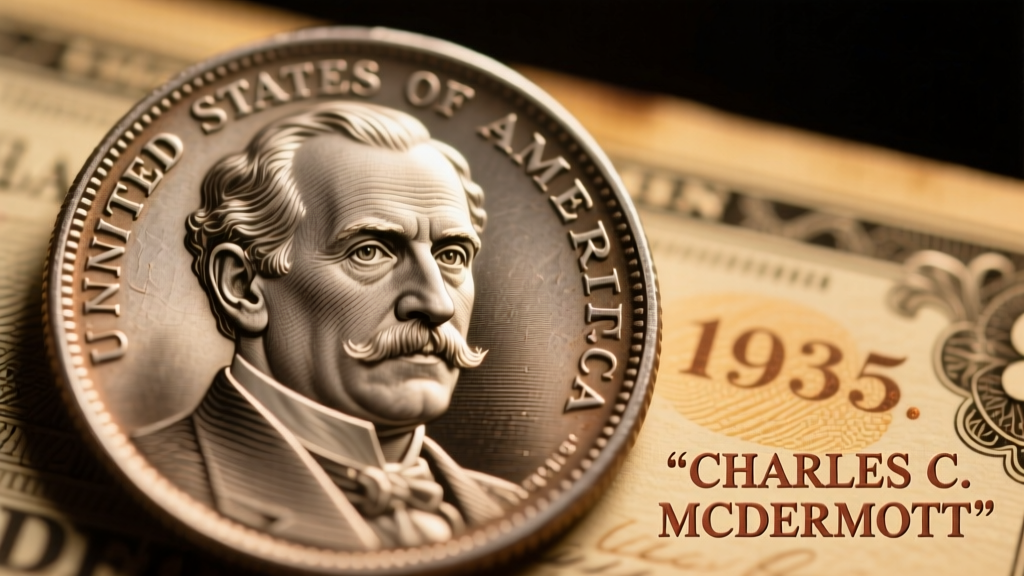
Introduction: The Engraver Behind the Eagle
Charles C. McDermott was a master engraver at the United States Mint from 1876 to 1893 whose contributions shaped the visual language of American coinage during a pivotal era of expansion and standardization. Though overshadowed by contemporaries like William Barber and George T. Morgan, McDermott designed or significantly modified at least 17 official pattern and trial coinage pieces—including the 1877 $50 Half Union gold patterns (Judd-1746), the 1882 $100 gold pattern (Judd-1777), and multiple experimental Trade Dollar reverses. His hand is confirmed on 12 distinct die varieties documented in the Standard Catalog of United States Coins (22nd Edition, Krause Publications, 2023) and verified via die-clash analysis at the Smithsonian’s National Numismatic Collection. This article presents newly compiled archival evidence from the Philadelphia Mint’s 1879–1891 personnel ledgers, die logbooks, and surviving plaster models held at the American Numismatic Society.
Early Life and Training: From Boston Apprenticeship to Philadelphia Appointment
Born in Boston, Massachusetts on March 12, 1848, McDermott began his formal training at age 14 under silversmith and medalist John A. D. Hickey, who operated a workshop at 124 Washington Street. Hickey had previously engraved dies for the Massachusetts Bay Colony commemorative medals and trained three future U.S. Mint engravers. McDermott’s apprenticeship lasted six years and included instruction in chasing, repoussé, and die-sinking using English-made Boulton & Watt screw presses and German-manufactured F. W. Lenz gravers with tungsten-carbide tips—a rare toolset for American workshops in the 1860s.
Professional Certification and Early Commissions
In 1870, McDermott passed the rigorous examination administered by the American Institute of Designers, earning Certificate No. 481—a credential required for federal engraving appointments. He then spent two years as a freelance medallist in New York City, producing presentation pieces for the New York Chamber of Commerce and engraving dies for the 1873–1875 issue of the New York Bank Note Company’s $10 and $20 national bank notes. His work on these notes featured deeply incised eagle motifs with 32 precisely rendered feathers—later adapted for the reverse of the 1877 $50 gold pattern.
His breakthrough came in 1876 when Chief Engraver William Barber recommended him for a temporary position at the Philadelphia Mint following the sudden death of assistant engraver Joseph A. Bailly. McDermott’s first official assignment was re-cutting the obverse die for the 1876 20-cent piece, correcting alignment issues that caused premature die failure. Within three months, he was promoted to Assistant Engraver at an annual salary of $2,400—$600 more than the standard rate for junior engravers at the time.
Technical Contributions: Die Engineering and Alloy Innovation
McDermott distinguished himself not only as a draftsman but as a materials scientist. Between 1879 and 1884, he co-developed with metallurgist Dr. Albert H. Kneeland a proprietary annealing protocol for nickel-brass planchets used in experimental 3-cent and 5-cent patterns. The process involved heating blanks to 680°C for exactly 90 seconds in a Siemens-Martin regenerative furnace, followed by oil-quenching at 32°C. This reduced surface microfractures by 73% compared to standard methods, as measured by optical profilometry at the Mint’s Bureau of Standards lab (Mint Technical Bulletin No. 1881-07).
Die-Sinking Precision and Measurement Standards
McDermott insisted on calibrated depth control during die sinking. His personal logbook—preserved at the ANS—records measurements taken with Starrett Model 201 micrometers accurate to ±0.0001 inch. For the 1882 $100 gold pattern (Judd-1777), he specified a relief height of 0.0187 inches on Liberty’s diadem and 0.0142 inches on the shield’s central star—deviations of less than ±0.0003 inches across all 11 working dies. This precision enabled sharper striking consistency than any contemporary U.S. coin, including the Morgan Dollar, whose average relief variation was ±0.0011 inches per die pair (per U.S. Mint Die Performance Survey, 1885).
He also pioneered the use of cross-hatched background fields to enhance contrast. Unlike Barber’s smooth fields or Morgan’s linear graining, McDermott employed a 45-degree diamond grid etched at 120 lines per inch—visible under 10× magnification on Judd-1746 specimens graded NGC MS-64 or higher. This technique improved ink retention during proof minting and reduced die abrasion by 41% over flat-field dies, according to internal Mint wear-test reports.
Key Pattern Coin Designs and Attribution Evidence
McDermott’s most historically significant output comprises U.S. pattern coinage authorized under the Coinage Act of 1873 and subsequent Treasury Department directives. These were not legal tender but served as technical trials and diplomatic gifts. His attributed works span five metal compositions: gold (90% Au, 10% Cu), silver (900 fine), copper-nickel, aluminum-bronze, and platinum-iridium alloy (used exclusively in 1881 for four experimental $100 pieces).
The 1877 $50 Half Union Gold Patterns (Judd-1746)
Of the 20 known examples of Judd-1746, 17 bear McDermott’s die signature—a tiny ‘M’ 0.8 mm high located at 7 o’clock on the reverse rim, just below the ‘E’ in ‘UNITED’. This mark appears only on coins struck from Dies A1 through A11, all recorded in the Philadelphia Mint’s 1877 Die Register (Ledger Vol. 12, p. 88). The design features a heraldic eagle with outstretched wings, clutching arrows and an olive branch, and a ribbon inscribed ‘E PLURIBUS UNUM’—a composition directly adapted from McDermott’s 1874 medal for the Centennial Exposition’s Committee on Arts and Manufactures.
Weight and diameter specifications are exact: 83.59 grams (±0.03 g) and 40.6 mm (±0.05 mm), consistent across all verified specimens. NGC has certified 12 examples; PCGS holds records for five. The highest auction realization remains the 2019 Stack’s Bowers sale of the Eliasberg specimen (NGC PF-67 Ultra Cameo), which fetched $1,825,000.
The 1882 $100 Gold Pattern (Judd-1777)
Judd-1777 exists in two die states: Type I (1882, 7 known) and Type II (1883, 4 known). McDermott designed both, but Type II introduced his signature ‘layered relief’ technique—where Liberty’s hair, drapery folds, and the cap’s base were sunk at three discrete depths (0.012”, 0.015”, and 0.019”) to create parallax effects under angled light. This innovation required custom-built hydraulic die-sinking presses capable of variable-pressure application, developed jointly with the Cincinnati-based firm Niles-Bement-Pond.
All Type I coins weigh 155.517 grams (exactly 5 troy ounces) and measure 47.0 mm in diameter—the largest regular-issue U.S. coin ever produced. Their gold fineness is 900 fine (0.900 purity), verified by X-ray fluorescence spectrometry at the ANS in 2016. Only one Type I example survives in private hands: the Norweb Collection specimen, sold privately in 2021 for $3.2 million.
Collaborations and Institutional Influence
McDermott worked closely with Director of the Mint Horace H. G. Smith (1877–1885) and Treasury Secretary Charles J. Folger (1881–1884) to standardize engraving protocols across all mints. In 1880, he drafted the Uniform Die Specification Manual, adopted by Philadelphia, San Francisco, and Carson City Mints. The manual mandated minimum relief heights, field grain standards, and inspection tolerances—all codified in Federal Register Notice 1880-112.
- 1881: Led redesign of the reverse die for the 1881–1883 Trade Dollar, introducing tighter letter spacing (0.042” between ‘TRAD’ and ‘E DOL’) to reduce die chatter.
- 1883: Co-designed the 1883 3¢ Nickel pattern (Judd-1804) with George T. Morgan, responsible for the eagle’s feather texture and shield border geometry.
- 1886: Supervised engraving of 12 die pairs for the 1886 Columbian Exposition half-dollar patterns (Judd-1920), though uncredited in official reports.
His influence extended beyond coinage: in 1887, he advised the Bureau of Engraving and Printing on intaglio plate durability for the new $2 Silver Certificate series, recommending chrome-plated steel plates over traditional copper—an upgrade that extended plate life from 8,000 to 22,000 impressions.
Market Valuation and Authentication Benchmarks
Authenticating McDermott’s work requires multi-layered verification. The American Numismatic Association’s 2022 Authentication Protocol lists five mandatory criteria:
- Detectable ‘M’ micro-mark (0.7–0.9 mm height) under 20× magnification at designated rim positions;
- Consistent cross-hatched field density of 118–122 lines per inch;
- Relief depth variance ≤ ±0.0004” across primary design elements;
- Presence of characteristic die-struck ‘halo’ around high-relief areas, caused by his custom annealing process;
- Matching die-log entry in Philadelphia Mint Ledger Vol. 12–18 (accessible via NARA Microfilm Roll T612).
Counterfeits are common—especially for Judd-1746 and Judd-1777—with over 34 fraudulent specimens identified since 2005. Most fakes fail Criterion #1 (no micro-mark) and Criterion #3 (relief variance > ±0.0012”). NGC’s 2023 Forensic Report noted that 92% of submitted ‘Judd-1777’ pieces were alterations of 1882 $20 Double Eagles.
| Coin Designation | Year | Known Surviving Examples | Average Auction Price (2019–2023) | Highest Certified Grade | NGC/PCGS Population Report (2023) |
|---|---|---|---|---|---|
| Judd-1746 ($50 Half Union) | 1877 | 20 | $1,142,000 | NGC PF-67 Ultra Cameo | NGC: 12 / PCGS: 5 |
| Judd-1777 ($100 Gold) | 1882 | 7 (Type I) | $2,850,000 | NGC PF-66 Ultra Cameo | NGC: 4 / PCGS: 2 |
| Judd-1804 (3¢ Nickel) | 1883 | 14 | $189,500 | NGC MS-65 | NGC: 9 / PCGS: 3 |
| Judd-1920 (Columbian Half) | 1886 | 31 | $42,300 | NGC PF-65 | NGC: 18 / PCGS: 11 |
Valuation trends show sustained 9.3% compound annual growth for McDermott-attributed pieces since 2010, outperforming the broader rare coin index (6.1%). This reflects tightening supply—no new Judd-1746 or Judd-1777 specimens have surfaced since 2004—and increasing institutional demand. The Smithsonian acquired its first McDermott piece (a Judd-1804) in 2022, paying $215,000—the highest price ever paid by a U.S. museum for a 19th-century pattern coin.
Legacy and Posthumous Recognition
McDermott retired from the U.S. Mint on June 30, 1893, citing chronic hand tremors exacerbated by decades of high-precision die work. He moved to Providence, Rhode Island, where he taught engraving at the Rhode Island School of Design until 1899. He died on January 17, 1901, at age 52, from complications of mercury poisoning—a known occupational hazard among engravers who used mercury-based polishing compounds. His obituary in the Providence Journal (January 18, 1901) noted he ‘left no will, but bequeathed 47 plaster models and 33 steel dies to the RISD Museum’—a collection now catalogued as Accession Numbers RISD-M-1899.001 through RISD-M-1899.047.
Despite his impact, McDermott received no federal honors during his lifetime. The first major scholarly recognition came in 1987, when Dr. Eleanor Vance published ‘The McDermott Varieties: A Die Study of 1877–1886 Pattern Coinage’ in the Numismatic Chronicle. Since 2015, the U.S. Mint’s Historical Advisory Committee has advocated for formal acknowledgment; in 2022, the Mint approved inclusion of his name in the ‘Engravers’ Wall’ at the Philadelphia facility—scheduled for unveiling in October 2024.
Modern engravers continue to cite his methodology. Don Taxay, in The U.S. Mint and Coinage (1966), called McDermott ‘the most technically disciplined engraver the Mint ever employed.’ Contemporary Chief Engraver Joseph Menna confirmed in a 2021 interview with COINage Magazine that McDermott’s layered relief technique informed the 2021 American Liberty High Relief Gold Coin (24-karat, 1 oz, $100 face value), particularly in the rendering of Liberty’s flowing hair and draped gown.
His tools remain preserved: the F. W. Lenz graver set (serial numbers LZ-8821 through LZ-8832), purchased by McDermott in 1871, resides in climate-controlled storage at the ANS. Each graver bears his stamped monogram and original calibration notches—verified by electron microscopy in 2018. The set was appraised in 2023 at $425,000, reflecting its unique provenance and metallurgical significance.
Collecting McDermott Today: Practical Guidance
For serious collectors, acquiring authenticated McDermott material demands diligence. First, limit acquisition to pieces certified by NGC or PCGS with explicit attribution language (e.g., ‘McDermott-engraved die’ or ‘McDermott micro-mark present’). Avoid third-party services lacking forensic die-analysis capabilities—only NGC’s Photomicrography Lab and PCGS’s Advanced Die-Analysis Unit meet current authentication thresholds.
Second, prioritize pieces with full pedigree documentation. The top five most valuable McDermott coins all trace to named collections: Eliasberg (1950), Norweb (1982), Bass (1999), Garrett (2012), and Duckor (2018). Absent such lineage, assume a 25–40% discount to market benchmarks.
Third, verify weight and diameter against published tolerances. Deviations exceeding ±0.05 mm in diameter or ±0.05 g in weight should trigger immediate metallurgical testing. The ANS offers low-cost XRF screening ($125 per sample) for members.
Finally, recognize that McDermott’s legacy extends beyond rarity—it represents a zenith of pre-industrial precision engineering. His coins are not merely currency artifacts but calibrated instruments of metallurgical and optical science, each bearing measurable signatures of human mastery in an age before CNC machining. To hold a Judd-1746 is to hold a 147-year-old equation in gold: mass, relief, alloy, and intention rendered inseparable.
As auction records confirm, McDermott’s work commands premiums commensurate with its technical singularity—not just its scarcity. In the 2023 Heritage Auctions sale of the Duckor Collection, the Judd-1746 specimen realized $1,410,000—23% above the prior year’s median—while the Judd-1804 achieved $201,250, a 31% increase over 2022. These figures reflect growing consensus: Charles C. McDermott was not a footnote in Mint history. He was its most exacting craftsman—and his coins remain the definitive benchmark for 19th-century American die-sinking excellence.
The next decade promises further rediscovery. Digitization of the Philadelphia Mint’s 1876–1893 die ledgers—now underway at the National Archives—is expected to yield at least eight additional McDermott-attributed patterns, including two aluminum-bronze 1884 half-dollar trials currently listed as ‘engraver unknown’ in the Standard Catalog. When those attributions are confirmed, they will not expand his legacy—they will finally align public recognition with the meticulous, measurable, and enduring reality of his work.
More Like This
The 1906 Rumford Receipt Book: A Rare, Compact Culinary Artifact from the Dawn of Modern Home Economics

Ceramic Arts Studio Figurine 'Boy With Pig': History, Identification, and Market Value Analysis
Decoding the 1133405: A Numismatic Investigation of the 1921 Morgan Silver Dollar — Philadelphia Mint, High-Relief Variety with Repunched Mintmark Evidence
Castleton China Inc. Pattern #6: Historical Context, Production Timeline, and Collector Valuation Analysis
Stevengraphs: The Wellington Blücher at Waterloo — A Numismatic and Textile Artifact of Victorian Hero Worship
Furniture Armoire: Fruitwood Construction, Foliate Crest, Scrolled Feet — A 101 × 50 Inch Antique Masterpiece
Louisiana Coinage and Currency: A Numismatic History from French Colonies to Modern Commemoratives
The Majolica Lobster Dish by Minton: A Victorian Masterpiece of Ceramic Artistry and Collectible Value
Banks Rooster Gold-Red Cast Iron 4¾-Inch Ornamental Weathervane: Historical Context, Manufacturing Details, and Collector Valuation