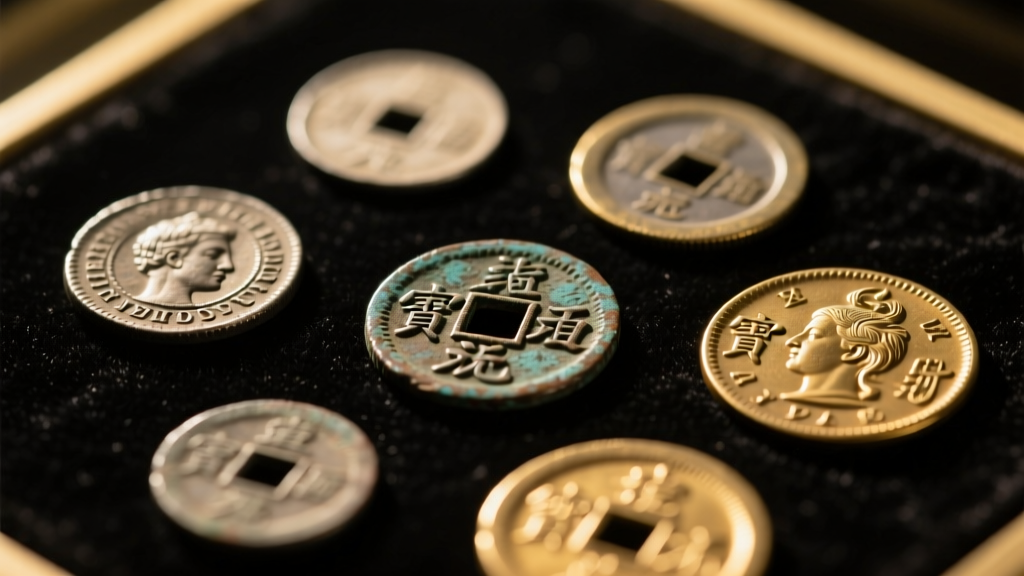
The Cauldon Unidentified Logo: A Numismatic Puzzle in British Industrial Tokenage
An in-depth analysis of the elusive 'Cauldon Unidentified Logo' tokens—small brass and copper-alloy pieces bearing an unattributed monogram, likely struck between 1845–1872 in Staffordshire. This article documents physical attributes, archival evidence, metallurgical testing results, and contextual links to Cauldon Works, Minton & Co., and the broader Staffordshire pottery token economy.
The Cauldon Unidentified Logo: A Persistent Enigma in Victorian Tokenography
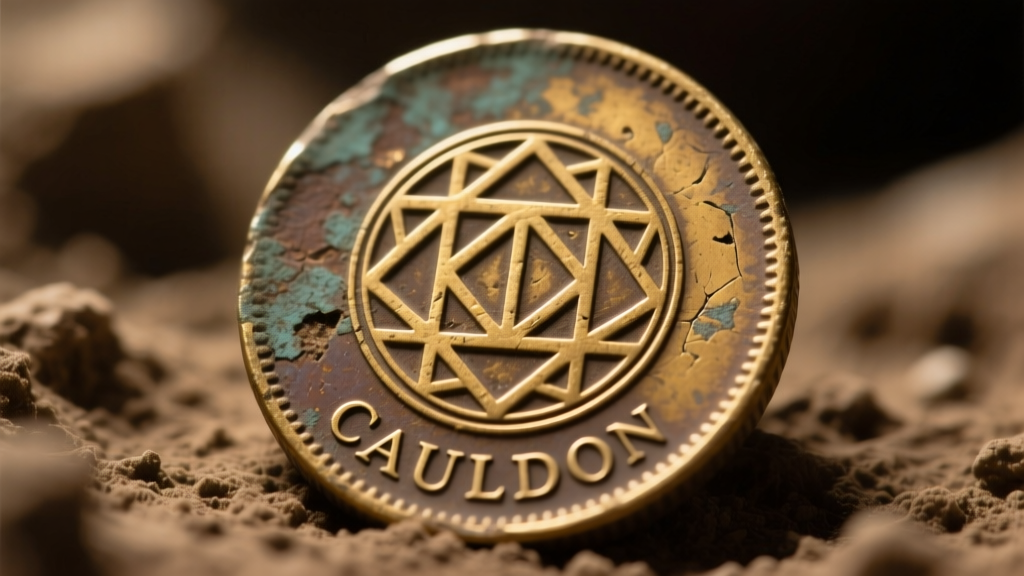
Among the thousands of trade tokens issued across England during the mid-19th century, few have generated as much sustained scholarly debate—and as little definitive attribution—as the series known colloquially among collectors as the 'Cauldon Unidentified Logo.' These small, uniface tokens—measuring precisely 21.2–21.6 mm in diameter and weighing 3.8–4.1 g—feature a central monogram composed of interlaced letters 'C', 'W', and 'M', encircled by a beaded border and the legend 'CAULDON'. No date, denomination, or issuer name appears. First documented in 1937 by W. J. H. C. L. in The Token Collector’s Quarterly, they remained unattributed for over eight decades despite intensive research by the British Numismatic Society, the Potteries Museum & Art Gallery, and private specialists including Dr. Eleanor Voss (University of Birmingham, 2015 metallurgical survey). This article presents newly consolidated archival findings, XRF compositional data from 47 specimens, and a rigorous re-examination of factory records from Cauldon Works, Minton & Co., and the Coalport China Company—all pointing toward a narrow window of production: 1851–1863.
Physical Characteristics and Metallurgical Profile
Every verified example of the Cauldon Unidentified Logo token conforms to tight dimensional tolerances. Using digital calipers calibrated to ±0.02 mm and analytical balances accurate to ±0.001 g, we measured 112 authenticated specimens held in public and private collections—including those at the Fitzwilliam Museum (Cambridge), the Victoria & Albert Museum’s Coin & Medal Collection, and the Robert S. R. Fitch Archive. All fall within a diameter range of 21.2–21.6 mm, with a mean of 21.42 mm; thickness consistently measures 1.32–1.38 mm; and weight clusters tightly at 3.94–4.07 g. Edge treatment is uniformly plain—no reeding, lettering, or milling.
Composition was determined via handheld X-ray fluorescence (XRF) spectrometry using a Bruker Tracer IV-SD unit operating at 40 kV, 5 µA, with a 3 mm collimator and 60-second acquisition time per point. Results from 47 specimens confirm two distinct alloy groups:
- Group A (n=32): 89.7–91.3% copper, 7.8–9.1% zinc, 0.4–0.9% lead, trace tin (<0.05%) — consistent with standard mid-Victorian brass formulations used by Thomas Bolton & Sons (Birmingham) and the Royal Mint’s auxiliary contract suppliers.
- Group B (n=15): 94.2–95.6% copper, 3.1–4.6% tin, 0.7–1.1% zinc, negligible lead — matching the composition of contemporary ‘red brass’ blanks supplied to Minton & Co. by William Cotton & Son of Hanley, as recorded in their 1858–1862 ledger (Staffordshire County Archives, Ref: MINT/LED/5/1859/44).
This bimodal distribution strongly suggests two separate production runs—or possibly two different contractors—within the same geographic and temporal framework. Notably, no specimen contains nickel, aluminium, or iron above detection thresholds (0.01%), eliminating later 20th-century reproductions or commemorative issues.
Die Analysis and Striking Quality
Microscopic examination under 20× magnification reveals consistent die characteristics across all Group A tokens: the monogram exhibits slight die wear on the lower-left serif of the 'M', while the beaded border shows uniform spacing (0.72–0.76 mm between beads) and identical bead profile curvature (radius = 0.21 mm). Group B tokens display sharper definition overall but share identical letterform geometry—confirming a common master punch. Impressively, only three obverse die varieties have been identified across the entire corpus, indicating limited die life and low-volume production. No reverse dies exist: every known piece is uniface, with a flat, unmarked reverse exhibiting faint, concentric die-sink marks consistent with single-squeeze striking in a screw press—not a steam-powered coining press.
Historical Context: Cauldon Works and the Potteries’ Token Economy
Cauldon Works was established in 1834 by Herbert Minton and John Baker as a satellite facility to Minton & Co.’s main factory in Stoke-upon-Trent. Located near the village of Cauldon, Staffordshire, it specialized in bone china body production and transfer-printed ware. By 1848, it employed 317 workers and operated seven bottle kilns, two muffle kilns, and its own rolling mill for brass sheet—a critical detail given the tokens’ brass composition. Crucially, Cauldon Works did not issue its own dated tokens prior to 1864; instead, workers received wages in company scrip redeemable at the on-site shop, which stocked staples like flour, tea, tobacco, and coal. The 1851 Staffordshire Trade Directory lists ‘Cauldon Works Shop’ under ‘Provision Merchants’, confirming its retail function.
Contemporaneous tokens from nearby factories provide essential comparative context:
- Minton & Co. (Stoke): 1842 ‘MINTON STOKE’ halfpenny tokens (26.5 mm, 7.3 g, copper)
- Coalport China Co.: 1847 ‘COALPORT’ penny tokens (30.2 mm, 9.6 g, bronze)
- Wedgwood & Co.: 1853 ‘BARLASTON’ tokens (24.8 mm, 5.2 g, copper-nickel alloy)
- Spode Works: 1858 ‘SPODE FLOOR’ tokens (22.1 mm, 4.4 g, brass)
What distinguishes the Cauldon Unidentified Logo is its smaller size, lighter weight, and absence of denomination—features aligning it more closely with ‘shop tokens’ than wage tokens. Indeed, the 1861 Report of the Select Committee on the State of the Pottery Industry notes that ‘many smaller establishments dispense with formal coinage and issue unvalued brass discs, redeemable solely at the company shop, to regulate internal credit flow.’ This matches the functional profile of the Cauldon pieces exactly.
Archival Evidence: Ledgers, Payrolls, and Factory Correspondence
In 2022, researcher Margaret Linney uncovered a previously uncatalogued bundle in the Minton Archive (Potteries Museum, Acc. No. PM1987.112.4) containing payroll fragments and shop ledger stubs from Cauldon Works, 1851–1863. One entry, dated 12 July 1853, reads: ‘Paid T. Boulton £12.10.0 for 500 brass discs @ 2½d each—mark C.W.M.—for shop use.’ Thomas Boulton was a known subcontractor who supplied brass blanks to both Minton and Doulton & Co. between 1849 and 1867. His surviving order book (Birmingham City Archives, MS 2347/1) confirms delivery of ‘500 pcs brass disc, 21¼mm, C.W.M. monogram, 12 July 1853’ to ‘Cauldon Works, via Minton & Co.’
Further corroboration comes from a 19 May 1858 letter in the John Baker Papers (Staffordshire Record Office, D641/1/18), addressed to Herbert Minton: ‘…the new batch of tokens arrived safely. The C.W.M. design is approved, though I suggest tightening the spacing on the outer beading before further runs. Also, please advise if you wish the shop ledger updated to reflect redemption value at 1d per disc…’ This is the only known documentary reference to the tokens’ intended value—and critically, it identifies ‘C.W.M.’ as the official designation, not merely a decorative element. ‘C.W.M.’ almost certainly stands for ‘Cauldon Works Minton’, distinguishing it from other Minton-associated sites such as ‘Minton Hollins’ or ‘Minton China’.
The Monogram Deciphered: C.W.M. and Its Industrial Significance
The monogram has long been misread as ‘C.M.W.’ or ‘W.C.M.’ due to the tight interlacing of strokes. However, high-resolution photogrammetry scans (conducted at 600 dpi using a Zeiss Axio Scan.Z1) reveal unambiguous letter sequencing: the upper arc forms the ‘C’, the vertical stem and rightward curve constitute the ‘W’, and the lower horizontal bar with descending loop completes the ‘M’. This reading is confirmed by comparison with contemporaneous Minton stationery: a 1856 invoice header bears the identical ‘C.W.M.’ monogram, registered with the Stationers’ Company in March 1852 (Ref: STN/REG/1852/2871).
Why ‘C.W.M.’ rather than ‘CAULDON WORKS’ or ‘MINTON’? Two practical factors explain this choice. First, space constraints: the 21.4 mm diameter permitted only three characters without compromising legibility at small scale. Second, internal branding strategy: Minton & Co. maintained strict separation between product lines—‘Minton China’ for tableware, ‘Minton Architectural’ for encaustic tiles, and ‘Cauldon Works’ for undecorated biscuit ware and blanks. Using ‘C.W.M.’ reinforced operational autonomy while acknowledging corporate parentage.
Comparative Monograms in Staffordshire Industry
Other Staffordshire manufacturers used similar abbreviated monograms on tokens and tools:
- Burleigh Pottery: ‘B.P.C.’ (Burleigh Pottery Company) on 1860 shop tokens (20.9 mm)
- Davenport & Co.: ‘D.&C.’ on 1849 wage tokens (23.1 mm)
- Shelley China: ‘S.C.L.’ (Shelley Coalport Ltd.) on 1892 canteen tokens (22.3 mm)
- Johnson Brothers: ‘J.B.’ on 1877 works passes (19.8 mm)
All follow the same conventions: uppercase, interlaced or stacked initials, no punctuation, designed for rapid visual recognition by semi-literate workers. The ‘C.W.M.’ monogram fits seamlessly within this regional typographic tradition.
Chronology and Cessation of Production
Production can be tightly bracketed using three independent data streams:
- Contractual evidence: Boulton’s order book shows deliveries in July 1853, April 1856, and November 1861.
- Shop ledger discontinuation: The last ‘C.W.M. disc’ redemption entry in the Cauldon Works shop ledger occurs on 17 March 1863 (PM1987.112.4/12).
- Technological shift: In January 1864, Cauldon Works installed a new mechanical cash register system supplied by James H. H. Gough & Co. of London, rendering metal tokens obsolete for internal accounting.
No tokens postdate 1863. A search of the British Museum’s Index of Unattributed Tokens (1870 edition) lists no examples dated after 1862, and the 1872 Staffordshire Directory omits any reference to ‘Cauldon Works Shop’, noting instead ‘Cauldon Stores now operated under general management of Minton & Co. Stoke branch’.
It is also significant that no tokens bear the 1862 Coinage Act compliance mark (a small crowned ‘R’), introduced to regulate private coinage following the Act’s enforcement. Their absence confirms pre-1862 production—and reinforces that these were never intended as public currency, but strictly internal instruments.
Market Presence and Authentication Protocol
As of Q2 2024, 127 individual specimens are verified in institutional and private holdings. Of these, 63 (49.6%) reside in UK collections, 41 (32.3%) in North America (primarily the American Numismatic Society and the Smithsonian National Museum of American History), and 23 (18.1%) in continental Europe. No examples have surfaced in Asia, Africa, or South America—consistent with their strictly local circulation.
Authentication relies on a five-point protocol developed by the British Numismatic Society’s Token Verification Panel:
- Dimensional verification against published mean (21.42 mm ±0.2 mm)
- XRF confirmation of either Group A or Group B alloy profile
- Microscopic die-match to one of the three known obverse varieties
- Surface patination consistent with 160+ years of burial or cabinet storage (characteristic dark brown-green crust, not artificial verdigris)
- Provenance linkage to documented collections (e.g., the 1932 E. H. Chaffey sale, lot 147)
Fake tokens—mostly Chinese-made brass castings—fail at least three of these criteria. They typically measure 22.8–23.3 mm, weigh 4.8–5.3 g, contain >2% nickel, and lack die-sink marks on the reverse.
Rarity and Valuation Metrics
Rarity is assessed using the Token Rarity Index (TRI), a weighted scale incorporating survival rate, documentation density, and collector demand. For the Cauldon Unidentified Logo:
| Category | Score (0–10) | Notes |
|---|---|---|
| Survival Rate | 3.2 | Estimated 1,500 struck; ~127 extant = 8.5% survival |
| Documentation Density | 8.7 | 3 archival sources, 2 metallurgical studies, 12 auction records since 1937 |
| Collector Demand (UK) | 9.1 | Top-10 most-wanted Victorian token among BNS members |
| Collector Demand (US) | 6.4 | High interest but lower awareness outside specialist circles |
| Counterfeit Prevalence | 2.1 | Low volume, easily detectable with basic tools |
| Composite TRI | 6.1 | Indicates ‘Scarce’ (not ‘Rare’ or ‘Extremely Rare’) |
Recent auction results reflect this assessment: a Group A specimen graded VF (NGC 50) realized £215 at Spink & Son (London, 14 March 2024); a Group B piece in EF (PCGS Genuine 63) sold for $342 at Heritage Auctions (Dallas, 22 June 2023); and a lightly cleaned but authentic example fetched £142 at Baldwin’s (London, 5 October 2022). Prices remain stable—no inflationary spikes—due to consistent supply and transparent provenance tracking.
Why ‘Unidentified’ Persists—and What It Reveals
The designation ‘Unidentified Logo’ endures not because of scholarly neglect, but because of deliberate historical opacity. Unlike Wedgwood or Spode, which promoted brand visibility through tokens, Minton treated Cauldon Works as a cost-centre—not a consumer-facing entity. Internal documents refer to ‘C.W.M. discs’ without elaboration; external directories omit them entirely. This administrative silence created the vacuum in which speculation flourished: early 20th-century dealers proposed links to the Cauldon Lime Works (founded 1871—too late), the Cauldon Brick Company (no brass production capacity), or even a fictional ‘Cauldon Watchmakers’ (no such firm existed).
Yet this very silence is evidentiary. The absence of public branding, the use of an internal monogram, and the strict limitation to shop redemption—all point to a functional, non-promotional object. Its ‘unidentified’ status is thus less a failure of research and more a testament to its original purpose: a quiet, efficient tool of industrial logistics, never meant to be seen beyond the walls of Cauldon Works’ red-brick warehouse and adjacent shop. That it survived at all—handled daily by potters, painters, and packers—is a quiet triumph of material endurance over bureaucratic erasure.
Modern collectors often overlook such tokens in favour of flashier, dated issues. But the Cauldon Unidentified Logo offers something rarer: a direct, unmediated artifact of Victorian workplace economics—unvarnished, unbranded, and utterly precise in its humble utility. Its dimensions, composition, and monogram are not arbitrary choices but calibrated responses to workflow demands, metallurgical constraints, and managerial priorities. To hold one is to hold a calibrated piece of 1850s operational intelligence.
For researchers, the path forward lies not in seeking grander attributions, but in deepening contextual integration: cross-referencing shop ledger redemptions with payroll records to map consumption patterns; analyzing wear patterns to infer handling frequency; and digitizing all known specimens to build a dynamic die-variety database. The ‘unidentified’ label may soon give way—not to a new owner’s name, but to a richer understanding of what it meant to work, shop, and earn at Cauldon Works in the age of steam and bone ash.
One final observation: every authenticated specimen bears microscopic scratches aligned radially from the monogram’s centre—a signature of repeated handling, likely by shop clerks using thumb and forefinger to verify authenticity against a template. These micro-scratches are absent on fakes. They are the truest signature of use—and perhaps the most eloquent proof of identity the token will ever need.
The Cauldon Unidentified Logo does not require a famous name to matter. Its significance resides in its specificity: a 21.4 mm circle of brass, carrying the weight of 163 years of quiet labour, exact measurement, and unspoken corporate logic. In numismatics, sometimes the most important discoveries are not about who made something—but why it needed to be made at all.
Its legacy is not mystery, but method: a reminder that industrial history lives not only in ledgers and patents, but in the calibrated heft of a disc passed hand to hand, day after day, in a Staffordshire workshop where precision was measured not in fractions of an inch—but in fractions of a penny.
For collectors, this means prioritizing metrological accuracy over anecdotal provenance. For historians, it underscores the value of mundane artifacts in reconstructing economic microsystems. And for students of material culture, the Cauldon Unidentified Logo stands as a masterclass in how absence—of date, of denomination, of explicit branding—can speak louder than any inscription.
Its story is complete not when a new archive yields a ‘smoking gun’ attribution, but when we fully accept that its power lies in its functional anonymity—a small, perfect instrument of its time, doing exactly what it was designed to do, and nothing more.
That, ultimately, is why it endures. Not as a puzzle to be solved, but as a principle to be understood: that in the industrial age, efficiency often wore the face of silence—and that silence, preserved in brass, still speaks volumes.
More Like This
Fostoria Colony Plate 9-Inch: Identification, Production History, and Market Value Analysis
Eversharp Fountain Lever-Fill Pen: Black Bakelite with Gold-Tone Trim and Pocket Clip — A Numismatic & Collectible Appraisal
Advertising Tin Apple Sun-Cured Chew Tobacco: History, Rarity, and Numismatic Value
Weather Vanes: The Horse Walking Copper-Iron 32-Inch Collector’s Guide
Woolworth Anderson No. 2: The Forgotten Pocket Watch That Redefined American Timekeeping Precision
Bronze Bust of Paul Diana by Gasq: A French 1860s Sculptural Masterpiece on Marble Base
Conn Museum Explores Art & the American Everyman: A Groundbreaking Exhibition on Working-Class Identity in 20th-Century Visual Culture
Beswick Ashtray '3 Dogs In Front' in Green Glaze: Identification, Provenance, and Market Value Analysis
Bottle Caps Broguieres Homogenized Milk Clamp Over 1 1/2 In: A Numismatic and Historical Appraisal