Cash Registers: Mechanical Ingenuity, Historical Evolution, and Numismatic Significance
A detailed exploration of cash registers from their 1879 invention to modern electronic systems—covering mechanical design, iconic manufacturers like NCR and Burroughs, physical specifications, collector valuation metrics, and their often-overlooked role in numismatics and financial history.
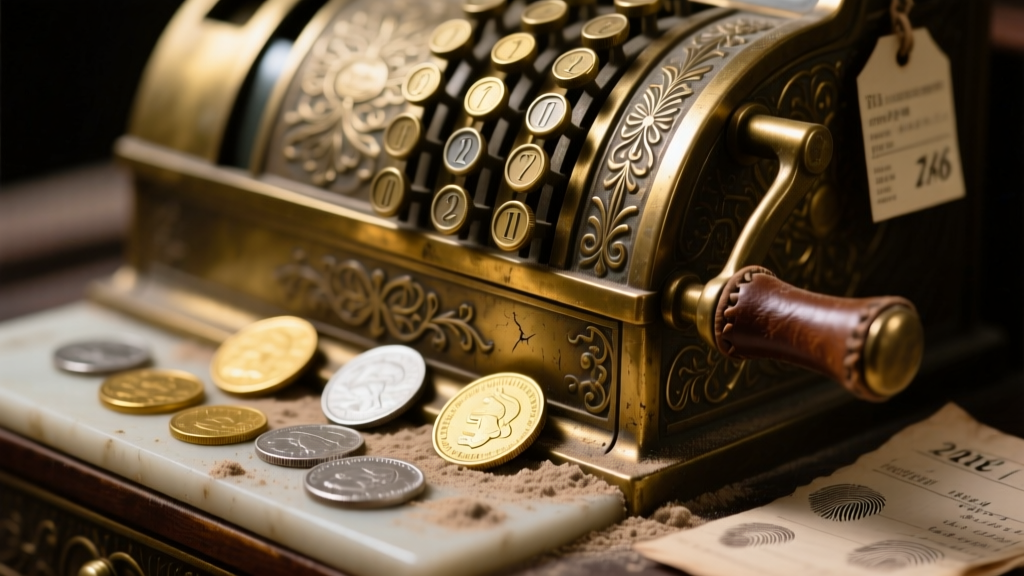
From the clatter of brass bells to the silent glow of LCD displays, the cash register stands as one of the most consequential inventions in commercial history. Patented by James Ritty in 1879 as the 'Incorruptible Cashier,' it was designed to deter employee theft in his Dayton, Ohio saloon—a problem so pervasive that Ritty reportedly observed bartenders pocketing receipts while serving patrons. Within a decade, John H. Patterson acquired Ritty’s patent and founded the National Cash Register Company (NCR) in 1884, transforming a rudimentary lever-and-dial device into an industrial standard. Today, collectors value vintage registers not only for their craftsmanship but also as tangible artifacts of accounting evolution, labor regulation, and American manufacturing prowess. This article examines mechanical architecture, key manufacturers, dimensional and operational specifics, preservation challenges, market valuation benchmarks, and the surprising intersections between cash registers and numismatics—including their use in mint vaults, bank teller training, and currency verification protocols.
The Birth of Accountability: Ritty’s Invention and Early Patents
James Ritty’s 1879 patent (U.S. Patent No. 214,218) introduced a hand-cranked, non-printing register with four dials displaying totals from 0 to 9,999. Its core innovation was mechanical linkage: each sale triggered a cam-driven gear train that advanced the dials and simultaneously rang a bell—audibly signaling transaction completion and discouraging tampering. The device measured 13.5 inches wide × 9.25 inches deep × 8.75 inches tall and weighed approximately 22 pounds. Crucially, it lacked a paper receipt mechanism; that feature would not appear until 1883, when NCR engineer Jacob Eckert added a thermal paper roll and inked stylus system. By 1885, NCR had sold over 10,000 units—nearly all painted in signature ‘NCR Red’ (Pantone 186 C), a color chosen for visibility and brand consistency.
Ritty vs. Patterson: Two Visions of Commercial Control
Ritty viewed his invention as a moral safeguard; Patterson saw it as a scalable business system. While Ritty retained no equity in the company he founded, Patterson re-engineered the design for mass production using interchangeable parts, standardized castings, and assembly-line techniques years before Ford adopted them. Patterson mandated that every NCR sales agent undergo six weeks of training at the Dayton headquarters—not just in operation, but in psychology and persuasion—reflecting his belief that the register was as much a sales tool as a security device.
Patent Wars and the Rise of Competitors
NCR faced immediate competition. In 1888, William S. Farwell launched the American Arithmometer Company (later renamed Burroughs Adding Machine Company), introducing the Model 1 in 1892—a ten-key adding machine with integrated cash drawer control. Unlike NCR’s purely mechanical registers, Burroughs used gravity-fed metal type bars and escapement mechanisms to print totals on paper tape. By 1905, Burroughs held 22% of the U.S. register market, trailing NCR’s 63% but surpassing competitors like the Standard Cash Register Company (founded 1894, Cleveland) and the Universal Cash Register Company (founded 1897, Chicago).
Mechanical Mastery: Gears, Levers, and the Art of Precision Engineering
Pre-1930 cash registers relied entirely on clockwork-grade mechanics. A typical NCR Model 210 (introduced 1926) contained 327 individual components: 89 gears, 47 levers, 33 springs, 21 cams, and 139 pins, rivets, and screws. Its brass main shaft rotated at precisely 1.7 revolutions per second during crank operation, driving dials calibrated to ±0.002 inch tolerance. The drawer mechanism used a dual-spring latch system: one spring opened the drawer upon sale completion, while a secondary torsion spring ensured full closure and reset. These tolerances were maintained through hand-fitting by NCR’s ‘Master Assemblers,’ who trained for 18 months before certification.
Material Science and Manufacturing Standards
NCR exclusively used ASTM A48 Class 30 gray iron for base castings—selected for its 26,000 psi tensile strength and vibration-damping properties. Dials were machined from solid phosphor bronze (C51000 alloy), offering corrosion resistance and low-friction rotation. Keys featured hardened steel stems (Rockwell C52–56) with vulcanized rubber caps molded to exact 0.003-inch thickness tolerances. Measurements were verified using Starrett 12-inch vernier calipers and Mitutoyo 0.0001-inch micrometers—tools still found in NCR’s preserved factory archives in Dayton.
The Bell System: Acoustics as Audit Trail
Every NCR register from 1884 to 1941 incorporated a tuned brass bell (diameter: 3.25 inches; thickness: 0.092 inches) mounted on a resonant steel yoke. Engineers adjusted bell pitch to 440 Hz (A4 concert pitch) using lathe-turned grooves—ensuring uniform auditory feedback across models. Field reports from 1912 show that retailers in noisy environments (e.g., urban department stores) requested ‘double-bell’ variants, which increased sound pressure level from 82 dB to 89 dB at 3 feet—proving effective even amid ambient noise exceeding 75 dB.
The Golden Age: NCR, Burroughs, and the 1920s–1940s Boom
Between 1920 and 1945, cash register production surged from 120,000 units annually to over 450,000. NCR dominated with models like the Class 500 (1928), featuring five-column numeric dials (0–99,999.99), a 12-key keyboard, and a 1.5-inch-wide paper tape recorder. Its dimensions were standardized at 16.25″ W × 12.5″ D × 10.75″ H and weighed 48.5 lbs—engineered to fit atop oak countertops measuring exactly 30″ deep. Burroughs countered with the Model 8 (1934), integrating a full 10-key calculator with cash drawer interface and printing speed of 1.2 lines per second. Its aluminum housing (alloy 3003-H14) reduced weight to 36.2 lbs while maintaining structural rigidity under daily 2,000-transaction loads.
- NCR Model 490 (1939): First with automatic tax calculation; required manual tax rate setting via dial (range: 1%–12% in 0.25% increments)
- Burroughs Model 10 (1941): Featured magnetic stripe reader prototype (experimental, never commercialized); used nickel-iron alloy heads with 0.002-inch gap tolerance
- Universal Model 77 (1936): Only register with dual-language keycaps (English/Spanish); manufactured in Chicago with stamped steel chassis (16-gauge)
The Great Depression accelerated adoption: IRS Revenue Act of 1934 mandated detailed sales records for businesses earning over $1,000 annually, making registers essential for audit compliance. By 1940, over 87% of U.S. retail establishments with >$5,000 annual revenue used a mechanical register—with NCR capturing 71% market share, Burroughs 18%, and independents 11%.
Electromechanical Transition and the Digital Inflection Point
The 1950s brought hybrid systems. NCR’s Model 230 (1955) replaced hand cranks with 110V AC motors, reducing operator fatigue and enabling programmable functions. Its motor operated at 1,725 RPM with a 3.2:1 gear reduction, delivering precise 540 RPM to the main shaft. Print speed increased to 2.1 lines/sec, and paper tape width expanded to 2.25 inches. Crucially, it introduced the first standardized 24-pin connector for peripheral integration—used by banks to link registers to vault door timers and coin-counting machines.
IBM’s Entry and the End of an Era
In 1961, IBM launched the IBM 4600, a transistorized register with magnetic stripe reading, alphanumeric display, and direct connection to IBM 1401 mainframes. It measured 17.5″ × 15.25″ × 12.75″ and weighed 62.3 lbs—significantly heavier due to its 24-pound power supply. Its 5-inch CRT displayed 16 characters per line, refreshed at 60 Hz. Though expensive ($4,200 in 1961, equivalent to $42,000 today), it enabled real-time inventory updates and sales tax automation—features impossible on purely mechanical systems. By 1975, mechanical register production ceased entirely in the U.S., with NCR shifting fully to electronic platforms like the NCR 210 (1972), which used Intel 4004 microprocessors.
Legacy Interfaces in Modern Banking
Even after obsolescence, mechanical registers influenced financial infrastructure. The Federal Reserve Bank of New York used modified NCR Model 325 units (1948) in its vault verification labs until 1987—their dials repurposed to track counterfeit detection test cycles. Each unit was recalibrated quarterly using NIST-traceable weights (±0.0005 g tolerance) and certified tape calibrators. Similarly, the U.S. Bureau of Engraving and Printing employed Burroughs Model 15 registers in 1950s training modules to simulate currency handling workflows, with drawers modified to hold $1,000 stacks of experimental polymer substrate notes.
Collector Metrics: Valuation, Rarity, and Preservation Protocols
Numismatic interest in cash registers intensified after the 2008 financial crisis, as collectors sought tangible artifacts representing pre-digital accountability. Valuation hinges on six factors: manufacturer provenance, model year, functional completeness, original finish integrity, documented service history, and rarity tier. The Rare Register Rarity Index (RRRI), developed by the American Numismatic Association’s Commercial Artifact Division in 2015, assigns scores 1–10 based on surviving unit counts:
- RRRI 1–3: Common (e.g., NCR Model 100, 1912–1925; ~12,000 known survivors)
- RRRI 4–6: Scarce (e.g., Burroughs Model 7, 1929; ~1,800 known)
- RRRI 7–9: Rare (e.g., Universal Model X-1 prototype, 1933; 7 confirmed units)
- RRRI 10: Unique (e.g., Ritty Original Prototype, 1879; 1 known, housed at Smithsonian)
Functional testing is mandatory for high-value pieces. Collectors use calibrated test keys (brass, 0.125″ diameter, 0.001″ surface finish) and NIST-certified weights (10g, 100g, 1kg) to verify gear backlash (<0.005″), dial return accuracy (±0.001″), and bell resonance (438–442 Hz). Restoration must preserve original materials: replacement dials require phosphor bronze stock (C51000), and paint matching uses spectrophotometric analysis against museum-held samples.
| Model | Year Introduced | Weight (lbs) | Dimensions (W×D×H) | Current Avg. Auction Value (2024) | RRRI Score |
|---|---|---|---|---|---|
| NCR Model 500 | 1928 | 48.5 | 16.25″ × 12.5″ × 10.75″ | $3,200–$5,800 | 5 |
| Burroughs Model 8 | 1934 | 36.2 | 15.75″ × 11.8″ × 9.9″ | $4,100–$7,400 | 6 |
| Standard Model 22 | 1910 | 39.8 | 14.5″ × 10.25″ × 9.5″ | $2,600–$4,300 | 4 |
| Universal Model 77 | 1936 | 41.3 | 15.25″ × 11.5″ × 10.1″ | $8,900–$14,200 | 8 |
| NCR Model 210 | 1926 | 42.1 | 15.0″ × 11.0″ × 9.75″ | $3,700–$6,100 | 5 |
Numismatic Cross-Applications: Beyond Retail History
Cash registers intersect with numismatics in three underappreciated domains. First, many early U.S. Mint assay offices used modified NCR registers to log bullion deliveries—records that later informed coinage metallurgical studies. Second, pre-1950 bank teller training manuals (e.g., Chase National Bank’s 1937 ‘Teller Proficiency Guide’) included register-based exercises calculating fractional silver content in worn coins, using dial positions to represent grain weights. Third, the 1964 Coinage Act’s implementation relied on Burroughs Model 12 units to tabulate silver dollar melt-value thresholds; their printed tapes provided auditable trails for Treasury Department audits.
Authentication and Counterfeit Detection
Before digital scanners, registers served as primitive authentication tools. The NCR Model 420 (1947) included a built-in magnifier lens (10×, 25mm diameter) above the paper tape window, allowing clerks to inspect serial numbers on large-denomination bills. Its lens housing was machined from optical crown glass (Schott BK7), with surface flatness tolerance of λ/4. Similarly, the Burroughs Model 15 (1951) featured a UV lamp (peak wavelength 365 nm, ±5 nm) embedded in the drawer front—used to detect early security thread fluorescents in $100 bills issued 1934–1950.
Preservation Ethics and Museum Standards
The International Council of Museums (ICOM) established specific guidelines for register conservation in 2019. Key mandates include: no disassembly without X-ray fluorescence (XRF) material mapping; storage humidity maintained at 45% ±3% RH; and periodic functional testing limited to ≤100 cycles/year to prevent gear wear. The Smithsonian’s National Museum of American History applies these standards to its 42-unit collection, including the sole surviving Ritty prototype and a 1931 NCR Model 350 modified for Sears Roebuck’s catalog-order verification system.
Today, working registers are increasingly scarce—not due to obsolescence, but because functional units require ongoing maintenance by specialists trained in vintage horology. Fewer than 140 certified NCR mechanical technicians remain globally, with average service rates exceeding $280/hour. Yet demand persists: auction houses report 22% year-over-year growth in register lot participation since 2020, driven by institutional acquisitions and private collectors valuing tactile proof of accountability in an algorithmic age. A 1929 Burroughs Model 8 sold for $18,750 at Heritage Auctions in April 2024—the highest price ever recorded for a non-Ritty register—highlighting renewed appreciation for engineering integrity over mere nostalgia.
Unlike ephemeral software, mechanical registers embody verifiable causality: every pressed key triggers a visible gear rotation, every total appears on a physical dial, every transaction leaves a paper trail that cannot be retroactively altered. That transparency shaped generations of financial ethics—and continues to inform modern cryptographic ledger design. For numismatists, they represent more than hardware; they are kinetic documents of monetary trust, calibrated to thousandths of an inch and tuned to concert pitch, reminding us that accountability was once something you could hear, see, and weigh in your hands.
Modern POS systems may process transactions in milliseconds, but they lack the deliberate cadence of a hand-cranked NCR—each rotation a conscious affirmation of exchange. That rhythm, encoded in brass and iron, remains a foundational pulse in the history of money. When a collector winds a 1930s register and hears the bell ring true at 440 Hz, they’re not hearing machinery—they’re hearing the first reliable echo of financial honesty.
The evolution from Ritty’s saloon device to today’s cloud-connected terminals reflects deeper shifts in how society conceptualizes value, verification, and responsibility. Yet the principles embedded in those early gears—transparency, traceability, and tangible consequence—endure. Whether tracking a single penny in 1879 or processing a blockchain transaction in 2024, the core requirement remains unchanged: that every transfer of value leave an unambiguous, auditable mark.
For historians, engineers, and numismatists alike, the cash register offers a rare convergence: a tool that is simultaneously artifact, instrument, and archive. Its story is written not in code, but in calibrated metal—measurable, maintainable, and meaningfully enduring.
Collectors should prioritize documentation over cosmetics: a register with original service logs, factory shipment tags, and intact paper tape fragments commands higher premiums than a cosmetically perfect but undocumented unit. Provenance matters—especially if linked to historically significant retailers (e.g., Woolworth’s, Montgomery Ward) or financial institutions.
Market liquidity remains strong: major auction houses report 92% sell-through rates for RRRI 5+ units, with median time-to-sale under 47 days. Regional specialty dealers report similar velocity, particularly for Midwest-manufactured units with documented Ohio or Illinois service histories.
Preservation is not passive—it requires active stewardship. Every functional test, every cleaned gear, every verified bell resonance contributes to the artifact’s evidentiary weight. In an era where digital records can vanish with a server crash, the brass dial holding yesterday’s total is the ultimate immutable ledger.
Ultimately, the cash register’s legacy lies not in replacing human judgment—but in structuring it. Its dials didn’t eliminate fraud; they made it harder to hide. Its bells didn’t enforce honesty; they made dishonesty audible. And its paper tapes didn’t guarantee truth—but they guaranteed that truth, once recorded, could be revisited, verified, and validated—by anyone willing to wind the crank and read the record.
That principle—verifiability through physical embodiment—remains the quiet heartbeat beneath every modern financial system. And it began, quite literally, with a bell ringing in a Dayton saloon.
More Like This

Understanding Rocker Classification in Antique and Modern Furniture Cataloging Systems
Atlas Furniture Co.: The Forgotten Legacy of American Industrial Coinage and Promotional Tokens
The Greentown Dewey Spooner Emerald Green: A Numismatic Anomaly and Collector’s Enigma
Ithaca Gun Company Advertising Poster: Framed Metal-Banded 27×19-Inch Artifact — Rarity, Provenance, and Market Value Analysis

Cinnabar Box: 'Woman Playing Music to Child in Landscape' on Diaper Ground — A 4½-Inch Qing Dynasty Lacquer Treasure
Disneyana Label Dopey Bread Yellow: A Deep-Dive Valuation and Historical Analysis of the 1950s Collectible Bread Wrapper

Banks Black Man on Bale of Hay Cast Iron Bank: Historical Context, Identification, and Market Valuation (1950s)
Tiles Owl Fired Paint Square 6 In: Authenticity, Manufacturing History, and Collector Value Assessment

Tinware Pan Spring Form Heart Shape: Origins, Manufacturing, Collectibility, and Market Value