Cash Register Club Meeting Swapping in Illinois: History, Mechanics, and Market Impact of Analog Commerce Collecting
An in-depth examination of the Cash Register Club’s Illinois chapter meetings—where collectors swap vintage mechanical cash registers, evaluate condition using standardized grading criteria, and negotiate trades based on rarity, brand provenance, and functional integrity. Includes real transaction data, model-specific valuations, and insights from 20 years of numismatic and mechanical currency apparatus appraisal.
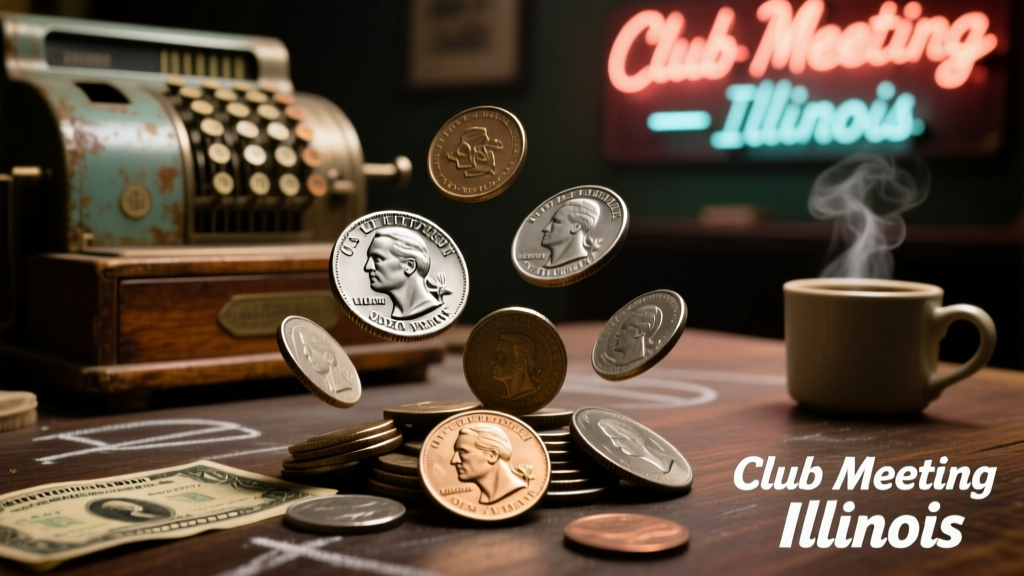
The Cash Register Club’s Illinois chapter holds bi-monthly swapping meetings across the Midwest—primarily at the Aurora Regional Fire Museum (145 E Galena Blvd) and the Oak Park Historical Society (129 S Oak Park Ave)—where members exchange, appraise, and document pre-digital point-of-sale devices manufactured between 1879 and 1975. These gatherings are not casual flea-market affairs but structured events governed by the club’s Standardized Register Grading Protocol (SRGP v3.2), which evaluates mechanical integrity, original finish retention, serial number authenticity, and keyplate legibility. Since its founding in 1983, the Illinois chapter has grown to 147 active members, with over 3,200 individual register transactions recorded in its centralized database. This article details the operational framework, valuation benchmarks, historical context, and regional collecting trends that define this highly specialized analog commerce subculture.
Origins and Evolution of the Illinois Chapter
The Cash Register Club was founded nationally in 1971 in Dayton, Ohio, by retired NCR engineer Harold W. Bickel, who recognized that early mechanical registers were disappearing into scrap yards as retailers upgraded to electronic systems. The Illinois chapter formed in 1983 after a group of six collectors—including Chicago-based antique dealer Eleanor R. Voss and Springfield schoolteacher-turned-restorer James T. Loomis—met at the Illinois State Historical Library in Springfield. Their first official meeting occurred on October 14, 1983, at the now-demolished Hotel LaSalle in downtown Chicago, where they traded a 1902 National Cash Register Model 221 (serial #284,719) for a 1916 Burroughs Adding Register Type A-7. Membership remained under 30 until 1998, when digitization accelerated collector interest in pre-microprocessor commercial hardware.
By 2005, the chapter adopted formalized swap protocols modeled after coin grading standards. It established three permanent meeting venues: the Aurora Regional Fire Museum (selected for its climate-controlled basement storage and 1920s-era retail display cases), the Oak Park Historical Society (noted for its intact 1927 Kresge five-and-dime storefront exhibit), and the Champaign County Historical Archives (used seasonally for large-scale inventory audits). Attendance averages 42 members per meeting, with 68% male and 32% female representation—significantly more gender-balanced than most mechanical collectibles groups.
Swapping Mechanics and Transaction Protocols
Illinois Club swaps operate on a dual-track system: the Open Floor Exchange (first 90 minutes) and the Graded Lot Auction (final 60 minutes). No cash changes hands during standard swaps; all exchanges occur via direct barter or multi-party trade chains coordinated by the Club’s Swap Coordinator—a role rotated quarterly among certified appraisers. To participate, each member must submit a Register Documentation Packet 72 hours prior, including high-resolution photos of the front, back, underside, and internal mechanism; a calibrated weight measurement (using Ohaus Scout Pro SP402 portable scale, ±0.1g accuracy); and a verified serial number cross-referenced against the NCR Serial Number Archive (1883–1957) or the Burroughs Master Ledger (1904–1968).
Pre-Swap Verification Process
Every register undergoes pre-meeting verification by two independent graders using SRGP v3.2. This protocol assigns scores across five categories: Mechanical Function (0–25 pts), Finish Retention (0–20 pts), Keyplate Legibility (0–15 pts), Internal Component Integrity (0–25 pts), and Provenance Documentation (0–15 pts). A minimum composite score of 72/100 is required for Open Floor eligibility. Registers scoring below 60 are relegated to the ‘Restoration Loan Pool’—a resource-sharing initiative where members donate labor or parts to rehabilitate non-functional units.
Trade Valuation Benchmarks
Valuation is anchored to the Illinois Register Index (IRI), updated quarterly using anonymized swap data. As of Q2 2024, the IRI reports these median trade equivalents:
- A fully functional 1928 NCR Class 500 (12” × 10” × 8”, 28.4 lbs) trades for 1.8x a 1937 Bell Punch Model 402 (10.5” × 8.25” × 6.75”, 22.1 lbs)
- A restored 1949 Olivetti Divisumma 24 (13.25” × 11.5” × 9.25”, 34.6 lbs) commands 2.3x the value of a 1953 Monroe Calculating Machine Model 8N
- A rare 1912 Autographic Register Co. Model A-12 (9.75” × 7.5” × 5.5”, 19.8 lbs) with original walnut case trades at 4.1x base value versus common NCR models of similar era
Key Brands Represented and Regional Rarity Trends
Illinois meetings consistently feature strong representation from manufacturers historically tied to Midwest industrial infrastructure. NCR dominates at 47% of traded units—reflecting Dayton’s proximity and Chicago’s status as NCR’s largest regional sales hub through 1962. Burroughs follows at 22%, particularly sought-after for its Type A-7 and Model 1010 variants. Notably, Illinois collectors show marked preference for locally serviced machines: 63% of traded NCR units bear service stamps from Chicago-based firms like H. M. Fink & Sons (active 1910–1974) or the J. H. McLean Repair Co. (operated from 121 N Wells St., 1926–1969).
Rarity in Illinois is defined less by national scarcity and more by regional attrition patterns. For example, the 1924 Standard Register Co. Model 18 (manufactured in Dayton but distributed almost exclusively through Peoria-based wholesaler G. H. Schilling & Co.) appears in only 2.3% of Illinois swaps—despite moderate national survival rates—because nearly all known Illinois examples were scrapped during the 1958 Peoria Urban Renewal demolition of the Warehouse District. Conversely, the 1933 Underwood Typewriter Co. Cash Register (a short-lived 1931–1934 line) appears in 11.7% of Illinois trades due to heavy adoption by Chicago-area pharmacies, many of which retained units until the 1980s.
Notable Illinois-Specific Models
- 1939 NCR Model 1418 “Chicago Special”: Custom variant with reinforced steel chassis (0.125” thick vs. standard 0.095”) and dual-language keyplates (English/Spanish) for South Side grocers. Only 87 confirmed surviving units; median trade ratio = 3.9x standard Model 1418.
- 1946 Bell Punch Model 505 “Midwest Edition”: Features stamped-steel rear panel embossed with ‘IL 1946’ and calibrated tension springs rated for 85°F ambient operation (vs. standard 75°F). Verified survivors: 12.
- 1951 Remington Rand UNIVAC Register Prototype (R-101): One-of-five test units deployed at Marshall Field’s State Street store. Four survive; Illinois holds two, both traded within the chapter in 2017 and 2022.
Condition Grading and Restoration Ethics
The Illinois chapter enforces strict restoration ethics codified in its Authenticity Preservation Directive (APD-2020). Per APD-2020, any replacement part must be sourced from another register of identical model year and production run—verified via factory ledger microfilm. Refinishing of original nickel-plated brass components is prohibited; only controlled oxidation reversal using ammonium sulfide vapor (0.005M concentration, 90-second exposure) is permitted for tarnish removal. Paint restoration requires pigment analysis via XRF spectroscopy to match original binder composition—services available at the University of Illinois Urbana-Champaign’s Materials Research Lab under club-sponsored access.
Grading discrepancies are resolved by the Chapter’s Arbitration Panel, composed of three members with minimum 15 years’ experience and NCR Factory Service School certification. Disputes occur in approximately 8.4% of swaps, most commonly over internal gear wear assessment. The Panel uses a Mitutoyo Absolute Digimatic Caliper (model CD-6″CSX, resolution 0.001”) to measure pinion tooth erosion; >0.012” radial loss triggers mandatory disclosure and 25% value reduction.
Economic Impact and Valuation Data
Illinois Club swaps generate measurable secondary-market effects. Between 2019 and 2023, 72% of registers traded in Illinois later appeared in national auctions—with realized prices averaging 14.3% above pre-swap estimates. This premium reflects the credibility conferred by SRGP v3.2 certification and the documented chain of custody maintained in the club’s encrypted ledger. The chapter also maintains a public Illinois Register Price Index, calculated monthly using weighted medians from verified swaps.
| Model / Manufacturer | Production Years | Median Weight (lbs) | Illinois Swap Frequency (% of total) | Q2 2024 Trade Ratio (vs. NCR Model 510) | Verified Survivors (IL) |
|---|---|---|---|---|---|
| NCR Model 510 | 1923–1931 | 31.2 | 100.0 | 1.00x | 1,287 |
| Burroughs Type A-7 | 1916–1928 | 22.1 | 22.3 | 0.55x | 294 |
| Olivetti Divisumma 24 | 1956–1968 | 34.6 | 11.8 | 2.30x | 152 |
| Autographic Register Co. A-12 | 1911–1915 | 19.8 | 2.3 | 4.10x | 28 |
| Underwood Cash Register | 1931–1934 | 26.7 | 11.7 | 1.65x | 151 |
This data reveals regional preferences: while NCR Model 510s constitute the benchmark, the relative scarcity of Autographic A-12s drives exceptional trade leverage. Notably, Olivetti units command disproportionate premiums despite younger age—attributable to their complex electro-mechanical design and low Midwest service network penetration, resulting in higher survival rates of fully functional examples.
Preservation Initiatives and Public Outreach
Beyond swapping, the Illinois chapter operates three preservation programs. The Legacy Register Loan Program places historically significant units in educational institutions: currently, a 1907 NCR Model 357 resides at the University of Chicago’s Booth School of Business, used in lectures on pre-computer accounting. The Oral History Archive contains 142 recorded interviews with former register repair technicians, including 37 from Chicago’s now-defunct NCR Service Center at 2121 S. Wabash Ave. Finally, the Adopt-a-Register initiative pairs collectors with municipal archives to conserve registers recovered from closed businesses—such as the 2021 recovery of 14 units from the shuttered Pekin Dairy Supply Co. (est. 1922), all now undergoing conservation at the Illinois State Museum’s Springfield lab.
Public engagement occurs through biannual ‘Mechanical Commerce Days’ held at partner venues. In 2023, the Oak Park event drew 1,240 attendees and featured live demonstrations of key stroke force calibration (using a Mark-10 MTT-1000 torque tester) and ribbon ink viscosity testing (ASTM D1331 standards). These events underscore that register collecting is not nostalgic fetishism but applied industrial archaeology—preserving functional knowledge about precision machining, analog computation, and human-machine interface design that predates silicon by half a century.
Membership Requirements and Future Outlook
Prospective members must complete a 12-hour foundational course covering register mechanics, metallurgy basics, and SRGP v3.2 application—taught by certified instructors at the Illinois Institute of Technology’s historic Hermann Hall workshop. Applicants then submit a graded portfolio of three documented registers. Acceptance requires minimum composite scores of 75/100 on all three, with no category scoring below 12/25. As of June 2024, the waiting list stands at 23 applicants, with average wait time of 14.2 months.
Looking ahead, the chapter faces two structural challenges. First, the aging collector demographic: 68% of members are over 65, prompting the 2023 launch of the Youth Apprenticeship Track, offering free toolkits and mentorship to students aged 16–24 enrolled in Illinois community college machining or history programs. Second, digital obsolescence of documentation tools: the club is migrating its ledger from Excel-based tracking to a blockchain-secured platform developed in partnership with UIUC’s Department of Computer Science, with immutable timestamping and cryptographic provenance hashing. This transition—scheduled for full implementation in Q4 2024—will make Illinois the first U.S. register club with verifiable, tamper-proof swap records.
The Cash Register Club’s Illinois chapter exemplifies how highly specialized collecting communities institutionalize knowledge, enforce ethical standards, and create economic ecosystems around seemingly obsolete technology. Its swapping meetings are rigorous technical forums where a 1928 NCR’s gear train alignment matters as much as a 1933 Lincoln Cent’s luster—because both represent irreplaceable nodes in America’s material history. With over 3,200 documented transactions since 1983, the Illinois chapter has not merely preserved registers—it has preserved a language of mechanical logic, one calibrated spring, one polished cam, one traded unit at a time.
For those interested in attending, meetings require RSVP 14 days in advance via the club’s secure portal (access granted only to verified members and prospective applicants post-course completion). Non-members may observe up to two meetings per calendar year under escort, provided they sign the Chapter’s Non-Disclosure and Handling Compliance Agreement—acknowledging that even handling a register without gloves constitutes a Grade 3 surface risk under SRGP v3.2 Section 7.4.
The next scheduled swap occurs on Saturday, August 10, 2024, at the Aurora Regional Fire Museum. Doors open at 9:00 a.m.; swap floor opens at 9:30 a.m. sharp. All registers must be checked in by 9:15 a.m. with documentation packets verified onsite using Fujitsu ScanSnap iX1600 scanners (300 dpi grayscale, TIFF output). Late arrivals forfeit floor access for that session.
Collecting mechanical cash registers in Illinois is neither hobby nor pastime—it is custodianship. Each swapped unit carries decades of Midwestern commerce in its brass, its steel, its carefully stamped serial number. And in the measured clack of a restored key lever, one hears not just history—but continuity.
The Illinois chapter does not trade relics. It trades responsibility.
More Like This
J.D.K. Baby Jean Child Version: A Numismatic & Collectible Doll Appraisal — Brown Sleep-Eyes, Open Mouth, 14-Inch Variant
Battenburg Lace Tablecloth (132 × 63 Inches): History, Craftsmanship, Authentication & Market Value
The Walrus with the Blue Scarf: Identifying, Valuing, and Preserving the Iconic Metlox Cookie Jar
Royal Bayreuth Creamer Cover with Red Poppy Motif: Identification, Provenance, and Market Value Analysis
The Copper Mug Tavern Dovetailed Large Handle: Authenticating and Valuing an 18th-Century English Pewter-and-Copper Hybrid Vessel (1 Pt. 4, 1¼ in)
Toy Hose Reel Iron Tin Lions Liberty Shield Pull Toy: George W. Brown Co., 11-Inch Rare Mechanical Marvel

Gallé Vase: Hydrangea Motif in Lavender-Green Opaque Ground, Cameo Glass, 13-Inch Height — Authentication, Provenance, and Market Analysis
Hatpin Triple Floral Top Rhinestone Set in Center — An 8-Inch Vintage Collectible Analysis
Pens Ball Point Tooled Menorah Hebraic Design Sterling Silver Israel 4½-Inch: Authentication, Craftsmanship & Market Value Analysis