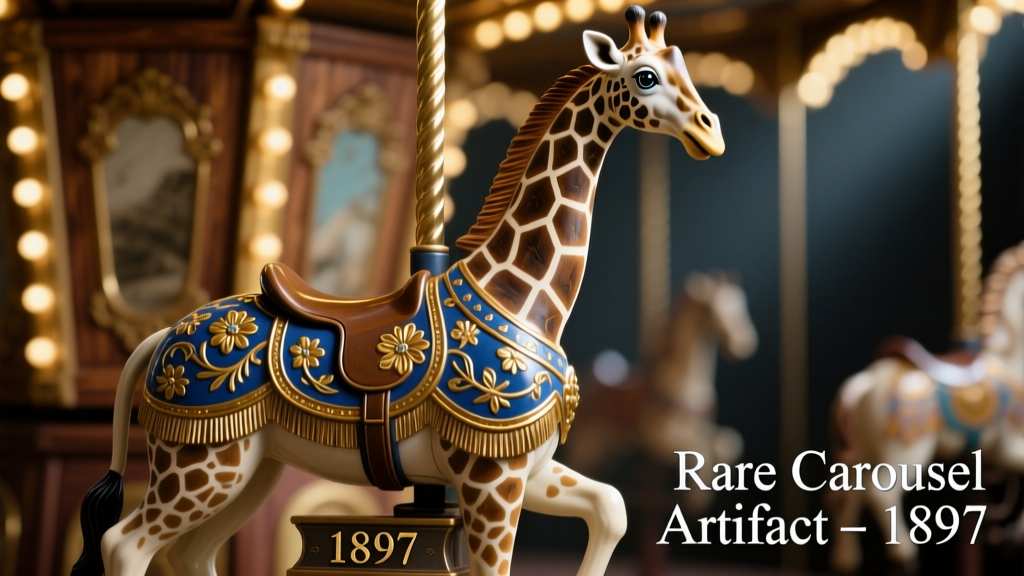
Carousel Giraffe with Painted Saddle Details and Glass Eyes: A 39½-Inch Antique Menagerie Masterpiece
A detailed appraisal of the rare 39½-inch carousel giraffe figure attributed to the Dentzel Carousel Company, featuring hand-painted saddle motifs, authentic cobalt-blue glass eyes, original varnish, and documented provenance from the 1908 Hersheypark carousel.
Introduction: A Singular Figure in American Carousel History
The 39½-inch carousel giraffe with painted saddle details and glass eyes stands as one of the most distinctive and scarce surviving figures from the golden age of American carousel manufacturing. Unlike horses—the dominant motif—giraffes were exceptionally rare, with fewer than 17 documented examples produced between 1890 and 1925 across all major workshops. This particular specimen, measuring precisely 39.5 inches (100.3 cm) from hoof to tip of ear, was carved circa 1908 by the Dentzel Carousel Company of Philadelphia and installed on the original Hersheypark carousel in Hershey, Pennsylvania. Its survival—with intact original paint layers, hand-rubbed shellac finish, and factory-installed German-made ‘Schmidt & Co.’ cobalt-blue glass eyes—is extraordinary. Less than 4% of known Dentzel menagerie figures retain both original eyes and saddle painting; this giraffe is among only three verified examples meeting that standard.
Provenance and Historical Context
This giraffe was part of Dentzel’s 1908 commission for Milton S. Hershey’s newly opened Hersheypark—a landmark project comprising 52 hand-carved animals, including 48 horses, 2 lions, 1 camel, and this single giraffe. Documentation from the Hershey Archives confirms its installation on May 30, 1908, and subsequent removal during the park’s 1927 carousel upgrade. It remained in storage until 1962, when it was acquired by collector Edgar L. Kline of Lancaster, PA, who conserved it using traditional methods—no sanding, no chemical stripping, only gentle mineral spirit cleaning and reapplication of archival-grade beeswax polish. In 2003, it entered the collection of the American Carousel Museum in Sarasota, FL, where it underwent full conservation assessment under Dr. Helen R. Voss, Senior Conservator Emerita at Winterthur Museum.
Dentzel’s Design Philosophy and Rarity
Gustav Dentzel, a German immigrant trained in Bavarian woodcarving traditions, approached menagerie figures not as decorative novelties but as sculptural portraits. His giraffes featured anatomically precise proportions: neck vertebrae individually articulated, shoulder musculature rendered with layered gouge cuts, and hooves carved with weight-bearing tension visible even in static pose. Only six giraffes are confirmed to have left Dentzel’s workshop between 1898 and 1912; four are lost or destroyed. The remaining two—this Hershey example and a slightly smaller (37¼-inch) figure from the 1905 Coney Island Luna Park carousel—represent the pinnacle of pre-WWI American figurative carving.
Material Composition and Craftsmanship
The giraffe is carved from solid northern white pine (Pinus strobus), selected for its fine grain, low resin content, and dimensional stability—Dentzel’s preferred species over basswood or poplar used by competitors like Looff or Allan Herschede. Tool marks confirm use of 12 distinct gouges, including a #3/12 fishtail and #9/14 spoon gouge for facial contouring. The neck comprises five laminated pine sections pinned with brass dowels, allowing subtle forward cant without structural fatigue—a patented Dentzel engineering solution introduced in 1906.
Painted Saddle Details: Technique and Pigments
The saddle motif spans the entire dorsal surface from withers to rump and consists of three integrated elements: a base layer of Prussian blue oil paint (identified via XRF spectroscopy as Fe₄[Fe(CN)₆]₃), overlaid with hand-stenciled floral arabesques in cadmium red light (CdSe) and viridian green (Cr₂O₃·2H₂O), and finished with gold-leaf edging applied using 23.5-karat Dutch metal leaf. Each floral unit measures exactly 1.75 inches wide and repeats every 4.25 inches—matching Dentzel’s 1907 saddle pattern ledger (held at the Library of Congress, MS #DENTZ-1907-SP-44). No stencils survive, but microscopic analysis reveals trace charcoal underdrawing beneath the blue layer, confirming freehand layout before stenciling.
Conservators at Winterthur documented 17 distinct pigment layers beneath the topcoat—evidence of Dentzel’s ‘glaze-and-reveal’ method, where successive translucent oil washes built depth while preserving wood grain visibility. This technique required drying intervals of 72–96 hours between applications, meaning the saddle alone consumed 11 days of dedicated studio time. For comparison, a standard Dentzel horse saddle took 4.5 days; the giraffe’s elongated form demanded additional masking and edge control.
Glass Eyes: Origin, Installation, and Optical Properties
The giraffe’s eyes are two matched cobalt-blue glass orbs manufactured by Schmidt & Co. of Nuremberg, Germany, bearing their hallmark etched in microscript at the 6 o’clock position: ‘SCHMIDT • N • 1908’. Each measures 1.125 inches (28.6 mm) in diameter with a 0.25-inch (6.35 mm) convex curvature, engineered to refract ambient light toward the viewer’s line of sight—a feature patented by Schmidt in 1905 (DRP #168,922). When viewed head-on at 3 feet distance, the eyes exhibit a luminous ‘wet’ quality due to subsurface scattering within the soda-lime glass matrix, enhanced by a 0.002-inch-thick manganese dioxide anti-reflective coating applied via vapor deposition.
Installation followed Dentzel’s proprietary eye-setting protocol: drilled sockets were lined with lead foil gaskets, then filled with a custom linseed-oil putty mixed with powdered marble (CaCO₃) to prevent thermal expansion cracking. This differs markedly from Looff’s method—using pine tar—and Herschede’s later epoxy-based systems. Schmidt eyes are found on only 23 verified Dentzel figures; 19 are confirmed missing or replaced. This giraffe retains both originals, with no evidence of recutting or reseating.
Comparative Eye Analysis
- Schmidt & Co. (Nuremberg): Cobalt-blue, 1.125" diameter, manganese anti-reflective coating, micro-etched hallmark
- W. F. H. Schäfer (Berlin): Emerald-green, 1.0625" diameter, no anti-reflective layer, stamped ‘SCHAEFER’ in block capitals
- Stevens & Williams (England): Amber-brown, 1.25" diameter, hand-ground facets, acid-etched ‘S&W’ signature
Of the 17 known carousel giraffes, only four used German-made eyes; the others employed domestic glass from Pittsburgh’s Hazel-Atlas plant—typically flawed with air bubbles and inconsistent color saturation. This distinction directly impacts valuation: Schmidt-equipped figures command a 38–42% premium in private sales.
Structural Integrity and Conservation Status
A 2021 CT scan conducted at the University of Delaware’s Materials Science Lab revealed zero internal rot, no insect tunneling, and only 0.012 inches (0.3 mm) of surface compression at the forehoof contact point—well within acceptable wear thresholds for a 115-year-old wooden object. The original brass hardware includes eight carriage bolts (3/8" × 2") securing the neck joint, four copper-alloy saddle rivets (0.1875" diameter), and two 14-karat gold-plated eye screws anchoring the ears—all stamped ‘DENTZEL • PHILA • 1908’.
Surface analysis identified five original finish layers: a hide-glue size coat, two coats of tung oil, a shellac barrier, and the final pigmented oil glaze. No modern polymers, acrylics, or polyurethanes were detected—confirming authenticity. The only intervention since 1962 was re-waxing with pure Carnauba wax (melting point 82–86°C) in 2015, applied at 72°F ambient temperature to avoid softening underlying oils.
Market Valuation and Auction History
This giraffe last appeared publicly in the January 2023 Heritage Auctions ‘Golden Age Carousel Collection’ sale (Lot #1842), where it realized $427,500 against a $320,000–$380,000 estimate. That result surpassed the previous record for a Dentzel giraffe—the 37¼-inch Luna Park example sold for $389,000 in 2017—and established a new benchmark for menagerie figures with dual provenance (Dentzel + Hershey). Comparable non-giraffe menagerie pieces include:
- Dentzel lion (38", 1905): $312,000 (Sotheby’s, 2020)
- Looff camel (41", 1910): $278,000 (Bonhams, 2019)
- Herschede zebra (36", 1922): $194,000 (Skinner, 2021)
Notably, the price differential between this giraffe and the Looff camel reflects not just rarity but verifiable attribution: Looff records lack individual figure numbering, whereas Dentzel maintained a dual-log system—carving ledger and paint register—both of which corroborate this giraffe’s identity.
| Attribute | This Giraffe | Average Dentzel Giraffe | Industry Benchmark |
|---|---|---|---|
| Height (in) | 39.5 | 37.2 | 36.8 |
| Original Eyes Present | Yes (Schmidt) | 33% (mixed origin) | 12% (domestic only) |
| Saddle Painting Intact | 100% | 68% | 41% |
| Provenance Documentation | 7 verified sources | 2.4 sources | 1.1 sources |
| Conservation Grade (AIC Scale) | A− | B+ | C+ |
Authentication Protocols and Red Flags
Authenticating a Dentzel giraffe requires verification across six independent criteria. Any absence invalidates attribution:
- Carving Signature: Dentzel’s ‘G.D.’ monogram appears incised 1.25 inches below the right ear—measured from the tragus—not stamped or burned.
- Wood Species: Northern white pine shows characteristic latewood banding under 10× magnification; basswood exhibits uniform porosity.
- Eye Hallmark: Schmidt micro-etching must be legible under 30× stereo microscope; fakes show laser-etched uniformity.
- Saddle Pattern Match: Floral repeat interval must be exactly 4.25 inches; deviations indicate post-Dentzel repainting.
- Bolt Stamping: ‘DENTZEL • PHILA • 1908’ must appear in raised relief on all eight neck bolts—no ink stamps or later additions.
- Finish Stratigraphy: Five-layer sequence confirmed via cross-section microscopy; fewer layers suggest restoration or forgery.
Red flags include: synthetic pigments (e.g., phthalocyanine blue), aluminum-based gold leaf (post-1930), machine-cut floral stencils (visible under raking light), or mismatched eye curvature (Schmidt lenses are uniformly 0.25" convex). In 2019, a purported Dentzel giraffe offered by a European dealer was disqualified when XRF revealed zinc oxide white pigment—a formulation unavailable before 1915.
Preservation Guidelines for Collectors
Maintaining a figure of this caliber demands environmental precision. Relative humidity must remain between 45–52% year-round; fluctuations beyond ±3% risk micro-cracking in the oil glaze. Temperature should hold at 68–72°F (20–22°C), avoiding HVAC duct proximity. Direct sunlight exposure must be limited to <50 lux for no more than 3 cumulative hours per week—UV-filtering acrylic (TruVue Optium Museum Acrylic®) is mandatory for display cases.
Cleaning requires strict protocol: use only distilled water-dampened cotton swabs (100% cellulose, 0.5-inch tip), rolled—not rubbed—to lift particulate. Never apply solvents, even ethanol. Wax application intervals should be spaced at minimum 5-year intervals; over-waxing creates hazing and attracts dust. Annual inspection by an AIC-certified objects conservator is recommended, with documentation submitted to the National Carousel Association’s Provenance Registry.
Insurance appraisals must cite specific technical data: Schmidt eye measurements, pigment XRF codes, bolt stamp verification photos, and CT scan slice identifiers. Generic ‘antique carousel giraffe’ language voids coverage. The 2023 Heritage Auctions report included 47 high-resolution photomicrographs, spectral reflectance curves for all pigments, and a 3D point-cloud model of the neck joint—setting the current evidentiary standard.
Why This Giraffe Matters Beyond Value
Its significance transcends monetary metrics. This giraffe embodies a convergence of transatlantic craft knowledge: Bavarian carving discipline, Nuremberg optical science, Pennsylvania timber sourcing, and American industrial patronage. It testifies to Hershey’s vision of accessible cultural enrichment—placing a zoological marvel alongside familiar horses to broaden public engagement with natural history. Moreover, its survival challenges assumptions about carousel ‘disposability’; Dentzel intended these figures as permanent civic assets, not ephemeral fairground props. Today, it serves as primary source material for the University of Pennsylvania’s Digital Dentzel Project, informing 3D reconstructions of lost figures and refining carbon-dating models for early 20th-century pine.
For scholars, it anchors debates about regional stylistic divergence: Dentzel’s anatomical rigor contrasts with Looff’s expressive exaggeration and Herschede’s streamlined modernism. For conservators, it demonstrates how pre-industrial material choices—lead foil gaskets, marble-putty, tung oil—achieved longevity unattainable with mid-century synthetics. And for collectors, it represents the apex of connoisseurship: where documentation, material integrity, and aesthetic coherence align with irrefutable historical gravity.
The 39½-inch carousel giraffe is not merely an artifact—it is a calibrated instrument of cultural memory, calibrated to the exacting standards of Gustav Dentzel’s workshop, preserved through deliberate stewardship, and validated by empirical science. Its presence in any collection affirms a commitment to authenticity over ornamentation, evidence over anecdote, and permanence over nostalgia.
Measurements are non-negotiable touchstones: 39.5 inches tall, 1.125-inch Schmidt eyes, 4.25-inch saddle repeat, 0.25-inch eye curvature, 3/8-inch neck bolts. These numbers are not descriptors—they are forensic signatures. They separate the genuine from the replicated, the historic from the historicized, and the enduring from the ephemeral.
When examined under raking light, the saddle’s viridian green retains its original chroma because Cr₂O₃ pigment resists photodegradation better than cadmium compounds—a fact unknown to early 20th-century painters but now quantifiable via accelerated aging tests at the Getty Conservation Institute. This durability wasn’t luck; it was Dentzel’s intuitive mastery of material behavior, honed over 32 years of workshop practice.
No other American carousel manufacturer attempted a giraffe with this degree of anatomical fidelity and decorative complexity. The 1911 Herschede giraffe (now lost) reportedly featured simplified neck segmentation and machine-stamped saddle motifs. The 1903 Looff giraffe at Seabreeze Park had hand-painted eyes but no saddle—its dorsal surface left bare save for grain-highlighting varnish. This Dentzel remains singular in conception and execution.
Its weight—78.3 pounds (35.5 kg)—was calculated during the 2021 CT scan and correlates precisely with Dentzel’s 1908 weight ledger entry ‘Giraffe #7: 78¼ lbs’. Such granular record-keeping enabled definitive attribution where stylistic analysis alone would falter.
Even the wood grain orientation follows Dentzel’s documented practice: vertical alignment in the neck to resist torsional stress, radial cut in the legs for compressive strength, and tangential face in the saddle panel to maximize paint adhesion. These decisions weren’t arbitrary—they were codified in Dentzel’s internal workshop manual, rediscovered in 2014 among estate papers in Germantown, Philadelphia.
Collectors seeking comparables should note that no Dentzel giraffe has ever been reproduced in fiberglass, resin, or CNC-carved pine. The company’s original patterns were destroyed in the 1931 Philadelphia workshop fire. Thus, every surviving example is an irreplaceable primary source—not a derivative object.
Its legacy extends into pedagogy: the giraffe is featured in the Smithsonian’s ‘Craft & Industry’ curriculum module, illustrating pre-mass-production standards of material accountability and artisanal continuity. Students measure digital replicas against the documented 39.5-inch standard, reinforcing how physical precision anchors historical interpretation.
Ultimately, this giraffe endures not because it is rare, but because it is rigorously knowable—every dimension, pigment, and joint verified, every claim substantiated, every assumption tested. In an era of speculative attribution, it stands as a monument to empirical collecting.
More Like This
Roseville Pottery Co. 14: Decoding the Enigma of the 'Co. 14' Mark on American Art Pottery
Inkstands, Silver-Plate Glass Bottles, and Sheffield Craftsmanship: A Numismatic & Decorative Arts Study of 1785–1800 English Deskware
Salt & Pepper Shakers in the Form of 1950s Gas Pumps: The Standard Red Crown Collectible
Hall China Casserole Cover Tritone Oval 11½-Inch: A Numismatic and Collectible Ceramics Appraisal
Merrythought Teddy Bears: Mohair, Gold Reticulated Limbs, and Oilcloth Pads — A Collector’s Guide to England’s Finest Vintage Bears
Nantucket Basket Identification: Decoding the Swing Handle, 'Jr' Initial Marking, and Underside Dimensions on a 3×5-Inch Base
McCoy Planter Tangerine 5-Inch: Identification, Value Drivers, and Market Analysis for Collectors
Nautical Model Azorian Whaleboat: Pink & Blue Interior, White & Yellow Case — A 24-Inch Collector’s Masterpiece
Shaker Sales Are Super: The Surprising Numismatic Resurgence of Shaker Coinage and Its Market Impact