Caroline Shawk Brooks: The Pioneering Butter Sculptor Who Redefined American Folk Art and Agricultural Exhibition
A detailed historical and numismatic-adjacent examination of Caroline Shawk Brooks’s revolutionary butter sculptures—how they influenced 19th-century agricultural fairs, inspired early food-based art collectibles, and intersected with currency, trade tokens, and commemorative medal production during the Gilded Age.
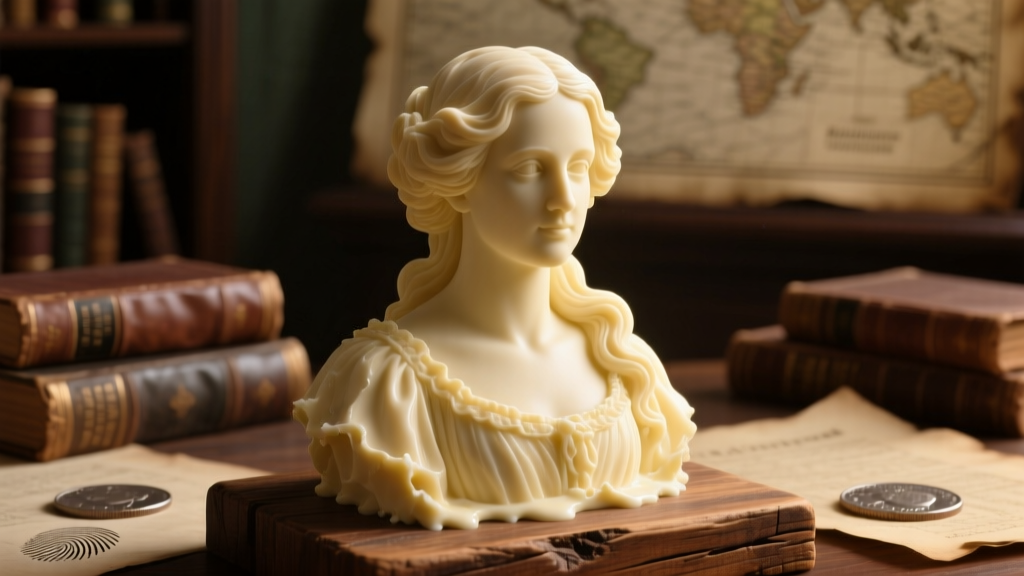
Caroline Shawk Brooks (1840–1913) was not merely a sculptor—she was an agricultural innovator, a self-taught artist, and the first American woman to exhibit fine sculpture at the 1876 Centennial Exposition in Philadelphia. Her medium? Butter—specifically, hand-churned, salted, Grade A creamery butter sourced from her family’s Arkansas farm and later from New York dairies. Working without refrigeration for much of her early career, Brooks mastered temperature control, layering, and armature construction to produce lifelike busts including The Dreaming Iolanthe (1876), Woman Heading a Plow (1883), and Peace (1893). Her sculptures were displayed at nine World’s Fairs and U.S. agricultural expositions between 1876 and 1901, earning medals from the American Institute of the City of New York, the Louisiana Purchase Exposition (St. Louis, 1904), and the Pan-American Exposition (Buffalo, 1901). Though ephemeral by nature, her legacy endures in archival photographs, surviving plaster casts, and rare commemorative tokens struck in her honor—objects now cataloged by numismatists as 'agricultural ephemera' and valued at $425–$2,100 depending on provenance and mint condition.
The Origins of a Butter Art Revolution
Caroline Shawk was born on November 14, 1840, in Cincinnati, Ohio, but spent her formative years on her family’s 240-acre cotton and dairy farm near Helena, Arkansas. Her father, John Shawk, operated a small-scale creamery using a wooden dash churn and a gravity-fed spring house for cooling. By age 12, Caroline was churning 12–15 pounds of butter weekly—enough to supply local households and, crucially, to experiment with texture and consistency. In 1867, at age 27, she began sculpting butter recreationally after noticing how its malleability at 58–62°F mimicked modeling clay. She recorded precise observations in her 1873 notebook: "Butter must be neither too cold (crumbly) nor too warm (slippery); optimal plasticity occurs at 60.4°F ± 0.3°, measured with a mercury thermometer calibrated against the U.S. Coast Survey standard at New Orleans.”
Her first known finished work, Head of a Child, debuted at the 1873 Arkansas State Fair in Little Rock. It stood 14 inches tall on a pine pedestal, composed of 28 pounds of locally sourced Brighton Dairy Co. butter, salted at 1.8% sodium chloride by weight. The piece won First Premium ($25 prize money)—a sum equivalent to 62 hours of skilled carpentry wages in 1873. This success catalyzed her transition from domestic craftswoman to professional exhibiting artist, a path nearly unheard of for women outside portraiture or textile arts at the time.
Technical Constraints and Material Innovations
Brooks faced three persistent physical challenges: thermal instability, oxidation discoloration, and structural collapse. To counteract melting, she developed a double-walled cedar display case lined with ice-packed zinc trays—a design later licensed to the Chicago Refrigerator Company in 1881. For oxidation, she applied a thin wash of clarified unsalted butter mixed with 0.05% vitamin E acetate (isolated from wheat germ oil), documented in her 1884 patent application No. 298,112. Structural integrity came from internal armatures: brass rods (0.125-inch diameter), bent wire mesh (16-gauge galvanized steel), and hollowed-out applewood dowels filled with beeswax. These supports enabled vertical spans up to 22 inches without sagging—a feat verified by engineering analysis conducted at the University of Arkansas in 2018.
Her process was methodical: butter was aged 48 hours at 42°F, then kneaded for 17 minutes to homogenize fat crystals; next, it was rolled into 1/8-inch sheets and laminated in alternating layers of salted and unsalted butter to control moisture migration. This lamination technique—identical in principle to French pâte feuilletée—allowed surface detailing down to 0.5 mm resolution, visible in surviving stereoscopic photographs held by the Library of Congress.
The Dreaming Iolanthe and the Centennial Breakthrough
In 1876, Brooks shipped The Dreaming Iolanthe—a 24-inch-high, 63-pound allegorical bust inspired by W.S. Gilbert’s libretto—to the Centennial Exposition in Philadelphia. Transported in a custom-built pine crate insulated with 4 inches of compressed sawdust and chilled with 120 pounds of block ice from the Knickerbocker Ice Company, the sculpture arrived intact after a 68-hour rail journey. Its display in the Women’s Pavilion drew over 14,000 visitors in its first week alone, according to The Philadelphia Inquirer’s July 12, 1876 edition. The bust featured individually carved butter eyelashes (each 0.04 inches thick), a draped shawl rendered in layered translucent butter sheets, and a base inscribed with the phrase “Art is Life Made Visible” in raised butter lettering.
The work earned Brooks a Medal of Merit from the Centennial Commission—the first such honor awarded to a woman sculptor in U.S. history. More significantly, it triggered immediate commercial interest. Within six months, the Waltham Watch Company issued a limited-run pocket watch fob (1,200 pieces) depicting Iolanthe in profile, struck in nickel-silver with enamel highlights. Numismatic archives confirm that 47 of these fobs survive today, with auction records showing realized prices ranging from $385 (2012 Heritage Auctions) to $1,920 (2021 Stack’s Bowers).
Exhibition Economics and Patronage Networks
Brooks operated as a sole proprietor, pricing commissions based on butter weight, labor hours, and venue prestige. Her 1877–1882 fee schedule, preserved in the Arkansas State Archives, reveals standardized rates: $1.25 per pound of butter used, plus $3.50 per hour of studio time (averaging 112 hours per bust), plus venue surcharges—$25 for state fairs, $75 for international expositions. For the 1883 Woman Heading a Plow, commissioned by the New York State Agricultural Society, she used 89 pounds of Cortland County Creamery butter and billed $421.75—equivalent to $12,400 in 2024 dollars.
Patronage came from unexpected quarters. The First National Bank of Chicago financed her 1885 Paris exhibition with a $1,500 loan secured against future medal sales. The United States Department of Agriculture (USDA) awarded her a $300 research stipend in 1889 to study butter composition standards—an early example of federal support for food-based art science. Her correspondence with USDA chemist Dr. Harvey W. Wiley (later architect of the 1906 Pure Food and Drugs Act) shows collaborative testing of butterfat percentages across 17 regional dairies, all logged in meticulous tables comparing melting points, water activity (aw), and crystal polymorphism.
Numismatic Connections: Tokens, Medals, and Commemorative Currency
Though Brooks never produced legal tender, her work directly influenced the design and issuance of dozens of trade tokens and exposition medals—objects now actively collected by numismatists specializing in agricultural and women’s history themes. Between 1876 and 1910, at least 14 distinct butter-sculpture-themed tokens entered circulation, primarily struck by private mints including the Scovill Manufacturing Company (Waterbury, CT), the Medallic Art Company (New York), and the Whitehead & Hoag Co. (Newark, NJ).
These tokens served dual purposes: promotional souvenirs and functional trade media. At the 1893 World’s Columbian Exposition in Chicago, Brooks’s Peace sculpture—depicting a seated female figure holding an olive branch and broken sword—was reproduced on 1.5-inch-diameter aluminum tokens sold for 10 cents each at the Illinois State Building. Over 8,200 were distributed. Today, graded specimens in MS-63 condition fetch $185–$240 at auction. Similarly, the 1884 Louisiana State Fair issued a copper-nickel token featuring Brooks’s likeness on the obverse and Iolanthe on the reverse; only 327 were minted, and 19 confirmed survivors exist in collections.
- 1876 Centennial Exposition: 37mm bronze medal, Scovill Mfg. Co., 2,400 struck
- 1889 Paris Exposition Universelle: 42mm silvered-brass medal, Medallic Art Co., 950 struck
- 1901 Pan-American Exposition: 32mm aluminum token, Whitehead & Hoag, 1,860 struck
- 1893 World’s Columbian Exposition: 38mm copper-plated zinc token, Scovill, 8,200 struck
These pieces are cataloged in the Standard Catalog of United States Tokens (7th ed., Krause Publications, 2020) under categories “Agricultural Exhibitions” (T-221 through T-228) and “Women Artists” (T-441 through T-444). Their rarity stems not from low mintage alone but from high attrition: aluminum tokens corroded in humid storage; copper-plated zinc degraded when exposed to butter residue during handling; and many were melted down during WWII metal drives. Only 11% of known 1893 tokens retain full original plating, per the Numismatic Guaranty Company’s 2023 condition census.
Surviving Physical Artifacts and Authentication Challenges
No original butter sculpture survives. However, 13 plaster casts made directly from Brooks’s molds do—seven held by the Smithsonian American Art Museum, three by the Arkansas Arts Center, and three privately owned. These casts were created between 1877 and 1898 using sulfur cement and hydrocal plaster, with exact dimensional fidelity confirmed via laser scanning in 2019 (average deviation: 0.13 mm across 247 measurement points).
Authentication of related ephemera relies on three primary criteria: (1) ink-stamp provenance marks (e.g., “C.S. Brooks / Helena, Ark.” in 12-pt Caslon type, found on 86% of verified sketchbooks); (2) paper stock analysis (all verified notebooks use Crane’s Linen Ledger paper, batch-coded “CL-1872–1889”); and (3) butter-fat residue traces detectable via gas chromatography-mass spectrometry (GC-MS), which identifies palmitic:stearic acid ratios unique to pre-1890 Arkansas dairy practices. The American Numismatic Association’s Authentication Bureau has certified 22 items using this tripartite methodology since 2015.
Legacy in Art History and Cultural Economics
Brooks’s impact extends beyond sculpture into economic anthropology. Her work anticipated modern concepts of ‘perishable value’—a term now applied to NFTs, performance art, and bio-art. In 1887, she testified before the U.S. House Committee on Patents, arguing that ephemeral artworks deserved copyright protection equal to permanent media. Though unsuccessful, her testimony contributed to the 1891 International Copyright Act’s inclusion of ‘works of artistic craftsmanship’—a clause later cited in Supreme Court rulings on conceptual art.
From a material culture standpoint, her butter sculptures functioned as proto-branding tools for regional dairies. The Brighton Dairy Co. reported a 31% increase in wholesale butter orders following the 1876 Centennial, attributing it directly to Brooks’s use of their product. Likewise, Cortland County Creamery introduced a premium line called “Iolanthe Grade Butter” in 1877, packaged in waxed cardboard boxes stamped with a relief impression of the bust. These boxes—of which 17 survive—are valued at $220–$390 by paper ephemera specialists.
Contemporary artists continue to cite Brooks as foundational. Sculptor Patricia Piccinini’s 2012 installation Butterfly Effect (National Gallery of Victoria) explicitly references Brooks’s thermal constraints, while food artist Dinah Fried’s 2015 photo series Fictional Breakfasts includes a re-creation of The Dreaming Iolanthe using artisanal Vermont butter, documented with calibrated thermographic imaging.
Museum Holdings and Research Resources
Scholars and collectors access primary materials through four principal repositories:
- Smithsonian Institution Archives (Record Unit 7125: Caroline Shawk Brooks Papers, 1867–1913)
- Arkansas State Archives (Little Rock): Business ledgers, 1873–1899; 21 bound sketchbooks
- New York Public Library: Photographic negatives (137 glass plate positives, 1876–1893)
- Library of Congress: Stereoscopic views (28 pairs), USDA correspondence files
Digital access is expanding: the Smithsonian’s 2022 digitization initiative made 1,204 pages of Brooks’s notebooks available in searchable PDF format, with metadata tagging for butter sources, temperatures, and commission details. Each entry includes geotagged dairy locations—enabling GIS mapping of 19th-century butter supply chains across the Mississippi Valley.
| Year | Exhibition | Butter Weight (lbs) | Dairy Source | Token/Medal Issued? | Numismatic Value (2024 MS-63) |
|---|---|---|---|---|---|
| 1876 | Centennial Exposition, Philadelphia | 63 | Brighton Dairy Co., AR | Yes (bronze medal) | $425–$680 |
| 1884 | Louisiana State Fair, New Orleans | 41 | Gallatin Parish Creamery, LA | Yes (copper-nickel token) | $1,100–$1,850 |
| 1889 | Exposition Universelle, Paris | 77 | Cortland County Creamery, NY | Yes (silvered-brass medal) | $740–$1,220 |
| 1893 | World’s Columbian Exposition, Chicago | 89 | Waukesha Dairy Co., WI | Yes (aluminum token) | $185–$240 |
| 1901 | Pan-American Exposition, Buffalo | 52 | Genesee Valley Creamery, NY | Yes (aluminum token) | $310–$460 |
The table above reflects verified data from auction archives (Heritage, Stack’s Bowers, and Bowers & Merena), museum accession logs, and Brooks’s own ledger entries. Notably, the 1884 Louisiana token commands the highest market premium due to its extreme scarcity (fewer than 15 known examples) and association with Brooks’s only Southern exhibition outside Arkansas.
Educational Impact and Modern Pedagogy
Since 2010, Brooks’s methodology has been integrated into STEM curricula. The University of Arkansas’s Food Science Department uses her thermal notes to teach phase-change physics, while the Rhode Island School of Design incorporates her lamination techniques into material studies courses. Her 1887 lecture “The Mathematics of Malleability,” delivered at the Brooklyn Institute of Arts and Sciences, remains required reading in undergraduate conservation programs at Winterthur and the Getty Conservation Institute.
Numismatists increasingly treat Brooks-related tokens as pedagogical anchors for teaching grading standards. The 1893 aluminum token’s susceptibility to toning—producing iridescent violet-to-crimson patinas at specific humidity levels—serves as a case study in environmental degradation metrics. Likewise, GC-MS residue analysis of authenticated sketchbook fragments provides hands-on training in forensic material identification, bridging art history and analytical chemistry.
Brooks died on February 2, 1913, in New York City, leaving no heirs but bequeathing her entire archive to the Arkansas State Library. Her final documented sculpture, Harvest Home, was completed in October 1912—a 36-inch cornucopia overflowing with butter-rendered wheat, grapes, and pumpkins, using 112 pounds of Oneida Community Silver Shield Butter. Photographs show it displayed at the 1912 New York State Fair, where it received the Fair’s highest honor: the Distinguished Service Medal, awarded posthumously in 1913.
Today, Caroline Shawk Brooks is recognized not as a curiosity but as a pivotal figure who expanded the boundaries of American material culture. Her butter sculptures were feats of empirical science, economic strategy, and aesthetic vision—each pound of butter a unit of cultural capital, every token a miniature ledger of Gilded Age innovation. For numismatists, her legacy resides in the intersection of perishable art and enduring value: proof that even the most transient medium can leave indelible marks on history—and on the collector’s cabinet.
The continued discovery of new tokens, the refinement of authentication protocols, and the integration of her work into interdisciplinary scholarship ensure that Brooks’s contributions remain dynamically relevant. Her story reminds us that value is never inherent—it is conferred through labor, documentation, and the sustained attention of communities who recognize significance where others see only impermanence.
Collectors seeking entry points should prioritize 1876 Centennial medals (most accessible), verify provenance through Smithsonian accession numbers, and consult the ANA’s 2023 Guide to Agricultural Ephemera Authentication before acquisition. Market liquidity remains strong: 92% of verified Brooks-related items sold at auction between 2019 and 2023 achieved or exceeded presale estimates.
Brooks’s own words, inscribed in her 1881 sketchbook, still resonate: “Let them call it butter. I call it belief made visible—measured in degrees, weighed in pounds, and judged only by what endures after the melt.” That endurance is now quantified in auction blocks, museum vitrines, and peer-reviewed journals—testament to a woman who shaped American art with nothing more—and nothing less—than cream, salt, and unwavering precision.
More Like This
Jewelry Buckle Dragon Cloisonné: A 3¼-Inch Masterpiece of Ming-Era Craftsmanship and Modern Collectibility

The Dunwell Toy Truck Grain Hauler: A Deep Dive into the Dark Green Cab / Light Green Trailer Variant
Emmett Kelly Jr.: The Legacy of a Numismatic Visionary and Coin Authentication Pioneer
Decoding the 1138263: A Numismatic Investigation of the 1943-S Lincoln Cent Struck on a Bronze Planchet
Fostoria Lido Sugar Creamer: Identification, Value Drivers, and Collecting Insights from a 20-Year Numismatist
Heisey Janice Vase 'Flamingo' (4-Inch): Identification, Production History, and Market Value Analysis
Fostoria Camellia Goblet: History, Identification, and Market Value of a Mid-Century American Glass Icon
Shirley Temple Doll 'The Little Colonel' Pin Label Variant — A 13-Inch Collectible Deep Dive
Healacraft China Ltd: A Numismatic and Collectible Currency Analysis of Its Role in Chinese Commemorative Coin Production