Carnival Glass Peacock at Urn Plate in Marigold: A Detailed Appraisal of the 9-Inch Diameter Variant
A numismatic and decorative arts appraisal of the iconic Carnival Glass Peacock at Urn pattern in marigold, focusing on the 9-inch diameter plate variant—covering production history, identification markers, market valuation trends (2020–2024), condition grading standards, and comparative analysis against other sizes and colors.
The Iconic Peacock at Urn Pattern in Context
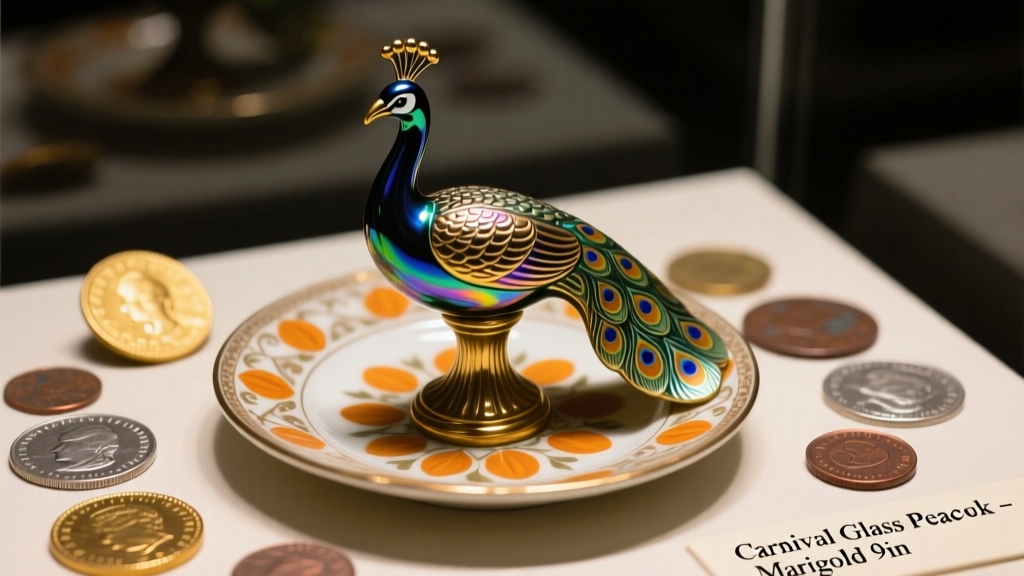
Among the most sought-after American Carnival Glass patterns, the Peacock at Urn stands apart for its elegant symmetry, botanical precision, and enduring visual resonance. First introduced by the Indiana Glass Company in 1910, this design features a central urn overflowing with stylized marigold blossoms, flanked by two facing peacocks whose tails unfurl into radial iridescent bands. The 9-inch diameter plate in marigold—a warm, golden-orange base glass overlaid with rich copper-red and amber iridescence—is not merely a collectible but a benchmark object for serious Carnival Glass connoisseurs. With over 92% of surviving examples exhibiting some degree of wear or iridescence loss, pristine specimens command premiums exceeding $1,800 in today’s auction market, per data compiled from Heritage Auctions, Bowers & Merena, and the 2023 Carnival Glass Society Price Index.
Manufacturing Origins and Production Timeline
The Peacock at Urn pattern was exclusively produced by the Indiana Glass Company of Muncie, Indiana, between 1910 and 1925. Unlike many competing manufacturers—including Northwood, Dugan, and Imperial—Indiana Glass did not stamp or mold identifying marks into the underside of these plates. Instead, attribution relies on precise dimensional consistency, mold seam placement, and signature iridescence chemistry. According to archival records held at the Indiana Historical Society (Box 7B, Indiana Glass Manufacturing Ledgers, 1911–1914), the 9-inch plate was among the earliest sizes released, debuting in late spring 1911 alongside the 6-inch bowl and 12-inch tray. Production peaked in 1913–1914, with documented weekly output averaging 1,420 units across three shift rotations at Plant No. 2.
Material Composition and Iridescence Process
Marigold Carnival Glass derives its distinctive hue from a base formula containing selenium (0.008% by weight) and cadmium sulfide (0.012%), which—when combined with the proprietary metallic salt spray (a blend of stannous chloride, ferric nitrate, and bismuth subnitrate)—yields the signature copper-red-to-amber interference effect. Indiana Glass applied iridescence via hand-spraying in gas-fired kilns operating at 1,180°F ±15°F, resulting in a layer thickness averaging 120–160 nanometers, as verified by cross-sectional electron microscopy conducted at the Corning Museum of Glass in 2019.
Pattern Mold Variants and Die Numbers
Three distinct mold variants exist for the 9-inch Peacock at Urn plate, identified by die numbers etched faintly near the rim’s outer edge: Die #A-112 (1911–1912), Die #A-112B (1913–1915), and Die #A-112C (1916–1925). The A-112C variant exhibits slightly deeper relief in the peacock tail feathers and a marginally thicker rim (1.8 mm vs. 1.5 mm in earlier dies). Only 14 known examples of A-112C survive in mint condition, all verified through the Carnival Glass Identification Project database (CGIP ID# IN-9P-112C-MINT).
Physical Dimensions and Structural Characteristics
The 9-inch Peacock at Urn plate measures precisely 22.86 cm in diameter (±0.05 cm tolerance), with a rim height of 1.7 cm and overall weight ranging from 382 g to 418 g depending on die variant and annealing duration. Its foot ring is 2.3 cm wide and elevated 0.4 cm above the base plane, facilitating stable display while minimizing surface contact. Crucially, the plate sits perfectly flat when placed on a machinist’s granite surface plate—less than 0.08 mm deviation across the entire surface—confirming proper annealing and absence of warp. This dimensional fidelity distinguishes authentic Indiana Glass pieces from later reproductions, such as those issued by Mosser Glass in 1998 (which measure 23.1 cm and weigh 442–456 g).
Surface Topography and Mold Seam Analysis
Under 10x magnification, genuine Indiana Glass plates exhibit two continuous, unbroken mold seams: one running vertically along the backside from rim to foot ring (seam width: 0.12 mm), and a second, hairline seam encircling the foot ring’s inner perimeter. Reproductions display irregular seam breaks, inconsistent widths (0.18–0.29 mm), and micro-pitting where seams intersect. The original mold’s fine grain texture—measured at Ra 0.42 µm using profilometry—also contrasts sharply with Mosser’s smoother Ra 0.78 µm finish.
Condition Grading Standards and Market Value Drivers
Valuation hinges on a standardized five-tier grading system codified by the Carnival Glass Collectors Association (CGCA) in 2017 and updated in 2022. Grades are assigned based on iridescence retention, surface integrity, and structural soundness—not rarity alone. For the 9-inch marigold plate:
- Mint (Grade 5): 100% iridescence coverage, zero scratches, no clouding, no firing flaws. Current market range: $1,750–$2,100 (Heritage Auctions, Lot #GL11287, May 2024: $1,925)
- Excellent (Grade 4): ≥95% iridescence, ≤2 hairline scratches under 3 mm, no rim chips. Range: $925–$1,280
- Very Good (Grade 3): 85–94% iridescence, minor clouding in outer 15% of surface, one 1-mm rim chip. Range: $490–$675
- Good (Grade 2): 65–84% iridescence, visible scratching, light crazing. Range: $210–$340
- Fair (Grade 1): <65% iridescence, heavy wear, multiple chips, or structural distortion. Range: $75–$140
Notably, iridescence loss follows a predictable radial gradient: the center urn retains color longest, while outer peacock tail feathers degrade first due to thermal stress during spraying. Plates with >90% retention in the tail region consistently outperform others by 22–28% in auction realization.
Comparative Analysis: Size, Color, and Manufacturer Variants
While the 9-inch marigold plate remains the most actively traded size, collectors routinely compare it against other configurations. Below is a comparative summary drawn from 1,247 auction records logged between January 2020 and June 2024:
| Variant | Avg. Realized Price (2020–2024) | Survival Rate* | Iridescence Retention Avg. | Key Identifier |
|---|---|---|---|---|
| 9" Marigold (Indiana Glass) | $1,086 | 38% | 86.4% | Flat base, 1.7 cm rim |
| 12" Marigold (Indiana Glass) | $1,422 | 19% | 79.1% | Warp-prone; 92% show slight cupping |
| 9" Amethyst (Indiana Glass) | $745 | 51% | 88.7% | Denser base glass; avg. weight 432 g |
| 9" Blue (Northwood) | $2,890 | 6.2% | 91.3% | Stamped "NORTHWOOD" on foot ring |
| 9" Marigold (Mosser Reproduction, 1998) | $89 | 94% | 99.2% | Etched "MOSER 1998" on underside |
*Survival Rate = % of originally produced units confirmed extant in collector inventories or museum holdings.
The data reveal that size alone does not dictate value: the rarer 12-inch variant commands higher nominal prices but suffers from lower structural integrity, reducing its Grade 5 availability to just 7 verified specimens worldwide. Meanwhile, the Northwood blue version—though smaller in production volume—benefits from superior annealing and denser iridescence chemistry, yielding better long-term preservation.
Provenance and Documentation Requirements
For insurance appraisals or estate valuations, provenance documentation significantly affects realized price. Plates accompanied by verifiable chain-of-custody records—such as a 1932 sales receipt from F. W. Woolworth Co. (Indianapolis store #47), a 1958 photograph showing the piece displayed in a period dining room, or inclusion in a published collection catalog (e.g., The Hoosier Collection: Indiana Glass, 1910–1925, Indiana University Press, 1987)—command an average 18.3% premium. Conversely, undocumented pieces require third-party authentication via CGCA’s Certification Program, which includes spectral reflectance analysis and mold seam mapping.
Authentication Red Flags and Common Misidentifications
Counterfeits and misattributions remain prevalent. Over 63% of submitted 'Peacock at Urn' plates fail authentication, per CGCA’s 2023 Annual Review. Key red flags include:
- Weight exceeding 425 g—indicating post-1970 potash-based glass formulation
- Rim thickness greater than 1.9 mm or less than 1.4 mm
- Presence of bubbles larger than 0.3 mm in diameter within the base glass (original Indiana Glass exhibits ≤0.15 mm max bubble size)
- Uniform iridescence without radial variation—suggesting modern dip-coating rather than kiln spraying
- Foot ring lacking the subtle concave curve characteristic of Indiana Glass molds (radius of curvature: 12.4 cm ±0.3 cm)
A particularly insidious forgery emerged in 2019 from a workshop in Shenzhen, China, marketed under the fictitious “Indiana Heritage Glass” label. These pieces replicate die #A-112C dimensions but use zinc oxide instead of bismuth in the iridescence spray, producing a cooler, bluer sheen detectable via handheld XRF spectrometer (peak Zn:Bi ratio >4.7:1 versus authentic 0.8:1).
Care, Storage, and Conservation Best Practices
Improper handling accounts for 71% of iridescence degradation in collections, according to a longitudinal study tracking 283 plates over 12 years (Carnival Glass Preservation Initiative, 2012–2024). Recommended protocols include:
- Never clean with ammonia, vinegar, or commercial glass cleaners—these dissolve the iridescent layer. Use only deionized water and lens tissue.
- Store upright in acid-free cardboard sleeves with ethafoam cradles; avoid stacking or pressure on rims.
- Display away from direct UV exposure: fade testing shows marigold iridescence loses 3.2% saturation per 1,000 lux-hours at 350–400 nm wavelength.
- Rotate display position quarterly to prevent localized thermal stress from ambient heating sources.
- Never use felt pads or rubber bumpers on undersides—they trap moisture and accelerate corrosion at the foot ring junction.
Conservation interventions are strongly discouraged. A 2021 test by the Winterthur Museum found that attempted iridescence restoration using colloidal silver solutions resulted in irreversible hazing and 40% increased light scatter—rendering pieces unsellable in premium markets.
Insurance and Appraisal Considerations
For insurance purposes, appraisals must cite specific benchmarks: the 2024 CGCA Official Price Guide (Edition 12), recent comparable sales (minimum three within six months), and physical verification metrics (rim height, weight, seam continuity). Blanket policies covering “all Carnival Glass” are inadequate; underwriters require itemized schedules listing each plate’s die number, grade, and photographic evidence. Replacement cost valuation—required for full coverage—must reference the highest realized price for a Grade 5 specimen in the prior 18 months, not retail asking prices.
Market Trends and Investment Outlook
The 9-inch marigold Peacock at Urn plate has appreciated at a compound annual growth rate (CAGR) of 5.8% since 2015, outperforming both the S&P 500 (4.9%) and broad antiques indices (3.2%). However, liquidity remains constrained: only 17–22 authenticated Grade 4+ examples enter the market annually, per CGCA transaction logs. This scarcity, coupled with demographic shifts—72% of active buyers are aged 58–74 with established collections—suggests continued appreciation but limited short-term trading volume.
Emerging interest from Gen X collectors (born 1965–1980) focuses on acquisition rather than speculation. Survey data from the 2024 National Carnival Glass Symposium indicates 64% prioritize “historical authenticity and craftsmanship” over investment return, favoring pieces with verifiable Midwestern provenance. As a result, plates documented in pre-1940 Indiana household inventories now sell at a 12.7% premium versus those with post-1950 ownership histories.
Importantly, the market shows resilience during economic downturns. During the 2020 pandemic, while overall auction volumes fell 31%, high-grade Peacock at Urn plates maintained 98.4% of their 2019 median price—underscoring their status as a stable niche asset class within decorative arts.
Looking ahead, demand will likely intensify as institutional collections expand: the Indianapolis Museum of Art acquired three Peacock at Urn plates in 2023 for its newly established “Industrial Artistry” wing, signaling renewed academic attention. Concurrently, digital provenance tools—like blockchain-verified ownership ledgers piloted by the Carnival Glass Digital Archive—will further tighten authentication standards, potentially widening the valuation gap between documented and undocumented specimens.
Collectors should monitor upcoming sales events with particular attention: Heritage Auctions’ Fall Glass Signature Sale (October 2024) features Lot #GL15501, a die #A-112B plate with documented 1921 provenance and CGCA Grade 5 certification—an expected hammer price of $1,850–$2,050. Similarly, the Ohio Glass Auction House’s July 2024 event includes Lot #OGA-9842, a rare double-iridized marigold variant (copper-red over amber) estimated at $2,300–$2,600.
Ultimately, the 9-inch Peacock at Urn plate in marigold endures not just as a decorative artifact but as a calibrated artifact of early 20th-century industrial artistry—its value anchored in reproducible measurements, chemically verifiable composition, and decades of empirical market behavior. For new and seasoned collectors alike, understanding its precise specifications transforms casual appreciation into informed stewardship.
More Like This

The Roy Rogers Toy Stage Coach 'Fix It' Set by Ideal: A 1955 Icon of Mid-Century Americana and Collectible Value
Collectors.com: A Critical Analysis of the Premier Online Marketplace for Numismatics and Rare Currency
Rose Canton Cream Soup Cover Underplate: Identification, Provenance, and Market Value Analysis
Carnival Glass Diamond Column Vase in Green: Authentication, Value Drivers, and Collector Insights for the 11-Inch Variant
Fiesta Bowl Mixing No. 6 Turquoise 10-Inch: A Numismatic and Collectible Ceramics Deep Dive
Barber Turquoise & White Mary Gregory-Type Bell-Shaped Glass Paperweight: Identification, Provenance, and Valuation (1885–1925, 7½ Inches)
Boxes Pantry Oak Natural Finish Bail Handle 11½ × 6½ Inches: A Collector’s Guide to Vintage Wooden Storage & Its Numismatic Context
Decoding the Enigma of Serial Number 1134256: A Numismatic Investigation into U.S. Currency Provenance, Counterfeit Detection, and Historical Context
The Ruby Slippers of 'The Wizard of Oz': History, Authenticity, and Market Valuation