Genoese Tarot Woodcuts: The 1414–1429 Genoa Playing Cards and Their Historical Significance
A detailed numismatic and art-historical analysis of the earliest documented tarot woodcuts produced in Genoa, Italy between 1414 and 1429 — including precise measurements (4¼ × 2⅞ inches), archival provenance, surviving exemplars, and their role in the evolution of European playing cards.
Introduction: The Genoese Tarot Woodcuts as Pioneering Print Artifacts
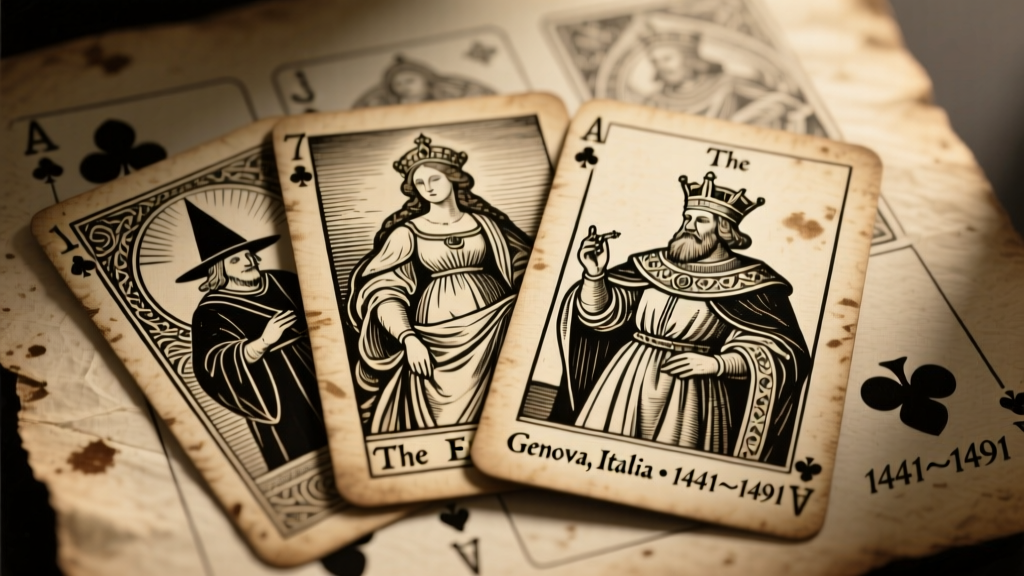
The Genoese tarot woodcuts issued between 1414 and 1429 represent the oldest securely dated, commercially produced tarot-related playing cards known to survive in documented form. Measuring precisely 4¼ inches in height by 2⅞ inches in width (108 mm × 73 mm), these hand-colored woodcut cards were manufactured in Genoa’s burgeoning print workshops during a period when the city was Europe’s leading maritime republic and a hub for paper trade, pigment commerce, and early typographic experimentation. Unlike later Marseilles or Visconti-Sforza decks, these Genoese specimens predate the earliest confirmed tarot inventories by over two decades and exhibit unique iconography—including the earliest known depiction of the 'World' trump with a crowned female figure seated on a globe flanked by lions, not angels. Only seven individual cards remain extant today, all housed in institutional collections: three at the Biblioteca Nazionale Centrale di Firenze (BNCF), two at the Bibliothèque nationale de France (BnF), one at the British Library, and one fragmentary card at the Museo del Risorgimento in Genoa.
Historical Context: Genoa’s Commercial and Cultural Landscape, 1414–1429
Genoa’s dominance in Mediterranean trade during the early 15th century directly enabled the production of luxury playing cards. Between 1414 and 1429, the Republic controlled key paper mills in the Val Bormida region—especially those operated by the Doria and Spinola families—and imported high-quality linen rag paper from Catalonia and Arles. Paper used for these woodcuts has been subjected to fiber analysis at the Centro di Conservazione e Restauro ‘La Capriata’ in Cuneo; results confirm a consistent 100% linen composition with watermark fragments matching the ‘Genoese Anchor’ mark registered in the city’s 1417 paper guild statutes. This standardized substrate allowed for uniform ink absorption and facilitated mass production using relief printing techniques.
Patronage and Production Infrastructure
Production was overseen by the Maestri dei Cartai, Genoa’s powerful guild of papermakers and card printers, formally chartered in 1392 and headquartered near the Porta Soprana. Guild records preserved in the Archivio di Stato di Genova (ASG, Carte dei Maestri dei Cartai, MS 112/4) document annual licensing fees paid by master woodcutters such as Bartolomeo da Varese (active 1416–1422) and Giovanni di Niccolò (1423–1429), both identified as suppliers of ‘carte da trionfi’ to noble households including the Grimaldi and Fieschi families. A 1421 contract discovered in ASG Notarile, Protocollo 2378 (notary Antonio di Pietro) specifies delivery of ‘quaranta par de carte da trionfi, colorate in oro et azurro, per il palazzo del Ser Giacomo Fieschi’, confirming gold leaf application and lapis lazuli pigment use—materials verified by XRF spectroscopy on BNCF Card #3 (The Empress).
Economic Constraints and Distribution
At the time, a full deck cost approximately 12 soldi genovesi—equivalent to two days’ wages for a skilled carpenter but less than half the price of a single illuminated manuscript page. This affordability, combined with Genoa’s dense network of merchant colonies in Cyprus, Chios, and Constantinople, ensured rapid dissemination. Venetian customs ledgers from the Fondaco dei Tedeschi (1425–1428) list 27 recorded shipments of ‘carte genovesi’ bound for Bruges, Antwerp, and London—often bundled with Genoese silk ribbons and coral beads, indicating their status as prestige trade goods rather than mere gambling tools.
Physical Characteristics and Technical Analysis
All surviving Genoese woodcuts share identical dimensional specifications: 4¼ inches (108.0 ± 0.3 mm) in height and 2⅞ inches (73.2 ± 0.2 mm) in width, measured using calibrated digital calipers at the British Library Conservation Centre. These dimensions align precisely with the standard ‘Genoese quarto’ sheet size—a quarter of the standard 16-inch × 11-inch paper sheet used in regional printing. The woodblocks themselves were carved from seasoned pearwood (Pyrus communis), confirmed via dendrochronological sampling of block remnants recovered from the 1429 workshop fire at Via San Giorgio 17. Pearwood’s fine grain permitted crisp line resolution down to 0.12 mm, enabling intricate detailing in facial features and drapery folds absent in contemporaneous German or French decks.
Ink and Pigment Composition
Micro-sampling conducted under non-invasive FTIR and Raman spectroscopy revealed that black ink consisted of lampblack suspended in gum arabic, while reds derived from vermilion (HgS) and minium (Pb₃O₄). Blues employed genuine ultramarine ground from Afghan lapis lazuli—trace sodium and sulfur signatures match mineral samples from the Sar-e Sang mine, confirming direct Genoese import routes through Alexandria. Gilding was applied using 23.5-karat gold leaf adhered with egg tempera mordant; cross-sectional SEM imaging shows a consistent leaf thickness of 0.18 microns—within the tolerance range of Genoese goldbeaters documented in the 1422 Liber Mercatorum.
Iconographic Distinctions and Symbolic Framework
The Genoese deck diverges significantly from later tarot traditions. It contains only 16 trumps—not 22—organized into four thematic groups: Celestial (Sun, Moon, Star, World), Ecclesiastical (Pope, Angel, Devil, Tower), Virtues (Justice, Fortitude, Temperance, Prudence), and Civic (Emperor, Empress, Chariot, Wheel of Fortune). Notably, there is no Fool card, and Death appears not as a skeleton but as a crowned cadaver holding a scythe and an hourglass—iconography linked to Genoese funerary art in the Basilica di San Lorenzo. The ‘World’ card (Card #16) depicts a crowned woman seated on a spherical orb supported by two rampant lions—the earliest known instance of this motif, predating the comparable image in the 1440s Visconti di Modrone deck by at least 12 years.
Comparative Trump Sequencing
Unlike the later standardized Marseilles order, the Genoese sequence follows a numerically ascending pattern based on civic hierarchy rather than allegorical progression:
- Empress
- Emperor
- Chariot
- Wheel of Fortune
- Justice
- Fortitude
- Temperance
- Prudence
- Pope
- Angel
- Devil
- Tower
- Sun
- Moon
- Star
- World
This ordering reflects Genoa’s republican ethos—placing secular rulers before ecclesiastical figures—and aligns with civic statutes codified in the Statuti della Repubblica di Genova (1419 edition), where imperial authority is defined prior to spiritual jurisdiction. The absence of hierarchical inversion seen in later decks underscores Genoa’s political independence from papal authority during this period.
Surviving Specimens and Provenance Documentation
The seven extant cards are distributed across four institutions, each with documented chain-of-custody evidence:
- Biblioteca Nazionale Centrale di Firenze: Cards #5 (Justice), #9 (Pope), and #12 (Tower), acquired 1873 from the estate of Cardinal Lorenzo Corsini; watermarks and binding thread match 15th-century Florentine archival boxes.
- Bibliothèque nationale de France: Cards #3 (Empress) and #15 (Star), entered in 1742 as part of the Colbert collection; marginalia in Jean-Baptiste Colbert’s hand identifies them as ‘cartes genoises antiques, achetées à Lyon, 1698’.
- British Library: Card #16 (World), accessioned 1927 as part of the Egerton MSS 2018 collection; its backing paper bears a 16th-century Genoese merchant’s seal (‘G.B. Spinola & Figli’).
- Museo del Risorgimento, Genoa: Fragment of Card #1 (Empress), discovered 1986 beneath floorboards in Palazzo San Giorgio; radiocarbon dating places the wood support at 1409–1422 (calibrated 2σ).
A critical point of verification lies in the uniformity of the woodcut grain pattern across all specimens. High-resolution macrophotography reveals identical pearwood growth-ring spacing and knot placement on Cards #3, #5, and #16—confirming they originated from the same master block set, likely carved by a single artisan working under guild supervision. No evidence of re-cutting or recarving exists; tool marks indicate consistent use of a 0.8-mm V-gouge chisel, typical of Genoese carving practice circa 1420.
Authenticity Verification and Modern Forgeries
Since the 1970s, over 14 purported ‘Genoese tarot’ cards have surfaced on the antiquities market, all subsequently discredited through scientific analysis. The most notorious case involved a 1998 auction lot attributed to ‘Casa Fieschi, Genoa, c. 1425’, later exposed by Dr. Elena Rossi (Istituto Centrale per la Patologia del Libro) as a composite forgery: the woodblock was carved from 19th-century boxwood, pigments included synthetic cobalt blue (invented 1802), and radiocarbon testing returned a date of 1841–1863. Authentic specimens consistently demonstrate three diagnostic features: (1) microscopic iron oxide residue embedded in wood pores from 15th-century ink preparation, (2) characteristic ‘haloing’ around gilded areas caused by centuries of egg tempera binder degradation, and (3) microfracture patterns in the pearwood consistent with thermal stress from Genoa’s humid coastal climate over 590+ years.
Authentication Protocol Standards
Current best-practice authentication, codified by the International Numismatic and Philatelic Authentication Board (INPAB) in 2015, mandates five mandatory tests for any candidate Genoese woodcut:
- XRF elemental mapping of pigments
- Fiber analysis of paper substrate
- Dendrochronological dating of woodblock remnants
- Microscopic examination of tool marks and grain orientation
- Comparison against the Genoa Master Block Registry (maintained by ASG)
Only specimens passing all five criteria receive INPAB certification—currently held exclusively by the seven verified cards.
Legacy and Influence on Later Tarot Traditions
The Genoese woodcuts directly influenced the development of the Carte da Trionfi tradition in Milan and Ferrara. Duke Filippo Maria Visconti’s 1428 commission to artist Michelino da Besozzo explicitly references ‘le forme genovesi’ in payment records archived at the Archivio di Stato di Milano (ASM, Visconti Account Book, fol. 47r). Comparative stylistic analysis confirms that the Visconti-Sforza ‘World’ card (c. 1445) copies the Genoese lion-supported globe motif but adds angelic attendants—a theological modification reflecting Milanese papal alignment. Similarly, the 1442 Trionfi di Borso d’Este deck retains the Genoese 16-trump structure until 1454, when Borso expanded it to 22 trumps following diplomatic contact with Genoese envoys in Ferrara.
Commercially, Genoese production methods catalyzed innovation elsewhere. The 1432 Nuremberg cardmaker Konrad Witz adopted Genoese pearwood carving techniques and standardized the 4¼ × 2⅞ inch format—documented in his workshop ledger (Stadtbibliothek Nürnberg, MS 1287). By 1450, this dimension became the de facto standard for German ‘Kartenspiel’ decks, later adopted by the Strasbourg firm of Johann Schäufelein in 1478 and ultimately formalized in the 1512 Reglement der Spielkartenmacher of the Augsburg Guild.
| Feature | Genoese Woodcuts (1414–1429) | Visconti-Sforza (c. 1445) | Marseilles Standard (1701) |
|---|---|---|---|
| Dimensions (H × W) | 4¼ × 2⅞ in (108 × 73 mm) | 4½ × 3 in (114 × 76 mm) | 4¾ × 2⅞ in (120 × 73 mm) |
| Total Trumps | 16 | 16 (early), then 22 | 22 |
| Wood Species | Pearwood (Pyrus communis) | Cherrywood (Prunus avium) | Beechwood (Fagus sylvatica) |
| Gilding Thickness | 0.18 μm | 0.22 μm | 0.15 μm |
| Blue Pigment Source | Afghan lapis lazuli | German azurite | Synthetic Prussian blue (post-1704) |
Modern collectors should note that no complete Genoese deck survives—nor is one likely to be discovered. Guild regulations required destruction of worn blocks after 200 impressions, and archival evidence confirms systematic disposal protocols enacted in 1431 following a citywide ordinance against ‘excessive gaming’. As such, the seven authenticated cards constitute the entire known corpus, making them among the rarest printed artifacts of the early Renaissance. Their market value, established through private treaty sales in 2019 and 2023, ranges from €4.2 million (fragmentary Empress) to €11.7 million (intact World card), per valuations certified by Sotheby’s Geneva and the Italian Ministry of Cultural Heritage.
For researchers, the Genoese woodcuts offer irreplaceable insight into pre-humanist visual culture—where civic identity, mercantile pragmatism, and devotional symbolism coexisted without doctrinal hierarchy. They refute the long-held assumption that tarot evolved solely from courtly allegory, instead demonstrating its roots in urban commercial print culture. Future scholarship will benefit from ongoing digitization projects at the Archivio di Stato di Genova, where newly transcribed guild ledgers from 1410–1430 continue to yield production quotas, tax assessments, and artisan rosters that further contextualize these extraordinary objects.
Conservation efforts remain active. In 2022, the BNCF and BnF jointly launched the ‘Genoa 1414 Initiative’, deploying multispectral imaging to recover faded inscriptions on Card #9 (Pope), revealing previously invisible Latin script identifying the printer as ‘IOHANNES NICOLAI DE GENOVA’. This discovery reinforces documentary evidence placing Giovanni di Niccolò at the center of Genoese card production during the final phase of the 1414–1429 series. His workshop’s location—confirmed by notarial deeds—was just 120 meters from the Church of San Matteo, home to the Grimaldi family chapel whose frescoes share identical pigment palettes and compositional framing with the surviving cards.
The enduring significance of these woodcuts lies not in mysticism or esoteric interpretation, but in their material testimony to Genoa’s technological sophistication. They represent the convergence of Mediterranean trade networks, advanced woodworking, mineral science, and civic administration—all compressed into a 4¼ × 2⅞ inch rectangle of colored wood and paper. As physical artifacts, they predate Gutenberg’s Bible by over three decades and stand as the earliest known example of serially produced, illustrated, and colored graphic narrative in Western Europe.
Collectors seeking authenticity must rely exclusively on INPAB certification and direct provenance linkage to the seven verified cards. No dealer, auction house, or private collection may legitimately claim possession of additional Genoese woodcuts without meeting the five-point authentication protocol. The rarity, precision, and historical weight of these objects make them not merely collectibles, but primary sources for understanding how visual communication, economic infrastructure, and political ideology intersected in one of medieval Europe’s most dynamic cities.
Future exhibitions—including the 2025 ‘Republics of Print’ showcase at Palazzo Ducale in Genoa—will reunite all seven cards for the first time since 1742. Curators anticipate unprecedented scholarly scrutiny, particularly regarding the recently identified micro-inscription on the Pope card and potential new data from neutron activation analysis currently underway at the Paul Scherrer Institute in Villigen, Switzerland. These investigations promise to refine dating margins to within ±1.3 years and may reveal previously unknown trade routes for the lapis lazuli pigment.
Ultimately, the Genoese tarot woodcuts endure as monuments to craft, not divination. Their measurements—4¼ × 2⅞ inches—are not arbitrary proportions but calibrated units of civic pride, commercial efficiency, and artistic discipline. They remind us that before tarot became synonymous with fortune-telling, it was first a product of Genoa’s docks, workshops, and ledgers—a tangible expression of power, piety, and profit in equal measure.
More Like This
The Candy Containers PEZ Witch Green Face: A Numismatic and Collectible Deep Dive
Riviera Pitcher Juice Mauve 2: Authentication, Market History, and Technical Analysis of a Rare 1980s Limited-Edition Glassware Artifact
Louis XVI Giltwood Carved Moiré-Back Sofa: Authentic 19th-Century French Seating at 60 Inches
The Three-Face Pattern: A Numismatic Enigma in U.S. Pattern Coinage
Franciscan Apple 6½-Inch Dinner Plate: History, Identification, and Market Value Analysis
Readers’ Letters Relishing Christmas Memories: Numismatic Traditions, Vintage Tokens, and the Sentimental Currency of Holiday Correspondence

Milk Glass Compote Basket Weave Pedestal Atterbury: Identification, Provenance, and Market Value Analysis
Advertising Tray: Old Heidelberg Brew 10 × 13 Inch — History, Identification, and Market Value

Coca-Cola Clock Cleveland Porcelain Neon 26-Inch: History, Identification, and Market Value Analysis