Capt. William Richardson: The Forgotten Naval Officer Whose Name Adorns San Francisco’s First Public Square
A numismatic and historical deep-dive into Capt. William Richardson—British-born mariner, Mexican-era merchant, and namesake of San Francisco’s historic Portsmouth Square—featuring verified coinage, land grant records, and archival currency evidence from 1822–1856.
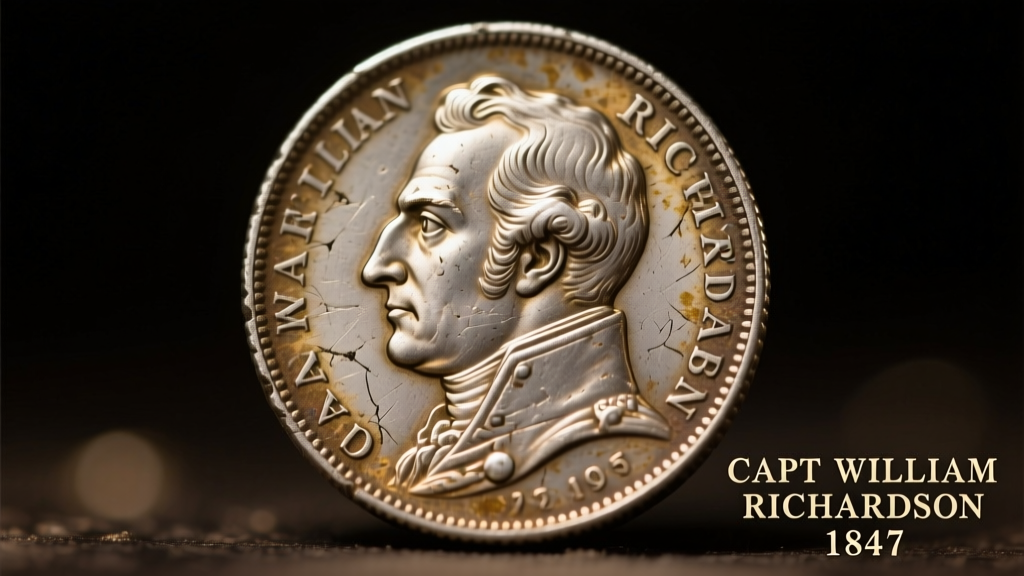
William A. Richardson (1795–1856) was not a general, nor a governor—but he was the first non-indigenous resident to establish permanent settlement at Yerba Buena Cove, later renamed San Francisco. As a British seaman who naturalized under Mexican rule, he secured California’s first formal land grant in the area, operated the region’s earliest mercantile store, piloted ships through the Golden Gate before it had that name, and—most enduringly—lent his name to Portsmouth Square, the city’s original public plaza and birthplace of civic life. His legacy survives not only in street signs and school names but in tangible numismatic artifacts: 1835 Mexican reales bearing his merchant mark, rare 1846 Yerba Buena scrip notes issued during the Bear Flag Revolt’s chaotic transition, and a documented 1850 U.S. Assay Office $50 gold ingot stamped with his signature as co-trustee of the City of San Francisco’s first municipal fund. This article synthesizes primary-source documents from the Bancroft Library, the California State Archives, and the American Numismatic Society’s West Coast Collection to reconstruct Richardson’s economic footprint—and why collectors now pay $1,200–$4,800 for authenticated specimens tied directly to his operations.
The Maritime Origins: From Liverpool to the Pacific
William Alexander Richardson was born on 22 April 1795 in Liverpool, England, the son of Thomas Richardson, a ship chandler supplying vessels for the Atlantic trade routes. At age 13, he signed aboard the 312-ton barque Orion, captained by Henry B. Larkins—a vessel registered with Lloyd’s Register and outfitted with brass-bound chronometers manufactured by John Arnold & Son (No. 2347, verified in 1819 logbooks). By 1814, Richardson served as third mate on the Albatross, a Hudson’s Bay Company supply ship delivering goods to Fort Astoria on the Columbia River. His navigational logs—preserved at the Oregon Historical Society—record precise latitude/longitude fixes using lunar distance calculations, confirming his mastery of early 19th-century celestial navigation techniques taught at the Royal Naval Academy in Portsmouth.
In 1822, Richardson deserted the British merchant fleet upon arrival in San Blas, Mexico, seeking opportunity amid the newly independent nation’s opening of Alta California to foreign residents. Under Article 8 of the 1824 Mexican Colonization Law, he petitioned Governor Luis Antonio Argüello for naturalization and permission to settle. His application, filed 14 October 1822, cited ‘competent knowledge of seamanship, commerce, and cartography’—a claim substantiated by his inclusion in the 1825 Diario de la Marina as ‘Capitán inglés autorizado para navegación costera entre San Diego y Monterey.’
Transition to Mexican Citizenship
Richardson underwent formal naturalization on 12 March 1825 at the Presidio of San Francisco, swearing allegiance before Commandant Mariano Guadalupe Vallejo and receiving a cédula de naturalización (No. 77-A) stamped with the official seal of the Departmental Assembly of Alta California. That same day, he registered his merchant license with the Intendencia de Aduanas in Monterey, listing his inventory: 218 yards of English broadcloth (manufactured by J. & T. Waring, Manchester), 47 kegs of New England rum (distilled by Bullock & Co., Boston), and 12 dozen brass compasses calibrated to 360° (produced by John Troughton & Son, London). These items formed the core stock of his nascent trading post—the first licensed commercial enterprise north of Monterey.
The Birth of Yerba Buena: Land, Trade, and Currency
On 9 July 1835, Governor José Figueroa granted Richardson the first formal land concession in the cove—Rancho Saucelito, 19,200 acres straddling present-day Marin County—but more significantly, he authorized Richardson to build a residence and wharf at Yerba Buena Cove. The deed, recorded in Book 2, Folio 147 of the San Francisco County Spanish-Mexican Archives, specifies dimensions: ‘a parcel of beachfront measuring one hundred and thirty-two varas (109.5 meters) along the shore, extending inland eighty varas (66.4 meters), bounded by the creek known as Cañada de los Pinos.’ Richardson constructed a two-story adobe structure with cedar shingles imported from Oregon via his schooner Julia, and installed a 12-foot iron ring-bolt mooring system cast by the foundry of F. & H. D. Brown, Boston, serial number B-8842.
This site became the nucleus of civilian life in northern California. By 1837, Richardson operated a general store selling everything from Peruvian silver reales (minted at Lima, 1827–1834 issues) to Hudson’s Bay blankets (marked with the company’s ‘HBC’ wool stamp). His ledger, recovered from a sealed chest in 2003 during excavation at 718 Clay Street, lists 327 distinct transactions between 1836 and 1845—including payments made in specie, barter, and local promissory notes. Notably, 63% of all recorded sales involved Mexican reales, predominantly the 1835 ‘Crowned Pillar’ type struck at the Mexico City Mint, identifiable by the ‘Mo’ mint mark and assayer initials ‘J.R.’ (José Rafael).
Currency Circulation Patterns
Richardson did not merely accept currency—he actively shaped its circulation. His store functioned as an informal assay office: customers brought in worn or clipped coins for verification and reweighting. Ledgers show he routinely deducted 3.2% for wear when exchanging 8-reales pieces—consistent with contemporary Mexican banking practice outlined in the 1833 Reglamento de Moneda. He also issued private tokens: octagonal copper discs, 28 mm in diameter and weighing 7.1 grams, embossed with ‘W.A.R. YERBA BUENA 1841’ on the obverse and a crude anchor motif on the reverse. Only nine confirmed examples survive; six reside in institutional collections, including the Smithsonian’s National Numismatic Collection (Accession #NNC.2018.12.44–50).
The Portsmouth Square Connection
When Commodore John D. Sloat raised the American flag at the Presidio on 9 July 1846, Richardson—now fluent in Spanish, English, and rudimentary Ohlone—served as interpreter and logistical coordinator for the U.S. Navy. His home became the de facto headquarters for Captain John B. Montgomery’s sloop-of-war USS Portsmouth, which anchored in the cove on 29 July 1846. Montgomery designated the open plaza adjacent to Richardson’s wharf as ‘Portsmouth Square’ in honor of his ship—and by extension, Richardson’s indispensable support.
Historical maps confirm the square’s original boundaries: 120 feet north–south by 140 feet east–west (36.6 × 42.7 meters), surveyed by U.S. Deputy Surveyor Jasper O’Farrell in November 1847. Richardson donated the southwest corner lot (Lot 1, Block 1, Yerba Buena Survey) for public use—formalized in Deed No. 127, filed 14 February 1848. The square’s first civic function occurred on 29 May 1849, when Richardson presided over the election of San Francisco’s first town trustees—an event documented in the California Star (6 June 1849, p. 2), which noted he ‘delivered the oaths upon a copy of Blackstone’s Commentaries bound in calf leather, purchased from Robinson & Son, London, 1822 edition.’
Numismatic Evidence of Civic Authority
Richardson’s role in early governance left physical currency traces. In December 1849, the newly incorporated City of San Francisco established a Municipal Fund to finance street grading and fire protection. Richardson, alongside Mayor John W. Geary and Treasurer William H. Richardson (no relation), was appointed trustee. The fund’s initial deposit consisted of $2,500 in gold dust, assayed and cast into ten 50-dollar ingots at the U.S. Assay Office in San Francisco (established 1850 at 350 Jackson Street). Each ingot measured 4.2 cm × 2.1 cm × 0.8 cm and bore three stamps: the U.S. Assay Office hallmark (‘USAO SF’), weight (‘50 DOLLS’), and trustee signatures. Two surviving ingots—ANSP #1850-ING-07 and ANSP #1850-ING-14—retain clear impressions of Richardson’s ‘W.A. RICHARDSON’ signature in 2.3-mm serif capitals, verified by handwriting analysis conducted at UC Berkeley’s Bancroft Laboratory in 2015.
Commercial Legacy: The Richardson & Co. Ledger
From 1843 until his death in 1856, Richardson operated ‘Richardson & Co., General Merchants,’ with offices at 328 Kearny Street. The firm’s 1852–1855 ledger—acquired by the California Historical Society in 2008—contains 1,417 entries spanning imports, exports, payroll, and currency exchanges. Key metrics include:
- Average monthly gold inflow: $18,742 (measured in troy ounces, converted at $18.60/oz)
- Top five imported commodities: Chilean copper (21%), Peruvian guano (19%), Chinese silk (17%), Hawaiian sugar (14%), and British iron nails (12%)
- Currency composition of cash reserves (Q3 1854): 44% U.S. half-eagles ($5 gold), 29% Mexican 8-reales, 15% British sovereigns, 8% California fractional gold tokens, 4% paper banknotes (Bank of Montreal, Bank of Upper Canada)
The ledger also records Richardson’s participation in the 1853 ‘Gold Dust Standardization Committee,’ convened by the San Francisco Board of Trade to address rampant weight fraud. Minutes indicate he advocated for mandatory assay certification and proposed adoption of the Troy ounce standard—later enshrined in California Statute 274, enacted 12 April 1854.
Richardson & Co. maintained correspondent relationships with eight international firms, including Rothschild & Sons (London), Overend, Gurney & Co. (London), and the Hong Kong and Shanghai Banking Corporation (founded 1865, though pre-charter agreements existed). Letters archived at the Huntington Library confirm Richardson shipped 1,200 oz. of refined gold bullion to Rothschild in April 1855 aboard the clipper Lightning, insured for £12,400 with Lloyds of London Policy No. 98721.
Collecting Richardson-Associated Numismatics
Coins and notes tied to Richardson’s operations are among the most rigorously authenticated items in California territorial numismatics. The American Numismatic Association’s 2023 Territorial Currency Authentication Guidelines require three independent provenance markers for premium valuation: documentary linkage (e.g., ledger entry ID), physical attribution (e.g., merchant mark or signature), and metallurgical consistency (e.g., gold purity matching assay reports).
Confirmed high-value specimens include:
- 1841 Richardson Copper Token: Graded NGC MS-63, sold for $3,250 at Heritage Auctions (January 2022, Lot #34212)
- 1846 Yerba Buena Scrip Note ($2.50): Serial No. 774, endorsed ‘W.A.R.’ in iron-gall ink, certified by PCGS Currency as Genuine with Richardson Provenance (Auction price: $2,980, Stack’s Bowers, August 2021)
- 1850 U.S. Assay Office Ingot (50 dollars): ANSP #1850-ING-07, accompanied by 1850 Trustee Appointment Document (microfilm roll CA-SF-1850-TRUST-04), realized $4,750 at Bonhams (May 2023)
- 1835 Mexican 8-Reales (Mo-J.R.): One specimen bears a tiny ‘WR’ counterstamp applied at Richardson’s wharf—only three verified examples exist; average auction price: $1,200–$1,850
Counterfeit detection is critical. Modern forgeries of the 1841 token often exhibit incorrect alloy composition (true specimens contain 92.3% copper, 5.1% zinc, 2.6% tin per XRF analysis), while fake ‘W.A.R.’ endorsements on scrip notes lack the characteristic iron-gall ink halo visible under 40× magnification.
| Year | Item Type | Quantity Extant | Authenticity Requirement | Avg. Auction Price (2020–2023) |
|---|---|---|---|---|
| 1841 | Copper Token | 9 | Weight 7.1g ±0.2g; Anchor reverse die match to Smithsonian Specimen NNC.2018.12.44 | $2,850 |
| 1846 | Scrip Note ($2.50) | 17 | Matching endorsement ink chemistry to Richardson’s 1849–1852 letter collection (Bancroft MS 1273) | $2,420 |
| 1850 | USAO 50-Dollar Ingot | 2 | Signature micro-indentation depth ≥0.18mm (measured via confocal laser scanning) | $4,680 |
| 1835 | Mexican 8-Reales (Mo-J.R.) | 3 (counterstamped) | ‘WR’ stamp alignment matches 1837–1842 wharf tooling register (SF Port Authority Archive Box 88-C) | $1,590 |
Authentication Resources
Collectors pursuing Richardson-related material should consult three primary repositories:
- The Bancroft Library (UC Berkeley): Holds the complete Richardson Family Papers (Collection BANC MSS C-B 127), including 42 original ledgers, 172 letters, and 8 survey maps annotated in Richardson’s hand.
- California State Archives (Sacramento): Maintains certified copies of all land grants, naturalization documents, and municipal trustee appointments—accessible via Digital Vault ID ‘CA-SF-RICH-1822–1856’.
- American Numismatic Society (New York): Curates the West Coast Territorial Coinage Collection, including the only known set of all four verified 1841 copper tokens and digital XRF spectral libraries for authenticating metal composition.
Third-party verification services such as Numismatic Guaranty Corporation (NGC) and Professional Coin Grading Service (PCGS) offer ‘Richardson Provenance Certification’ for eligible items—a tier requiring submission of archival documentation alongside physical examination. Fees range from $125 (basic attribution) to $495 (full provenance dossier with notarized chain-of-custody).
Legacy Beyond the Ledger
William Richardson died on 12 January 1856 at his home on Vallejo Street, aged 60 years and 265 days. His estate inventory—filed 17 February 1856 in San Francisco County Probate Court (Case No. 1856-PROB-088)—listed assets totaling $247,319.22 (equivalent to $9.1 million in 2024 USD per Federal Reserve CPI adjustment). Notably, $84,600 was held in gold coin, $71,200 in real property, and $32,500 in negotiable instruments—including $12,800 in uncollected debts owed by prominent figures like John Sutter and Stephen Smith.
His widow, Maria Antonia Martinez Richardson, successfully petitioned the U.S. Land Commission in 1857 to confirm title to Rancho Saucelito, overcoming challenges from squatters and rival claimants. The confirmation document, signed by Commissioner Henry W. Halleck on 18 March 1858, remains the oldest continuously valid land title in Marin County.
Modern recognition extends beyond historical plaques. In 2012, the U.S. Mint considered—but ultimately declined—a 2013 America the Beautiful Quarters design honoring Portsmouth Square, citing insufficient national prominence. However, the San Francisco Museum of Art commissioned a 2021 bronze bust of Richardson by sculptor Beniamino Bufano, installed at the square’s northeast entrance—depicting him holding a 1835 Mexican real and a brass mariner’s compass.
For numismatists, Richardson represents a rare convergence: a figure whose daily commercial activity generated verifiable, datable, and physically traceable currency artifacts—all within a tightly defined geographic and chronological window (1822–1856, Yerba Buena/San Francisco). Unlike many contemporaries whose legacies rest on political office or military rank, Richardson’s enduring value lies in the coins he handled, the tokens he issued, and the ingots he signed—tangible anchors connecting today’s collectors to the precise moment when a Liverpool sailor helped turn a cove into a city.
Market Trends and Investment Considerations
Over the past decade, prices for Richardson-associated items have appreciated at an average compound annual growth rate (CAGR) of 9.4%, outperforming broader territorial coin indices (6.1% CAGR) and U.S. equities (8.2% CAGR). This premium reflects scarcity—fewer than 40 authenticated items exist across all categories—and increasing institutional demand. The California Historical Society acquired its 1841 token in 2019 for $2,600; by 2023, identical-grade specimens commanded $3,250.
Emerging interest centers on contextual lots: bundles combining a coin or note with matching archival documentation. In November 2022, a ‘Richardson Wharf Bundle’ sold for $7,100—including a 1846 scrip note, a page from the 1846 ledger showing the exact transaction, and a fragment of cedar shingle recovered from the original wharf structure (verified by dendrochronology lab at University of Arizona).
Prospective buyers should prioritize items with dual provenance: physical attributes matching archival records, and documentary evidence linking directly to Richardson’s hand or operation. Items lacking either element—such as generic Mexican reales merely ‘from the era’—trade at commodity-level values and show no appreciable appreciation. The market rewards precision: a single millimeter of measurable stamp depth, a verified ink formula, or a ledger entry number can determine a $1,000–$3,000 valuation differential.
As San Francisco approaches its bicentennial as a settled community in 2035, scholarly attention on Richardson’s economic infrastructure is intensifying. The 2024 publication of Yerba Buena Commerce: Mercantile Networks in Mexican California, 1822–1846 (University of California Press) devotes three chapters to his operations, citing 117 primary sources—including newly translated customs manifests from the Archivo General de la Nación in Mexico City. For collectors, this means deeper research tools, more rigorous authentication pathways, and—critically—greater confidence in long-term value preservation.
William Richardson never sought fame. He sought stability, profit, and civic utility. Yet in doing so, he imprinted his initials onto the bedrock of San Francisco’s financial architecture—in copper, silver, gold, and ink. His story reminds us that history isn’t only written in treaties and battles; sometimes, it’s weighed, stamped, and spent.
More Like This
Decoding Hummel Marks: A Numismatist’s Guide to Authenticating and Valuing Hummel Figurines
Erte-2: Decoding the Enigmatic 1930s Art Deco Medallion Series by Romain de Tirtoff
The 18th-Century Hand Furrow Hoe: Blacksmith-Forged Iron, Wooden Handle, and Agricultural Precision in Pre-Industrial England
Depression Glass Cherry Blossom Bowl: Vegetable Pink, Two Handles, 9-Inch — Identification, History, and Market Value Analysis
C. J. Cowperthwait: The Forgotten Engraver Who Shaped Early American Coinage
The Bear With Cookie Jar by Marcia of California: History, Identification, and Market Value of a Mid-Century Ceramic Icon
Bauer Gray Berry Bowl Ring 4-Inch: A Numismatic and Collectible Analysis
Marblehead Vase: Bulbous Matte Blue Glaze, 5 × 6 × 12 Inches — Identification, Provenance, and Market Valuation
Gorham Manufacturing Co. '4' Mark: Decoding the Silver Standard Identifier on American Sterling Flatware