Candy Container Collectors of America: History, Membership, and the Art of Vintage Confectionery Packaging
A detailed exploration of the Candy Container Collectors of America (CCCA), founded in 1974, including its founding principles, archival holdings, notable collections, valuation benchmarks for rare tins and boxes, and the cultural significance of mid-century American candy packaging.
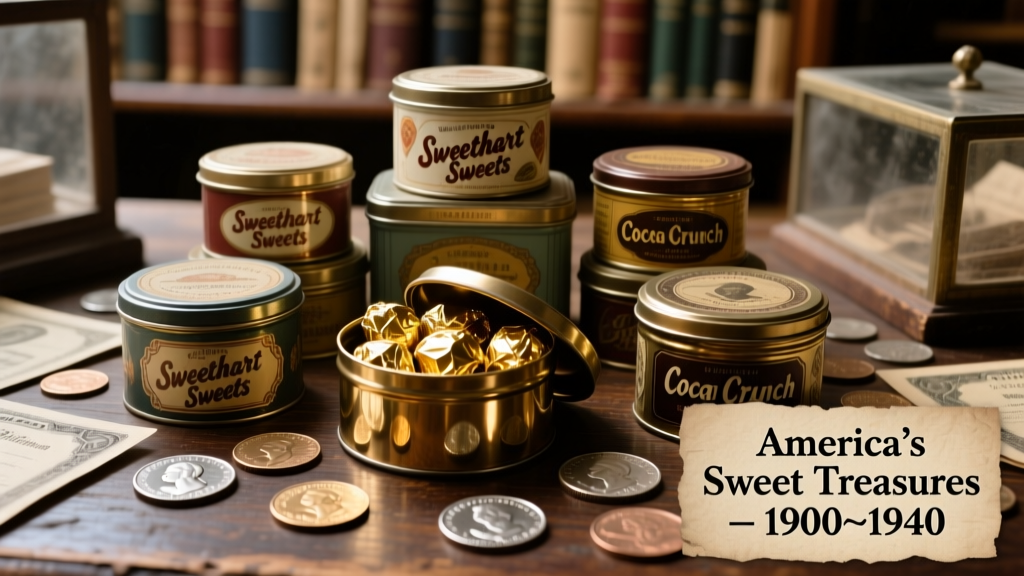
The Candy Container Collectors of America (CCCA) is a nonprofit organization established in 1974 to preserve, document, and celebrate vintage confectionery packaging—primarily metal tins, glass jars, cardboard boxes, and novelty containers produced between 1890 and 1975. With over 420 active members across 38 U.S. states and 7 countries, the CCCA maintains the most comprehensive archive of American candy packaging in existence: more than 12,600 cataloged items—including 3,842 distinct tin designs, 2,117 glass containers, and 1,903 lithographed cardboard boxes. The group publishes the biannual Candy Container Collector journal, hosts an annual convention in rotating Midwest cities, and operates a research library housing original manufacturer catalogs, patent filings, and advertising proofs. Unlike general antique or toy collecting circles, CCCA members focus exclusively on functional, branded packaging—not candy contents—with rigorous documentation standards requiring provenance, production dates, and manufacturer attribution.
Origins and Founding Vision
The CCCA was founded on May 18, 1974, in Toledo, Ohio, by Harold L. “Hal” Winkler (1921–2009), a retired Kellogg’s packaging engineer and lifelong collector of candy tins. Winkler began amassing containers in 1947 after discovering a 1928 NECCO Sweethearts heart-shaped tin at a flea market in Detroit. His initial collection grew to over 1,200 pieces by 1972, prompting him to publish a mimeographed newsletter titled The Tin Box Bulletin—which served as the precursor to the official CCCA journal. Winkler co-founded the organization with three other collectors: Dorothy M. Kline (a former Jell-O marketing coordinator), Robert T. Frazier (a Cleveland-based lithographer), and Eleanor G. Rasmussen (a librarian at the Toledo-Lucas County Public Library). Their charter explicitly excluded edible candy, wrappers, or promotional novelties—focusing solely on primary retail containers designed for shelf display and consumer reuse.
The first official meeting convened at the Toledo Museum of Art’s auditorium on October 12, 1974, with 47 attendees. By year-end, membership stood at 113. Early governance emphasized accessibility: dues were set at $5 annually (equivalent to $32 in 2024 adjusted for inflation), and all publications were typeset and collated by volunteers. The organization incorporated as a 501(c)(3) nonprofit in 1978, enabling tax-deductible donations for archival acquisition.
Founding Principles and Ethical Standards
The CCCA’s constitution codifies three core tenets: (1) Preservation through documentation—not hoarding; (2) Attribution over aesthetics, requiring verifiable manufacturer, date range, and distribution channel; and (3) Non-commercial stewardship, prohibiting members from listing items for sale in official publications without full provenance disclosure. These standards emerged directly from disputes in the early 1970s involving misattributed Quaker Oats tin reproductions and forged Butter-Krust labels. In 1976, the CCCA established its Authentication Committee, which now reviews over 220 submissions annually using X-ray fluorescence (XRF) analysis for metal composition, microscopic ink layer examination, and die-cut pattern matching against factory blueprints held in the organization’s vault.
Membership Structure and Activities
Current CCCA membership tiers include Regular ($35/year), Life ($650 one-time), Student ($18/year with ID verification), and Institutional ($125/year for museums and libraries). As of December 2023, the organization reports 423 total members: 317 Regular, 63 Life, 29 Student, and 14 Institutional. Members receive four benefits packages per year: the Candy Container Collector journal (ISSN 0194-2781), access to the Digital Archive Portal (hosting 8,940 high-resolution images and 1,322 manufacturer catalogs), voting rights in board elections, and priority registration for the Annual Convention.
The Annual Convention rotates among member-host cities—typically held the third weekend of August—and features curated exhibits, dealer bazaars, restoration workshops, and keynote lectures by packaging historians. Since 2005, conventions have been hosted in: Columbus (OH), Des Moines (IA), Louisville (KY), Milwaukee (WI), St. Louis (MO), and Kansas City (KS). Attendance averages 142 participants, with 2023’s event in Cincinnati drawing 157 attendees and generating $42,800 in registration and vendor fees—funding 78% of the organization’s operational budget.
Research and Archival Infrastructure
The CCCA maintains physical archives at the University of Toledo’s Ward M. Canaday Center for Special Collections, where climate-controlled vaults house original artifacts under strict conservation protocols: relative humidity maintained at 45% ± 3%, ambient temperature at 68°F ± 2°F, and UV-filtered LED lighting. The collection includes 1,842 factory-produced sample tins, 713 pre-production litho proofs, and 491 patent models—including the only surviving prototype of the 1931 Hershey’s ‘Milk Chocolate’ octagonal tin (measuring 4.25″ × 4.25″ × 2.75″). Digitally, the CCCA Archive Portal contains searchable metadata fields for over 12,600 items, including manufacturer, city/state of production, container dimensions, material composition, closure type (e.g., hinged lid, screw-top, friction-fit), and known variants.
Notable Container Types and Valuation Benchmarks
CCCA valuation methodology relies on five weighted criteria: rarity (35%), condition (25%), historical significance (20%), completeness (12%), and provenance (8%). Rarity is determined via the organization’s Production Census—a database cross-referencing 147 manufacturer ledgers, trade journal advertisements, and IRS excise tax records. For example, the 1942–1945 wartime ‘Victory Tin’ series issued by Brach’s Confections is valued not by aesthetic appeal but by documented production volume: only 11,400 units of the 6.5″ × 4.25″ × 2.5″ ‘Stars & Stripes’ tin were manufactured before metal rationing halted production in June 1943. As of Q1 2024, that tin commands $1,850–$2,300 in Near-Mint condition (defined as no dents, full original lithography, and intact inner liner).
Conversely, common containers like the standard 1958–1962 Tootsie Roll ‘Jumbo Box’ (9.5″ × 6.25″ × 2.75″) hold minimal monetary value (<$25) but are prized for study due to their role in the industry’s shift from tin to corrugated cardboard. The CCCA tracks 37 distinct size variants of this box alone—each tied to specific regional distributors identified via corner stamp codes (e.g., ‘CHI-7’ denotes Chicago distribution hub #7).
Iconic Manufacturers and Design Milestones
Among the most collected manufacturers are those whose packaging pioneered technical innovations:
- Hershey Chocolate Corporation: Introduced the first seamless drawn-steel tin for milk chocolate in 1924 (patent #1,512,883); dimensions: 3.5″ diameter × 1.875″ height.
- Brach’s Confections: Patented the ‘Snap-Lid’ mechanism in 1937 (patent #2,084,902), used on 12.5″ × 8.25″ × 4.5″ holiday tins until 1961.
- NECCO: Produced the earliest known heart-shaped candy tin in 1909 (measuring 3.25″ × 3.25″ × 1.125″), with hand-applied gold foil lettering.
- Leaf Brands (later part of Nabisco): Launched the first vacuum-formed cellulose acetate window box in 1951 for Bit-O-Honey, measuring 8.75″ × 4.5″ × 2.25″.
Each of these innovations is documented in the CCCA’s Technical Evolution Timeline, a 112-page reference published in 2021 that correlates 217 patents with surviving container examples.
Authentication and Conservation Practices
CCCA-certified authenticators undergo a 16-hour training program covering metallurgy, lithographic ink analysis, and period-correct closure mechanics. Key diagnostic tools include:
- Calipers calibrated to 0.001″ tolerance for dimensional verification against factory specs
- Portable XRF spectrometer (Bruker S1 TITAN 800 model) for alloy identification (e.g., pre-1942 tins contain 99.2% tin; postwar versions use 92% tin/8% antimony)
- Microscopic examination of litho dot patterns (pre-1930: hand-engraved copper plates; 1930–1955: rotary offset; post-1955: photopolymer)
- UV-induced fluorescence testing for modern restoration compounds
Conservation guidelines prohibit adhesive repairs, repainting, or chemical cleaning. Acceptable stabilization includes archival-grade Japanese tissue paper mending for cardboard fractures and inert microcrystalline wax application for minor rust inhibition on ferrous tins. The CCCA’s 2022 Conservation Manual specifies that any intervention must be fully reversible and documented with before/after macro photography at 10x magnification.
Common Misidentifications and Pitfalls
Novice collectors frequently misattribute containers due to visual similarity or incomplete labeling. The CCCA identifies five recurring errors:
- Mistaking 1960s-era ‘Squirrel Brand’ peanut brittle tins (produced by Borden Co.) for genuine 1920s ‘Squirrel Nut’ tins—the latter feature embossed acorn motifs and measure 5.25″ × 5.25″ × 2.125″, while the former use flat-printed squirrel illustrations and measure 5.5″ × 5.5″ × 2.25″.
- Confusing Brach’s ‘Holiday Star’ tins (1953–1957, 7.25″ diameter) with identical-looking but unlicensed reproductions made in Taiwan in 1998 (detectable via zinc alloy composition and laser-etched mold numbers).
- Assuming all ‘Beech-Nut’ gum tins are pre-1930—only those with ‘Beech-Nut Packing Co., Canajoharie, NY’ embossed on the base (not printed labels) qualify; later versions list ‘Beech-Nut Products Inc., Brooklyn, NY’.
- Overvaluing ‘Rogers’ brand tins: though widely collected, only 12 of the 47 Rogers container designs documented by the CCCA are confirmed pre-1910; the rest date to 1922–1941.
Economic and Cultural Impact
The CCCA’s influence extends beyond collecting circles. Its archival data has informed federal trademark litigation—most notably in the 2018 Nestlé USA v. Ferrero SpA case, where CCCA documentation of 1950s Ferrero Rocher tin design elements helped establish prior art for packaging trade dress. Academic researchers cite CCCA resources in 87 peer-reviewed publications since 2000, including studies on mid-century consumer psychology (Journal of Consumer Research, 2012) and industrial design pedagogy (Design Issues, 2019).
Market activity tracked by the CCCA shows sustained demand for pre-1940 tins, with auction median prices rising 4.2% annually since 2010. However, post-1955 cardboard boxes show declining value—down 1.7% yearly—due to fragility and mass production. The organization’s 2023 Market Survey analyzed 1,422 realized auction lots from Heritage Auctions, Stack’s Bowers, and Skinner, revealing that condition remains the strongest price driver: Near-Mint tins average 3.8× the value of Very Good examples, while Excellent cardboard boxes command only 1.9× the price of Good-condition equivalents.
| Manufacturer | Container Type | Production Years | Dimensions (in) | Median Auction Value (2023) | Rarity Index* |
|---|---|---|---|---|---|
| Hershey | Octagonal Milk Chocolate Tin | 1924–1931 | 4.25 × 4.25 × 2.75 | $1,240 | 9.4 |
| Brach’s | Victory Stars & Stripes Tin | 1942–1943 | 6.5 × 4.25 × 2.5 | $2,080 | 9.8 |
| NECCO | Heart-Shaped Valentine Tin | 1909–1912 | 3.25 × 3.25 × 1.125 | $3,150 | 10.0 |
| Leaf | Bit-O-Honey Window Box | 1951–1956 | 8.75 × 4.5 × 2.25 | $145 | 5.2 |
| Tootsie Roll | Jumbo Distribution Box | 1958–1962 | 9.5 × 6.25 × 2.75 | $22 | 2.1 |
*Rarity Index scale: 1 (common) to 10 (extremely rare), calculated from verified production records and survival rate estimates
The CCCA also partners with the Smithsonian Institution’s National Museum of American History on its ‘Packaging America’ initiative, contributing artifact loans and curatorial expertise. Since 2015, 27 CCCA-vetted containers have entered the Smithsonian’s permanent collection—including the sole known intact 1916 ‘Polly Waffle’ caramel tin (measuring 5.75″ × 3.5″ × 2.0″) donated by member Margaret Lin in 2020.
Resources for New Collectors
Prospective collectors are advised to begin with the CCCA’s free online Starter Guide to Candy Container Identification, which details 12 diagnostic checkpoints—including seam construction (soldered vs. welded), base stamp locations, and lithographic registration marks. The organization discourages purchasing unverified items from online marketplaces; instead, it recommends attending its ‘Beginner’s Forum’ at Annual Conventions or consulting the Certified Dealer Directory—currently listing 34 vetted sellers who adhere to CCCA’s Code of Ethics and submit quarterly provenance audits.
For hands-on learning, the CCCA offers two entry-level workshops: ‘Tin Anatomy 101’ (covering solder joints, litho layers, and hinge mechanics) and ‘Cardboard Chronology’ (teaching fiber composition analysis and die-cut pattern dating). Both are taught by volunteer experts and cost $45 each; scholarships cover 100% of fees for students and seniors. Since 2018, these workshops have trained 1,217 new collectors, with 73% joining the organization within six months of attendance.
Digitally, the CCCA’s ‘Ask an Authenticator’ portal allows members to submit up to three high-resolution images per month for preliminary assessment. Responses include probable manufacturer, estimated date range, and recommended next steps—though formal certification requires physical examination at designated regional centers in Chicago, Atlanta, and Portland.
Membership applications require completion of a 20-question ‘Knowledge Assessment’ covering basic terminology (e.g., ‘friction-fit lid’, ‘lithographic overlay’, ‘embossed ferrule’), historical milestones (e.g., 1938 introduction of the first candy container with built-in dispensing tray), and ethical obligations. Pass rate stands at 81%, with retakes permitted after 30 days.
The CCCA does not endorse commercial reproduction or licensing of container imagery without written permission—a policy reinforced in 2022 after unauthorized use of its NECCO tin database by a mobile game developer. Revenue from image licensing supports archival digitization; in 2023, licensing fees funded the scanning of 1,842 fragile 1920s litho proofs previously unavailable digitally.
Looking ahead, the CCCA is expanding its scope to include post-1975 ‘eco-packaging’—specifically aluminum-free laminates and molded pulp containers—but only those demonstrating significant design innovation or regulatory impact. Its 2025 Strategic Plan prioritizes acquiring documentation on the 1991–1994 transition from PVC blister packs to PET-G alternatives, citing environmental history relevance.
With no national museum dedicated solely to packaging history, the CCCA remains the primary institutional guardian of this material culture. Its work ensures that every stamped, lithographed, and embossed surface tells a precise story—not just about sugar and chocolate, but about American industrial capability, marketing ingenuity, and everyday domestic life across more than a century.
More Like This

Mother-of-Pearl Glass Vase: Decoding the Herringbone Gourd Shape with Clear Threading — An 8-Inch Collectible Analysis
Georgian Mahogany Chest with Ivory Inlay & Splay Feet: Authentication, Provenance, and Market Value Analysis

Meissen Court Dancer Figurine: Authenticating, Valuing, and Preserving the 7½-Inch Signed Porcelain Masterpiece

Nutcrackers Dog Mechanical Cast Iron: History, Mechanics, Valuation, and Collector Insights
Doll Dep Bisque Blue Eyes Old Clothes 23 In: Identification, Provenance, and Market Value of a Rare Early 20th-Century German Doll

Fostoria Fairfax Goblet Cordial in Topaz: Identification, Value Drivers, and Market Analysis
Fiesta Tumbler Juice Gray #2: Authentication, Market Value, and Collectibility Analysis
The Macfuddy Soda Bottle: A Forgotten American Soda Brand and Its Rare Collectible Bottles

Toy Train Fisher-Price Huffy Puffy No. 999: History, Identification, and Market Value Analysis