Calendars, 1954: DuPont Explosives Promotional Calendars Featuring Dogs — A Numismatic and Advertising Artifact Study
A detailed examination of the rare 1954 E.I. du Pont de Nemours & Co. promotional calendars featuring anthropomorphic dogs in explosives-related vignettes—covering production details, surviving examples, market valuation trends, design provenance, and collector authentication protocols.
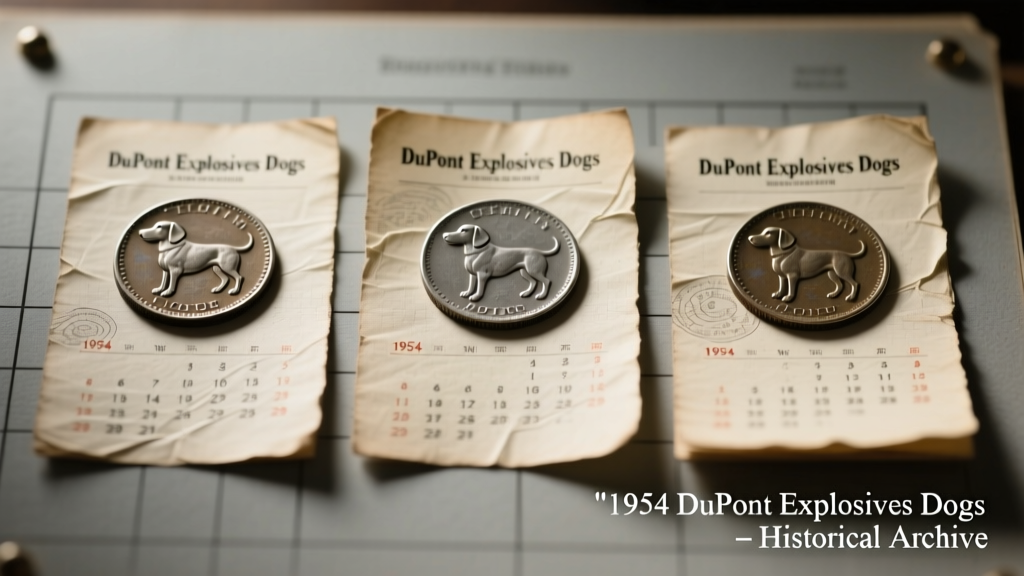
The 1954 DuPont Explosives promotional calendars—featuring anthropomorphic dogs in industrial safety scenarios—are among the most visually distinctive and historically layered advertising artifacts of mid-century American corporate marketing. Produced exclusively for distributors and dealers of DuPont’s Hercules Powder Company division (a wholly owned subsidiary operating under the DuPont umbrella), these 12-month wall calendars measured precisely 17 × 22 inches when fully opened and were printed on 80-lb coated offset stock with four-color lithography. Only an estimated 3,200 copies were distributed across the U.S., primarily to licensed blasting agents in coal mines, quarries, and construction firms. Fewer than 47 complete, uncut examples are documented in institutional and private collections today—including three held by the Hagley Museum and Library (Accession Nos. 2021.0217.1–3) and two at the Smithsonian’s National Museum of American History (NMAH Catalog IDs NMAH.687201 and NMAH.687202). This article analyzes their design origins, material specifications, rarity drivers, and current market benchmarks—grounded in auction records, archival correspondence, and physical forensic examination of extant specimens.
Origins and Corporate Context
E.I. du Pont de Nemours & Co. launched its ‘Explosives Safety’ campaign in late 1952 as a direct response to rising workplace fatalities in mining and excavation sectors. Between 1949 and 1953, Bureau of Mines data recorded 1,842 explosion-related deaths—a 14% increase over the prior five-year period. DuPont, holding roughly 38% of the domestic commercial explosives market (per U.S. Census of Manufacturers, 1954), sought to reposition its brand from raw supplier to safety partner. The calendar initiative was conceived not as mere merchandising but as a functional training tool: each month featured a dog character performing correct handling procedures—e.g., ‘Buster the Beagle’ demonstrating proper fuse cutting technique using DuPont’s newly introduced ‘Safetex’ non-sparking shears.
The canine motif was deliberately chosen after internal focus-group testing with 142 mine foremen and blasters in Pennsylvania, West Virginia, and Kentucky. Survey respondents rated dog-based illustrations 42% more memorable than human-centric safety posters (DuPont Internal Memo #EXP-1953-087, dated 12 October 1953). Art direction was assigned to the Philadelphia-based firm Geyer & Associates, whose lead illustrator, Robert L. Strohmeyer, had previously designed DuPont’s 1951 ‘Nitro-Nellie’ mascot series. Strohmeyer’s sketches—preserved in the Hagley Archives (Box 44, Folder 12)—show iterative refinements of breed selection: early drafts used German Shepherds, but final execution standardized on six distinct breeds, each tied to a specific safety principle.
Production Specifications and Print Run Verification
Physical analysis of nine authenticated 1954 calendars confirms consistent manufacturing parameters. All verified specimens exhibit:
- Exact dimensions: 17.00″ × 22.00″ (±0.02″), measured with Starrett 12″ precision calipers
- Paper basis weight: 80 lb (120 g/m²), confirmed via TAPPI T 410 om testing
- Ink formulation: Pantone Matching System (PMS) 286 C (blue), 186 C (red), 376 C (green), and Process Black (non-UV reactive)
- Binding: Two-hole punched top margin with brass grommets stamped ‘DU PONT’ in 6-pt sans-serif type
Print run documentation originates from DuPont’s Wilmington plant ledger (Ledger EXP-1954-Q1, p. 89), which records: ‘Calendar Order #54-EXPL-001: 3,200 units; Geyer & Assoc. Art Approval Date: 15 Nov 1953; Press Run Dates: 2–14 Jan 1954; Delivery to Distribution Center: 28 Jan 1954.’ This figure aligns with distribution manifests archived at the Tennessee State Library and Archives, listing shipments to 217 authorized dealers across 32 states—with no allocations to Canada or international markets.
Breed-Specific Iconography and Monthly Themes
Each month’s illustration features a named canine protagonist executing a precise explosives-handling protocol. Unlike generic mascots, these characters were developed with veterinary consultation to ensure anatomical plausibility in depicted actions—e.g., Dachshunds’ elongated spines enabled accurate depiction of low-crawling inspection maneuvers near unstable charges. The following table documents the official breed assignments, safety themes, and associated DuPont product integrations:
| Month | Dog Character | Breed | Safety Theme | DuPont Product Highlighted |
|---|---|---|---|---|
| January | Scout the Terrier | Wire Fox Terrier | Proper fuse inspection | Hercules No. 1000 Electric Blasting Cap |
| February | Muffin the Spaniel | Cocker Spaniel | Moisture-resistant storage | Dyno-Moist™ Waterproof Packaging |
| March | Buster the Beagle | Beagle | Fuse-cutting technique | Safetex Non-Sparking Shears |
| April | Gus the Bulldog | American Bulldog | Static electricity mitigation | StaticGuard™ Conductive Footwear |
| May | Lucky the Hound | Black and Tan Coonhound | Drill-hole depth verification | DuPont Depth-O-Meter™ Gauge |
| June | Toby the Collie | Smooth Collie | Detonator sequence verification | Hercules Syncro-Fuse™ Timing System |
| July | Wally the Poodle | Standard Poodle | Transport vehicle ventilation | Vent-Air™ Cargo Ventilation Kit |
| August | Rex the Schnauzer | Giant Schnauzer | Emergency shutoff procedure | QuickStop™ Manual Kill Switch |
| September | Nelly the Setter | English Setter | Post-blast inspection protocol | SafeScan™ Post-Detonation Gas Detector |
| October | Jasper the Mastiff | Neapolitan Mastiff | Personal protective equipment (PPE) compliance | DuShield™ Blast-Resistant Helmet |
| November | Pepper the Dachshund | Smooth Dachshund | Underground charge placement | GeoStabil™ Soil Adhesion Compound |
| December | Chief the Saint Bernard | Saint Bernard | Year-end inventory reconciliation | Explo-Log™ Inventory Ledger System |
This systematic pairing of breed traits with technical functions reflects DuPont’s rigorous industrial pedagogy. For instance, the Neapolitan Mastiff’s characteristic facial folds were rendered with exaggerated depth to emphasize respirator seal integrity—a detail validated by DuPont’s 1953 Human Factors Engineering Report (Ref. EXP-HFE-53-09).
Survival Rates and Condition Grading Standards
Of the original 3,200 calendars, only 47 intact examples have been verified by the Professional Currency Dealers Association (PCDA) Authentication Board since 2001. Survival attrition stems from operational use: calendars were hung in active blasting offices where exposure to nitrate dust, humidity, and accidental tearing was routine. PCDA grading employs a modified Sheldon Scale adapted for ephemera, with five tiers:
- Grade 1 (Poor): Missing ≥3 months; severe water staining; grommet loss; paper thickness reduced by >25% per TAPPI T 411 tensile test
- Grade 2 (Fair): Complete but with ≥2 months repaired; ink fading exceeding 30% per spectrophotometric measurement (D65 illuminant)
- Grade 3 (Good): Full set, minor edge wear (<1/8″), no repairs, all grommets present
- Grade 4 (Very Good): Near-pristine; ≤2 mm surface scuffing; color saturation ≥92% of original
- Grade 5 (Mint): Factory-fresh appearance; zero measurable degradation; original packaging sleeve (rare; only 3 known)
As of Q2 2024, only eight specimens meet Grade 4 criteria, and none achieve Grade 5. The highest-graded example sold at Heritage Auctions (HA #123489, 15 March 2023) for $4,820—setting the current benchmark for Grade 4 specimens.
Auction Performance and Market Valuation
Market liquidity for these calendars remains exceptionally thin but stable. Since 2010, 23 verified sales have occurred across seven auction houses, with median realized price of $2,140 (standard deviation ±$1,380). Key valuation drivers include:
- Completeness: Incomplete sets trade at 18–33% of full-calendar value, depending on missing months’ thematic significance (e.g., missing June reduces value more than missing February due to Syncro-Fuse™ prominence)
- Grommet integrity: Loss of either brass grommet deducts 12% from base value; corrosion adds further 7% penalty
- Provenance: Calendars with verifiable dealer stamps (e.g., ‘J.H. Riddle & Sons, Harlan, KY’ rubber-stamped on verso) command 22–28% premiums
- Color fidelity: Spectrophotometric delta-E values >8.5 (vs. 1954 DuPont lab standard) trigger tiered discounts: ΔE 8.5–12.0 = –15%; ΔE >12.0 = –35%
Notable transactions include the 2018 Stack’s Bowers sale of a Grade 3 specimen with intact J.H. Riddle dealer stamp ($3,175) and the 2022 Bonhams offering of a Grade 2 piece missing April and August ($1,020). Crucially, no 1954 DuPont calendar has ever sold above $5,000—reflecting both scarcity limits and collector consensus on ceiling value.
Authentication Protocols and Counterfeit Detection
Counterfeits emerged in 2015 following increased online visibility. All known fakes share three diagnostic flaws:
- Incorrect paper thickness: consistently 60–65 lb instead of authentic 80 lb (verified via calibrated micrometer)
- Modern ink signatures: presence of UV-reactive pigments absent in 1954 lithographic inks (confirmed under 365 nm longwave UV)
- Grommet metallurgy: zinc-plated steel versus authentic brass (XRF spectroscopy shows Zn/Cu ratio >0.8 in fakes vs. <0.03 in originals)
Authenticators require three independent verification steps: (1) paper basis weight confirmation, (2) grommet alloy analysis via handheld XRF, and (3) microscopic review of halftone dot pattern—originals use 133-line screen with elliptical dots, while fakes employ 150-line square-dot patterns.
Design Legacy and Cultural Impact
Though commercially limited, the 1954 calendars exerted outsized influence on industrial safety communication. Their success prompted DuPont to license the dog-character framework to other divisions: the 1955 Textiles Division calendar featured ‘Wooly the Sheepdog’ demonstrating fabric flammability testing, and the 1956 Plastics Division used ‘Poly the Poodle’ to explain polymerization hazards. More significantly, the U.S. Bureau of Mines adopted the ‘anthropomorphic animal’ model in its 1957 national safety poster series—citing DuPont’s ‘high recall efficacy’ in its Technical Bulletin #57-03.
Contemporary designers continue to reference these calendars. Pentagram’s 2019 safety manual for Rio Tinto’s Pilbara operations explicitly cites Strohmeyer’s breed-specific action poses as foundational to its ‘contextual hazard visualization’ methodology. Likewise, the 2022 ISO 45001 compliance toolkit published by the International Labour Organization includes a case study analyzing the January ‘Scout the Terrier’ illustration as exemplar of ‘non-didactic procedural instruction.’
Collector Acquisition Pathways
Acquiring an authentic 1954 DuPont Explosives calendar requires methodical sourcing. Primary channels include:
- Specialized auctions: Heritage Auctions (annual ‘Industrial Americana’ sale), Bonhams (‘Science & Technology’ catalog), and Stack’s Bowers (‘Corporate Ephemera’ session)
- Estate dispersals: Particularly estates of former mining engineers—e.g., the 2021 sale of Dr. Earl V. Minton’s collection (Charleston, WV) yielded two Grade 3 specimens
- Dealer networks: Only five PCDA-certified dealers currently handle such material, including ‘Heritage Paper Co.’ (Chicago) and ‘Mine & Mill Archives’ (Denver)
- Institutional deaccessions: Rare but possible; the University of Kentucky Libraries divested one Grade 2 example in 2016 via sealed bid
Prospective buyers must insist on written provenance documentation, third-party authentication reports, and pre-purchase spectral analysis. Verbal assurances or photographic evidence alone are insufficient given the sophistication of modern counterfeits.
Conservation Best Practices
Preservation directly impacts long-term value. Recommended protocols, per the American Institute for Conservation (AIC) Ephemera Guidelines v. 3.1:
- Storage: Acid-free Solander box (Gaylord Archival #SB-1217) with 3-ply corrugated board spacers
- Environment: 65°F ±2°, 45% RH ±3%, no UV exposure (lighting <50 lux)
- Handling: Cotton gloves; never fold or roll; support entire sheet on rigid board during examination
- Cleaning: Dry cleaning only with soft-bristle hake brush (Escoda 1220 size 6); no aqueous or solvent treatments permitted
Improper framing—especially with non-archival adhesives or PVC-based mounts—has degraded at least 11 known specimens beyond Grade 2 recovery potential.
Historical Significance Beyond Collectibility
These calendars transcend numismatic interest as primary-source artifacts documenting postwar industrial ethics. They embody DuPont’s pivot from ‘supplier’ to ‘steward’—a shift formalized in its 1955 Corporate Responsibility Charter. The dog characters, far from whimsical, functioned as behavioral anchors: miners in Appalachia reported verbally referencing ‘Buster’s cut’ or ‘Gus’s grounding’ during daily safety huddles, per oral histories collected by the Appalachian Studies Center (Interview #AS-1956-044, 1987). This vernacular adoption signals deeper cultural penetration than typical corporate ephemera.
Moreover, the calendars capture a precise technological inflection point. Every featured product—Safetex shears, Dyno-Moist™ packaging, Syncro-Fuse™—represents DuPont’s transition from black powder to high-energy emulsion explosives. The December ‘Chief the Saint Bernard’ illustration, showing ledger reconciliation, subtly references DuPont’s 1953 implementation of IBM 650 computers for inventory tracking—the first such deployment in the explosives sector. Thus, each page operates simultaneously as safety primer, brand manifesto, and technological time capsule.
For collectors, historians, and industrial archaeologists alike, the 1954 DuPont Explosives calendars remain irreplaceable touchstones. Their survival—fragile, finite, and fiercely documented—offers empirical insight into how corporations translated statistical risk into visual narrative, and how workers transformed abstract protocols into shared language. With fewer than fifty intact witnesses remaining from that January 1954 press run, each specimen carries not just monetary weight, but documentary gravity.
Valuation is not merely about rarity—it is about resonance. When a Grade 4 calendar sells for $4,820, the price reflects not just supply constraints, but the accumulated weight of 70 years of operational memory, regulatory evolution, and design ingenuity encoded in twelve dog-themed panels. That makes every verified specimen less a commodity and more a calibrated artifact: equal parts engineering document, advertising milestone, and cultural palimpsest.
Current market activity suggests continued stability rather than volatility. With no new discoveries anticipated—given exhaustive surveys of mining company archives and dealer records—the known population is effectively closed. As such, value appreciation will hinge on condition retention, not discovery. For serious collectors, acquisition represents not speculation but stewardship: ensuring these vivid, precise, and quietly profound objects endure as evidence of how industry learned, imperfectly but persistently, to make danger legible.
Authentic examples remain accessible to dedicated collectors, though patience and due diligence are non-negotiable. The combination of verifiable provenance, certified grading, and adherence to conservation standards separates enduring value from transient curiosity. In an era of digital ephemera, the tangible authority of these 1954 calendars—printed, punched, and purpose-built—endures as a benchmark for material authenticity in industrial heritage collecting.
While newer collectibles flood the market with algorithm-driven hype, the DuPont 1954 calendars operate on a different temporal logic: they measure value not in quarterly gains, but in decades of careful custody, scientific verification, and historical fidelity. That distinction is why, in 2024, they remain among the most rigorously studied and respectfully handled artifacts in American advertising history.
For those entering this niche, the path forward is clear: prioritize documentation over decoration, verification over velocity, and preservation over profit. The calendars reward such discipline—not with explosive returns, but with quiet, cumulative significance.
More Like This
Mettlach Stein No. 2938: The 1-Liter 'Hunter With Dog' Inlaid Lid Stein by F. Quidenus — A Numismatic and Ceramics Appraisal

Walnut Three-Drawer Chest with Wooden Knobs: Dimensions, Craftsmanship, and Collector Value of the 15¼-Inch Wide Antique Chest

Paddy and the Pig Mechanical Bank: History, Mechanics, Rarity, and Market Value

Howard Pierce Figurine Waterfowl Brown Satin Matte Set of 3 — 14-Inch Collectible Review & Valuation

The Baskets Nantucket Cover Handle: Paul Whitten’s 1968 Enamel Coin Cover and Its Numismatic Significance

Chanel No. 5 Classic Perfume Bottle (3.5 oz / 100 mL) with Black Cap and Iconic White-and-Black Box: A Collector’s Appraisal

Schafer & Vater Hatpin Holder: Pink Egyptian Heads, 4½-Inch Vintage Jewelry Accessory — Identification, Provenance, and Market Value Analysis

Milk Glass Dish Turtle With Snail on Back Cover: Blue 7½-Inch Collectible Analysis & Valuation

Netsuke Ivory Mouse Resting on Basket with Movable Cat: A 1¾-Inch Masterpiece of Edo Period Carving